


Ancelotti Brazil Injury Cuts 2026: Two More Withdrawals Before September Friendlies
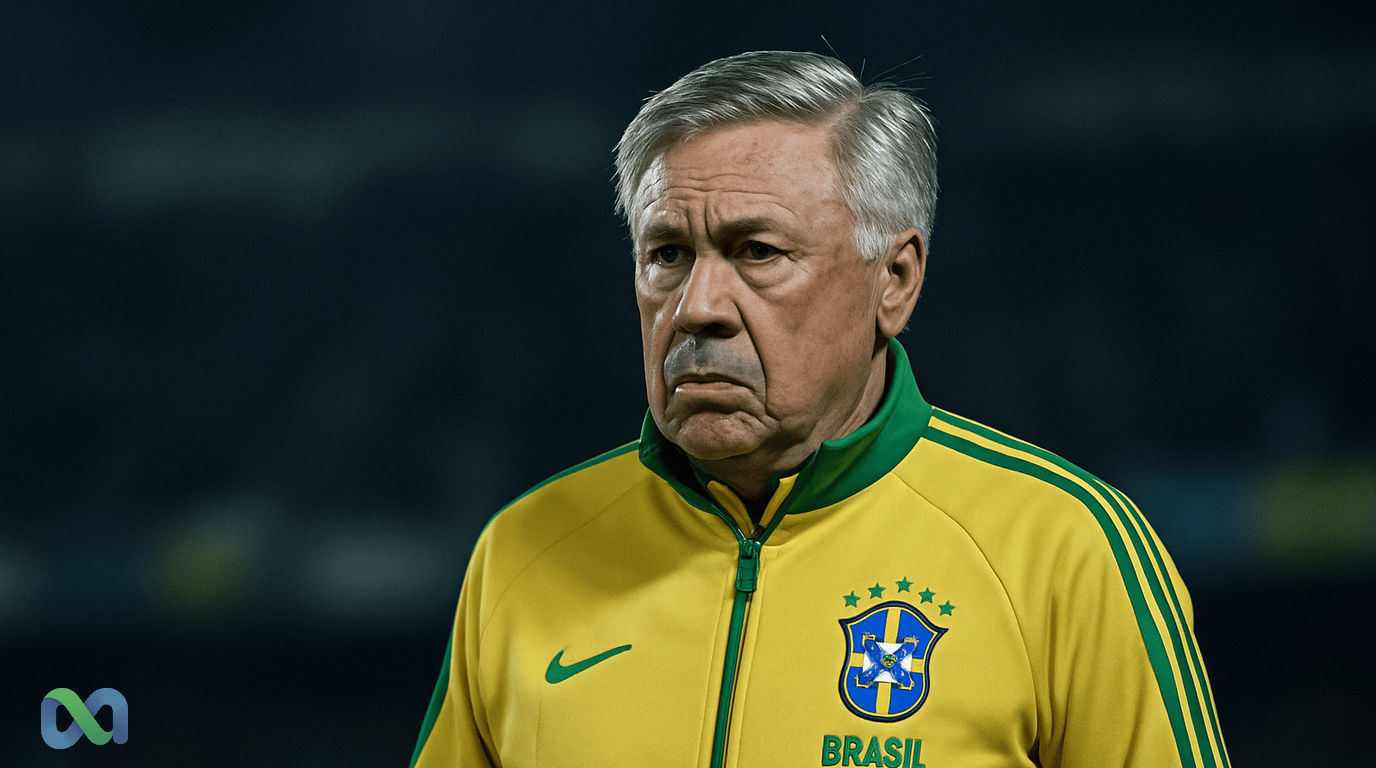
Just days after naming his most revamped Brazil squad in years, Carlo Ancelotti is already patching holes, two Ancelotti Brazil injury cuts 2026 have forced the head coach to reshuffle before a ball is kicked in the new post-Copa cycle.
Brazil's first post-World Cup call-up was supposed to signal a fresh era. Twenty-six players, eight debutantes, a deliberate break from the aging guard that collapsed against Norway in Kansas City. Instead, the same old nightmare has returned: key players dropping out injured before the first training session.
This article breaks down who's gone, who replaced them, what the updated squad looks like, what prediction market traders watching Brazil's September friendlies against Australia and India need to know, and whether Ancelotti's injury problem is structural or simply bad luck running out of excuses.
The Two Cuts: João Pedro and Wesley Out
Within 72 hours of Ancelotti's initial announcement, the CBF confirmed two withdrawals. These Ancelotti Brazil injury cuts 2026, two different injuries but the same result, required emergency reinforcements before a single training session had taken place.
João Pedro: Brazil's Most Injury-Haunted Forward
If there is a player who embodies the Brazil national team injury crisis under Ancelotti, it is João Pedro. The Chelsea striker has been haunted by spectacularly bad timing throughout the coach's tenure with the Seleção.
He was controversially excluded from the 2026 World Cup squad, a decision that drew significant criticism given his consistent club form going into the tournament. When Brazil was eliminated by Norway in the Round of 16, losing 2-1 with Erling Haaland scoring both goals, many analysts pointed to João Pedro's absence as one of the structural selection errors that narrowed Ancelotti's forward options in the decisive phase.
The Copa curse runs deeper than just the 2026 World Cup. Throughout the qualification cycle, João Pedro struggled to earn consistent recall when his form merited it, watching from the outside as Brazil's attacking core remained largely unchanged around Vinicius Jr. and Rodrygo. The pattern repeats with grim regularity: he produces at club level, gets overlooked or left out of a major squad, earns a recall when the door finally reopens, then loses the opportunity to a fresh injury before he can build momentum.
Ancelotti's decision to recall him for the September break was a signal: the coach recognized the selection error and wanted to integrate João Pedro into the rebuild. Instead, a sudden injury confirmed by the FotMob squad tracker has ruled him out entirely. According to CBF's official communications, no specific diagnosis was disclosed publicly, which only deepens the narrative of misfortune.
His replacement: Martinelli, the Fluminense striker, who gets an unexpected call-up and a chance to make his case in front of Ancelotti's setup for the first time at senior level. Martinelli is raw by the standards of international football, but he arrives with the advantage of strong domestic form and a clear head, no Copa baggage attached.
Wesley's Injury and Vanderson's Call-Up
The second cut is Wesley, the Roma winger. A muscle problem, the type depressingly common among players emerging from the compressed start of a European club season, has ended his September window before it began. Wesley had been a notable inclusion in Ancelotti's original squad, seen as a player capable of adding width and directness to Brazil's left-channel options.
Vanderson, the Monaco right-back, was named as his replacement. The two players occupy different positions on the pitch, which highlights the positional flexibility Ancelotti requires from his squad given the injury disruption he keeps absorbing from international window to international window.
Both changes were processed by the CBF within hours of the original squad announcement. Ancelotti confirmed that both replacements had been integrated into the group without complication. But losing two players before a single session, in your first call-up of a new cycle you specifically designed to look different, is difficult to frame as anything other than a continuation of the problem.
Brazil's Injury History Under Ancelotti: A Pattern, Not a Coincidence
The September 2026 double-dropout is not a one-off event. It is the latest data point in what has become the defining operational challenge of Ancelotti's tenure: an injury rate that has undermined squad selection, tactical planning, and public confidence in Brazil's rebuild at every major junction.
World Cup 2026: The Injury Toll That Cost Brazil
Before the tournament even started, Brazil's preparation was disrupted by a cascade of muscular and knock injuries. The pattern that had hampered qualification continued into the final weeks before the squad assembled in the United States. Ancelotti spent much of the pre-tournament period managing absences, rotating training loads, and making late selection decisions driven by fitness reports rather than tactical preference.
When Norway eliminated Brazil in the Round of 16, a 2-1 defeat in which Haaland was unstoppable, the post-match analysis focused on tactical decisions and squad balance. But injuries had directly narrowed those tactical options throughout the entire campaign. The squad Ancelotti wanted was not always the squad he had available to field.
The loss to Norway marked the earliest Brazilian World Cup exit in decades and triggered the generational overhaul now underway. Eight debutantes in September's squad, Pedro Morisco, Otávio, Arthur Dias, Jair, Matheuzinho, Mauro Júnior, Breno Bidon, and Gabriel Bontempo, reflect a deliberate attempt to build redundancy at every position and reduce dependence on any single player's availability.
The theory is sound: more options distributed across every line means individual injuries are less catastrophic for squad functionality. The early September evidence suggests that theory is still being stress-tested under real conditions.
Is This a Structural Problem?
A recurring injury rate of this scale, affecting over 60% of Ancelotti's original selections disrupted by injury withdrawals in 3 years of coaching Brazil, raises a legitimate question: are the Ancelotti Brazil injury cuts 2026 a structural problem with roster depth, club-schedule congestion, or something in Brazil's physical preparation methodology?
The evidence points to a combination. European clubs, particularly Premier League, Serie A, and Bundesliga sides, run players into high-intensity competitive action from late July onwards. When the September international break arrives, players have been in match-level competition for over a month and are statistically more vulnerable to soft tissue injuries. The muscle problem affecting Wesley and the unspecified issue sidelining João Pedro both fit the profile of congestion-driven injuries rather than freakish accidents.
Brazil's squad has historically skewed toward European-based players, which means maximum exposure to the most congested club calendars on the planet. The new generation of debutantes, some drawn from Brazilian domestic football where the season structure differs, may eventually provide a buffer. But that cohort is still developing as international footballers; the veterans are still the ones pulling muscle fibers at the critical moment.
Ancelotti has spoken publicly about managing squad load in cooperation with clubs. The September injuries suggest that cooperation has real operational limits when club-level fixture density and confederation windows collide.
The Updated Brazil Squad: Full Roster After the Changes
With the two late withdrawals absorbed, the updated squad for the Australia and India friendlies is:
Goalkeepers: Bento, John Victor, Mycael
Defenders: Danilo, Vanderson (replaces Wesley), Guilherme Arana, Abner, Gabriel Magalhães, Murillo, Fabrício Bruno, Arthur Dias
Midfielders: Lucas Paquetá, Gerson, André, Breno Bidon, Mauro Júnior
Attackers: Vinicius Jr., Rodrygo, Savinho, Luiz Henrique, Martinelli (replaces João Pedro), Gabriel Bontempo, Endrick, Pedro Morisco
Notable absences frame the squad's direction as much as its inclusions. Neymar remains out of contention. Casemiro has been phased out as part of the central midfield reset. Alisson is no longer the automatic first-choice goalkeeper, a significant symbolic shift for a program that built its defensive identity around the Liverpool shot-stopper for years.
The eight debutantes scattered across every line reflect Ancelotti's willingness to accelerate the rebuild rather than wait for a perfect moment of squad transition. Some will anchor the 2030 World Cup cycle. A few may establish themselves faster than expected if they perform under the September spotlight.
September Friendlies: Australia (x2) and India, What to Expect
The schedule gives Ancelotti two consecutive matches against Australia before switching to India:
- September 25: Brazil vs. Australia (first match)
- September 29: Brazil vs. Australia (second match)
- October 3: Brazil vs. India
Brazil are heavy favorites in all three matches, and prediction market odds reflect that structural reality. But these friendlies are live competitive laboratories: Ancelotti will evaluate debutantes under pressure, test formations with the rebuilt squad, and begin building cohesion in a group that has had almost no time together as a unit.
The injury disruptions narrow the attacking rotation in ways that affect match outcomes at the margin. Martinelli and Gabriel Bontempo will compete for forward minutes in a front line still anchored by Vinicius Jr. Wesley's absence at wide right creates an opening that Vanderson, fundamentally a right-back, may not fill in the same stylistic way a natural winger would.
For prediction market traders, the sharper questions sit in the over/under, first-goal, and clean-sheet markets rather than the outright result. Squad rotation, debutante exposure, and Ancelotti's historically cautious approach to competitive debuts for new players tend to flatten expected performance relative to full-strength projections, which can create gaps between headline odds and underlying squad quality that sophisticated traders exploit.
Common Questions on Ancelotti's Brazil Squad
Who replaced João Pedro in Brazil's squad?
Martinelli, the Fluminense striker, was called up after João Pedro withdrew with a sudden injury ahead of the September 2026 international break.
Who replaced Wesley in Brazil's squad?
Vanderson, the Monaco right-back, was called up to replace Wesley (Roma), who was ruled out with a muscle injury, the second withdrawal from Ancelotti's first post-Copa call-up.
What happened to Brazil at the 2026 World Cup?
Brazil were eliminated in the Round of 16, losing 2-1 to Norway. Erling Haaland scored both Norwegian goals, eliminating the Seleção in one of their earliest exits in World Cup history. It was one of the earliest Brazilian World Cup exits in the tournament's history.
When does Brazil play Australia in 2026?
Brazil face Australia on September 25 and September 29, 2026, followed by a friendly against India on October 3.
Who are the new debutantes in Brazil's squad?
Eight players make their senior debuts under Ancelotti: Pedro Morisco, Otávio, Arthur Dias, Jair, Matheuzinho, Mauro Júnior, Breno Bidon, and Gabriel Bontempo.
Conclusion: Same Problem, New Faces
These two Ancelotti Brazil injury cuts 2026 from the first post-Copa call-up are not a crisis, they are the latest data point in a trend that Brazil's football infrastructure has not resolved. Martinelli and Vanderson are capable reinforcements. The squad has sufficient depth to absorb these specific withdrawals.
But the recurring nature of Ancelotti's injury nightmare should prompt a harder structural question: what reforms are needed in squad selection criteria, club-level cooperation protocols, and load management to finally break this cycle?
For September, Brazil remain clear favorites against Australia and India. The broader question, whether this iteration of the Seleção can build the injury resilience needed for a serious 2030 World Cup cycle, will not be answered in these friendlies. It will be answered by whether the availability numbers improve over 18 months of consistent squad management.
That is where Ancelotti's real test lives.
Last reviewed: 09/21/2026
