


Kalshi Banned in Brazil: What Changes for Prediction Markets
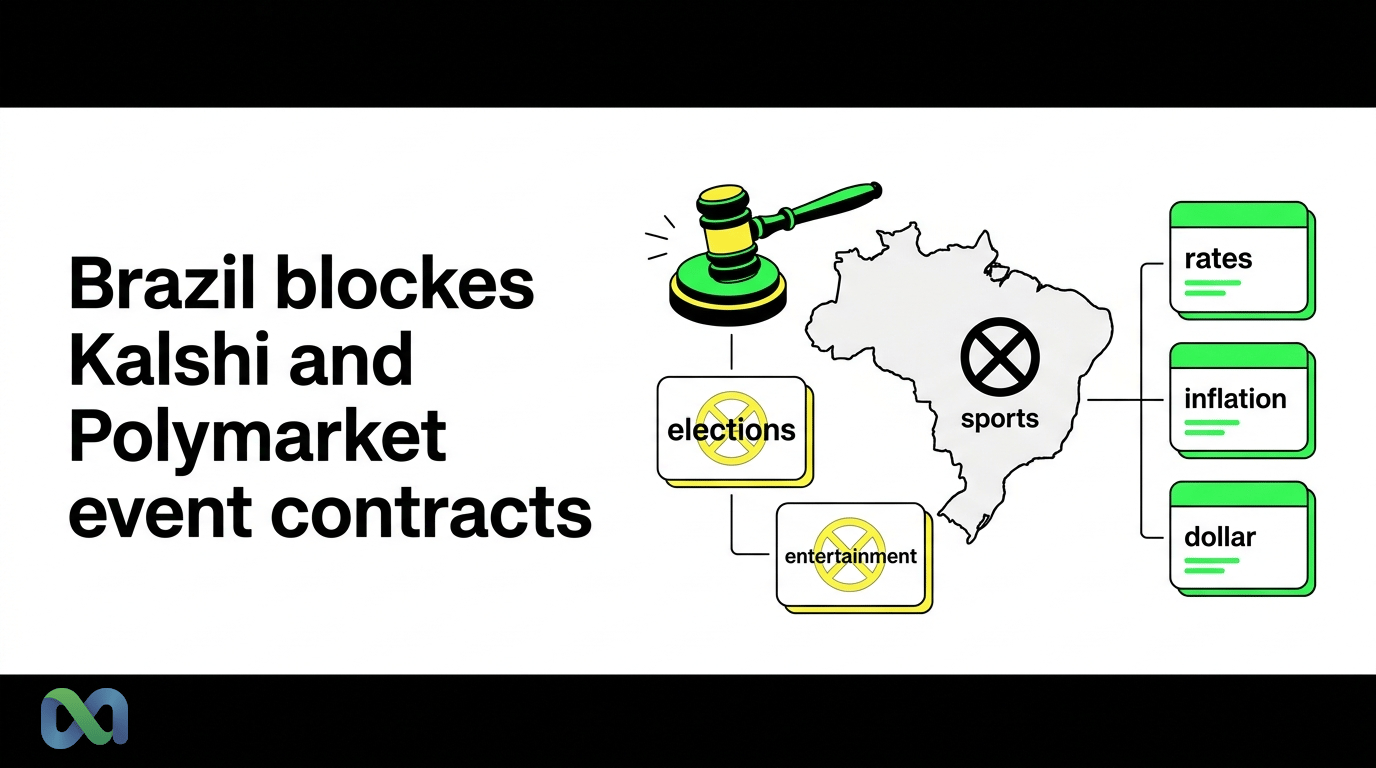
Kalshi banned in Brazil is the headline, but the regulatory signal is more precise. Brazil moved against Kalshi, Polymarket, and 25 other platforms because the targeted products were event contracts on elections, sports, culture, entertainment, social topics, and online games. The government treated those products as outside the financial perimeter.
That does not erase every prediction market in Brazil. It draws a line. On one side are events with no clear economic or financial reference. On the other side are contracts tied to market data, such as interest rates, inflation, the dollar, equities, commodities, or bitcoin.
That distinction matters for traders, analysts, and platforms. This guide explains what changed, which products were blocked, and where a narrower path may still exist. It is informational only. It is not financial advice, legal advice, or an invitation to use blocked websites.
Quick answer: what Brazil prohibited
Brazil’s National Monetary Council barred event contracts without an economic or financial reference. The rule covered themes such as elections, sports, culture, entertainment, social issues, and online games.
After that, Anatel began executing access blocks. The list includes Kalshi and Polymarket. It also includes other prediction market platforms cited by the government.
The central point is simple. The regulator did not look only at the interface. It looked at the event that decides who wins and who loses. If the event has no clear financial basis, the risk of a veto is high.
According to Valor Econômico, the decision came with a strict reading of global platforms. UOL, Bloomberg Línea, and Capital Aberto also treated the case as a milestone for the sector in Brazil.
So the question is no longer only whether the technology works. The question is whether the contract fits Brazil’s financial regime.
Why Kalshi and Polymarket became the center of the case
Kalshi became the symbol because it is one of the best-known brands in event contracts. It operates event contracts in the United States. It also drew attention in Brazil because Luana Lopes Lara, one of its cofounders, is Brazilian.
Polymarket entered the same debate for a different reason. It became famous in crypto for markets on elections, wars, sports, culture, and breaking news. Many of those themes are exactly what the Brazilian regulator decided to block.
The two companies show the conflict clearly. A prediction market can produce a useful signal. A price can show the probability that traders assign to an event. However, not every event can become a financial product for the public.
That is the boundary in the decision. Brazil did not say that collective forecasting has no value. It said that contracts on certain themes should not be sold as derivatives in the Brazilian market.
This affects any platform that wants to operate locally. Copying the United States model is not enough. Using crypto, smart contracts, or market language is not enough either. The product design must match the Brazilian rule set.
Blocked contracts: politics, sports, culture, and online games
The blocked area involves events that the government viewed as distant from a clear financial basis. Elections are the most sensitive example. A contract on who wins Brazil’s 2026 presidential election can be useful for analysis. Even so, the government may treat it as a product outside the financial perimeter.
Sports follow the same logic. A contract on the winner of a final depends on a sporting result. Even if the screen shows a price and an implied probability, the final event is not a financial index.
Culture and entertainment also enter the list. This includes awards, reality shows, celebrities, and public events without a direct economic reference. The rule targets the nature of the event, not the fame of the platform.
Online games were cited directly. Brazil wants to prevent game-like operations from using the label of a financial market. This concern became stronger after Law 14,790 of 2023, which organized the fixed-odds betting sector.
The word betting here is legal and limited. For Macro Markets, language still matters. A serious prediction market should talk about analysis, risk, price, source data, and settlement. It should not promise easy profit.
What may still exist: contracts with economic references
The decision leaves an open zone for contracts with an economic or financial reference. That zone is not a blank check. It depends on rules, data sources, governance, and supervision.
A contract on the next COPOM decision has an economic basis. It connects to the Selic rate and to an official Central Bank meeting. The source is public. The date is known. The settlement method can be clear.
The same logic can apply to inflation, the dollar, Ibovespa, oil, gold, or bitcoin. These themes have prices, indexes, or market data. They can help analysts measure expectations before an official event.
However, every product needs careful design. The settlement rule must state which source is valid. It must also define the cut-off time, the exact data point, and what happens if the data is revised. Without that, the contract becomes noise.
This is the most promising path for Brazil prediction markets. They can be useful when they quantify economic expectations. To do that, they need transparency and technical discipline.
Prediction markets versus traditional betting sites
The difference is not only the name. It is in price formation, settlement rules, custody, governance, and how risk is shown to the user.
A traditional betting site sets prices to protect its own margin. A serious prediction market tries to aggregate collective expectations. The price changes as traders buy and sell. That price can become an implied probability.
Still, Brazil showed that transparency alone is not enough. The underlying event must be suitable. If a contract revolves around an election, a match, or an entertainment outcome, the regulator may reject its financial classification.
That distinction can protect the serious side of the sector. It forces platforms to explain products with rigor. It also prevents every popular event from being packaged as financial analysis.
For users, the lesson is practical. Do not look only at the probability shown on screen. Look at the event that resolves the contract. Look at the source that decides the result. Then ask whether a clear local rule supports the offer.
How to read the role of each authority
The National Monetary Council sets guidelines for the financial system. In this case, it set limits for contracts trying to enter the market as derivatives. That was the base decision.
The CVM may have an important role in the next phase. It regulates securities and derivatives within its scope. If products tied to indexes and economic data appear, the CVM may detail the rules.
The Ministry of Finance handles the fixed-odds betting and online gaming regime. This background explains part of the government’s urgency. Without a clear limit, a platform could try to avoid one regime by using another name.
Anatel executes access blocks. It does not design financial contracts. It handles the technical part when there is an order to restrict websites.
This division shows why the topic is complex. Prediction markets sit between finance, technology, consumer protection, communications, and public policy. That is why the language must be precise.
Impact for Brazilian traders
For traders, the biggest impact is access and continuity risk. A platform can look liquid today and be blocked tomorrow. That changes the risk analysis.
It also changes how opportunities should be evaluated. A price is not enough. The trader needs to understand whether the contract can exist in Brazil. The trader also needs to know whether the settlement source is objective and whether there is intervention risk.
Economic contracts tend to be more defensible. They connect to official data or market assets. Even then, they still need clear rules. Without those rules, the user is exposed to disputes, delays, or cancellations.
The decision also reinforces a basic point. Do not use blocked platforms as if nothing changed. A block is a real regulatory risk signal. It can affect access, withdrawals, support, and market resolution.
For analysis, however, collective probability remains valuable. The point is to use that signal inside a transparent and well-designed environment.
Impact for platforms in Brazil
For platforms, the message is direct. The product must be built with a regulatory thesis from the start. This is not something to patch after launch.
The event list must be filtered from day one. Elections, sports, culture, entertainment, and online games carry high risk. Economic themes may have a better path, but only with clear rules.
The platform also needs disciplined communication. Vague terms create risk. Return promises create even more risk. The better path is to explain the source, settlement method, probability, fees, and limitations.
This standard may reduce volume in the short term. However, it creates a stronger base. A market that depends on transparency should not grow through confusion. It should grow through trust.
So the Kalshi banned in Brazil case is not only a barrier. It is a maturity test for the sector. Anyone who wants to operate in Brazil will need to show more than technology.
Simple checklist before evaluating a contract
Use this checklist before analyzing any prediction market in Brazil.
- Does the event have a clear economic or financial basis?
- Is the outcome source public and easy to verify?
- Does the settlement rule define the date, time, and criterion?
- Does the contract avoid elections, sports, entertainment, culture, social themes, and online games?
- Does the platform explain risks without promising profit?
- Is there clear support if a dispute appears?
- Does the user know which authority may supervise the product?
If several answers are weak, the risk is high. It may be legal risk. It may be operational risk. It may also be the risk of poor information.
Prediction markets need trust. Trust comes from simple rules, clear sources, and stable execution. Without that, the probability on screen loses value.
What changes in daily use
For the average reader, the change looks simple. Sites may go offline. Links may fail. An app may stop accepting access from Brazil. That alone is a serious risk.
For anyone who analyzes markets, the extra step is to read the contract rule. The question is not only whether there is a price. The question is which fact resolves that price. That fact must be clear and easy to check.
If the theme is an election or a sport, the local risk is now high. If the theme is interest rates, the dollar, or inflation, the conversation changes. Even then, the platform must show the rule, source, date, and limits.
This care prevents a basic mistake. A product can look like a market and still fall outside the financial rule. Another product can be simple and still have a strong economic basis. The name does not decide everything. The design decides a lot.
For the sector, the new phase requires less hurry. It requires clear products, clear writing, and clear rules. It also requires fewer promises and more data. That is the path to trust in Brazil.
Example: two similar markets with different risks
Consider two cases. In the first, the contract asks whether the Selic rate will fall at the next meeting. The source is the Central Bank. The date is public. The data appears in an official statement. The rule can be clear.
In the second case, the contract asks who wins an election. There is also a public source. There is also a date. But the theme is political. The new rule targets this kind of event. Therefore, the risk is higher.
Both cases use prices. Both can display a probability. But they do not carry the same legal weight. The theme changes everything. The source helps, but it does not solve the issue alone.
The same applies to sports. A match has a clear score. Even so, the government treated this group as outside the financial field. So clarity of the result is not enough. The event must fit the rule.
This example shows why traders should not look only at volume. High volume can attract attention. It can also attract risk. The better signal is different. Check for an economic basis, an official source, simple wording, and a dispute rule.
For platforms, the lesson is direct. List fewer themes. Explain every rule better. Use official data. Avoid sensitive topics. Show fees and risks. Make the user understand before clicking.
For analysts, the lesson is also clear. Use prices as signals, not as truth. Compare them with real data. Watch what changed in the news. Check liquidity. Check blocking risk.
This method is slower. However, it is safer. It separates analysis from noise. It also helps the sector grow without selling confusion as innovation.
A practical rule of thumb
Use a short rule. If the final fact comes from market data, read the contract carefully. There may be a basis for analysis. If the final fact comes from a ballot box, a match, a show, an award, or social media, local risk rises sharply.
This rule does not replace legal analysis. But it helps filter weak cases. It also reduces haste. In a new sector, haste is usually expensive.
Frequently asked questions
Is Kalshi banned in Brazil?
Kalshi appeared on the list of platforms affected by Brazil’s move against event contracts without a clear economic or financial reference. The practical result is access and offering risk for Brazil-facing users.
What does Kalshi do?
Kalshi is an event contract platform. In Brazil, it drew attention because of expansion plans and because cofounder Luana Lopes Lara is Brazilian. The government decision targeted the offer of contracts without a clear economic or financial reference.
Who founded Kalshi?
Kalshi was cofounded by Luana Lopes Lara and Tarek Mansour. Luana is Brazilian, which increased local interest in the case.
Was Polymarket Brazil banned too?
The Polymarket Brazil ban appeared in the same context. The key issue is the offer of contracts on events without a clear financial basis to users in Brazil.
Does the rule block all prediction markets?
Not necessarily. The rule blocks specific themes and contracts without an economic or financial reference. This leaves Brazil prediction markets in a regulatory adjustment phase. Markets tied to interest rates, inflation, the dollar, equities, or bitcoin may have another path if structured under proper rules.
Which government legalized fixed-odds betting in Brazil?
Law 14,790 of 2023 organized fixed-odds betting under the Lula administration. That regime is not a broad authorization for financial prediction markets. The topics are related, but the rules are different.
Conclusion
The Kalshi banned in Brazil decision should not be read as the end of every prediction market in the country. It is a line of separation. Brazil blocked Kalshi and other platforms when the product involved events without a clear financial basis. At the same time, it left room for well-defined economic contracts.
That room requires discipline from Kalshi Brazil, the Polymarket Brazil ban debate, and any new platform. The sector must avoid shortcuts. It needs to show sources, rules, risks, and governance. It also needs to separate serious analysis from financial entertainment.
For traders and analysts, the lesson is simple. Market probabilities can be useful. But they matter only when the contract is clear, verifiable, and compatible with the regulatory environment.
For platforms, the message is tougher. Brazil will not accept a simple copy of Kalshi or Polymarket. Anyone who wants to build here must adapt the product to local reality. If they do that well, prediction markets can become a serious economic analysis tool for Latin America.
