


Prediction Markets Glossary: Core Terms, Mechanisms, and Trading Concepts
Last reviewed: April 2026.
Prediction markets are easy to open and hard to read well. New traders quickly run into terms like automated market maker, implied probability, liquidity provider, spread, resolution criteria, and open interest. That creates friction at the exact moment they are trying to compare platforms, understand price moves, or make a clean first trade.
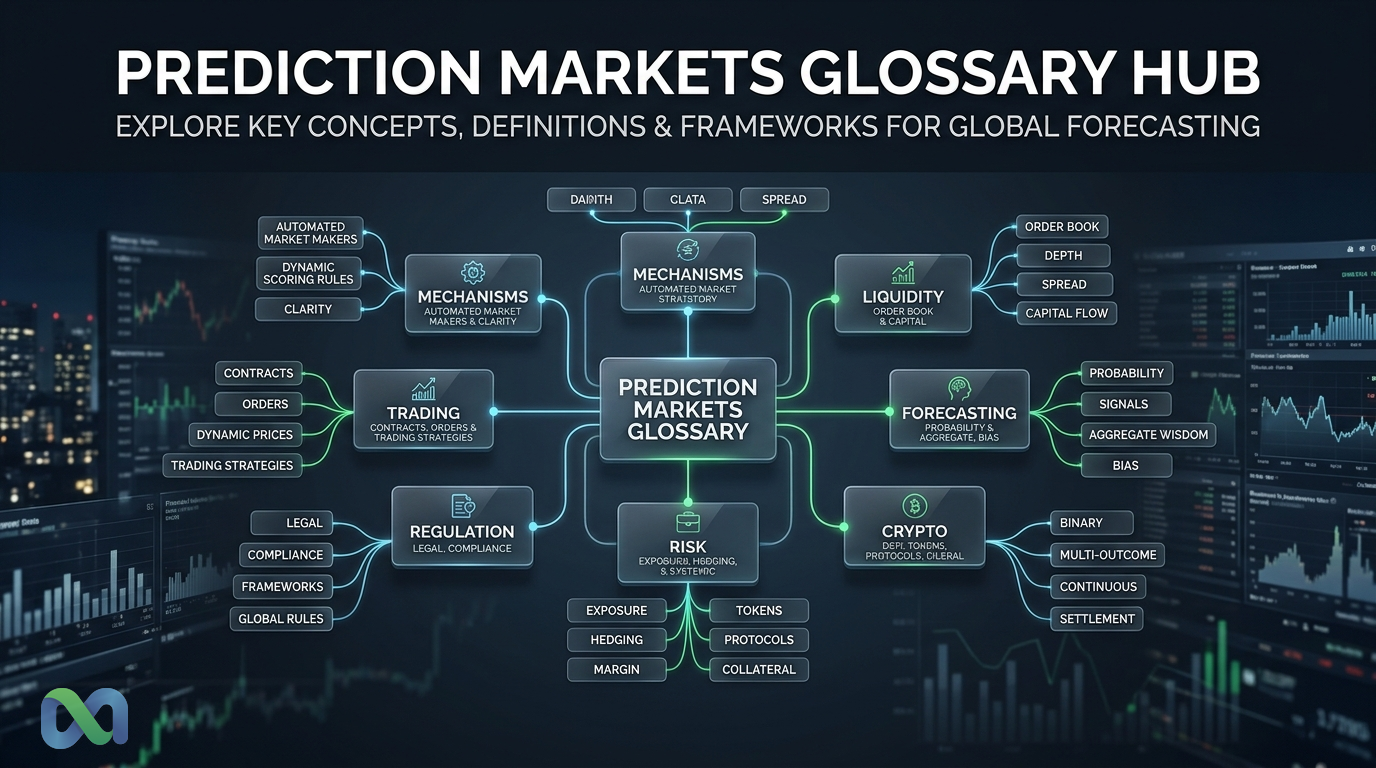
This prediction markets glossary is the English hub for the Macro Markets knowledge base. We built it to organize the category into clear clusters, explain how each group fits together, and point readers to deeper glossary entries and supporting articles. Instead of forcing every term into one giant page, this hub creates a structure people can actually use.
We designed this page for two jobs. First, it works as a quick reference for core prediction market language. Second, it works as a map of the broader content cluster, from market design and pricing to regulation, analytics, and event verticals. As the knowledge base expands, this page will connect every glossary article and related explainer in one place.
If you are new to the category, start with our explainers on how prediction markets work, automated market makers, and market makers. For background on forecasting as a field, the Wikipedia overview of forecasting is also useful. Those starting points make the rest of this hub much easier to follow.
Why a Glossary Hub Matters
A prediction markets glossary should do more than define words. It should help readers separate similar concepts, group related ideas, and understand where each term sits in the market stack. That matters because this category borrows language from forecasting, finance, derivatives, exchange design, and crypto.
For example, many readers need to understand the difference between liquidity and volume, implied probability and expected value, or a market order and a limit order before making even a basic decision. A strong hub reduces that confusion. It also gives each supporting page a clear SEO job instead of making every article compete for the same broad terms.
Our structure is cluster-first. This hub targets the broad navigation query. Child pages target tighter search intents. That preserves room for internal linking and reduces cannibalization across the full knowledge base.
The 11 Clusters in This Knowledge Base
Raphael defined 11 topic groups for the English rollout. We use those groups as the core architecture for the cluster. Each one combines glossary terms, supporting explainers, and comparison pages where useful.
- Prediction Markets and Mechanisms
- Pricing and Liquidity Mechanisms
- Trading and Operations
- Finance and Derivatives
- Forecasting and Probability
- Market Microstructure
- Crypto and DeFi
- Exchanges and Platforms
- Regulation and Compliance
- Analytics and Risk
- Events and Verticals
This structure keeps the hub focused on orientation. The deeper pages will handle definitions, examples, and platform-specific detail.
Prediction Markets and Mechanisms
This cluster explains the product layer. It covers terms such as prediction market, outcome contract, binary market, categorical market, scalar market, resolution source, oracle, and market creator. These are the terms readers need before the rest of the stack starts to make sense.
These pages should serve beginners first, but they also support advanced readers. A pricing article may assume the reader already understands how a binary market settles. A regulation article may assume the reader already understands what makes a resolution rule valid.
Planned glossary batch
- What is a prediction market?
- Binary markets vs categorical markets vs scalar markets
- Resolution criteria and settlement rules
- Oracles, judges, and market resolution
- Market creation and outcome design
Supporting content ideas
- Prediction markets vs betting exchanges
- Prediction markets vs sportsbooks
- Why market design shapes information quality
Pricing and Liquidity Mechanisms
This cluster explains how prices form and how traders enter or exit. It covers AMM, liquidity pool, slippage, spread, depth, overround, order book, and liquidity provider concepts.
Search intent here is practical. Readers want to know why a price moved, why a trade cost more than expected, or why one platform feels easier to use than another. The Federal Reserve's market liquidity explainer is a useful outside reference because it clarifies the core idea of liquidity beyond prediction markets.
Planned glossary batch
- Automated market maker (AMM)
- Liquidity, liquidity pools, and depth
- Slippage and price impact
- Spread, overround, and fee structure
- Order books vs AMMs in prediction markets
Supporting content ideas
- Automated market makers
- Market makers
- How liquidity changes the quality of market probabilities
Trading and Operations
This cluster covers the operational side of using a platform. It includes order types, position sizing, entry and exit execution, partial fills, portfolio tracking, realized and unrealized profit and loss, and settlement workflow.
The main intent is execution. Traders searching these terms are often trying to do something right now, not just understand theory. That makes these pages useful for product education and platform onboarding.
Planned glossary batch
- Market orders, limit orders, and execution
- Position size, average entry, and exposure
- Profit and loss (PnL) in prediction markets
- Closing a position before resolution
- Settlement, payouts, and fees
Supporting content ideas
- How to trade a prediction market without overpaying on entry
- When to close before resolution
- Beginner mistakes in prediction market execution
Finance and Derivatives
Prediction markets overlap with derivatives language more than many newcomers expect. This cluster covers payoff, hedge, volatility, arbitrage, synthetic exposure, event contract, contingent claim, and correlation. The CFTC definition of event contracts is especially relevant because it frames how regulators and professionals talk about this product class.
These definitions help Macro Markets attract readers who come from traditional finance or crypto derivatives and want to map familiar ideas onto event contracts. They also support comparison content around exchange-style products.
Planned glossary batch
- Event contracts and contingent claims
- Hedging with prediction markets
- Arbitrage in fragmented event markets
- Volatility, convexity, and payoff shape
- Correlation and portfolio construction
Supporting content ideas
- Are prediction markets derivatives?
- When arbitrage exists between platforms
- How event contracts fit into a macro trading framework
Forecasting and Probability
This cluster focuses on the statistical layer. It covers implied probability, calibration, base rates, expected value, Bayesian updating, confidence, and forecast error.
These terms matter because prediction markets are not just trading venues. They are probability engines. Readers in this cluster often care more about interpretation than execution. They want to know what a 62% price means, how to compare it with polls or models, and how to think about signal versus noise.
Planned glossary batch
- Implied probability and fair value
- Calibration and forecast accuracy
- Base rates and prior beliefs
- Expected value in event trading
- Bayesian updating and market moves
Supporting content ideas
- Why market probabilities are not certainties
- How to compare market prices with polls
- What makes a forecast well calibrated
Market Microstructure
Microstructure covers how trading rules shape behavior. It includes bid-ask spread, queue priority, inventory risk, informed trading, adverse selection, and price discovery.
This is one of the most valuable advanced clusters because it helps serious readers understand why two platforms with the same event can produce different prices, different execution quality, and different volatility patterns. It also creates strong bridges into finance and analytics content.
Planned glossary batch
- Price discovery in prediction markets
- Adverse selection and informed flow
- Inventory risk and liquidity management
- Bid-ask spread and queue priority
- Volume, open interest, and participation
Supporting content ideas
- Why thin markets can still move fast
- What informed trading looks like in event contracts
- How microstructure affects signal quality
Crypto and DeFi
Crypto-native users often arrive with different assumptions around wallets, on-chain settlement, stablecoins, token incentives, and decentralized resolution. This cluster translates that language into prediction market context.
It includes wallet connection, gas fees, bridges, stablecoin collateral, on-chain oracle risk, governance tokens, and composability. These pages are especially useful for comparing centralized and decentralized platforms.
Planned glossary batch
- On-chain prediction markets
- Stablecoins and collateral design
- Wallets, gas, and transaction flow
- Oracle risk in DeFi markets
- Governance tokens and platform incentives
Supporting content ideas
- Prediction markets in crypto vs traditional finance rails
- What DeFi users should know before trading event markets
- On-chain transparency vs usability tradeoffs
Exchanges and Platforms
This cluster covers venue-level terminology, including exchange model, venue risk, custody, market listing standards, interface design, and cross-platform differences.
The search intent here often includes comparison and commercial evaluation. People want to know where to trade, how one platform differs from another, and what tradeoffs come with each architecture.
Planned glossary batch
- Prediction market exchange models
- Custody, counterparty, and venue risk
- Market listing and approval standards
- Platform UX and execution quality
- Cross-platform fragmentation
Supporting content ideas
- Kalshi vs Polymarket vs Macro Markets
- What to evaluate before choosing a prediction market platform
- Why platform structure changes the user experience
Regulation and Compliance
This cluster addresses one of the highest-friction topics in the category. It covers legality, licensing, jurisdiction, KYC, AML, restricted markets, and event eligibility. Readers looking for these terms usually need clarity fast.
They may be trying to understand whether a platform is accessible in their country, whether a market type is allowed, or why two similar platforms face different legal treatment. Because regulation changes, this cluster should emphasize evergreen definitions supported by timely news explainers.
Planned glossary batch
- KYC and AML in prediction markets
- Jurisdiction and restricted users
- Event eligibility and prohibited markets
- Licensing, compliance, and platform obligations
- Resolution disputes and legal risk
Supporting content ideas
- Regulation of prediction markets in the US, Brazil, and Europe
- Why some event markets are restricted
- What compliance means for everyday traders
Analytics and Risk
This cluster focuses on measurement. It includes drawdown, hit rate, expected value, liquidity-adjusted returns, scenario analysis, and portfolio risk management.
The audience here is usually more advanced. They want process, not just participation. That makes this cluster useful for retaining serious users and for attracting finance-oriented readers who value structured decision-making.
Planned glossary batch
- Drawdown and bankroll risk
- Hit rate vs expected value
- Liquidity-adjusted returns
- Scenario analysis and stress testing
- Portfolio risk across event markets
Supporting content ideas
- How to measure whether a strategy has edge
- Risk management for event-driven traders
- Why win rate alone is a weak metric
Events and Verticals
Prediction markets span many domains, but user intent often becomes vertical-specific very quickly. Someone looking for political market terms may not care about sports pricing jargon, while a crypto user may need event-specific settlement examples.
This cluster creates sub-hubs for major verticals such as elections, central bank decisions, sports championships, crypto milestones, entertainment events, and macro releases. Those pages can route traffic into the glossary from specific entry points.
Planned glossary batch
- Political prediction market terms
- Sports prediction market terms
- Crypto event market terms
- Macro and central bank event terms
- Entertainment and culture event terms
Supporting content ideas
- Election market terminology explained
- World Cup and championship market mechanics
- How macro event markets differ from sports markets
How We Avoid Cannibalization
Keyword overlap is a real risk in this category. Terms like prediction market, market maker, AMM, liquidity, and implied probability appear almost everywhere. If every page tries to rank for all of them, the cluster gets noisy and the internal links become less useful.
Our solution is simple. This hub targets the broad glossary query. Foundational explainers target single high-intent concepts. Batch glossary pages target closely related groups of definitions. Comparison pages target commercial or investigative intent.
In practice, that means a page about implied probability should go deep on that term, while this hub only summarizes its role and points readers forward. A page about regulation should mention AMMs only when needed, not compete with the AMM explainer.
Suggested Reading Path
If you are getting oriented, follow this order:
- Read how prediction markets work
- Read automated market makers
- Read market makers
- Return to this hub and choose the cluster closest to your question
- Move into regulation, risk, or vertical-specific pages once the basics feel clear
That path gives you a fast route from basic mechanics to practical decision-making.
Final Takeaway
A strong prediction markets glossary should reduce confusion, create a clean internal-link system, and help readers move from broad curiosity to specific expertise. That is the job of this hub.
We are building the English cluster first. PT-BR should follow only after the English foundation is in place. As new glossary batches and supporting articles go live, this hub will expand into the main directory for the full prediction markets knowledge base.
If your goal is to understand how prices form, how event contracts work, or how to compare platforms with more confidence, this glossary is the right place to start.
