


2026 World Cup Official Ball: TRIONDA Guide
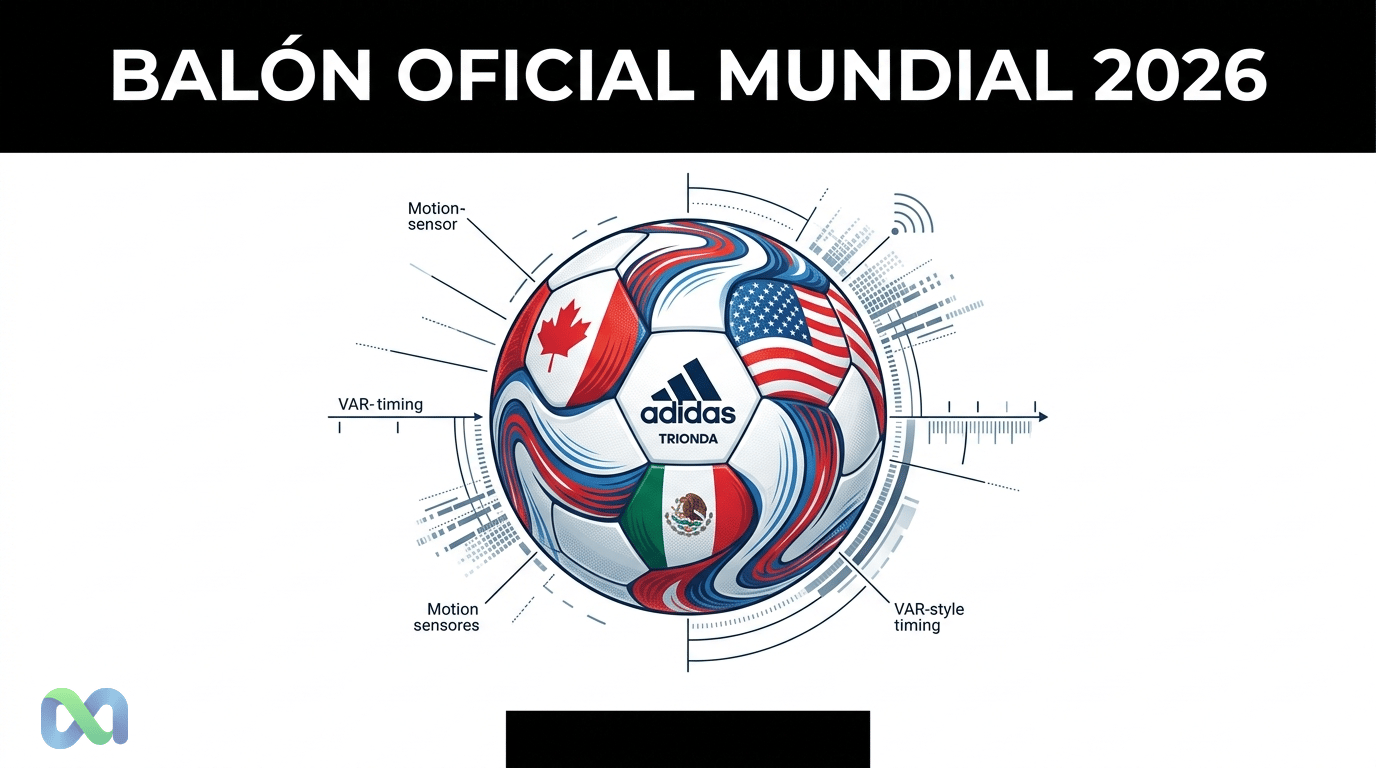
The 2026 World Cup official ball already has a name, a manufacturer and a clear tournament story. It is called TRIONDA, it was unveiled by adidas, and it will be used at the first men's FIFA World Cup hosted by three countries: Canada, Mexico and the United States.
The ball for the 2026 World Cup is not only a visual object for the tournament. It combines a tricolor design, direct references to the host nations and connected technology designed to support refereeing decisions. At the same time, it is still too early to say that it will increase goals, change playing styles or favor a specific kind of national team.
This guide separates confirmed facts from manufacturer messaging and from questions that can only be answered during the competition. The goal is simple: understand TRIONDA without confusing marketing, technology, retail availability and real performance on the field.
What is confirmed about the 2026 World Cup official ball
The 2026 World Cup official ball is adidas TRIONDA. According to FIFA's official TRIONDA page, it is the official match ball for the tournament in Canada, Mexico and the United States.
adidas also confirmed TRIONDA through its own official launch coverage, describing the product, its design language and its connected ball technology on the adidas TRIONDA campaign page. The launch added another chapter to the long-running relationship between adidas and FIFA World Cup match balls.
Quick facts:
- Official name: TRIONDA.
- Manufacturer: adidas.
- Tournament: FIFA World Cup 2026.
- Host countries: Canada, Mexico and the United States.
- Public launch: early October 2025.
- Core technology: connected ball with motion sensor.
- Main role: official match ball and visual symbol of the tournament.
Official name: TRIONDA
The name TRIONDA brings together two ideas. The first is “tri,” a reference to the three host countries. The second is “onda,” a word connected to wave imagery and to the stadium wave that moves through crowds.
That name helps the ball work as a tournament symbol, not just a piece of equipment. The 2026 World Cup will be the first men's edition with 48 teams and three host nations. The product therefore needs to communicate scale, unity and regional identity before a ball is even kicked.
Launch timing: early October 2025
TRIONDA was publicly launched in October 2025. That timing matters because official World Cup balls usually appear well before the tournament begins. The launch opens a heavier commercial phase in which the ball becomes a retail product, a collector item, a training reference and a central piece of the tournament's visual identity.
The gap between launch and kickoff also gives players, national teams, retailers and fans time to engage with the product. Teams may train with available versions, collectors can decide which model to buy, and supporters begin to associate the visual design with the coming World Cup cycle.
Manufacturer and official supplier: adidas
adidas is the manufacturer of the 2026 World Cup official ball. That does not mean adidas is the only sponsor of the tournament. The brand occupies a specific commercial category: official match ball supplier and equipment partner for this product line.
This distinction matters for editorial clarity. A separate article about World Cup sponsors should cover the wider partner ecosystem. This guide focuses on the ball itself: the product, the technology, the design, the retail angle and the possible sporting impact.
Why the ball is called TRIONDA
The name TRIONDA tries to condense the main institutional novelty of the 2026 World Cup: three countries organizing the same edition. That decision places the ball at the center of the tournament identity, not only inside the field of play.
The World Cup will be played across North America, in stadiums spread across three national markets. Because of that, the ball needs to represent more than one visual culture. adidas addresses that challenge with colors, symbols and panel shapes that suggest motion.
Three hosts and the stadium wave
The “tri” element points to Canada, Mexico and the United States. The wave idea creates a connection with the collective movement of supporters in stadiums. It is an accessible concept for a global audience because the wave is instantly associated with large sporting events.
The reading is simple and useful. TRIONDA wants to feel like the ball of a bigger, more distributed and more collective World Cup. The name reinforces the scale of the competition before the reader even studies the graphics on the ball.
Colors and symbols of Canada, Mexico and the United States
The ball uses blue, red and green as highlight colors. The most direct interpretation links blue to the United States, red to Canada and green to Mexico.
The design also includes visual references to the host countries. The key symbols include stars, a maple leaf and an eagle. Those details turn the ball into a compact visual map of the 2026 World Cup. They also give each host country a recognizable place in the product's identity.
Technology in the 2026 World Cup ball
The technology in the 2026 World Cup ball is one of TRIONDA's most important themes. It also requires careful language because the word “technology” can easily create exaggerated expectations.
The confirmed feature is significant. TRIONDA uses connected ball technology with a motion sensor that sends real-time data to the refereeing system. That data can help with offside reviews, ball-contact moments and potential handball decisions.
Connected ball technology and real-time data
TRIONDA uses Connected Ball Technology. In practical terms, that means the match ball contains a sensor designed to register movement and contact data at high frequency.
The sensor is intended to transmit signals to the VAR ecosystem. The purpose is not to replace human referees. The purpose is to reduce uncertainty in moments when milliseconds and small touches can change the interpretation of a play.
This is an important difference. A connected ball does not make every decision automatic. It gives match officials another layer of evidence. Referees still need the laws of the game, camera angles, protocols and judgment to reach the final decision.
How the ball can support offside and contact decisions
Connected ball data can help semi-automated offside systems because the exact moment of contact matters. In a fast attacking move, a frame or two can change whether a player appears onside or offside. If the ball provides a more precise contact signal, the system has a better reference point for drawing lines and timing the pass.
The same logic can apply to possible touches, deflections or handball reviews. If the ball registers a clear contact, the refereeing team receives additional information for the review.
That does not end debate. Intention, arm position, body shape, advantage and context still depend on the laws and on the refereeing team. The ball improves the technical base of the decision, but it does not remove interpretation from football.
What cannot be claimed yet
adidas describes TRIONDA as a fast and precise ball, with construction intended for control, flight and stability. Those claims are relevant, but they are not the same as proof of competitive impact.
It is too early to claim that the 2026 World Cup official ball will raise the number of goals. It is also too early to say that it will favor goalkeepers, free-kick specialists, technical teams or transition-heavy sides.
Those hypotheses can only be assessed with tournament data. Analysts will need to observe long-range goals, goalkeeper errors, public player comments, average game speed, set-piece results and shot patterns before making stronger claims.
TRIONDA design: the visual identity of the first three-country World Cup
TRIONDA's design is more than decoration. It has to deliver a commercial, sporting and symbolic message in a few seconds.
In recent World Cups, the official ball became part of each tournament's visual memory. Jabulani, Brazuca, Telstar 18 and Al Rihla all carried distinct identities. TRIONDA enters that line with the task of representing a World Cup unlike any previous men's edition in scale and geography.
Wavy panels and a tricolor look
The ball uses panels and lines that create a sense of wave motion. That feature reinforces the name and makes the product feel dynamic. It also helps distinguish TRIONDA from more geometric balls used in previous tournaments.
The tricolor look has two jobs. First, it makes the ball easy to recognize in photos, video highlights, retail displays and social campaigns. Second, it connects the object to the host countries without relying on full flags or heavy text.
A successful World Cup ball must be legible at different distances. It appears in close-up product photos, in television shots, in stadium graphics and in fast live action. TRIONDA's high-contrast color approach is designed for that kind of broad visibility.
Visual references to the host nations
The combination of national symbols creates a language of a shared World Cup. Canada appears through the maple leaf. Mexico appears through the eagle. The United States appears through stars.
That choice has commercial value. The ball must sell globally, but it also needs acceptance in the three markets hosting the tournament. Visual balance is therefore part of the strategy. If one host identity dominated too strongly, the product would feel less aligned with the event's central story.
The shared design also works for broadcasters and advertisers. A single object can quickly communicate the idea of Canada, Mexico and the United States hosting together. That is useful in coverage before the tournament and during the event itself.
adidas: sponsor, manufacturer or official ball supplier?
A common question is whether adidas is the sponsor, the manufacturer or the owner of the ball. The correct answer depends on the commercial category being discussed.
For TRIONDA, adidas is the manufacturer and official supplier of the match ball. It is also a historic FIFA partner in this specific product category. The wider set of World Cup sponsors and partners includes companies from many other sectors.
adidas as a historic World Cup ball supplier
adidas has supplied official World Cup balls for decades. That continuity gives the brand technical authority and symbolic value.
For supporters, it creates familiarity. For FIFA, it creates operational consistency. For adidas, it creates a global platform for technology, design and retail products.
The official match ball is seen by billions of people during a World Cup cycle. It appears in goals, saves, training sessions, ceremonies, promotional images, licensed products and highlight reels. That visibility gives the category much more weight than a normal sports-equipment launch.
Official ball versus global sponsors and commercial partners
The official ball is a specific product. It has a manufacturer, commercial versions and direct sporting use. Global sponsors can appear in boards, campaigns, digital experiences, hospitality, fan activations and other brand placements.
This distinction avoids confusion. When someone asks who sponsors the World Cup ball, they usually want to know the manufacturer. When they ask about 2026 World Cup sponsors, they usually want the full commercial partner picture.
For this topic, the practical answer is direct: the 2026 World Cup official ball is TRIONDA by adidas.
Price, retail availability and the collector angle
Search interest around TRIONDA is also commercial. Many people want to know whether the ball is already available, which versions exist and whether an official unit is worth buying.
The best approach is cautious. Prices, stock and model names can change by country, retailer and date. What is true at launch may not be true during the tournament.
Match, training and collector versions
Official World Cup balls usually appear in several versions. The professional match version tends to be the most expensive and the closest to the ball used on the field. Training, league, club, mini and collector versions can use different materials and construction.
Before buying, readers should check:
- The exact model name.
- The ball size.
- The intended use.
- Whether it is a professional version or a replica.
- Warranty and return policy.
- Whether the store is official or an authorized retailer.
This check avoids a common trap. Not every ball with TRIONDA graphics will have the same technology as the official match ball used in World Cup games.
What buyers should verify before purchase
Buyers should confirm availability through official adidas channels or trusted retailers in their own country. They should also read the product description carefully and identify the version.
Terms such as Pro, Competition, League, Club and Mini often indicate differences in materials, finish, weight and intended use. A collector may care most about authenticity and packaging. A player may care more about durability and price. A fan who wants the closest version to the World Cup match ball will usually look first at the professional model.
The key is not to assume that the visual design tells the whole story. The same look can appear across multiple price levels. The technology and construction can differ substantially.
Can the 2026 World Cup ball change the game?
TRIONDA can change how some incidents are analyzed. That is more likely in refereeing than in tactics.
The connected technology gives an objective signal about movement and contact. As a result, it may reduce review time in certain situations. It may also reduce uncertainty about the precise moment the ball was touched.
Refereeing, tempo and faster decisions
If the technology works smoothly, the biggest effect should appear in close decisions. Tight offsides and possible handballs are the clearest examples.
Less delay around VAR could improve match rhythm. However, that depends on the integration between the ball, cameras, software, referees and competition protocol.
The ball alone cannot solve every problem. It adds a layer of data. The final quality of a decision still depends on how that information is used.
Real performance can only be measured during the tournament
The sporting side needs evidence. Some players may praise the ball. Others may complain about flight, weight, bounce or control. That happens in almost every World Cup cycle.
To evaluate real impact, analysts should track indicators during the tournament. Those indicators include long-range goals, first-touch errors, cross volume, set-piece performance, goalkeeper comments, shot speed and VAR decision timing.
This is where the market-reading angle becomes interesting. For Macro Markets, technical narratives such as the official ball can enter the watchlist for World Cup 2026 coverage. They should not, however, become automatic conclusions about winners, top scorers or over-under goal markets.
Confirmed facts versus unproven claims
Confirmed facts:
- The official ball is called TRIONDA.
- The manufacturer is adidas.
- The design references the three host countries.
- The official match ball includes connected technology.
- The sensor is designed to support refereeing and VAR.
Unproven claims:
- That the ball will increase goals.
- That the ball favors one type of player.
- That every retail version has a sensor.
- That prices will remain stable in every market.
- That the ball will materially change tournament outcomes.
This distinction protects readers from two common mistakes. The first is treating launch marketing as sporting proof. The second is assuming that a retail replica has the same features as the official match ball used in competitive matches.
It also helps market observers stay disciplined. A new ball can shape narratives, and narratives can move attention. But tournament probabilities still depend on squad quality, injuries, draw path, tactical fit, travel demands, schedule density and actual performance.
How TRIONDA fits the wider 2026 World Cup context
The official ball is one of the first concrete objects of the World Cup. Before the matches begin, it turns a future competition into something visible and purchasable.
That affects media coverage, retail planning, collectors, national teams and supporters. It also creates new questions for anyone tracking sporting performance. How does the ball behave in flight? Do goalkeepers approve of it? Do free kicks change? Does VAR move faster?
Those questions do not have final answers yet. Even so, they will likely appear throughout coverage before the tournament begins.
For prediction markets and sports analysis, the discipline is to separate signal from noise. The official ball can influence conversation and perception. Market price and title probability depend on deeper variables such as squads, matchups, form, travel, health and the actual tournament bracket.
Why ball narratives matter before a major tournament
World Cup balls often become shorthand for bigger stories. A ball praised for stability can support a narrative about technical quality. A ball criticized by goalkeepers can create discussion around long shots and set pieces. A connected ball can create expectations around cleaner officiating.
Those narratives matter because fans and media use them to frame the tournament before it starts. They can also affect how early incidents are interpreted. If a goalkeeper makes a mistake, the ball may enter the conversation immediately, even if the error had other causes.
That is why a cautious baseline is useful. TRIONDA is important because it is official, visible and technologically relevant. It is not yet evidence that the 2026 World Cup will play in a specific way.
What to monitor once matches begin
Once the tournament starts, the useful questions become measurable. Are VAR checks quicker on average? Are tight offside decisions explained more clearly? Are there unusual numbers of long-range goals? Are goalkeepers publicly comfortable with the ball? Are teams changing set-piece choices because of its flight?
None of these signals should be judged from one match. A single spectacular goal or a single goalkeeper mistake can distort perception. A better approach is to watch patterns across groups, venues and weather conditions.
Because the 2026 World Cup spans three countries, conditions may vary. Stadium type, altitude, humidity, travel and surface conditions can all influence how players experience the ball. Any serious analysis should consider those factors before assigning too much importance to TRIONDA itself.
FAQ: 2026 World Cup official ball
What brand makes the 2026 World Cup official ball?
The brand is adidas. The company manufactures TRIONDA, the official match ball for the FIFA World Cup 2026 in Canada, Mexico and the United States.
What is the name of the 2026 World Cup ball?
The name is TRIONDA. It combines the idea of three host countries with wave imagery linked to supporters and stadium atmosphere.
Does TRIONDA have a sensor?
Yes. The version used in official matches includes connected ball technology with a motion sensor. The system sends real-time data to help refereeing decisions such as offside timing and possible ball contacts.
Is the ball already for sale?
TRIONDA was announced for sale through adidas channels and selected retailers. Availability, price and versions can vary by country and date. Before buying, confirm whether the product is a professional match ball, training ball, replica, mini ball or collector item.
Does every TRIONDA ball sold to the public have the same technology?
Not necessarily. Retail versions can share the same design while using different materials and technology. The official match ball is the main technical reference. Replicas and training versions usually sit in different price and use categories.
Could the 2026 World Cup official ball increase goals?
There is no proof yet. adidas highlights precision, speed and control, but the real impact can only be assessed after official matches. Until then, any prediction about more goals should be treated as a hypothesis.
Why does the ball matter for Macro Markets readers?
The ball matters because it can influence tournament narratives, refereeing discussions and fan expectations. For market analysis, it should be monitored as one variable among many, not treated as a decisive signal on its own.
Conclusion
The 2026 World Cup official ball is adidas TRIONDA. It brings together a tricolor design, symbols of Canada, Mexico and the United States, and connected technology intended to support refereeing.
The central point is to separate fact from expectation. It is confirmed that TRIONDA is the official ball, that adidas is the manufacturer and that the sensor supports the refereeing ecosystem. It is not yet proven that the ball will change goal averages, favor certain players or alter the style of the tournament.
For supporters, TRIONDA is part of the visual identity of the first men's World Cup hosted by three countries. For collectors, it is a product with several possible versions. For anyone following the World Cup through data, probabilities and market expectations, it is another variable to monitor calmly.
Macro Markets will continue treating the ball as a useful signal, but not as a shortcut. The real tournament picture will come from team quality, injuries, bracket paths, tactical decisions, venue conditions and the evidence produced once the 2026 World Cup begins.
