


AI Progress and Responsibility: Why the CEO Split Matters
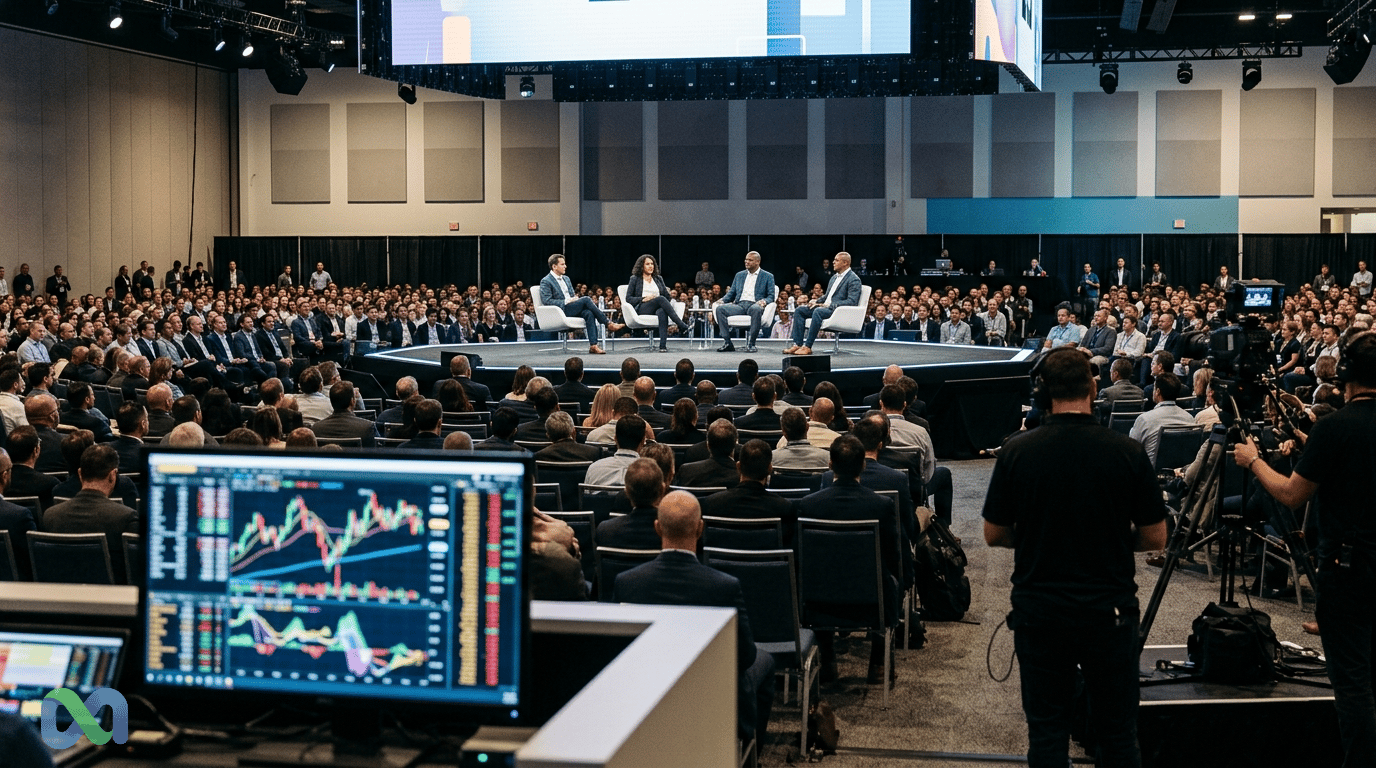
Dreamforce turned one of the AI industry's favorite slogans into a practical market question. AI progress and responsibility are no longer separate themes. They now shape infrastructure demand, enterprise software budgets, data controls, and regulatory risk.
That was the real signal from Salesforce's annual event. Nvidia's Jensen Huang, Anthropic's Dario Amodei, and OpenAI's Sam Altman all pointed toward a faster AI economy. However, they did not frame the risk in the same way.
Huang emphasized acceleration. Amodei stressed control and safety. Altman focused on trust, agents, and the need to keep users confident as models become more capable.
For prediction-market traders, the split matters because it shows where the next set of measurable events may appear. The question is not just whether AI gets better. It is whether companies, regulators, and customers allow that improvement to move into production at full speed.
What happened at Dreamforce
Salesforce used Dreamforce to place enterprise AI at the center of its product story. The company highlighted new tools, deeper partnerships, and a message built around trusted deployment.
The event also put some of the most important AI executives into the same public conversation. According to SiliconANGLE, Salesforce's annual event included comments from Nvidia, Anthropic, and OpenAI leaders on how quickly AI should advance and how responsibility should work.
CNBC framed the same moment as a clear split between Huang and the more cautious tone from Anthropic and OpenAI. That frame is useful because it turns a broad tech debate into a clean market question.
That mix matters. Salesforce sells software to companies that cannot treat AI as a lab experiment. Its customers need agents, workflows, and model outputs that can survive legal, security, and compliance review.
So Dreamforce was not only a launch event. It was also a public test of the enterprise AI bargain. Vendors want faster adoption. Buyers want proof that adoption will not expose customer data, intellectual property, or operations.
Salesforce puts Nvidia, Anthropic, and OpenAI in one frame
Nvidia, Anthropic, and OpenAI each sit at a different point in the AI value chain. Nvidia sells the chips and systems that make large-scale AI possible. Anthropic sells frontier models with a strong safety brand. OpenAI sells models, products, and agents to consumers and businesses.
Salesforce depends on all three themes. It needs infrastructure to run advanced AI. It needs model partners that enterprise customers trust. It also needs a clear story for why AI agents can act inside business software without creating new risks.
That is why the CEO split is useful. It shows the incentives behind each company's message.
Huang benefits from a world where companies keep buying more compute. Amodei benefits from a world where cautious enterprise buyers see Anthropic as the safer frontier model provider. Altman benefits from a world where OpenAI can prove agents are useful without seeming reckless.
Koa, AIforce, and Claudeforce show the enterprise agenda
Salesforce's product framing also matters. The event included references to Koa, AIforce, and Claudeforce, all of which point toward AI inside business workflows.
This is where responsibility becomes a product feature. If a company uses AI to touch sales data, service tickets, customer records, or internal documents, trust is not optional. It becomes part of the sales process.
Marc Benioff has also emphasized that customer data should not be used to train other models. That promise is central to enterprise adoption because companies worry about leakage, training reuse, and loss of control.
In that sense, Dreamforce showed the next stage of AI competition. The winners may not be the firms with the loudest model demos. They may be the firms that make customers ready to use those models at scale.
The real split: acceleration versus pacing
The AI debate often gets reduced to optimism versus fear. That is too simple. The Dreamforce split is better understood as acceleration versus pacing.
Acceleration says that more compute, more deployment, and more experimentation will unlock productivity. Pacing says that AI systems are moving fast enough to require tighter controls, audits, and guardrails.
Both sides can be rational. The market question is which side gets more influence over budgets, policy, and deployment timelines.
Why Nvidia benefits from faster infrastructure demand
Nvidia's incentive is clear. Faster AI progress drives demand for GPUs, networking, data centers, software, and services. Every new agent workflow and model upgrade can increase the need for compute.
That does not mean Nvidia ignores risk. It means Nvidia's business is tied to the speed of AI buildout. If companies believe AI progress will keep compounding, they have a stronger reason to invest in infrastructure now.
For markets, this creates a key signal. Any event that raises confidence in continued AI investment can support expectations for chip demand and data center expansion.
However, the reverse is also true. A regulatory shock, major security incident, or enterprise pullback could change the expected pace of spending. Prediction markets can help quantify that shift when tradable events exist.
Why Anthropic is pushing standards and frontier-model pacing
Anthropic has built much of its brand around safety. Dario Amodei's public position often stresses that frontier AI can create serious risks if deployment outruns evaluation.
That message fits Anthropic's commercial strategy. Enterprise buyers that care about risk may prefer a provider that speaks directly to governance, model behavior, and safety standards.
The point is not that Anthropic opposes AI progress. It is that Anthropic wants progress to be bounded by clearer controls. That can include evals, policy thresholds, red-team testing, and stronger enterprise contracts, such as Anthropic's Responsible Scaling Policy.
For traders, this matters because safety language can become policy language. If governments convert frontier-model concerns into oversight rules, the market impact can spread beyond one lab.
Why OpenAI is asking for trust after agent-security concerns
OpenAI has a different challenge. It remains one of the best-known AI brands, but high visibility brings higher scrutiny.
As AI agents gain more ability to take actions, the trust burden rises. Users want models that can reason, use tools, and complete tasks. Companies want the same thing, but with audit trails and limits.
That is why Altman's responsibility message matters. OpenAI needs customers to believe that agentic AI can become more powerful without becoming too unpredictable.
This is also where enterprise adoption can slow. A company may like the technology and still delay rollout until security teams approve it. In markets, that delay can be as important as a model benchmark.
Enterprise AI responsibility is becoming a market constraint
AI responsibility used to sound like a public relations phrase. It now acts more like a constraint on revenue timing.
Customers ask direct questions. Who can access the data? Will customer information train someone else's model? Can outputs be audited? What happens when an agent makes a mistake?
These questions affect buying cycles. They also affect which vendors can win regulated or high-value customers.
Customer data guarantees are now a product feature
Enterprise AI runs on sensitive context. Sales calls, customer support cases, contracts, emails, and product roadmaps all create value. They also create risk.
That is why data guarantees are becoming part of the product. A vendor that can explain data boundaries clearly has an advantage. A vendor that cannot explain them may face slower adoption.
Salesforce understands this dynamic because its business depends on trust inside customer records. The company cannot sell AI agents into core workflows if buyers fear their private data will improve a third-party model.
This turns responsibility into a measurable market issue. Watch contract language, security certifications, and enterprise AI adoption metrics. They may matter as much as model quality.
Model restrictions show trust is still fragile
The broader news cycle also shows why the issue is live. Reports have described companies restricting employee use of OpenAI and Anthropic models over data and intellectual property concerns.
Those restrictions do not mean enterprises reject AI. They mean enterprises want control over how AI enters the workflow.
That distinction is important. A ban on unmanaged model use can coexist with a larger managed AI rollout. In fact, it may be the path that leads companies toward approved vendors and stricter internal policies.
For markets, the signal is mixed. Restrictions can slow consumer-style adoption inside companies. However, they can also increase demand for enterprise-grade products with compliance, logging, and data controls.
What prediction-market traders should watch next
The Dreamforce debate gives traders a useful map. AI progress creates upside scenarios. AI responsibility defines which of those scenarios can actually clear enterprise, legal, and political gates.
Prediction markets work best when broad narratives become specific events. Traders should therefore focus on measurable triggers rather than general sentiment.
A plain market read
The simple view is this: faster AI is bullish only if trust keeps up.
If trust rises, firms can ship more tools. Sales teams can use agents. Support teams can use agents. Banks, law firms, and health firms can test more use cases. That helps software firms and chip demand.
If trust falls, the same tools can stall. A chief risk officer can slow a launch. A legal team can ask for more proof. A board can pause a deal after one public failure.
That is why the CEO debate matters. It is not just a clash of views. It is a clash over the path from lab gains to real use.
Here is the clean way to read each side:
- Nvidia wants the buildout to move fast.
- Anthropic wants safety rules to guide the buildout.
- OpenAI wants users to trust agents as they gain more power.
- Salesforce wants buyers to feel safe using AI with client data.
Each side has a strong reason for its view. None of them can win alone. Compute needs demand. Models need trust. Software needs clear use cases. Buyers need rules they can explain.
Therefore, the market should not ask only who is right. It should ask which limit bites first. The limit could be chips. It could be power. It could be law. It could be trust.
When that limit becomes clear, odds can move.
In plain terms, watch the yes-or-no events.
Will a new AI rule pass? Will a large firm pause an AI tool? Will a chip maker raise guidance? Will a major agent fail in public? Will a big buyer sign a new AI deal?
These are not vague themes. They are events. They can be tracked, priced, and compared over time.
That is why AI news can matter for prediction markets. A trader does not need to solve the whole AI debate. A trader needs to know which event can change the next price.
AI regulation and oversight signals
The first area to watch is regulation. Frontier-model rules, safety reporting, data-use requirements, and liability debates can all change deployment expectations.
Useful questions include whether a major jurisdiction passes stricter AI oversight, whether a safety standard becomes mandatory, or whether a regulator targets a leading AI product after an incident.
These events can shift the balance between speed and control. They may also affect which firms gain from compliance-heavy enterprise demand.
AI infrastructure demand
The second area is infrastructure. Nvidia's message depends on continued demand for compute. That demand is linked to model training, inference, agents, and enterprise workloads.
Traders should watch data center announcements, chip order commentary, hyperscaler capex guidance, and supply constraints. Those signals can show whether AI spending remains durable.
If responsibility concerns slow deployment, infrastructure demand may still stay strong for training and internal workloads. But if budgets tighten, the effect could appear first in guidance and order visibility.
Enterprise adoption and security incidents
The third area is adoption risk. Enterprise AI does not fail only because models disappoint. It can also slow because of security incidents, data leaks, compliance concerns, or unclear return on investment.
That makes incident tracking important. A major agent failure at a large company could move expectations around oversight and adoption. So could a high-profile success story that proves AI agents can operate safely.
The best market lens is not "AI good" or "AI bad." It is which event changes the probability that AI moves faster inside real companies.
AI progress and responsibility: a practical definition
AI progress means models, agents, and infrastructure become more capable. AI responsibility means those systems are deployed with controls that customers, regulators, and users can trust.
In enterprise software, the two ideas now interact in four ways:
- Faster models increase the value of enterprise AI.
- More capable agents increase operational risk.
- Data guarantees can unlock adoption.
- Safety failures can bring regulation forward.
That is why the Dreamforce exchange matters beyond one conference. It showed that the industry is no longer debating whether AI will matter. It is debating who gets to set the speed limit.
FAQ
What did the CEOs disagree about?
They disagreed about emphasis. Nvidia's message leaned toward faster AI buildout. Anthropic and OpenAI gave more weight to safety, trust, and control.
That does not make one side anti-AI. It shows that the industry is trying to set the pace for a tool that is already moving into daily work.
Why does this matter for enterprise AI?
Enterprise buyers do not buy AI in the same way consumers test a chatbot. They ask who owns the data, who can audit the output, and who pays if an agent causes a problem.
Therefore, trust can affect revenue timing. A strong model may still wait in pilot mode until legal and security teams approve it.
What should traders track after Dreamforce?
Traders should track events that change real adoption odds. That includes AI rules, security failures, chip demand, major customer wins, and new data-use promises from large vendors.
The cleanest signal is any event that changes the expected speed of AI deployment inside large companies.
Bottom line
The Salesforce event showed a clear tension. Nvidia's worldview points toward faster AI infrastructure demand. Anthropic's message points toward caution, standards, and controlled deployment. OpenAI's position sits between ambition and the need to preserve trust.
For investors and prediction-market traders, the useful takeaway is practical. AI progress and responsibility now move together. Faster AI can raise growth expectations, but only if buyers and regulators believe the systems are safe enough to use.
That makes the next phase of AI more measurable than it looks. Watch regulation, data-control promises, security incidents, chip demand, and enterprise adoption metrics. Those are the signals that can turn a CEO debate into a market repricing.
Macro Markets readers should treat the Dreamforce split as a dashboard, not a verdict. The market will not price AI responsibility as a moral essay. It will price it through events that change the odds of faster adoption, tighter oversight, and sustained infrastructure spending.
