


AMD Anthropic AI Infrastructure Deal: Rack-Scale Race
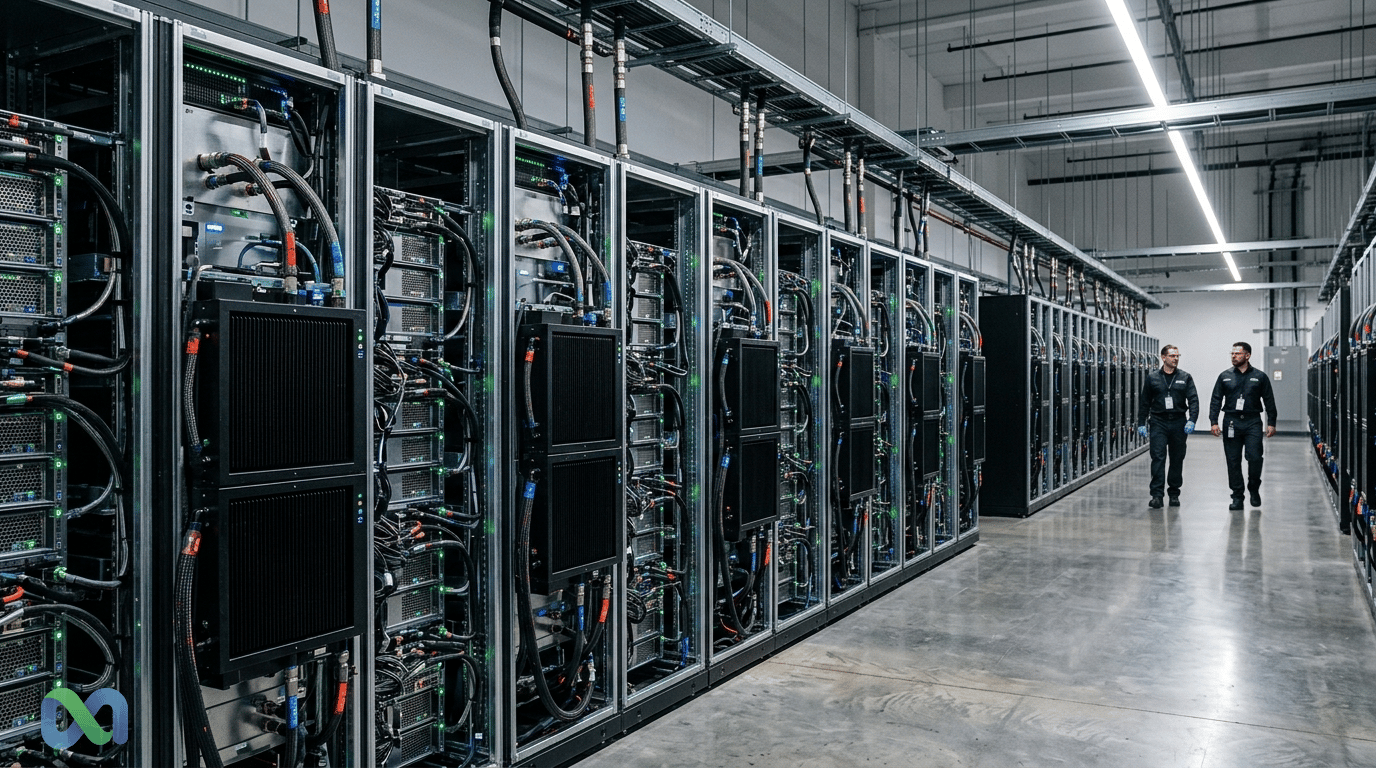
The AMD Anthropic AI infrastructure deal is more than a supply agreement for AI chips. It marks a shift in how frontier AI capacity is being bought, financed and measured. The key unit is no longer a single accelerator. It is the rack, the data center and the power contract behind it.
AMD says Anthropic plans to deploy up to 2 gigawatts of AMD Instinct MI450 Series GPUs through AMD Helios rack-scale systems. The first gigawatt is expected in the first half of 2027. AMD also committed up to $5 billion in a strategic equity investment in Anthropic.
Those numbers matter because Claude demand is now an infrastructure problem. Training frontier models is expensive, but serving millions of users can be just as demanding. Every answer requires compute, memory, networking and power. If a model lab cannot secure enough reliable capacity, product growth turns into a physical constraint.
For investors and prediction-market traders, the deal is a clean signal. The AI cycle is moving from chip scarcity toward systems execution. AMD has to prove it can deliver a full rack-scale platform. Anthropic has to prove it can use that capacity without losing cost discipline. Nvidia still has the strongest AI infrastructure position, but the competitive field is becoming broader than benchmark charts.
AMD Anthropic AI Infrastructure Deal in Plain English
In plain English, this deal is about capacity. Anthropic needs more machines to train and run Claude. AMD wants to prove that its AI systems can serve one of the most demanding labs in the market. The shared bet is that a full rack can matter as much as the chip inside it.
Think of the rack as the working unit. The GPU does the heavy math. The CPU manages work around it. Networking moves data between machines. Cooling keeps the system alive. Software helps the model use all of that gear without wasting time or power.
That is why the announcement matters. It gives AMD a large customer with real AI demand. It gives Anthropic another path to future compute. It gives the market a clear set of facts to test in 2027.
What AMD and Anthropic Announced
The AMD Anthropic AI infrastructure deal has three confirmed pillars. Anthropic intends to deploy up to 2 gigawatts of AMD Instinct MI450 Series GPUs. Those GPUs are planned for AMD Helios rack-scale systems. AMD also agreed to invest up to $5 billion in Anthropic as part of the strategic partnership.
A Business Insider markets wire version of the AMD release frames the deal around both deployment and collaboration. That distinction is important. The agreement is not just a purchase order. It is also a statement that AMD wants to shape the hardware stack used by one of the leading frontier AI labs.
The confirmed terms are best read in four parts:
- Up to 2 GW of MI450 GPUs: Anthropic plans a large deployment of AMD AI accelerators.
- First 1 GW in H1 2027: The first wave has a clear target window.
- Up to $5B investment: AMD is using capital to deepen the partnership.
- Helios rack systems: The product is a full AI system, not a chip alone.
The timing also matters. A first-gigawatt target in 2027 gives AMD a visible demand anchor for MI450. It gives Anthropic a second hardware path for future Claude workloads. It also gives the market a concrete timeline to track. The story can be tested against deployments, power access and software performance over the next several quarters.
Why Rack-Scale AI Infrastructure Matters
Rack-scale AI infrastructure means the system is designed as a complete deployable unit. It includes GPUs, CPUs, memory, networking, cooling, power and software. The goal is simple. The rack should work like one AI engine, not a pile of separate parts.
That change matters because frontier AI workloads stress every layer of the stack. A faster GPU does not help if networking slows the system. More memory does not solve the problem if cooling limits the rack. Better training speed may not lower inference cost if software is hard to tune.
This is why the AMD Anthropic AI infrastructure deal should be read as a systems strategy. Anthropic does not only need chips. It needs reliable capacity that can run Claude at scale. AMD does not only need a strong accelerator. It needs a platform that buyers trust for large model training and high-volume inference.
The industry has also moved into a power-constrained phase. A 2-gigawatt commitment is not an abstract figure. It points to substations, utility contracts, liquid cooling, land and data center buildout. In this phase, the winning supplier must help customers deploy capacity, not just announce silicon.
That is the strategic opening for AMD. If it can make Helios easier to deploy, tune and operate, it can compete on total system value. If it cannot, Nvidia's installed base and software ecosystem remain difficult to displace.
What Helios Adds to AMD's AI Strategy
AMD Helios is the center of the company's rack-scale push. In its technical materials, AMD describes Helios as an open rack-scale AI platform built around Instinct MI450 GPUs, EPYC CPUs, Pensando networking and ROCm software. AMD's Helios rack design blog says the system uses 72 MI450 GPUs and a large HBM4 memory pool.
The technical claim is simple: AI customers need a system, not a component. AMD wants MI450 accelerators to work with EPYC Venice CPUs, networking and ROCm as one coordinated stack. That gives the company more ways to compete than raw GPU performance alone.
The open standards angle is especially important. AMD has framed Helios around open rack designs and ecosystem participation. Its open rack-scale AI infrastructure post argues that agentic AI workloads require compute, networking and software to be planned together. For large buyers, open standards can reduce lock-in and make vendor diversification easier.
That does not remove the execution burden. ROCm has improved, but Nvidia's CUDA ecosystem remains the reference point for many AI teams. Developers and infrastructure engineers already know how to tune CUDA workloads. AMD has to make the migration worthwhile through performance, cost, supply and support.
Helios therefore gives AMD a clearer enterprise story. It can sell a rack-scale design for AI factories, not just an accelerator line. The Anthropic partnership gives that story a major proof point. However, proof will come from production workloads, not launch materials.
Why Anthropic Wants Hardware Diversification
Anthropic's incentive is direct. Claude growth depends on compute capacity. The company needs infrastructure for model training, fine-tuning, safety work and inference. If demand grows faster than available capacity, users feel it through limits, latency or higher prices.
Hardware diversification also gives Anthropic more strategic flexibility. Relying too heavily on one supplier can create pricing pressure, allocation risk and schedule risk. A credible AMD path gives Anthropic more options when planning future capacity.
This does not mean Anthropic is abandoning Nvidia. That would be too strong. The better reading is that frontier labs are building portfolios of compute supply. They want Nvidia for mature workloads, cloud partners for flexible capacity and alternative systems where the economics make sense.
The real test is workload matching. Some tasks may benefit from Nvidia's mature software ecosystem. Others may run efficiently on AMD if ROCm support and model tuning are strong enough. Anthropic will likely care less about brand preference than delivered cost per useful token.
That phrase matters: cost per useful token. AI infrastructure is not only about model training headlines. It is about how cheaply and reliably a lab can produce useful answers at scale. If AMD helps Anthropic reduce marginal inference costs, the partnership becomes strategically meaningful.
The Nvidia Challenge Is Bigger Than Benchmark Scores
The deal creates a stronger AMD narrative, but Nvidia remains the default AI infrastructure leader. Its advantage is not limited to faster chips. It includes CUDA, networking, system design, supply relationships, developer habits and years of production tuning.
That is why the Nvidia challenge is bigger than benchmark scores. A single test can show that a GPU is competitive on a narrow workload. A gigawatt-scale deployment has to work across procurement, installation, orchestration, model tuning, monitoring and maintenance. The customer has to believe the system will run well for years.
AMD can still win meaningful share. Large AI buyers want supply diversity. They also want leverage in pricing and access. If AMD delivers stable Helios deployments, the company can become the second path that every serious AI infrastructure buyer evaluates.
The first risk is software maturity. ROCm must keep improving for training and inference teams that are used to CUDA. Documentation, kernel support, debugging tools and framework integration matter as much as hardware specs.
The second risk is deployment timing. A first gigawatt in the first half of 2027 is ambitious. Delays in manufacturing, power procurement, data center readiness or system validation could reduce the market impact. The deal gives AMD a visible milestone, but it also gives traders a clear scorecard.
The third risk is economics. AMD may gain share through attractive pricing, strategic capital and tighter collaboration. That can be a rational strategy. Yet investors will watch whether the revenue, margin and cash-flow impact justify the scale of the commitment.
What 2 Gigawatts of AI Compute Means
Gigawatts are a power measure, not a chip count. In AI infrastructure, that language shows how physical the industry has become. A 2-gigawatt plan implies enormous electricity demand, cooling needs and data center coordination.
This is why AI capex concerns keep showing up in public markets. Cloud companies, chipmakers and model labs are spending before the full revenue curve is visible. The market has to price several questions at once: how fast AI demand grows, how efficient models become, and who captures the profit pool.
For AMD, a power-scale commitment from Anthropic helps validate demand for MI450. It also raises expectations. If Helios becomes a credible rack-scale option, AMD can compete in a market where buyers need capacity. If the system disappoints, the company risks being seen as a secondary supplier for less critical workloads.
For Anthropic, the benefit is capacity insurance. Claude needs room to grow. A long-term AMD path could support training runs, enterprise workloads and inference expansion. However, the company still has to convert infrastructure into durable revenue.
For Nvidia, the deal is a reminder that customers want alternatives. That does not mean Nvidia loses its lead. It means customers are willing to fund a second ecosystem if the economics and deployment path are credible.
What to Watch Next
The first signal is deployment progress. Investors should watch whether Anthropic and AMD confirm site readiness, power procurement and first-rack installation before the H1 2027 target. The market will reward evidence more than language.
The second signal is workload disclosure. If Anthropic shares that specific Claude training or inference workloads run well on MI450 systems, AMD's credibility improves. If the companies stay vague, the market may treat the deal as strategic positioning rather than operational proof.
The third signal is customer follow-through. One large model lab is important. Several hyperscalers or AI labs would be more important. Additional commitments would show that Helios is becoming a real buying pattern, not a bespoke partnership.
The fourth signal is software adoption. Watch for ROCm updates, framework support, model tuning work and developer case studies. These details may look technical, but they decide whether customers can use the hardware without friction.
The fifth signal is AI infrastructure pricing. If power, land and networking remain scarce, rack-scale execution becomes more valuable. If supply catches up or model efficiency improves faster than expected, buyers may become more selective about new capacity.
Prediction markets are useful here because each signal can be converted into a question. Will AMD hit first-gigawatt deployment by H1 2027? Will another frontier lab announce a Helios commitment? Will AI capex keep rising into 2027? These are not abstract debates. They are measurable events that markets can price.
Bottom Line
The AMD Anthropic AI infrastructure deal is best understood as a rack-scale systems bet. AMD is trying to turn Instinct MI450, Helios, EPYC, Pensando and ROCm into a credible AI infrastructure platform. Anthropic is buying a second path for Claude capacity and accepting the execution work that comes with it.
The deal does not make AMD the new Nvidia. It does make AMD harder to ignore. In AI infrastructure, the next phase will be judged by deployment, power, software and cost per useful token. That is a broader contest than a chip launch, and it is exactly the contest AMD wants to enter.
For traders, the clean read is this: AI infrastructure is becoming a systems market. The companies that secure power, integrate racks and run production workloads efficiently will set the next narrative. The AMD-Anthropic partnership gives that thesis a concrete timeline and a public scorecard.
