


Brazil 2026 Election: Dates, Candidates, Polls and Market Impact
The Brazil 2026 election is already the main political event on Brazil’s market calendar. Searches for dates, rules, candidates and polls are rising before the official campaign enters its most intense phase. That makes sense, because the election will not only choose the next president. It will also shape governorships, the Senate, the Chamber of Deputies, state assemblies and the Federal District legislature.
This guide is a live hub for readers who need the facts and the market context in one place. It separates official information from analysis, summarizes the electoral calendar, explains how to read polls and shows why the 2026 cycle matters for rates, the real, fiscal risk and Brazil’s risk premium.
The central reading is simple. First, follow the official calendar. Then compare polls carefully. Finally, use market-implied probabilities as an extra information layer, not as a promise about the final result.
Editorial update: May 2026. Official dates and rules should be checked with Brazil’s Superior Electoral Court and the regional electoral courts.
When Is the Brazil 2026 Election?
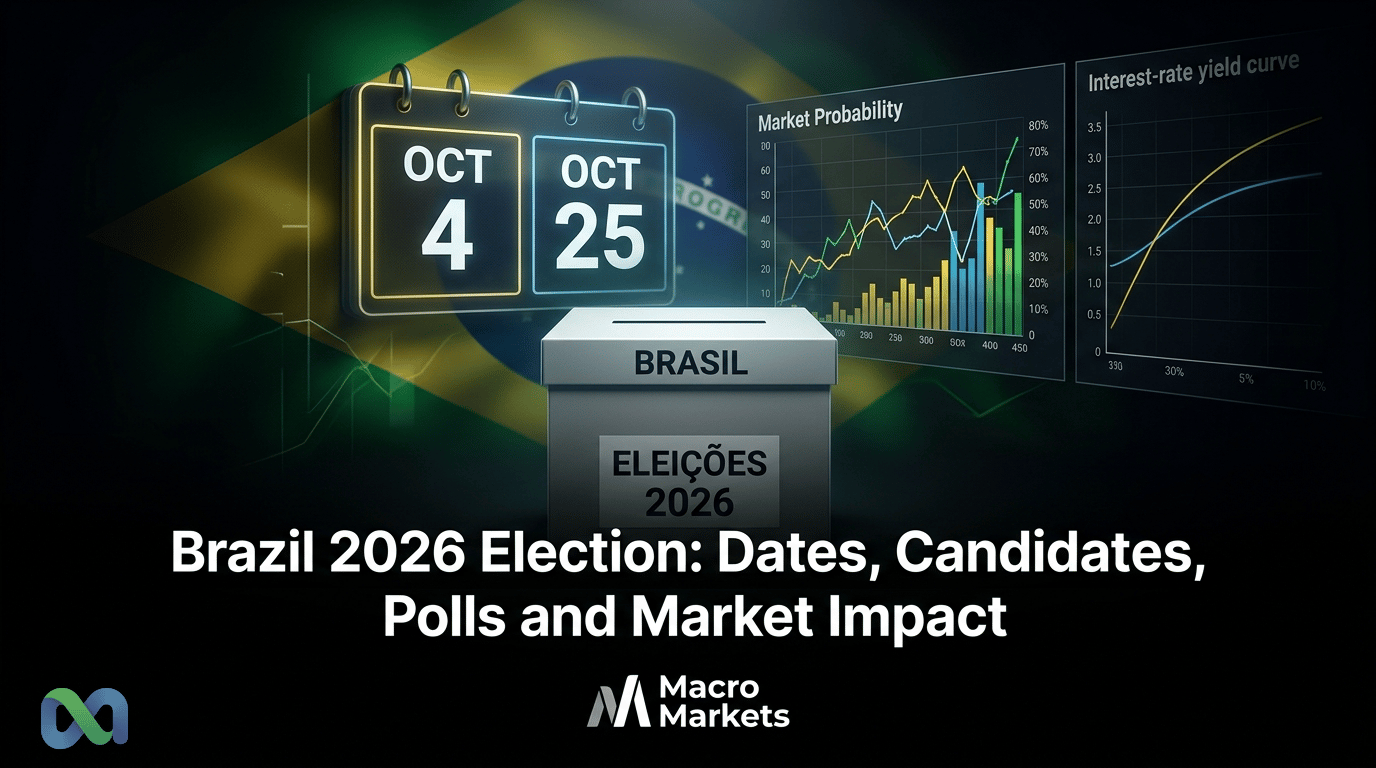
The Brazil 2026 election should hold its first round on the first Sunday of October and its second round, when needed, on the last Sunday of October. For the 2026 cycle, that puts the first round on October 4 and the second round on October 25.
Those dates follow the constitutional rule used in Brazilian general elections. The São Paulo Regional Electoral Court also highlighted these October 2026 dates when explaining the first and second rounds. Even so, the full operating calendar depends on official resolutions and notices from Brazil’s electoral justice system.
- First round: October 4, 2026. The vote covers national and state offices.
- Second round: October 25, 2026. It applies to presidential and governor races when no candidate wins in the first round.
- Official source: TSE and regional electoral courts. Use those pages for dates, rules and operational updates.
The second round does not apply to every office. It is used for majoritarian races that are not decided in the first round, such as president and governor. Senate, lower-house and state-legislature races follow their own rules.
Brazil Election 2026 Calendar: Key Dates to Track
The Brazil election 2026 calendar matters because each milestone changes the information available to voters, analysts and markets. Before party conventions, many names are still only being floated. After candidate registration, the field becomes more concrete. After campaign advertising and debates begin, attention shifts to polls, rejection rates and second-round scenarios.
The main checkpoints are:
- Poll registration: shows methodology, sponsor and field dates. It helps filter noise.
- Party conventions: formalize alliances and candidacies. They reduce uncertainty around coalitions.
- Candidate registration: defines who is officially trying to run. It changes first-round scenarios.
- Campaign advertising: raises candidate visibility. It can move name recognition and rejection.
- Debates: create high-attention events. They can shift narratives and probabilities.
- First round: reveals the real strength of each ticket. It reprices alliances and risks.
- Second round: concentrates the final race. It also concentrates political risk and asset reaction.
The official TSE page should remain the source for deadlines and legal rules. Scenario analysis needs another layer. It has to weigh alliances, polls, the economy, Congress and signals from prediction markets.
Which Offices Are Contested in the 2026 Brazilian Elections?
The 2026 Brazilian elections are general elections. Voters will choose executive and legislative offices. According to official TSE material on offices up for election, the cycle includes president, governors, senators and deputies.
In practice, the cycle has four arenas at the same time.
- President and vice president: define the direction of the federal government.
- Governors and vice governors: run the states and influence regional campaign platforms.
- Senators: renew an important part of the Senate, with direct impact on reforms and appointments.
- Federal, state and district deputies: define the legislative base and the limits of governability.
This mix explains why the presidential race should not be read in isolation. A president elected with a hostile Congress faces constraints. A strong state-level machine can change regional coalitions. A larger congressional bloc can unlock or block fiscal reform.
Therefore, the market question is not only “who wins?”. The full question is: who wins, with which coalition, in what fiscal environment and with what kind of Congress?
Brazil Presidential Election 2026: Candidates and Official Confirmation
The list of candidates in the Brazil presidential election 2026 should still be handled with care. Before party conventions and official registration, there are three different categories.
The first is a confirmed candidacy, which depends on party procedure and registration. The second is a pre-candidacy, when a public figure presents themselves as a likely competitor before formal confirmation. The third is a floated name, which appears in polls, media reports or behind-the-scenes scenarios without formal confirmation.
That distinction avoids a common mistake. Not every name tested in a poll will become a candidate. Not every early favorite reaches the end of the cycle in competitive shape. And not every formal candidacy has national electoral viability.
To follow the presidential field, watch five groups.
- Government and allies: they seek continuity, control of the economic narrative and state-level platforms.
- Right-wing opposition: it tries to consolidate one name with national reach and low fragmentation.
- The political center: it may run its own candidate or become the balance of power.
- Competitive governors: they bring regional machines, administrative visibility and local alliances.
- Outsiders and issue-based candidates: they can shift the debate even without leading polls.
The key point is to update the status of each name. “Floated” is not “confirmed”. “Leading one poll” is not the same as “likely winner”. “High rejection” does not eliminate a candidate, but it changes the second-round reading.
Brazil Election Polls 2026: How to Read Them Without Chasing Noise
Brazil election polls 2026 will be central to the news cycle. They help measure vote intention, rejection, candidate awareness and second-round scenarios. However, one poll rarely tells the whole story.
The first step is to look at the margin of error. If two candidates are separated by less than the margin, the race may be statistically tied. The confidence interval, field dates and sample size also matter.
The second step is to separate stimulated and spontaneous polling. In stimulated polling, the respondent receives a list of names. In spontaneous polling, the respondent answers without a list. Early in a long cycle, spontaneous polling often shows name recall and brand strength. Stimulated polling helps test possible scenarios.
The third step is to compare similar surveys. A national poll should not be directly compared with a state-level cut. A phone survey can have a different profile from in-person interviews. Methodology changes can look like electoral movement, but sometimes they are only collection effects.
That is why trend matters more than a headline. Context also matters. A sequence of polls moving in the same direction carries more weight than one outlier. Aggregators, averages and historical series can help, as long as their criteria are clear.
It is also important to check registered polls. Brazil’s electoral justice system has rules for disclosure and registration. Registration does not make every poll perfect, but it improves transparency around the sponsor, methodology and field period.
What Prediction Markets Add to the Brazil 2026 Election
Polls measure declared responses from a sample. Market-implied probabilities aggregate expectations from participants who trade contracts linked to future events. These are different signals.
In the Brazil 2026 election, prediction markets can help read changes between polls. A strong debate, a court decision, a state-level alliance or an economic surprise can move probabilities before it appears in traditional surveys.
That does not mean markets are always right. They can overreact to recent news. They can also be affected by thin liquidity, participant bias and the specific rules of each contract. Therefore, the best reading uses probabilities as a complement.
The useful comparison is this:
- Election poll: measures declared intention in a sample. It depends on method, date and tested scenario.
- Market-implied probability: measures aggregated expectations from traders. It depends on liquidity, rules and participation.
- Official result: shows the counted vote. It exists only after the election.
For Macro Markets, the value is in event transparency. A good market needs a clear question, an objective resolution criterion and a verifiable source. Elections require extra care. The contract must say exactly which result counts, which authority confirms it and what happens in exceptional cases.
Use this signal responsibly. Market probability is not investment advice, it is not an election poll and it is not a promise of the result. It is a real-time reading of traded expectations.
How the Brazil 2026 Election Can Affect the Economy and Markets
Brazilian presidential elections often move assets because they influence fiscal policy, the relationship with Congress, the regulatory agenda and confidence around inflation. In 2026, that effect should be tracked across four fronts.
Fiscal Policy and Country Risk
Fiscal policy tends to sit at the center of the market reaction. Investors watch debt trajectory, spending rules, revenue, subsidies and commitment to the primary balance. A candidacy seen as more predictable on fiscal policy can reduce the risk premium. A candidacy seen as more expansionary can lift long-term rates and pressure the currency.
The point is not to root for one political camp. The point is to measure credibility, coalition strength and delivery capacity. Similar programs can have different effects if Congress and the economic team are different.
Interest Rates, COPOM and the Central Bank
Brazil’s Central Bank reacts to inflation, expectations and activity. Elections affect the expectations that feed into that process. If markets price more fiscal risk, the rates curve can steepen. If the environment improves, the curve can ease.
The election also matters because of the relationship between the executive branch, the Senate and future appointments. The Central Bank does not operate in a vacuum. Confidence in monetary policy depends on institutions, communication and macroeconomic coordination.
The Real and Brazilian Assets
The real usually reacts to both global and domestic risk. During an election, local news can amplify moves. Polls, alliances, fiscal signals and debates can affect the dollar, equities, rates and companies exposed to regulation.
Regulated sectors deserve attention. Energy, banks, state-owned companies, infrastructure and education can react to government proposals. The analysis should separate short-term noise from a real change in probability.
Congress and Governability
Governability is the bridge between campaign promises and execution. A president without a majority needs to negotiate more. A strong coalition can accelerate reforms, but it can also raise the political cost of governing. The Senate and Chamber influence budgets, reforms, investigations, appointments and regulation.
That is why watching only the presidential election is not enough. The composition of Congress can reprice almost any presidential scenario.
How to Avoid Cannibalization in a Brazil 2026 Election Content Cluster
This article should work as a hub. It answers the broad search intent behind “Brazil 2026 election” and points to more specific guides. Each satellite article should have its own focus and should not repeat the same scope.
A clear split is useful.
- Brazil 2026 election hub: overview, dates, offices, candidates, polls, markets and macro impact.
- Brazil 2026 election dates: first round, second round and operating deadlines.
- Brazil election calendar 2026: detailed table of deadlines, conventions, registration and campaign advertising.
- Brazil election polls 2026: methodology, aggregators, tested candidates and trend reading.
- Brazil presidential candidates 2026: names, parties, alliances and official confirmation.
- Brazil 2026 second round: scenarios, rules, specific polls and vote transfers.
- Economic impact of the election: fiscal policy, rates, the real, equities, Congress and sectors.
This architecture prevents several pages from competing for the same query. The hub captures the broad query. Satellite pages capture long-tail searches. Internal links connect both sides when the reader’s intent changes.
Satellite Articles to Follow the Election Cycle
As the cycle advances, readers should be able to move from this hub to more specific pages. When the satellite articles are published, they should be connected by internal links validated by the site catalog.
The main satellites are:
- A guide to Brazil 2026 election dates.
- An election calendar with an updated table.
- Polling analysis and trend reading.
- Presidential candidates and official status.
- Second-round scenarios in 2026.
- The impact of elections on Brazilian financial markets.
- How prediction markets work for political events.
This structure also improves reader experience. Someone who only wants the election date gets a quick answer. Someone who needs economic context gets analysis. Someone following prediction markets gets the probability layer.
Frequently Asked Questions About the Brazil 2026 Election
When does the 2026 election campaign begin in Brazil?
The official campaign begins during the period defined by Brazil’s electoral calendar. The exact milestone depends on TSE resolutions for the cycle. Before that, there is pre-campaign activity, party coordination and conventions, but those are not the same as the official campaign.
Who has to vote in Brazil in 2026?
Voting is mandatory for literate Brazilian citizens between 18 and 70 years old. It is optional for 16- and 17-year-olds, people over 70 and people who are illiterate. Specific rules should be checked with the electoral justice system.
Who is ineligible in 2026?
Ineligibility depends on legal rules, court decisions and individual conditions. Do not treat a public figure as ineligible without checking the applicable decision and its timing. For readers, the safest sources are the electoral courts and specialized legal coverage.
Where can I check official information?
Use the TSE website for national elections, legislation, the calendar and official notices. For regional information, use the electoral court of the relevant state. For polls, check registration data, sponsor, methodology and field period.
What is the difference between a candidate, a pre-candidate and a floated name?
A candidate is someone who goes through the party process and official registration. A pre-candidate is someone publicly positioning for the cycle before formal confirmation. A floated name is only a name tested or discussed in polls and reporting. This distinction prevents speculation from being treated as fact.
How can the 2026 election affect financial markets?
It can affect rates, the real, equities, country risk and regulated sectors. The impact depends on proposals, fiscal credibility, Congress, the economic team and the external backdrop. The market reaction can change as new information appears.
Conclusion
The Brazil 2026 election should be tracked in three layers. The first is official: dates, rules, offices and registrations. The second is analytical: polls, candidates, alliances and scenarios. The third is market-based: probabilities, asset reaction and risk reading.
No single layer solves everything. The official calendar says what is defined. Polls show declared intention at specific moments. Market-implied probabilities show how expectations are priced in real time.
For anyone following politics and the economy, this set is more useful than isolated headlines. The electoral cycle will be long, noisy and full of events. The best answer is to keep a hub updated with verifiable sources, neutral language and clear criteria.
Follow Macro Markets to compare political narratives with market-implied probabilities, always focused on observable events and objective rules.
