


Brazil Bans Polymarket and Kalshi and Changes the Game for Prediction Markets
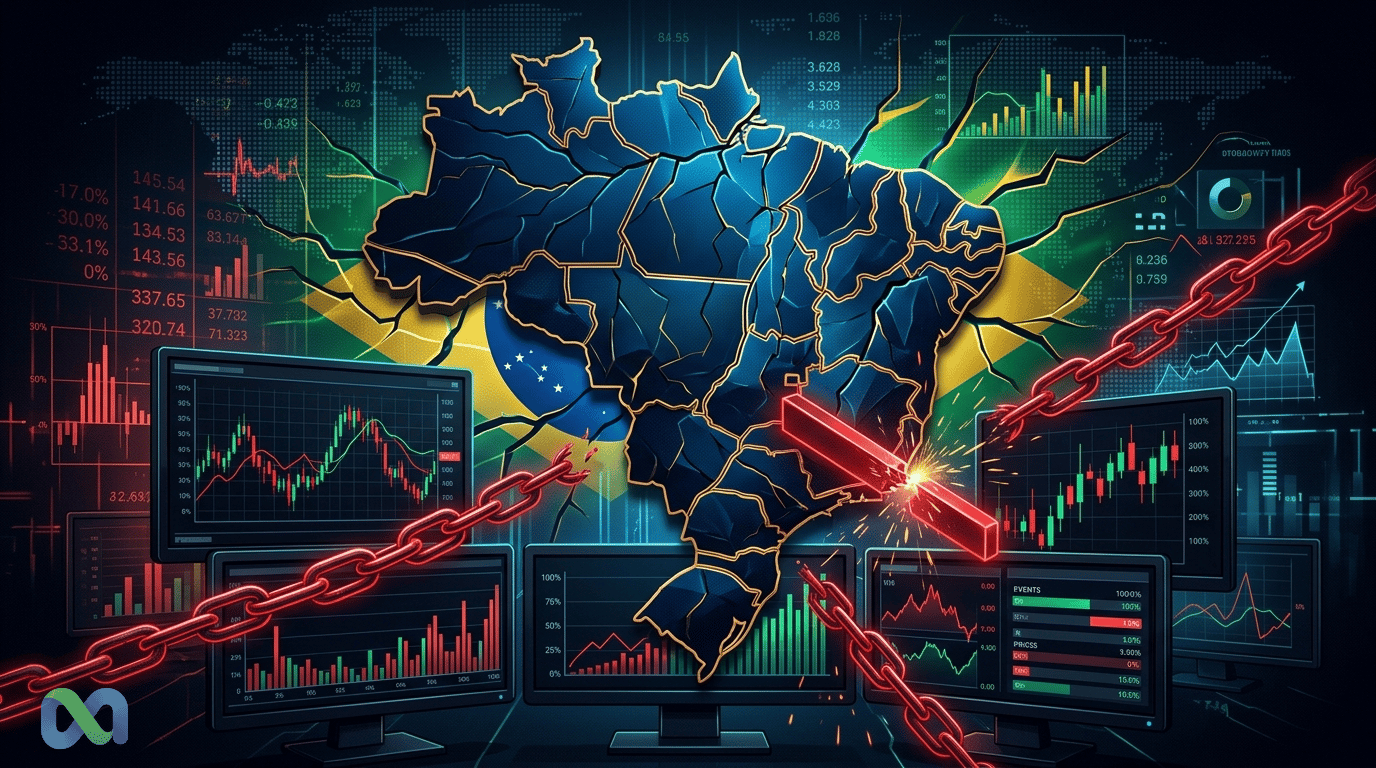
Brazil's government has tightened the screws on Polymarket, Kalshi, and other prediction market platforms with local access. The decision affects more than a digital niche. It hits a sector that had been gaining relevance as a tool for reading probabilities in elections, sports, and macroeconomic events.
In practice, the crackdown treats these products as unauthorized operations. The focus is on contracts tied to sports, elections, and other events that Brazil's Finance Ministry moved closer to betting or irregular derivatives. That is why the issue goes beyond blocking websites. It opens a broader debate about financial innovation, user protection, and the regulatory limits of prediction markets in Brazil.
In this article, you will understand what the government banned, why Polymarket and Kalshi became targets, the difference between a prediction market, a sportsbook, and a derivative, and what this decision signals for the future of the sector. For anyone following the rise of prediction markets in Brazil, this is a meaningful turning point.
What the government banned
The measure targeted platforms that offer contracts on future outcomes without local authorization. The main focus is on markets tied to sports and elections. Under the official view, these operations fall inside regulated areas and can expose users to products without adequate oversight.
The core point is simple. The government did not treat Polymarket and Kalshi as mere information tools. Instead, it framed the business as an activity with economic effects similar to betting or derivatives. As a result, the debate stopped being only technological and became clearly regulatory.
The list also was not limited to two famous names. Other platforms appeared on the radar as well. That suggests an effort to close loopholes before this market gains scale among Brazilian users.
Why Polymarket and Kalshi became targets
Polymarket and Kalshi attract attention because they turn public uncertainty into tradable prices. In theory, that makes them useful for reading expectations. In practice, it also raises a legal question. When a user buys exposure to the outcome of an election or a football match, what exactly is that person buying?
Brazilian regulators appear to have answered that question in the strictest possible way. If the product resembles a wager or a derivative and operates without local authorization, enforcement becomes the default response. That logic helps explain why platforms with strong brand recognition ended up under pressure.
Another factor is visibility. Polymarket gained global attention during election cycles and major geopolitical events. Kalshi has also been central to debates in the United States over what event contracts should be allowed. Once these brands entered the conversation in Brazil, they became natural symbols of a larger regulatory concern.
Prediction market, sportsbook, or derivative?
This distinction matters because the legal treatment changes with the label. A prediction market lets users trade probabilities tied to future events. A sportsbook offers direct wagering on outcomes. A derivative is a financial instrument whose value depends on another reference variable or event.
In real life, the borders can blur. A market contract about an election result may look like an information tool to one observer and like a speculative wager to another. A sports event contract can look even closer to betting. That ambiguity is exactly what makes regulation difficult.
Brazil's recent move suggests that authorities are less interested in the product's branding and more interested in its economic function. If users can profit from event outcomes in a way that resembles betting or unauthorized financial exposure, regulators may decide the distinction is not enough to justify open access.
What changes for users and the market
For users in Brazil, the immediate impact is less access. Depending on how enforcement unfolds, residents may face website blocks, payment restrictions, or both. Even when a platform remains technically reachable, legal uncertainty tends to reduce trust and participation.
For the market itself, the decision sends a broader signal. Brazil is not willing to let prediction markets scale first and discuss regulation later. The government appears to prefer early intervention over experimentation. That makes the country a harder environment for global platforms that rely on regulatory gray zones.
The move also affects the public conversation around information markets. Supporters argue these platforms aggregate dispersed knowledge and can produce valuable public signals. Critics argue they can blur the line between analysis, speculation, and gambling. Brazil's response clearly leans toward the second interpretation.
Why this matters beyond Brazil
This is not only a local story. The future of prediction markets depends on how major jurisdictions classify them. If large countries decide these products belong under gambling or derivatives rules, expansion becomes much harder. If they create a separate framework, the category may mature faster.
That is why Brazil's ban matters even for readers outside the country. It shows how quickly a government can move from curiosity to restriction when legal definitions remain unsettled. It also reinforces a key question in the global debate: where is Polymarket legal, and under what theory of regulation?
For international observers, Brazil now offers a concrete case study in how regulators respond when a fast-growing digital market collides with existing legal categories.
Will Brazil isolate or organize this market?
That is the central question after the crackdown. A ban is a fast response. Building rules is harder, but it usually produces better outcomes when a technology has real usefulness.
Prediction markets carry risks. They can be misused, badly explained, and badly sold. But they also offer a sophisticated way to aggregate dispersed information and turn conviction into a public signal. In the United States, the debate has already shown that the issue does not fit neatly into simple labels. In Brazil, the initial response was much harsher.
If the country wants to capture value from this innovation without repeating the mistakes of opaque platforms, it will need better distinctions between probabilistic analysis, entertainment, and derivatives. Until that happens, decisions like the one that hit Polymarket and Kalshi will keep defining the sector through prohibition rather than institutional design.
Conclusion
The decision against Polymarket, Kalshi, and other platforms marks a turning point for prediction markets in Brazil. The government chose to interpret this space through the lens of risk, user protection, and control over unauthorized operations.
That choice may make sense from a prudential standpoint. Even so, it leaves an open question: does Brazil only want to block Polymarket and similar platforms, or does it intend to build rules that can safely capture the value of this kind of market?
For now, the signal is restrictive. But the debate is far from over. For anyone who follows prediction markets, understanding this regulatory turn is essential to reading the sector's next moves.
