


Brazil Election Parties 2026: Congress and Coalitions
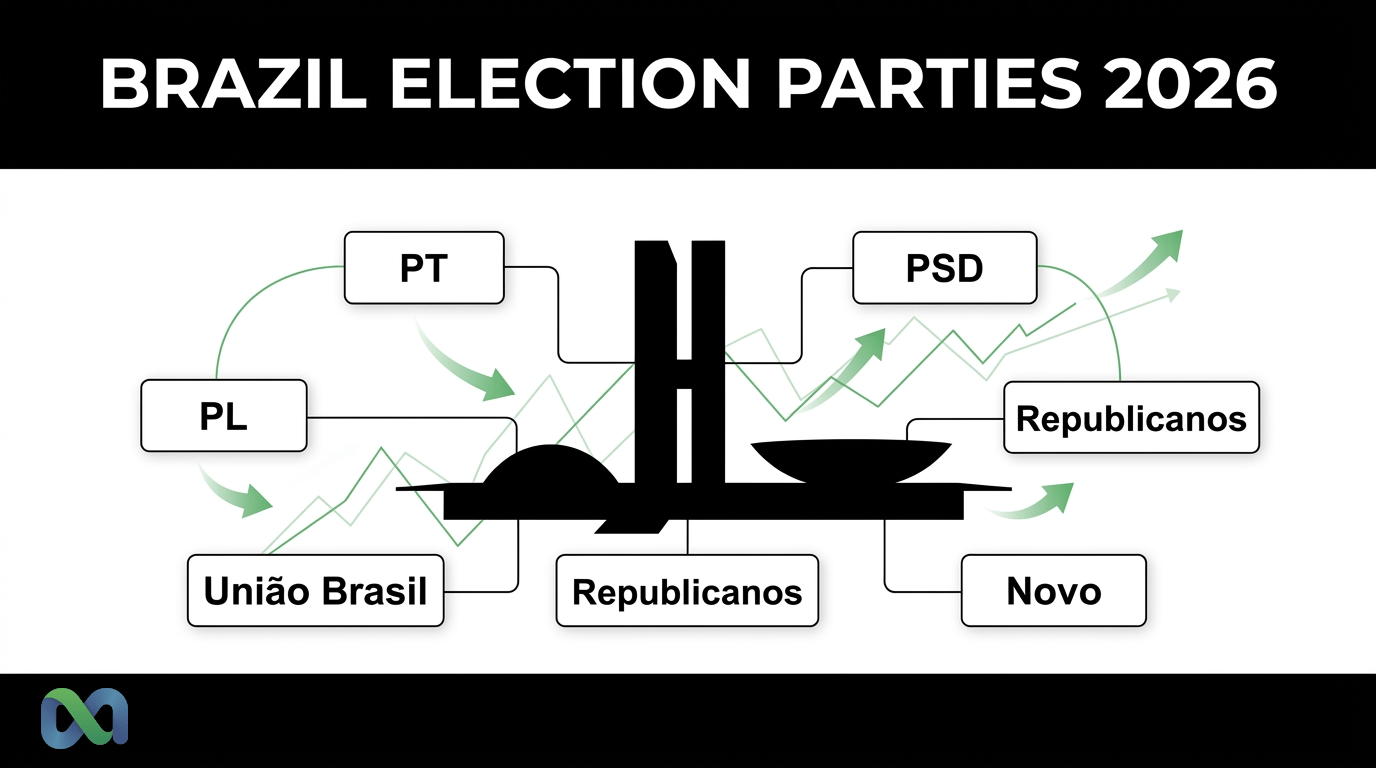
Brazil election parties 2026 is not just a search about acronyms. It is a search about power. The presidential race gets most of the attention, but parties define candidacies, political airtime, federations, state machines, congressional blocs, governability, and the fiscal cost of each scenario.
The cleanest reading starts with a simple separation. An official fact is something found in a calendar, registration, resolution, congressional caucus list, or verifiable party statement. A poll measures voting intention in a sample. A prediction market shows traded probability at a specific moment. A political scenario connects those signals, but it should not be treated as confirmation.
This guide maps PT, PL, PSD, União Brasil, Republicanos, Novo, MDB, PP, PSB, PSOL, Rede, PCdoB, PV, PSDB, Cidadania, Podemos, PDT, Solidariedade, Avante, PRD, and other relevant actors. The goal is to understand who matters in the 2026 election, who matters in Congress, and how each bloc can move probabilities and markets.
Which Brazil Election Parties 2026 Actually Matter?
The parties that matter in 2026 are those that combine at least one of these forces: a competitive candidate, a congressional caucus, governors, mayors, political airtime, a federation, or the ability to negotiate in a runoff.
By that rule, PT and PL are the obvious poles. PT anchors the Lula government continuity case and the Brasil da Esperança federation. PL concentrates the Bolsonaro-aligned right, even with Jair Bolsonaro currently ineligible unless a relevant legal change occurs.
The center is just as important. PSD, MDB, União Brasil, PP, and Republicanos may not dominate the presidential headline every day, but they control meaningful pieces of the Chamber, the Senate, state governments, and local machines. Without them, any elected president tends to pay a higher price to govern.
Novo, PSDB, Cidadania, Podemos, PDT, PSB, PSOL, Rede, PCdoB, PV, Solidariedade, Avante, PRD, and Missão enter the board differently. Some shape the agenda. Others decide state-level margins. Others help form federations, tickets, or thematic blocs.
The main question is not which party will get the most social media attention. The question is which party can turn votes, structure, caucus strength, and alliances into a real probability of victory or governability.
Quick Map of Brazil Political Parties in 2026
The mental table for Brazil election parties 2026 should split the race into three layers: presidential role, congressional role, and market reading.
- PT: the governing pole and likely continuity vehicle. Markets read fiscal policy, state companies, Congress, and government approval.
- PL: the main party of the Bolsonaro-aligned right. Markets read opposition coordination and the replacement of Bolsonaro's political capital.
- PSD: a pragmatic center party with local and congressional strength. Markets read governability, vice-presidential options, Senate power, and coalition cost.
- União Brasil: national machine, relevant caucus, and federation talks with PP. Markets read state tickets and bargaining power.
- Republicanos: institutional right and the Tarcísio de Freitas asset. Markets read the bridge between Bolsonarismo, center-right forces, and investors.
- Novo: a liberal niche with Romeu Zema as the central name. Markets read economic agenda, optionality, and scale limits.
- MDB: capillarity, Senate presence, governors, and center-party tradition. Markets read runoff leverage and legislative base.
For editorial clustering, each party deserves its own page. PT elections 2026, PL elections 2026, PSD elections 2026, União Brasil elections 2026, Republicanos elections 2026, Novo elections 2026, MDB elections 2026, and the broader 2026 election hub answer different search intents. They all point to the same conclusion: Brazil election parties 2026 is coalition analysis, not just a list of presidential names.
This view avoids two common errors. The first is treating smaller parties as irrelevant in every scenario. In a close election, a smaller acronym can decide state tickets, airtime, or regional margins. The second is confusing presidential strength with governing strength. A party can have little national vote share and still be indispensable in Congress.
Brazil Election Parties 2026 in Congress: Why Caucus Size Beats Narrative
Parties matter in the Brazil 2026 election because the election does not end at the presidential palace. The next president will need to pass budgets, negotiate appointments, handle reforms, respond to crises, and keep a base together in hard votes.
That is why caucus size often beats narrative. A candidacy can rise in polls and still carry risk if it cannot show a legislative base. The reverse is also true. A lower-polling name can become more valuable if medium-sized parties start moving closer.
The Chamber of Deputies publishes the composition of caucuses in office. The Senate also lets readers track senators by party. These numbers change with party-switching windows, substitutes, federations, and local moves. Any serious analysis needs a date and a source.
The market point is direct. Large caucuses reduce the expected cost of governing. Fragmented caucuses raise the risk of paralysis, expensive budget amendments, fiscal pressure, and an unstable agenda. For traders, that affects the reading on rates, FX, state-controlled companies, public banks, infrastructure, regulation, and Brazil risk premium.
Federations, Alliances, and the Party-Switching Window
The Superior Electoral Court, known as TSE, is the main source for registered parties, party federations, the electoral calendar, advertising rules, polls, conventions, and candidate registration. That matters because the language changes with the legal status.
An official candidate exists only after the formal convention and registration steps. Before that, safer terms are pre-candidate, possible candidate, quoted name, or scenario. The same rule applies to party support. It should be stated as fact only when there is a formal decision, minutes, an official note, or verifiable registration.
Federations also require care. They are different from informal alliances because they bind parties for a legal minimum period. The Brasil da Esperança federation includes PT, PCdoB, and PV. The PSOL Rede federation joins PSOL and Rede. The PSDB Cidadania federation joins PSDB and Cidadania. TSE is also the reference for newer federations or approved changes.
This discipline prevents editorial mistakes. A negotiation between União Brasil and PP, for example, should not be treated as a final fact before official confirmation. A public signal from PSD, MDB, Republicanos, or Novo is also not the same as formal support.
To track the cycle, use official sources such as the TSE page on registered parties, TSE electoral poll records, the Chamber caucus page, and the Senate list by party. Reporting helps explain backstage moves, but it does not replace official registration.
Brazil Election Parties 2026 and the Presidential Race
PT tends to be the continuity party. If Lula runs for reelection, PT works with incumbency, federal structure, a social base, and government memory. If Lula does not run, PT must prove it can transfer political capital to another name.
PL tends to be the axis of the Bolsonaro-aligned right. Since Bolsonaro is ineligible under the current scenario, the party needs to organize who can carry that political brand. Flávio Bolsonaro, Michelle Bolsonaro, Eduardo Bolsonaro, or other names may appear in scenarios, but an official candidacy requires party decision and registration.
Republicanos is central because of Tarcísio de Freitas. If Tarcísio stays in São Paulo, the party gains weight as an ally and negotiator. If he enters the national race, Republicanos moves into a different tier and becomes a presidential platform.
PSD operates as a pragmatic center. Gilberto Kassab and the party's state structure make PSD relevant to any field. It can support a candidate, offer a vice-presidential name, preserve Senate strength, or negotiate its position in the runoff.
União Brasil, PP, MDB, and other center parties should be read through incentives. They seek state tickets, caucus strength, governors, ministries, budget access, and regional survival. In many states, local logic can run against the national narrative.
Novo depends on scale. Romeu Zema gives the party a recognized asset, a management narrative, and a liberal economic agenda. The challenge is turning an ideological niche into a broad national coalition.
Coalition Scenarios and Market Impact
The continuity scenario happens if PT and allies preserve national strength and build a broad base in the center. In that case, markets tend to watch fiscal policy, Petrobras, public banks, social spending, relations with Congress, and the ability to adjust without political rupture.
The coordinated-right scenario happens if PL, Republicanos, Novo, União Brasil, PP, or other actors converge around a competitive name. Early coordination reduces uncertainty. Prolonged division raises the chance of fragmentation, a weaker runoff, and lower market-implied probability for each right-wing candidate.
The competitive-center scenario needs a known name, party structure, an economic narrative, state tickets, and tolerance from the large blocs. Without that, the center becomes bargaining power. With it, the center can become a real alternative to polarization.
The fragmented scenario helps whoever already has a consolidated base. If the right, the center, and liberal forces split, PT can gain a relative advantage. If the left splits, PL or another right-wing name can gain space. If the center waits too long, it may arrive strong in Congress and weak in the presidential race.
For prediction markets, the best signal does not come from one headline. It comes from the combination of polls, implied probability, party decisions, caucus size, and state tickets. When those signals diverge, the divergence may contain information.
Claim Risk: Confirmed, Likely, and Speculative
Content about Brazil election parties 2026 needs disciplined language. The topic is political and electoral. It can also affect financial interpretation. Overstated claims create false certainty.
Use confirmed only for official facts. Examples include the TSE calendar, a registered party, an approved federation, a caucus on a specific date, a completed convention, a registered candidacy, or a formal party note.
Use likely when there is a strong political pattern, consistent public signals, or convergence among reliable sources. Even then, explain the condition. Saying a party tends to support a candidate is better than saying it will support a candidate when no decision has been made.
Use scenario for hypotheses. Examples include Tarcísio as a national candidate, Zema as a liberal alternative, MDB as a runoff kingmaker, or União Brasil and PP forming a specific presidential bloc. Scenarios are useful, but they are not facts.
Use rumor with even more care. If the information does not have a solid source, the best option is usually not to use it. If it matters for explaining a market move, make clear that it is unconfirmed noise.
This separation also applies to polls and probabilities. A poll is not a forecast. Market probability is not a vote. A market price is not an editorial endorsement. Each signal answers a different question.
How to Track Brazil Election Parties 2026 Until October
The tracking routine should start with official sources. Check TSE for rules, calendar, parties, federations, registrations, and electoral polls. Check the Chamber and the Senate for caucus size and party leadership.
Then follow polls with methodology. Look at the institute, date, sample, margin of error, registration, tested scenario, and wording. A prompted poll with a given list of names does not answer every possible scenario.
Next, compare that with prediction markets. If a poll shows a candidate advancing and probability does not move, the market may be seeing low liquidity, rejection, alliance weakness, or noise. If the market moves before a poll, it may be reacting to backstage information, a court decision, or a coalition shift.
Finally, track parties individually. PT shows the continuity case. PL shows coordination on the Bolsonaro-aligned right. PSD, MDB, União Brasil, PP, and Republicanos show governability. Novo shows the strength of the liberal agenda. Smaller parties show margins, agendas, and local composition.
The full reading combines name, party, state ticket, caucus, political airtime, poll, and price. Looking at only one item gives a narrow view. Crossing all items gives a better map of the board.
FAQ on Brazil Election Parties 2026
Which parties should be most important in 2026?
PT and PL are the clearest national poles. PSD, MDB, União Brasil, PP, and Republicanos are decisive for governability. Novo, PSB, PSOL, Rede, PCdoB, PV, PDT, Podemos, Solidariedade, Avante, PRD, and others can affect niches, state tickets, and regional margins.
Does a large party always have a strong presidential candidate?
No. A party can be large in Congress and still prefer to negotiate support, a vice-presidential slot, a ministry, Senate races, or state tickets. Congressional strength and presidential strength are different things.
Does a prediction market replace an electoral poll?
No. A poll measures voting intention in a sample. A prediction market prices the chance of an event through trading. The two signals can be compared, but they are not equivalent.
When does a candidacy become official?
A candidacy becomes official after the party convention, the registration request, and validation in the electoral process. Before that, the correct wording is pre-candidate, quoted name, or scenario.
Why do parties affect financial assets?
Parties affect the ability to approve budgets, reforms, regulation, appointments, and economic policy. That changes perceptions of fiscal risk, rates, FX, state-controlled companies, and investor confidence.
Conclusion: Brazil Election Parties 2026 Is Part of the Price
Brazil election parties 2026 is a central topic for anyone tracking politics and markets. The candidate matters, but the party explains how that candidate reaches the ballot, who helps govern, how expensive the coalition may be, and which risks the ticket carries.
The safest way to track Brazil election parties 2026 is to separate official facts, polls, probabilities, scenarios, and rumors. Then compare PT, PL, PSD, União Brasil, Republicanos, Novo, MDB, PP, and other acronyms by what each one controls: votes, caucus size, state tickets, agenda, or veto power.
The common mistake is looking only at the presidential poll. The 2026 election will also be decided in the Chamber, the Senate, the states, the federations, and the deals that shape governability. For prediction markets, that is the key point: a party is not a footnote to the election. A party is part of the price.
Main sources:
- TSE, registered parties.
- TSE, electoral polls.
- Chamber of Deputies, caucuses.
- Federal Senate, senators by party.
