


Clarity Act Polymarket: 2026 Odds and Status
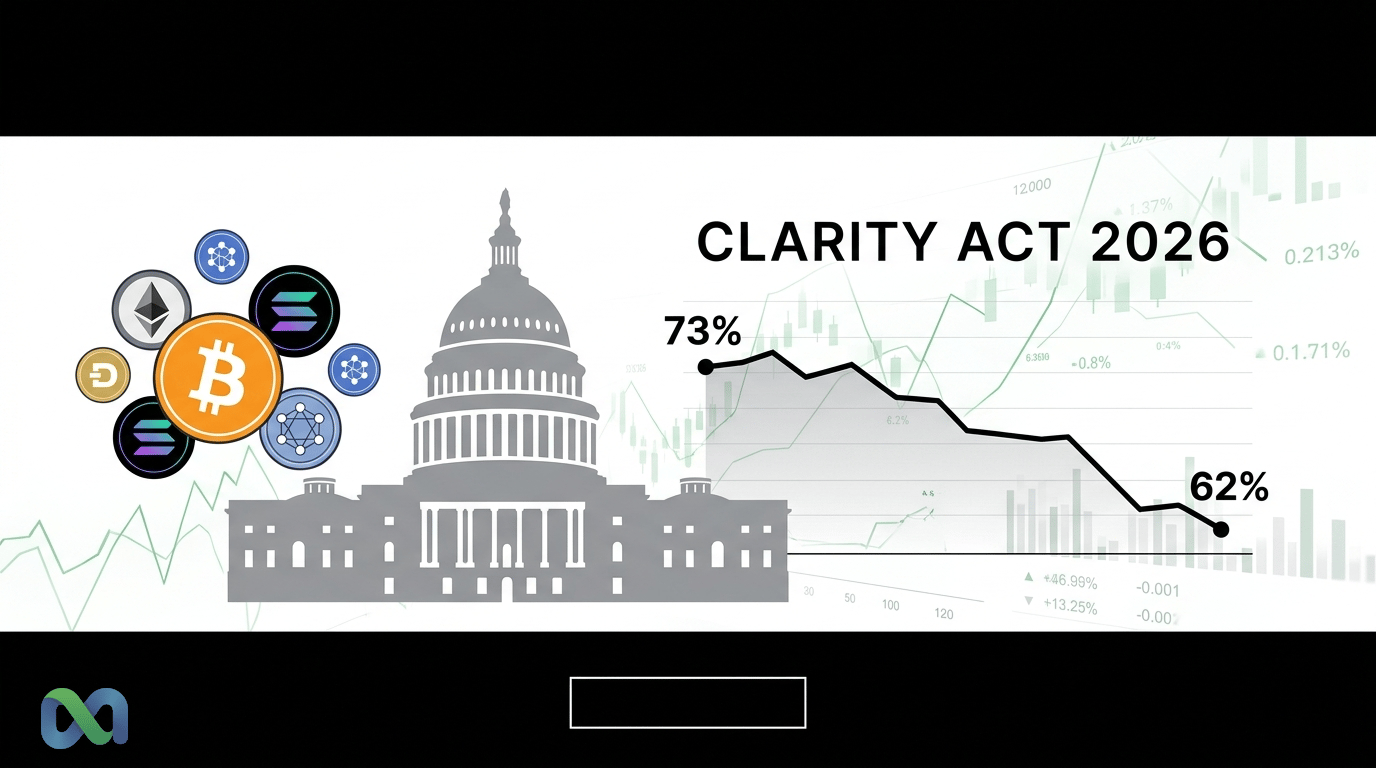
Clarity Act Polymarket is one of the cleaner ways to watch crypto regulation turn into a traded probability. As of May 22, 2026, the indexed Polymarket page showed the “Yes” side near 55%, with total volume around US$1 million since the market launched on January 11, 2026. That price is not a forecast from Congress. It is the market's live reading of whether the Digital Asset Market Clarity Act becomes law in 2026.
The bill itself has moved, but it is not law. The House passed its version in July 2025. Senate Agriculture advanced digital-asset market-structure legislation on January 29, 2026. Senate Banking then advanced substitute CLARITY Act text on May 14, 2026. The next step is reconciliation inside the Senate, then a full Senate vote, then a House-Senate reconciliation process if the final text differs.
This guide explains what the CLARITY Act is, why Polymarket traders care, how to read the 55% market price, and which signals matter next. It is written for analysts who want the market signal without confusing it with certainty.
Clarity Act Polymarket: Quick Read
The CLARITY Act is a U. S. crypto market-structure bill. Its main job is to define clearer lanes for digital assets, especially where the SEC and CFTC should sit. It also creates registration and disclosure paths for market participants.
Polymarket lists a market on whether the CLARITY Act will be signed into law in 2026. A “Yes” price near US$0.55 implies roughly a 55% market probability. If the price moves to US$0.70, the market is pricing a stronger path. If it falls below US$0.50, traders see the legislative route weakening.
That number needs context. The price can move on committee action, stablecoin disputes, Senate calendar risk, public comments from lawmakers, or changes in the market's resolution rule. It can also move because traders took profit after a fast rally.
The correct reading is simple: Clarity Act Polymarket is a live probability signal. It is not a legal status page, investment advice, or proof that the bill will pass.
What Is the CLARITY Act?
The CLARITY Act is short for the Digital Asset Market Clarity Act. The House Financial Services Committee introduced the House version in May 2025 as a framework for digital asset markets in the United States. The official House one-page summary says the bill is meant to set clear requirements for digital asset market firms, protect consumers, and define stronger registration paths.
The core problem is regulatory ambiguity. Crypto firms often face one question before they can plan: is a token, product, or platform under the SEC, the CFTC, or both? The CLARITY Act tries to reduce that gray area by drawing clearer lines.
The House committee summary describes three major themes. First, developers would get clearer pathways for disclosures and fundraising. Second, market participants could trade digital commodities through intermediaries and exchanges overseen by the CFTC. Third, customer-facing firms would face disclosure, customer-fund segregation, and conflict-of-interest requirements.
That matters because regulation by enforcement is hard to price. If the law is unclear, every new product carries legal risk. A statutory framework does not remove risk, but it can make the risk easier to model.
For traders watching Clarity Act Polymarket, that is the central issue. The market is not only pricing a bill. It is pricing the chance that U. S. crypto regulation moves from fragmented enforcement toward a more formal rulebook in 2026.
Where the Bill Stands in May 2026
The bill has made real progress, but it still has several steps left. On May 14, 2026, House Financial Services Chairman French Hill and House Agriculture Chairman G. T. Thompson said Senate Banking had advanced the CLARITY Act out of committee. Their statement also noted that the House had passed the bill the previous July with 78 Democrats and 216 Republicans supporting it.
That is important because bipartisan support reduces one risk. It does not remove the calendar risk. A bill can pass one chamber and still fail to become law if the Senate text changes, if negotiations stall, or if leadership does not give it floor time.
Legal analysis from Davis Wright Tremaine described the Senate Banking text as substitute text. It also said the bill now moves toward reconciliation with the Senate Agriculture Committee's digital commodity intermediaries bill before full Senate consideration. If the Senate passes a different version, the result must still be reconciled with the House CLARITY Act.
This is why the Polymarket price is not near 90%. The bill has momentum, but the path is not finished. The market must still price text risk, timing risk, stablecoin policy risk, and political bargaining.
For a clean status check, use official sources first. The House committee pages explain the House bill and committee statements. Congress. gov remains the official source for bill text and congressional actions. Polymarket then shows how traders price that information.
Why Polymarket Traders Care
Polymarket traders care because the CLARITY Act sits close to several high-value narratives. It affects crypto regulation, exchange compliance, stablecoin politics, DeFi oversight, and the future of U. S. digital-asset markets.
Polymarket itself uses crypto infrastructure. The CLARITY Act does not directly legalize or regulate every prediction market. However, clearer digital-asset rules can affect the operating environment for platforms that rely on tokenized settlement, wallets, and on-chain liquidity.
There is a second layer. Prediction markets in the United States also sit inside a CFTC debate over event contracts. That debate is separate from the CLARITY Act. Still, traders often connect the two because both involve market structure, consumer protection, and the boundary between financial markets and wagering.
Good analysis keeps those issues separate. The CLARITY Act is about digital assets. Event-contract policy is about what markets can list and how regulators treat them. Polymarket sits at the intersection because it is a prediction market built on crypto rails.
That intersection makes the Clarity Act Polymarket market useful. It shows how political progress can change pricing in a market that is itself exposed to regulatory uncertainty.
How to Read the 55% Polymarket Price
A 55% “Yes” price means traders see passage in 2026 as slightly more likely than not. It does not mean the bill has a 55% objective chance in a scientific sense. It means the marginal traded price implies that probability after fees, liquidity conditions, and trader positioning.
In a binary market, the math is direct. A “Yes” share near US$0.55 points to roughly 55%. If the market resolves Yes, that share pays US$1. If it resolves No, it pays US$0. That payoff structure forces traders to compare price against probability.
However, the price can be noisy. Political markets often move before formal events. Traders buy expected markup dates, public comments, or leaked text. Then they sell when the news becomes real or when the next step looks harder.
Liquidity matters too. The indexed Polymarket page showed about US$1 million in cumulative volume. That is meaningful activity for a legislative market. But cumulative volume does not guarantee a tight bid-ask spread at the moment you trade.
Resolution rules matter most. The Polymarket market asks whether the Digital Asset Market Clarity Act is passed by both chambers and signed into law in 2026. If a different bill passes, a renamed package emerges, or only part of the framework becomes law, the exact rule decides the outcome.
Therefore, the best way to read Clarity Act Polymarket is not “55% means it will happen.” The better reading is: “traders currently price a modest edge for 2026 enactment, while still assigning major odds to delay or failure.”
Why the Odds Moved So Much
The CLARITY Act market has moved because the legislative path has changed several times. Earlier optimism rose when traders expected committee action and a clearer Senate path. Then prices cooled as unresolved disputes and Senate timing risk returned.
A move from the mid-40s to above 60% can happen when a bill leaves the “stuck” category. Committee action changes the question. Traders stop asking whether the bill is alive and start asking whether leadership can finish the sequence.
A later drop toward 55% does not mean the bill is dead. It means the market has reintroduced risk. That risk can come from substitute text, reconciliation with Senate Agriculture, stablecoin provisions, ethics disputes, or simple uncertainty about when floor time appears.
This is normal for multi-step political markets. Each step removes one risk while exposing another. Committee passage removes committee risk. It does not remove floor risk. Senate passage would remove another risk. It would not remove reconciliation or signature risk.
That is why single-price commentary is weak. The useful question is what changed since the last price. If the price rises after a formal vote, that is stronger than a rise after a rumor. If it falls after substitute text creates new opposition, that is stronger than a random intraday move.
Plain English Reading for Traders
Here is the simple version. The bill is alive. It has support. It has also not cleared the hard part yet.
That is why the market sits near the middle. A price near 55% says Yes has an edge. It does not say Yes is safe.
Think of the market as a clock, not a verdict. Each vote moves the clock forward. Each delay moves it back. A new draft can help if it wins support. It can hurt if it opens a new fight.
The clean trade question is also simple. Do you think the true chance is above the market price? If yes, Yes may look cheap. If no, Yes may look rich. If you do not have a strong view, the market is still useful as a signal.
For readers who do not trade, the signal still helps. It shows when Washington news is real enough for traders to pay for it. It also shows when hype cools and risk comes back.
What the CLARITY Act Could Change for Crypto
If the CLARITY Act becomes law, the biggest change is legal mapping. Crypto firms would have a clearer view of when a digital asset is treated like a security, a commodity, or another category under the framework.
That could help exchanges, brokers, custodians, token issuers, and developers. Registration paths can make product planning less speculative. Disclosure rules can make customer-facing products more transparent. Customer-fund segregation can also address a core post-FTX concern.
The Senate Banking substitute adds further policy areas. Davis Wright Tremaine's analysis lists illicit finance, DeFi, limits on stablecoin yield, tokenization standards, developer protections, and customer-property protections. That wider scope shows why the bill can attract both support and resistance.
Clear rules are not automatically light rules. Some firms may benefit from certainty. Others may face higher compliance costs. Some DeFi models may need to change. Some stablecoin structures may lose flexibility.
For markets, the effect is still important. A clearer framework can support liquidity and institutional participation. It can also reduce the premium investors attach to legal uncertainty. That is why crypto traders watch the bill closely.
Does the CLARITY Act Regulate Polymarket Directly?
Not directly. The CLARITY Act is a digital-asset market-structure bill. It is not written as a complete prediction-market statute.
Even so, it can matter for Polymarket in three ways. First, it can affect the crypto rails that platforms use for settlement and custody. Second, it can shape how U. S. regulators divide authority over crypto-linked market infrastructure. Third, it can influence the broader policy mood around regulated event markets.
The CFTC issue remains separate. Event contracts are overseen under commodity-law rules, and U. S. regulators have debated what types of events are appropriate for listed markets. That debate does not disappear because Congress passes a crypto framework.
This distinction is useful for analysis. If the CLARITY Act passes, that may improve crypto regulatory clarity. It does not automatically answer every question about political prediction markets, sports event contracts, or offshore platforms.
For Clarity Act Polymarket traders, that means the bill is an indirect catalyst. It can change the environment around Polymarket, but it is not a one-line answer to Polymarket's U. S. regulatory position.
Signals to Watch Next
The first signal is Senate reconciliation. Senate Banking and Senate Agriculture need a coherent path before the full Senate can act. If both sides align quickly, the market should treat that as real progress.
The second signal is floor timing. A bill that lacks floor time can lose momentum even if committee support exists. Watch Senate leadership, calendar windows, and public comments from committee chairs.
The third signal is stablecoin policy. Yield, rewards, issuer permissions, and bank competition have become pressure points. If those disputes harden, the path gets harder.
The fourth signal is House-Senate compatibility. If the Senate version differs from the House bill, reconciliation can become the next bottleneck. The closer the texts are, the easier the path.
The fifth signal is the Polymarket market itself. Watch price, spread, volume, and order-book depth. A clean move with rising volume means something different from a thin move with a wide spread.
Finally, watch the resolution rule. A bill can pass under a broader package or with amended naming. The market will resolve based on the rule, not based on a loose media summary.
Practical Checklist for Analysts
Use this checklist before citing Clarity Act Polymarket as evidence.
- Record the market price and timestamp.
- Check the latest official congressional action.
- Read whether new text changed the bill.
- Compare price movement with volume and spread.
- Identify the next procedural step.
- Read the Polymarket resolution rule.
- Separate crypto-market effects from prediction-market regulation.
This process keeps the signal useful. It also prevents a common mistake: treating a market price as a headline without understanding the rule behind it.
Frequently Asked Questions
Has the CLARITY Act become law?
No. As of May 22, 2026, it has not become law. The House passed its version in 2025, and Senate committees have advanced related market-structure legislation. The bill still needs further Senate action, reconciliation if texts differ, and a presidential signature.
When will the CLARITY Act be voted on?
There is no guaranteed final vote date. The next useful signals are Senate reconciliation between committee approaches, Senate floor scheduling, and any official leadership statements.
When will the CLARITY Act be signed?
It can only be signed after both chambers pass final legislation. Polymarket traders are pricing whether that happens before the end of 2026, not whether the bill is already ready for signature.
Why is Clarity Act Polymarket near 55%?
The market sees real momentum, but it still prices major risk. Committee progress supports the Yes side. Senate text risk, stablecoin disputes, reconciliation, and calendar constraints support the No side.
Does a 55% price mean traders should buy Yes?
No. Price is not advice. A trade only makes sense if your assessed probability is higher than the market price after accounting for liquidity, fees, timing, and resolution risk.
Does the CLARITY Act directly legalize Polymarket in the United States?
No. The bill focuses on digital assets. It can affect crypto infrastructure and market structure, but prediction-market legality involves separate CFTC and event-contract questions.
Bottom Line
Clarity Act Polymarket is useful because it turns a complicated Washington process into a live probability. The current signal is balanced: the bill has momentum, but the remaining path is still hard enough for traders to keep the price near the middle.
For analysts, the market is best used as a dashboard. Watch the price, then check the official action behind it. If the market moves without procedural progress, be careful. If the market moves after formal Senate or House action, the signal is stronger.
The CLARITY Act could matter for crypto because it may define clearer lanes between the SEC and CFTC. It could also improve compliance planning for firms that need a digital-asset rulebook. But it does not settle every prediction-market question by itself.
That is the clean reading: Clarity Act Polymarket shows a live, tradable view of 2026 enactment. It should be read with the bill text, official congressional actions, volume, and the resolution rule. Educational content only. This is not investment, legal, or trading advice.
Sources used for factual status include the House Financial Services Committee statement from May 14, 2026, the House CLARITY Act one-page summary, Davis Wright Tremaine's May 21, 2026 legal analysis, Congress. gov bill tracking, and the indexed Polymarket market page.
