


England World Cup 2026: Group, Fixtures, Squad and Odds
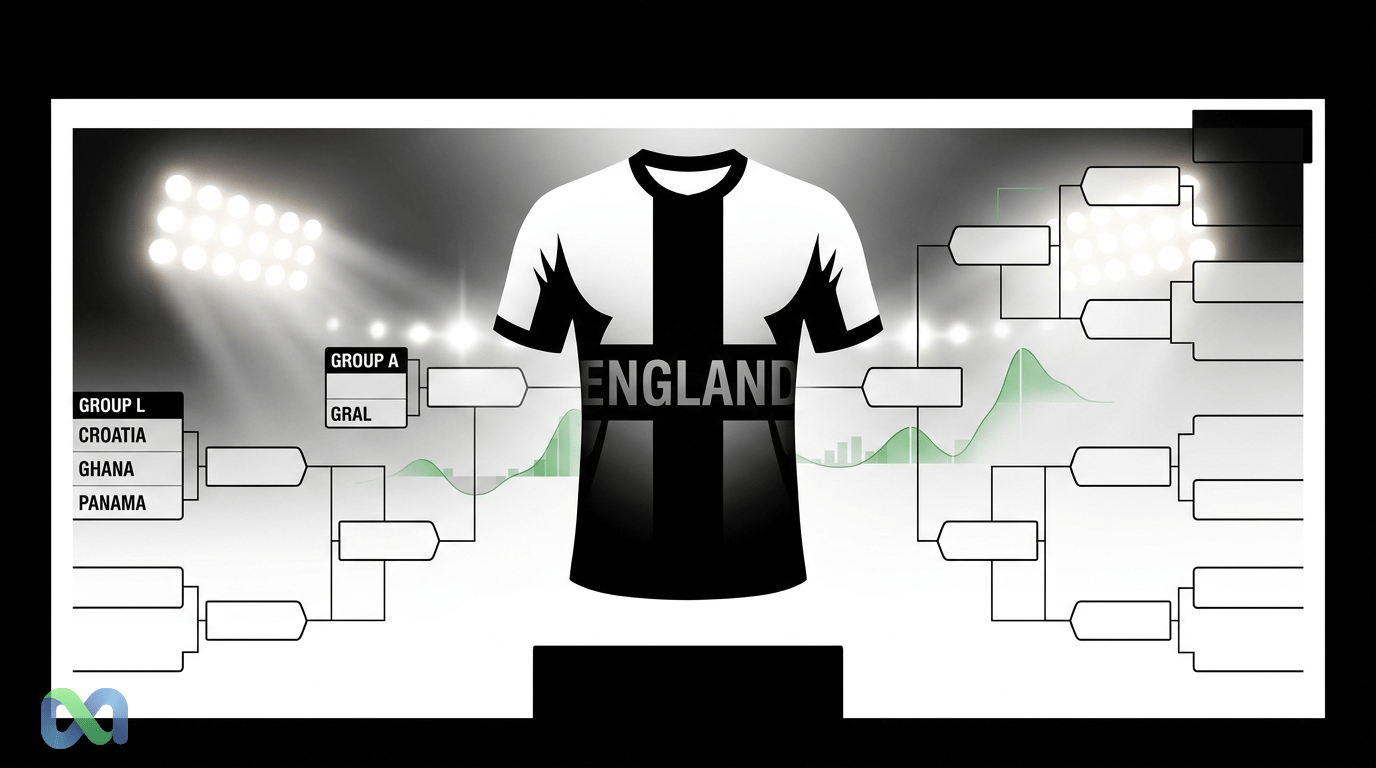
The England World Cup 2026 campaign starts with real title expectations and a market that will move quickly once team news, injuries, and match data arrive. Thomas Tuchel is in charge, Harry Kane remains the reference point, Jude Bellingham gives the side a powerful engine, and Group L already gives us a path to analyze.
This guide brings together what is confirmed, what still depends on the official squad, and how to read England's probabilities before the tournament starts. The goal is simple: separate facts, projections, and market price so readers can avoid confusing squad reputation with usable probability.
England also deserves special treatment. The squad has elite talent, but it carries a heavy World Cup history. Therefore, the better question is not just whether England has enough quality. The better question is whether the current price compensates for the risk of the path.
England at the 2026 World Cup: Quick Summary
England is in Group L at the 2026 World Cup with Croatia, Ghana, and Panama. Thomas Tuchel is the manager after the Gareth Southgate era. The final squad has not been announced, but the core should include Kane, Bellingham, Saka, Rice, Foden, and Palmer.
Team Profile
- Team: England.
- Group: Group L.
- Opponents: Croatia, Ghana, and Panama.
- Manager: Thomas Tuchel.
- Likely captain: Harry Kane.
- Key names: Kane, Bellingham, Saka, Rice, Foden, and Palmer.
- Best World Cup finish: champions in 1966.
- Market status: a strong favorite, but not risk-free.
The central issue is the balance between ceiling and price. England has rare depth in almost every position. However, the World Cup does not reward squad depth alone. It punishes bad matchups, injuries, cards, and difficult knockout draws.
What Is Confirmed and What Can Still Change
The group, opponents, and manager already shape the analysis. The final squad still depends on the Football Association. For that reason, any 2026 squad list should be treated as a projection until the official announcement.
Recent form, attacking hierarchy, and physical condition can also change. Kane, Bellingham, Saka, Rice, Foden, and Palmer look central. Even so, an injury or a drop in club minutes can change the read.
England World Cup 2026 Group
The England World Cup 2026 draw placed England in Group L. The group has a strong European rival, a physical African team, and a Concacaf side that can play with little pressure.
Group L: England, Croatia, Ghana and Panama
- England: group favorite with the deepest squad.
- Croatia: experience, technical midfield play, and recent tournament tradition.
- Ghana: physical intensity and fast transitions.
- Panama: lower pressure and a likely low block.
Croatia is the clearest test. Even during a transition, Croatia knows how to compete in tournaments. Ghana can create problems if the match becomes open and vertical. Panama should demand patience against a deep defensive line.
For England, the goal is not only to advance. Finishing first can change the side of the bracket. In the new format, some third-place teams can also stay alive. Therefore, goal difference, minutes management, and emotional control matter more than usual.
How the 48-Team Format Changes Group Risk
The 2026 World Cup will have 48 teams. That lowers the risk of an early exit for favorites, but it creates another problem. The path can become less predictable after the group stage.
With more third-place teams qualifying, England could face an unexpected opponent in the first knockout round. So winning the group still matters. It is not just pride. It is a way to reduce variance.
England World Cup 2026 Fixtures: Dates and Stadiums
The England World Cup fixtures already set the tone for preparation. The opener against Croatia should be the most important match in the group. It can define rhythm, confidence, and market price.
- June 17: England vs Croatia at AT&T Stadium. This is the biggest technical test.
- June 23: England vs Ghana at Gillette Stadium. The risk is Ghana's transition game.
- June 27: Panama vs England at MetLife Stadium. Control and goal difference may matter.
Dates and venues should be checked on official FIFA and England Football pages before any final editorial decision. World Cup calendars can face operational changes.
June 17: England vs Croatia, AT&T Stadium
The opener against Croatia is the match that best measures England's level. Croatia usually controls tempo and reduces space. That tests Tuchel's patience and Bellingham's ability to receive between the lines.
If England wins well, the market will likely cut the risk premium. If England draws or suffers, the read changes quickly. In World Cups, the first match often reprices favorites.
June 23: England vs Ghana, Gillette Stadium
Ghana should offer a different problem. England should have more of the ball, but it must protect turnovers. Rice will be crucial for stopping transitions and keeping England in the opposition half.
This match can favor wingers and full-backs. Saka, Foden, and Palmer can attack tight spaces. However, England cannot turn territorial dominance into anxiety.
June 27: Panama vs England, MetLife Stadium
England should be a heavy favorite against Panama. The risk is the classic trap: high possession, a low block, and few clear chances. In that scenario, set pieces and patience matter.
If qualification is already under control, Tuchel may also rotate the squad. That affects goal markets, Golden Boot markets, and starting-lineup markets. Traders should watch official teamsheets, not only likely names.
How England Qualified for the 2026 World Cup
England's qualifying campaign raises the team's floor. According to the brief, England won all eight matches in UEFA qualifying Group K, scored 22 goals, and conceded none.
That is a strong data point, but it needs context. Qualifiers do not simulate knockout pressure. Still, a defense with zero goals conceded shows organization, concentration, and box control.
Perfect Campaign in UEFA Qualifying Group K
Eight wins from eight matches signal clear superiority. They also show England did not rely only on individual talent. The team turned its technical edge into results.
Official result checks should go through UEFA and the FA. For market analysis, the most relevant number is the combination of attacking volume and defensive stability.
Numbers: 8 Wins, 22 Goals Scored and None Conceded
An average of 2.75 goals per match stands out. Yet the defensive zero may say more. World Cup favorites rarely fall because they lack talent. They fall when games become chaotic.
That is why England must keep control. Tuchel should try to reduce exposure for his center-backs while freeing the attacking talent without breaking the midfield.
England's World Cup History
England has won the World Cup once, in 1966. Since then, it has lived with a large gap between public expectation and final result. That tension influences narrative, pressure, and price.
The 1966 Title and the Search for a Second World Cup
The 1966 title remains the emotional reference. For 2026 analysis, though, it matters less as a forecast and more as pressure. Every England generation is compared with the only champion team.
That pressure can weigh in tight matches. It can also create excess optimism in strong squad cycles. The market needs to separate real quality from national narrative.
2018 Semi-Final, 2022 Quarter-Final and Recent Euro Finals
Recent England teams have been competitive. England reached the 2018 semi-finals, exited in the 2022 quarter-finals, and reached European Championship finals. That record shows consistency, but it also shows a ceiling in major matches.
The move from Southgate to Tuchel is meant to solve that ceiling. Southgate gave England stability. Tuchel arrives to add tactical aggression and knockout-game range.
Manager and Playing Style: What to Expect from Thomas Tuchel
Thomas Tuchel changes the read on England World Cup 2026. He tends to be more flexible than Southgate. He also often prepares big games with specific adjustments.
Pressing, Control and Tactical Flexibility
Tuchel can alternate between a back four and a back three. He can use inverted full-backs, wide wingers, or Bellingham closer to Kane. That flexibility raises England's ceiling.
However, flexibility also requires clarity. England cannot arrive at the tournament with too many doubts. The base XI must be mature before the opener.
Dilemmas: Full-Backs, Number 10 and Kane-Bellingham Fit
The biggest dilemma is fitting all the talent without losing balance. Kane drops to build play. Bellingham attacks the box. Foden and Palmer need freedom. Saka gives width on the right.
If Tuchel releases everyone at once, Rice can become exposed. If he protects too much, the attack loses flow. England's price depends on this point.
England World Cup Squad 2026: Likely Names
The England World Cup squad 2026 is not official yet. The list below is an editorial projection based on the expected core and tactical needs.
Goalkeepers
Jordan Pickford remains the natural favorite because of his England experience. Aaron Ramsdale, Dean Henderson, and other names can compete for places. In a World Cup, security matters more than short-term form.
Pickford also brings leadership. He is not only a shot-stopper. He organizes the line, communicates, and has already lived major tournaments.
Defenders
John Stones, Marc Guehi, Kyle Walker, Reece James, Ben Chilwell, Levi Colwill, and Trent Alexander-Arnold could all enter the debate. The battle at full-back is one of the squad's strongest areas.
Tuchel must decide whether he wants width, inside build-up, or protection from his full-backs. That choice changes the wingers' roles and Rice's positioning.
Midfielders
Declan Rice should start. Jude Bellingham should start too. The third place may depend on the opponent. Kobbie Mainoo, Conor Gallagher, Curtis Jones, and others offer different profiles.
Against strong teams, Tuchel may prioritize control. Against low blocks, he may pick more creation. The midfield will be England's thermometer.
Forwards
Harry Kane is the center of the attack. Saka should hold the right side. Foden, Palmer, Rashford, Grealish, Watkins, and other names will fight for minutes. The depth is huge.
The challenge is turning talent into function. A strong bench helps, but only if substitutions solve clear problems.
Likely Starting XI
A plausible base would be Pickford; Walker, Stones, Guehi, and Chilwell; Rice, Bellingham, and Foden; Saka, Kane, and Palmer. Still, this is only a projection. Tuchel may prefer more protection or a different shape.
England's Key Players
England has many elite names, but some players change the team's probability more directly.
Harry Kane
Kane is captain, scorer, and decision-point reference. He improves build-up when he drops and improves finishing when he attacks the box. Still, England cannot depend only on him.
If Kane is in good form, Golden Boot markets become stronger. If he is limited, England loses presence in the box.
Jude Bellingham
Bellingham is the player who can change England's ceiling. He combines box arrivals, physical duels, and spatial reading. He also connects midfield and attack.
The satellite page on Bellingham should be a priority in the cluster. He concentrates search demand, narrative, and real impact on England's price.
Bukayo Saka
Saka gives England stability on the right. He pins the full-back, creates crosses, and decides with short carries. In tournaments, reliable players are valuable.
His presence also helps Kane. When Saka attracts a double team, Kane gets more room to receive or finish.
Declan Rice
Rice is the system's insurance policy. He protects center-backs, covers full-backs, and allows Bellingham to go forward. Without Rice at a high level, England becomes more open.
Phil Foden and Cole Palmer
Foden and Palmer represent the good problem. Both have starter-level talent. The question is role. Foden can play inside or from the left. Palmer can create, finish, and take set pieces.
Tuchel must avoid a team of loose names. The attack needs hierarchy, clear movements, and complementary roles.
England World Cup 2026 Odds
England World Cup odds should be read as implied probability, not certainty. The brief cites an American odds reference of +650 to win the title. In decimal odds, that equals 7.50.
The simple calculation is implied probability = 1 / decimal odds. In this case, 1 / 7.50 = 13.3%. That percentage changes with margin, liquidity, and market updates.
Implied Probability to Win the Title
A probability near 13% places England among the favorites, but not as a dominant team. That makes sense. The squad is elite, but the World Cup requires seven matches, physical management, and draw luck.
In prediction markets, the best use of price is to compare scenario with narrative. If everyone treats England as almost inevitable, 13% may look low. If you value knockout risk, it may look fair.
Relevant Markets
The most useful markets include outright winner, group winner, qualification for the knockout rounds, Golden Boot, Kane goals, Bellingham impact, and match-by-match prices. Each market measures a different question.
Outright winner measures ceiling. Group winner measures early consistency. Golden Boot measures attacking volume. Match markets measure form, injuries, and lineups.
Where the Market Can Overreact or Underprice England
The market can overstate the value of the England shirt when news coverage is optimistic. It can also underprice England after a flat draw, even when the underlying control was good.
The best read combines three signals: lineup, expected performance, and bracket path. Price without context becomes noise.
England's Possible Knockout Path
England's path depends on its position in Group L. Finishing first tends to help projections, but the new format reduces predictability.
What Changes if England Finishes 1st, 2nd or 3rd in Group L
If England finishes first, it probably avoids some chaos. If it finishes second, the draw may become harder. If it advances in third, the path can become much more unstable.
That is why the Croatia match is worth more than three points. It can define England's price for the whole tournament.
How to Simulate England's Bracket
A simulation should consider three layers. First, the probability of winning Group L. Then, possible opponents in the first knockout round. Finally, the sequence toward the semi-final and final.
This method avoids shallow analysis. It is not enough to say England is strong, because the bracket can turn a favorite into a fragile trade very quickly. You need to estimate who England plays, when it plays them, and how much wear the team carries.
Recommended Satellite Pages for England Players
This article should work as a hub. Satellite pages deepen specific searches and help the reader navigate the 2026 World Cup cluster.
- Jude Bellingham at the 2026 World Cup: role between midfield and attack, goals, and creation.
- Harry Kane at the 2026 World Cup: scoring race, leadership, and attacking dependence.
- Bukayo Saka at the 2026 World Cup: right side, assists, and stability.
- Phil Foden at the 2026 World Cup: tactical role and minutes battle.
- Cole Palmer at the 2026 World Cup: set pieces, creation, and cut risk.
- Declan Rice at the 2026 World Cup: defensive balance and freedom for Bellingham.
These satellites also reduce excess information in the hub. The reader searching for the general squad stays here. The reader searching for a specific player moves to the right page.
FAQ: Common Questions About England at the 2026 World Cup
What group is England in at the 2026 World Cup?
England is in Group L at the 2026 World Cup with Croatia, Ghana, and Panama. England is favorite to advance, but Croatia makes the opener especially important.
When does England play at the 2026 World Cup?
England opens against Croatia on June 17. It then plays Ghana on June 23 and Panama on June 27, according to the schedule used in this brief.
Who is England manager for the 2026 World Cup?
England's manager is Thomas Tuchel. He took over after the Gareth Southgate cycle and should bring more tactical flexibility to the team.
What should England's squad look like?
The official squad has not been released. The projection includes names such as Pickford, Stones, Rice, Bellingham, Saka, Foden, Palmer, and Kane.
Why does the United Kingdom not play in the World Cup?
The United Kingdom does not play as one national team because England, Scotland, Wales, and Northern Ireland have their own football associations, historically recognized by FIFA.
How many World Cups has England won?
England has won one World Cup. The title came in 1966 at home, with a win over West Germany in the final.
How to Read England Without Falling for Hype
England is strong. That is a fact. Still, the World Cup is short. One bad match changes everything.
So look at simple signals. See who starts. See how the team creates chances. See whether Kane receives clean balls. See whether Bellingham enters the box. See whether Rice protects the defense.
Also compare the price before and after each match. If England wins without playing well, the price may rise too much. If England draws while creating a lot, the price may fall too much. That is where market reading matters.
The group also helps measure risk. Croatia tests the plan. Ghana tests the defense in open field. Panama tests patience. Each match shows one part of the team.
Therefore, do not read England only by player names. Read rhythm, health, lineup, and path. That view is more useful for anyone following prediction markets.
A good routine is direct. Before the match, check the lineup. During the match, check whether England enters the box. After the match, check whether the price moved more than the performance itself.
If Kane scores, the team grows. If Saka wins his side, the attack opens. If Rice loses duels, the defense suffers. If Bellingham disappears, England loses central force.
None of this requires blind prediction. It requires calm. The market moves with news, goals, injuries, and form. Anyone who reads those signals avoids entering only on euphoria.
The bench also matters. In a World Cup, the bench decides matches. Palmer can change a locked game. Foden can create inside. Watkins can add running and box presence. Those pieces reduce risk.
Even so, no squad is immune. An early card changes the plan. A heavy pitch changes rhythm. A long trip weighs on the body. England must win those details.
Think match by match. First comes Croatia. It is a hard test. It deserves a high grade. Then comes Ghana. The risk is the long ball. Finally comes Panama. The risk is rushing against a block.
If England takes seven or nine points, the signal is good. If it takes five, it can still be alive. If it takes four, the price should fall. The point is to measure cause, not only the table.
A controlled 1-0 can be good. A chaotic 3-2 can be bad. A draw with many chances can have more value than it seems. The match shows data the table hides.
Use the same logic in the knockouts. Who marks Kane? Who closes Saka? Who removes space from Bellingham? Who forces Rice to run backward? These questions matter more than fame.
Conclusion
The England World Cup 2026 setup combines a deep squad, a strong qualifying campaign, and a manageable group. That justifies favorite status. However, the market price must reflect more than names.
The key point is Tuchel's structure. If Kane, Bellingham, Saka, Rice, Foden, and Palmer have clear roles, England can fight for the title. If the team becomes a collection of talented players without structure, the risk rises.
To follow England, compare group position, lineup, path, and implied probability. That read is more useful than following only the favorite narrative.
