


Former Governors of São Paulo: Updated List and Complete Guide
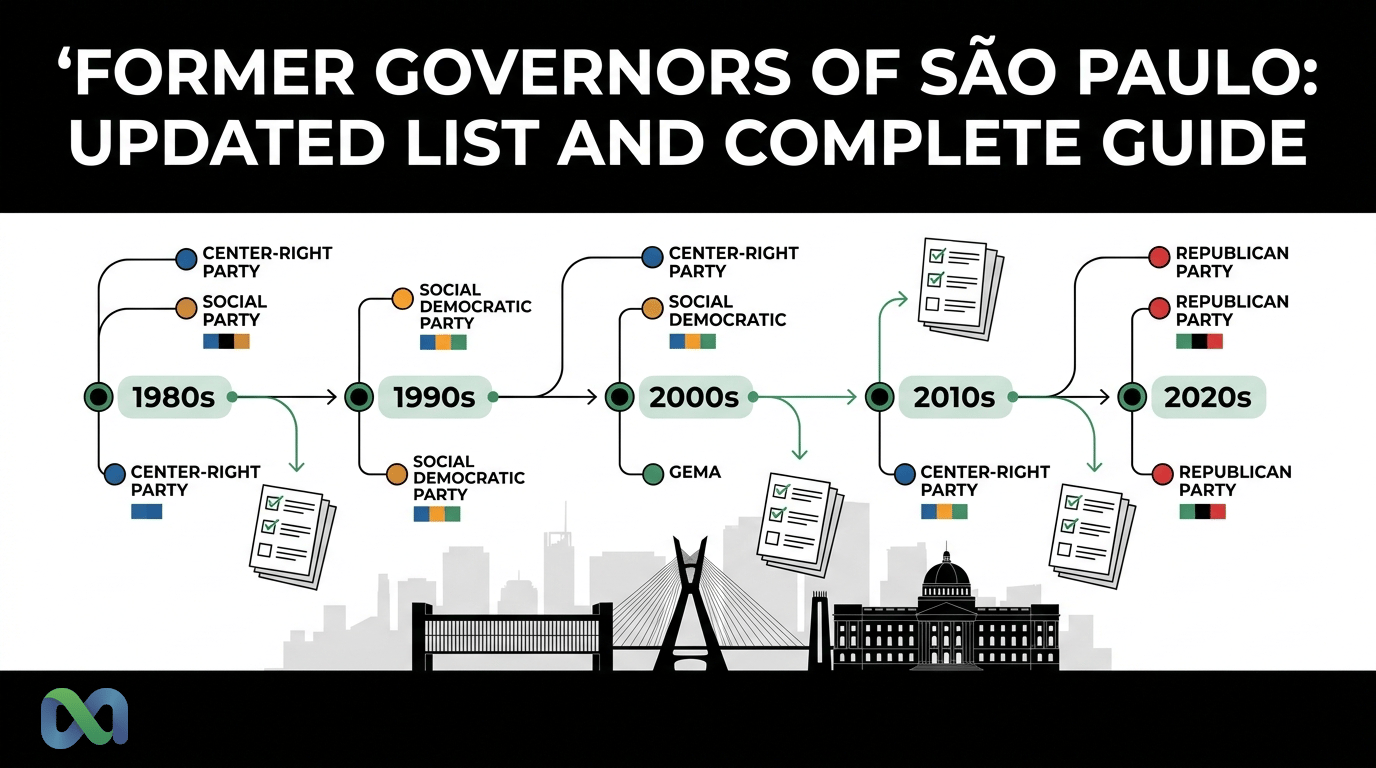
The former governors of São Paulo help explain politics in Brazil’s largest state. This list shows who controlled the state machine, which parties dominated each cycle, and which names still matter in national disputes.
This guide brings together the most relevant names for quick reference. It explains the main historical periods and answers common questions about recent terms. It also shows why São Paulo’s political history matters for elections, coalitions, and prediction markets focused on Brazilian politics.
Editorial update: May 2026. Terms, offices, and public records should be checked periodically against official sources, such as the São Paulo state government, the Legislative Assembly of São Paulo, the state Legal Library, and electoral records.
Quick Answer: Who Are the Former Governors of São Paulo?
Practical Summary for Fast Reference
If you only need the short answer, start here. This block helps readers coming from Google who need names, years, and context.
Rodrigo Garcia came before Tarcísio de Freitas. João Doria won the 2018 election. Garcia was his deputy governor. He took office when Doria stepped down.
Geraldo Alckmin was governor in 2016. He stayed in office until 2018. Then he left to run in the national election.
The PSDB governed São Paulo for a long time. That cycle started with Mário Covas. Then came Alckmin, José Serra, Alberto Goldman, Doria, and Garcia.
The PMDB was strong before that. Franco Montoro, Orestes Quércia, and Luiz Antônio Fleury Filho defined that phase. It came right after the return of direct elections.
Not every name on the list won an election for the office. Some were deputy governors. Even so, they governed the state. That is why they belong on the list.
The order helps avoid mistakes. First, check the term. Then check whether there was a resignation, death, or departure for another race. Finally, check who took over.
This method is simple. It separates fact from analysis. It also avoids confusing the current government with former governments.
These former governors are the politicians who headed São Paulo’s executive branch before the current governor. In common search intent, readers usually want the recent names, especially the state leaders in the democratic period that began in 1983.
Before Tarcísio de Freitas, the governor of São Paulo was Rodrigo Garcia. He took office in April 2022 after João Doria resigned. Garcia served until January 2023.
Recent Former Governors in Chronological Order
- Franco Montoro governed from 1983 to 1987 for the PMDB. He was the first governor elected after the political opening.
- Orestes Quércia governed from 1987 to 1991 for the PMDB. He consolidated the party’s strength in the state.
- Luiz Antônio Fleury Filho governed from 1991 to 1995 for the PMDB. His term closed the PMDB cycle.
- Mário Covas governed from 1995 to 2001 for the PSDB. He began the long PSDB cycle in São Paulo.
- Geraldo Alckmin governed from 2001 to 2006 for the PSDB. He took office after Covas died and later won his own election.
- Cláudio Lembo governed from 2006 to 2007 for the PFL. He was deputy governor and completed Alckmin’s term.
- José Serra governed from 2007 to 2010 for the PSDB. He left to run for president.
- Alberto Goldman governed from 2010 to 2011 for the PSDB. He was deputy governor and completed Serra’s term.
- Geraldo Alckmin returned as governor from 2011 to 2018 for the PSDB. This was his second long period in office.
- Márcio França governed from 2018 to 2019 for the PSB. He was deputy governor and completed Alckmin’s term.
- João Doria governed from 2019 to 2022 for the PSDB. He resigned to seek a presidential candidacy.
- Rodrigo Garcia governed from 2022 to 2023 for the PSDB. He was deputy governor and closed the cycle started by Doria.
This quick list answers the main search intent. However, the history of São Paulo governors is much longer. It includes provincial presidents, federal interventors, appointed governors, deputy governors who took over, and directly elected governors.
List of São Paulo Governors by Period
The list of São Paulo governors becomes clearer when it is divided by political period. Each phase had different rules for reaching power. For that reason, comparing a provincial president from the Empire with a governor elected by direct vote can create confusion.
The following breakdown is the most useful for reference and analysis.
Post-Redemocratization Period
The post-redemocratization period begins in 1983, with Franco Montoro. This is the most important time frame for readers who want to understand current elections, parties, and recent succession.
The recent sequence starts with Montoro, moves through the Quércia and Fleury cycle, and reaches the long PSDB dominance. Later come Doria and Rodrigo Garcia, who closed the PSDB phase before Tarcísio’s victory.
The key point is simple: since 1983, São Paulo has had elected governors and deputy governors who took office. These deputies also count as former governors because they exercised the office.
This time frame also explains several long-tail searches. The governor of São Paulo in 2016 was Geraldo Alckmin. The governor before Tarcísio was Rodrigo Garcia. The last elected governor before Tarcísio was João Doria.
Military Dictatorship and Transition
Between 1964 and 1982, São Paulo had governors chosen in a political environment limited by the military dictatorship. Some were elected indirectly. Others reached the office through institutional rules that were not equivalent to today’s direct vote.
This period includes names such as Adhemar de Barros, Laudo Natel, Roberto Costa de Abreu Sodré, Paulo Egydio Martins, Paulo Maluf, and José Maria Marin. They are central to understanding São Paulo politics before the democratic opening.
The transition to democracy changes the meaning of the list. From 1983 onward, the governor again came from direct election. That is why Franco Montoro appears as a political milestone, not just as one more name in the chronology.
Republic Before 1964
Before the military regime, São Paulo alternated among different regional forces. The state had major economic and political weight during the Old Republic, the Vargas Era, and the redemocratization period after 1945.
This section includes governors, interventors, and heads of the state executive branch during moments of institutional instability. The distinction matters. An interventor did not have the same political origin as an elected governor.
For a complete historical list, institutional sources are better than political memory. The Legislative Assembly keeps material on former governors, and the state Legal Library gathers inauguration speeches and official documents. These archives help verify dates and names without relying only on short encyclopedia entries.
Empire and Colonial Period: Historical Context
The history before the Republic uses a different vocabulary. During the Empire, São Paulo had provincial presidents. During the colonial period, it had administrators connected to Portuguese rule.
These names matter to historians. However, they are less useful for most current searches on this topic. Readers today usually want recent terms, parties, succession, and electoral impact.
That is why the best editorial approach is to separate the periods. The contemporary list supports political analysis. The colonial and imperial list serves historical context.
How to Use This List Without Getting Lost
Use the list in three simple steps. First, look at the year. Then check whether the person was elected or was a deputy governor. Finally, see which political group came out stronger.
This avoids a common mistake. Not every governor reached office in the same way. Some won at the ballot box. Others took over after the officeholder left.
Also look at the party at the time. Party labels change. Groups merge. Allies become rivals. The party name helps, but it does not explain everything.
For a fast reading, focus on the period from 1983 onward. This time frame speaks more directly to today’s politics. It shows the PMDB, the PSDB, the PSB, and the new São Paulo right.
Recent Former Governors and Their Weight in São Paulo Politics
The list is not just a sequence of names. It shows how parties build machines, how deputy governors become governors, and how state politics influences national disputes.
São Paulo concentrates population, tax revenue, media, strong parties, and municipal networks. Therefore, the Palácio dos Bandeirantes often works as a platform for presidential ambitions.
Franco Montoro and Redemocratization
Franco Montoro took office in 1983 after the first direct election for governor in the state since the authoritarian period. His government symbolized the democratic opening in São Paulo.
Montoro also helped form a political generation that would dominate the state in later decades. That period created bases for parties, mayors, legislators, and technical staff who remained influential.
For electoral analysis, Montoro matters for another reason. He shows how the political opening reorganized regional alliances. That rearrangement still appears in municipal and state disputes.
The Covas-Alckmin-Serra PSDB Cycle
The PSDB cycle begins with Mário Covas in 1995. He won after the São Paulo PMDB suffered political wear. His administration built a management brand associated with fiscal adjustment, privatizations, and technical administration.
Geraldo Alckmin took office after Covas died in 2001. Later, he won his own elections and became the most durable face of the São Paulo PSDB. In 2016, for example, Alckmin was the governor of the state.
José Serra entered this cycle as a national name. He governed São Paulo between 2007 and 2010, but left office to run for president. Alberto Goldman, his deputy, completed the term.
This group explains PSDB hegemony. For more than two decades, São Paulo was the party’s main electoral asset. Any serious analysis of the former governors of São Paulo needs to treat this period as the central axis.
Doria, Rodrigo Garcia, and the Post-PSDB Reorganization
João Doria won the 2018 election for the PSDB, but he did so inside a party that was already changing. His trajectory was more business-oriented, more media-driven, and less tied to the traditional PSDB machine.
In 2022, Doria resigned as governor. Rodrigo Garcia took over as deputy governor and tried to maintain control of the state. However, the 2022 election marked a rupture. Tarcísio de Freitas won and moved São Paulo’s government toward a new right-wing coalition.
As a result, Doria and Rodrigo Garcia became transition figures. They ended the direct PSDB dominance at the Palácio dos Bandeirantes and opened space for another political axis.
Tarcísio de Freitas and the New São Paulo Right
Tarcísio de Freitas is not a former governor. He is the current governor within this guide’s time frame. Still, his government reorganizes how readers interpret recent former governors.
Before Tarcísio, São Paulo had a long PSDB continuity. After his victory, the right associated with Bolsonarism and allied parties began controlling the state. That changed municipal alliances, expectations for 2026, and national strategies.
For readers, the practical question is simple. The list helps show which networks still have strength and which ones lost power in the state vote.
Which Former Governors of São Paulo Are Still Alive?
Among the recent names, several are still alive and may retain political weight. Others have died. Because this information changes over time, the list should be treated as a reference point, not as a permanent record.
Living and Deceased Names: How to Check Accurately
In the post-1983 period, the general picture is this, based on public information available through May 2026.
Franco Montoro, Orestes Quércia, Mário Covas, and Alberto Goldman have died. Luiz Antônio Fleury Filho, Geraldo Alckmin, Cláudio Lembo, José Serra, Márcio França, João Doria, and Rodrigo Garcia remain alive according to available public records.
The best verification method combines official sources, electoral biographies, party records, and reliable news coverage. For older historical figures, public archives are essential.
Who Remains Active in Offices, Parties, or Negotiations
Geraldo Alckmin is the clearest case of a former governor who remains active. After leading São Paulo for long periods, he returned to the center of national politics as Brazil’s vice president.
Márcio França also remains relevant. His base runs through the PSB, São Paulo disputes, and federal government offices. Even though he did not serve a full elected term as governor, his time at the Palácio dos Bandeirantes still matters for reading alliances.
João Doria and Rodrigo Garcia have different profiles. Doria maintained a business and public presence, while Garcia left government after the 2022 defeat. Even so, both matter for understanding the recomposition of the center and the São Paulo right.
How the History of Governors Affects Elections and Prediction Markets
The history of São Paulo governments affects elections because it reveals networks of power. It shows which parties controlled the administration, which groups lost space, and which leaders can still transfer support.
In prediction markets, this history becomes context data. It does not guarantee an outcome. However, it helps traders and analysts interpret coalitions, polls, candidacies, and changes in probability.
Why São Paulo Matters in National Politics
São Paulo is Brazil’s largest electoral college. The state also concentrates a decisive share of the Brazilian economy. For that reason, the governor of São Paulo often has national projection.
Mário Covas, Geraldo Alckmin, José Serra, João Doria, and Tarcísio de Freitas show that connection. All were or are names with impact beyond the state. Some ran for president. Others influenced tickets, parties, and alliances.
This weight makes the list useful for anyone following presidential elections, state elections, and the party composition of Congress.
What Traders Watch in State Successions
Traders watch three main signals. The first is the strength of the state machine. A governor with strong approval can help allies in future disputes.
The second signal is the coalition. Parties that control departments, city halls, and regional bases can sustain a candidacy. However, coalitions can also split when there is internal competition.
The third signal is transfer capacity. Not every former governor transfers votes. Some keep political capital. Others keep public memory but lose real coordination power.
How to Interpret Political Probabilities Without Treating Polls as Certainty
Election polls measure voting intention at a moment in time. Prediction markets aggregate expectations from participants who trade contracts on future outcomes. They are different tools.
Therefore, analysis should avoid certainty. A market probability is not a promise. It indicates how the market prices an event at that moment, given the available information.
On Macro Markets, the correct reading is to treat probability as a thermometer. If an alliance changes, if a former governor declares support, or if a poll shifts the scenario, the price can move. The value is in following the movement, not in looking for absolute certainty.
Editorial Criteria for This Guide
Our reading uses three checks. First, we separate elected governors from deputy governors who took office. Then, we cross-check term, year, and party context. Finally, we mark when a data point requires future review, such as life status or current office.
This method reduces errors in a long list. It also avoids mixing historical fact with electoral interpretation. When analysis appears, it is labeled as analysis, not as a certain fact.
Frequently Asked Questions About Former Governors of São Paulo
Who was governor of São Paulo in 2016?
The governor of São Paulo in 2016 was Geraldo Alckmin. He was in his second long cycle in the state government, which began in 2011 and ended in 2018, when he left office to run for president.
Who was governor before Tarcísio?
The governor before Tarcísio de Freitas was Rodrigo Garcia. He took office in 2022 after João Doria resigned and governed until Tarcísio was sworn in in January 2023.
What are the names of the recent governors of São Paulo?
In the recent democratic period, the main names are Franco Montoro, Orestes Quércia, Luiz Antônio Fleury Filho, Mário Covas, Geraldo Alckmin, Cláudio Lembo, José Serra, Alberto Goldman, Márcio França, João Doria, and Rodrigo Garcia.
This list covers governments since 1983. For earlier periods, it is better to consult official archives because there are elected governors, interventors, provincial presidents, and other types of state leadership.
Who was Tarcísio before becoming governor?
Before becoming governor of São Paulo, Tarcísio de Freitas was Brazil’s infrastructure minister in the federal government. He also had a technical career linked to transportation and infrastructure before entering the 2022 state race.
Which former governor of São Paulo had the largest national impact?
It depends on the criterion. Geraldo Alckmin had one of the largest impacts because of his long time in São Paulo’s government and his presence in presidential races. José Serra also had major national projection. Mário Covas marked the origin of the São Paulo PSDB cycle.
Why are deputy governors included in the list of former governors?
Deputy governors enter the list when they take office as governor. This happened with Cláudio Lembo, Alberto Goldman, Márcio França, and Rodrigo Garcia. Each completed a term after the officeholder left, died, or resigned.
Sources for Historical Verification
To verify terms and documents, use institutional sources. The Legislative Assembly of São Paulo keeps historical material on former heads of the São Paulo executive branch. The Legal Library of the São Paulo Government also maintains governors’ inauguration speeches and other official documents.
It is also worth checking records from Brazil’s Superior Electoral Court for recent elections. For political biographies, prefer official databases, public archives, and news outlets with a strong accuracy record.
Avoid relying on only one source. The list crosses very different political phases. Cross-checking data reduces errors in dates, offices, and terminology.
Conclusion
The list of former governors of São Paulo is more than a timeline. It shows redemocratization, the PMDB cycle, the long PSDB hegemony, and the reorganization opened by Tarcísio de Freitas’s victory.
For quick reference, Rodrigo Garcia was the governor before Tarcísio, and Geraldo Alckmin was the governor of São Paulo in 2016. For political analysis, the most important names are those that still move alliances, electoral memory, and expectations for future disputes.
In prediction markets, this history works as context. It helps interpret coalitions and probabilities, but it does not replace current data. The best analysis combines the historical list, official sources, recent polls, and real-time market prices.
