


Is Kalshi Gambling? What US Law Says in 2026

Kalshi is not licensed as a traditional sportsbook. It operates a federally regulated exchange where users trade event contracts. But that does not make “Kalshi is not gambling” a complete legal answer—especially for sports contracts.
The current U.S. position is contested. The Commodity Futures Trading Commission (CFTC) treats regulated prediction markets as derivatives venues. State regulators and tribal plaintiffs argue that some sports contracts are wagers governed by gaming law. In 2026, federal courts gave those challenges more weight in important preliminary rulings.
Last fact-checked: October 23, 2026. This area is changing quickly. Check the contract, your location, and the latest court order before trading.
Risk warning: A legal label does not reduce the financial risk. An event contract can settle at $0, and you can lose the full price paid plus fees. This article is educational, not legal or financial advice.
Is Kalshi Gambling? The Short Answer
The most accurate answer has three layers:
- As a company and venue: KalshiEX is a CFTC-designated contract market, not a state-licensed sportsbook.
- As a product: Kalshi lists event contracts that may be structured as derivatives, including swaps or futures.
- For some sports contracts: courts and regulators may still treat the activity as gaming or apply state and tribal gaming laws.
So, is Kalshi gambling? It can resemble gambling in function, but its legal classification depends on the specific contract and the law being applied. “Federally regulated” and “never gambling” are not synonyms.
This distinction is sharper after two 2026 Ninth Circuit decisions. One allowed Nevada's gaming-law challenge to proceed against Kalshi's sports contracts. Another found tribes likely to succeed on claims involving sports contracts initiated on tribal lands. Neither decision erased Kalshi's federal exchange registration.
What Kalshi Is Under Federal Law
Kalshi is a prediction-market exchange. Users buy and sell contracts whose value depends on whether a defined event happens. A binary contract often settles at $1 for the winning side and $0 for the losing side.
The CFTC's prediction-market explainer says event contracts are often yes-or-no products with a fixed payout and expiration. It also says they can serve two broad purposes: hedging a real-world risk or speculating on an outcome.
The CFTC's official registry for Kalshi lists KalshiEX as a designated contract market, or DCM, since November 2020. That status brings federal rules for exchange operations, market integrity, public information, surveillance, and enforcement.
Event contract does not mean one legal form
“Event contract” is a descriptive term, not one self-executing legal category. In its March 2026 prediction-markets rulemaking notice, the CFTC explained that event contracts may fall within the statutory definition of a swap. They may also be futures contracts, which are excluded from that definition.
That detail matters. Courts do not decide a dispute by asking only whether the platform calls something an event contract. They examine the instrument, statute, regulation, and asserted source of jurisdiction.
How the exchange model differs from a typical sportsbook
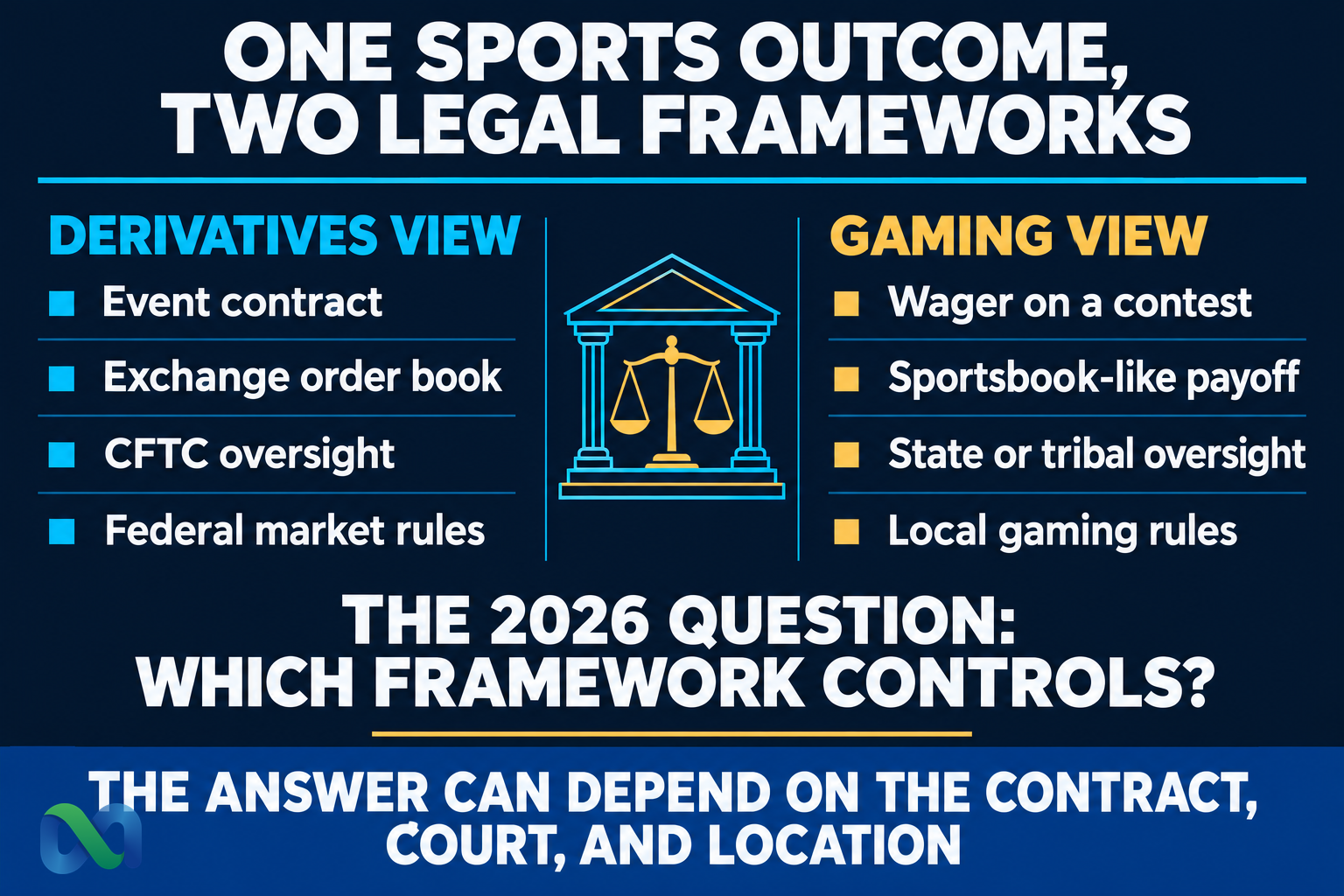
On an exchange, participants submit bids and offers. The venue matches orders and, according to the CFTC, does not take a side in the outcome. A typical sportsbook posts lines, accepts wagers as the operator, and works under state gaming licenses.
The user experience can still overlap. In both settings, a person can risk money on a game and lose if the selected outcome does not occur. Exchange mechanics explain why Kalshi is regulated differently; they do not end the legal analysis.
Why a Kalshi Trade Can Feel Like a Bet
For a retail user, the similarities are easy to see:
- money is placed at risk;
- the payoff depends on an uncertain event;
- sports, elections, and entertainment may be the subject;
- a correct forecast can produce a gain; and
- a wrong forecast can lose the full stake or contract cost.
The word “trade” does not prevent gambling-like behavior. Users can chase losses, overestimate their edge, trade for excitement, or take repeated short-duration positions. A regulated financial venue can still host speculative activity.
However, not every risky financial contract is legally gambling. Options, futures, insurance, and other contingent contracts also pay according to uncertain outcomes. U.S. law looks beyond everyday vocabulary to the product design and governing statute.
Gambling-like is not the same as legally classified as gambling
Three questions often get collapsed into one:
| Question | What it asks |
|---|---|
| Does the activity feel like betting? | How the user experiences risk and reward. |
| Is the product a derivative? | How federal commodities law classifies the instrument. |
| Can gaming law still apply? | Whether state, tribal, or other gaming rules govern the conduct. |
A single Kalshi sports contract can generate different answers to those questions. That is why categorical claims from either side can mislead.
The Federal Rule That Mentions Gaming
The Commodity Exchange Act gives the CFTC authority over covered derivatives on designated contract markets. It also contains a special framework for event contracts linked to subjects such as unlawful activity, terrorism, assassination, war, and gaming.
The current 17 CFR § 40.11 says a registered entity may not list certain contracts based on an excluded commodity if they involve, relate to, or reference gaming or activity unlawful under state or federal law. The rule also describes a 90-day review process for potentially covered products.
This is a key reason the answer is not simply “the CFTC regulates Kalshi, therefore gambling law is irrelevant.” Federal commodities law itself addresses gaming-linked event contracts.
At the same time, the CFTC has defended broad federal jurisdiction over prediction markets. In February 2026, the agency filed in a Ninth Circuit case arguing that state efforts threatened its exclusive jurisdiction over U.S. commodity derivatives markets. The agency's public materials also describe federally regulated prediction markets as nationally accessible to qualified customers.
The legal fight is partly about where that federal authority ends when a contract looks like a conventional sports wager.
What the 2026 Courts Said About Sports Contracts
The two most important Ninth Circuit opinions did not declare all Kalshi activity illegal. They addressed preliminary relief and specific claims. Still, they weaken the blanket claim that federal registration automatically blocks gaming law.
Nevada: federal registration did not automatically preempt gaming rules
In KalshiEX v. Assad, the Ninth Circuit affirmed in part the dissolution of a preliminary injunction on August 28, 2026. Kalshi had sought to stop Nevada from applying state gaming laws to its sports and election contracts.
The panel held that Kalshi had not shown a likelihood that the Commodity Exchange Act preempted Nevada's gaming rules as applied to the sports contracts. Its analysis treated the sports products as sports bets rather than swaps under the statutory provision at issue. It also relied on the federal rule concerning gaming-linked contracts. The court sent the election-contract issues back for further consideration.
This was a preliminary-injunction decision, not a final nationwide judgment about every event contract. But within the Ninth Circuit, it is a major warning against saying sports contracts are unquestionably protected from state regulation.
Tribal lands: IGRA can apply to where a user enters the contract
In Blue Lake Rancheria v. Kalshi, the Ninth Circuit ruled on September 16, 2026 that two tribes were likely to succeed on claims under the Indian Gaming Regulatory Act.
The panel said the sports contracts at issue could qualify as class III gaming when users entered them from tribal lands. It concluded that neither the Commodity Exchange Act nor the federal internet-gambling statute displaced the tribes' asserted remedy. The case returned to the lower court for the remaining preliminary-injunction factors.
Location therefore matters. A contract's availability on a national app does not erase laws tied to where the transaction occurs.
New York and the CFTC illustrate the jurisdictional conflict
New York also sued Kalshi in July 2026. In response, the CFTC used emergency authority and ordered the exchange to continue operating under the Commodity Exchange Act's core principles. The agency argued for a uniform national derivatives market rather than a patchwork of state gaming rules.
That action shows the conflict rather than resolving it. Federal regulators, states, tribes, and courts are still testing who controls which products.
Kalshi vs a Sportsbook: Practical Differences
The comparison below describes a typical model. Individual products and jurisdictions vary.
| Feature | Kalshi event-contract exchange | Typical U.S. sportsbook |
|---|---|---|
| Legal structure | Federally designated derivatives exchange | State-licensed gaming operator |
| Product | Tradable event contract | Wager |
| Price formation | Bids and offers from market participants | Odds or lines posted and managed by operator |
| Counterparty model | Exchange matches participants | Operator generally accepts the wager |
| Early exit | Often possible by selling, if liquidity exists | Cash-out may be offered at operator's discretion |
| Primary oversight claim | CFTC and federal commodities law | State gaming regulator and gaming law |
| Sports-law certainty in 2026 | Actively contested | Established state-by-state framework |
These differences are real. So are the similarities in payoff and user behavior. Use the table to understand structure, not to infer that one product is automatically safer or more profitable.
For a platform-level due-diligence review, see Is Kalshi legit?. For alternatives and fees, compare the best prediction market apps in the US.
How to Decide Which Rules Matter
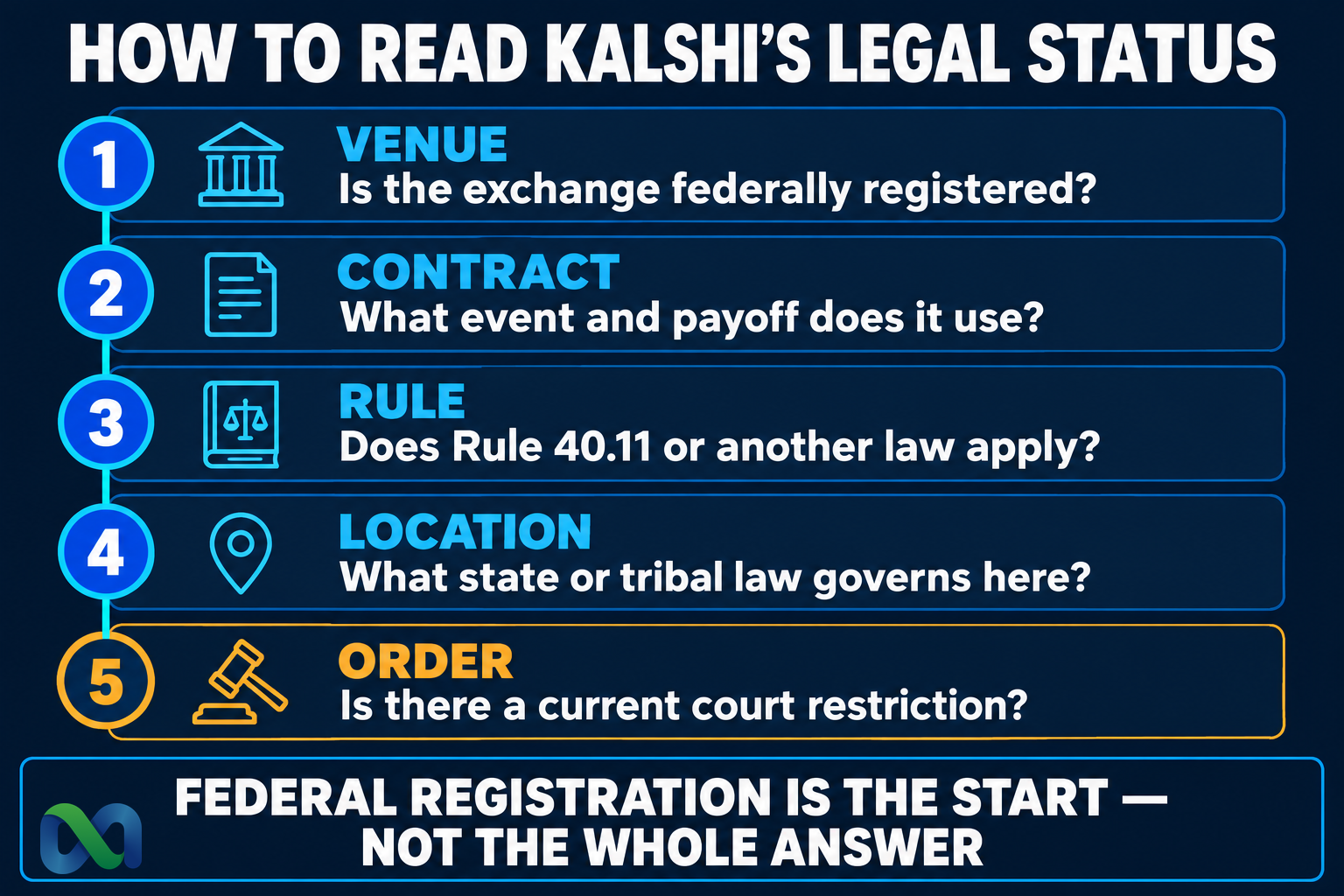
Use five checks instead of relying on one label:
- Venue: Confirm the exchange's current federal registration.
- Contract: Identify the exact event, payoff, and legal form.
- Rule: Check whether Rule 40.11 or another federal restriction may apply.
- Location: Review current state and tribal rules where you are physically located.
- Order: Look for a recent injunction, appellate opinion, agency order, or access notice.
This process can produce different results for an economic indicator, an election, and a sports proposition. It can also change over time as cases move from preliminary rulings to final judgments.
What users should do before trading a sports contract
- Do not rely on “legal in all 50 states” as a permanent guarantee.
- Confirm the contract is currently available for your location without using a VPN or other workaround.
- Read the settlement source and deadline.
- Check fees, bid-ask spread, and likely slippage.
- Size the position for a complete loss.
- Save the contract terms and transaction records.
- Recheck access if a state, tribe, court, or regulator announces new action.
Avoiding a geographic restriction can violate platform terms or applicable law. Our guide to prediction markets and VPN risks explains why location workarounds add legal and account risk.
Is Kalshi Investing, Trading, or Gambling?
“Trading event contracts” is the most precise neutral description of the activity on Kalshi. Whether it also counts as gambling depends on context.
- Trading describes the exchange mechanism: participants buy and sell contracts at market prices.
- Speculating describes the economic behavior: capital is risked in hopes of a gain.
- Hedging may describe a position that offsets a separate real-world exposure.
- Gambling may describe user behavior or a legal classification under a gaming statute.
The same instrument can be used differently by different people. A business may hedge weather risk. A retail user may take the same side for entertainment. Purpose alone does not necessarily settle the legal category, but it changes the economic story.
If the question is “Can using Kalshi become gambling-like behavior?”, the answer is clearly yes. If the question is “Is every Kalshi contract legally gambling throughout the United States?”, the answer is no—current law requires a more specific analysis.
Frequently Asked Questions
Is Kalshi considered gambling by the CFTC?
The CFTC regulates Kalshi as a designated contract market and describes prediction-market products as event-contract derivatives. Federal law and Rule 40.11 also address contracts that involve or reference gaming. CFTC oversight therefore does not mean the word “gaming” is legally irrelevant.
Is Kalshi the same as sports betting?
No. Its exchange structure, federal registration, order book, and contracts differ from a typical sportsbook. A sports contract can nevertheless create a similar economic payoff and may face gaming-law claims.
Is Kalshi legal in all 50 states?
The CFTC argues that federally regulated prediction markets can operate nationwide. The 2026 Ninth Circuit decisions show that state and tribal gaming laws may still apply to some sports contracts. Check the latest rule for your location and contract.
Did a court rule that Kalshi is gambling?
The Ninth Circuit made important preliminary rulings involving sports contracts. In the Nevada case, it treated the contracts as sports bets for the statutory analysis and allowed state enforcement to proceed. In the tribal case, it found the tribes likely to succeed in treating the activity as class III gaming on tribal lands. Those opinions do not classify every Kalshi market nationwide.
Are election contracts gambling?
Election contracts raise their own statutory and public-interest issues. The August 2026 Ninth Circuit opinion sent Nevada's election-contract issues back to the district court rather than resolving them with the sports-contract holding.
Can I lose all my money on a Kalshi contract?
You can lose the full amount committed to a position if it settles against you. Fees and poor execution can add to the economic loss. Federal regulation does not insure a forecast.
Bottom Line
Kalshi is a federally regulated event-contract exchange, not a conventional state-licensed sportsbook. That is a real structural and legal difference.
But the 2026 record does not support a blanket claim that Kalshi can never be treated as gambling. Sports contracts sit at the center of an active conflict among federal derivatives law, state gaming rules, and tribal gaming law. Courts have allowed serious gaming-law challenges to proceed even while Kalshi's federal registration remains intact.
The best answer to “is Kalshi gambling?” is therefore conditional: Kalshi offers regulated event-contract trading, but a specific sports contract may still be treated as gaming under the law that applies to the transaction and location. Read the contract, check current access, and treat the financial risk as real regardless of the label.
