


Prediction Markets: Why They Could Reach $1 Trillion
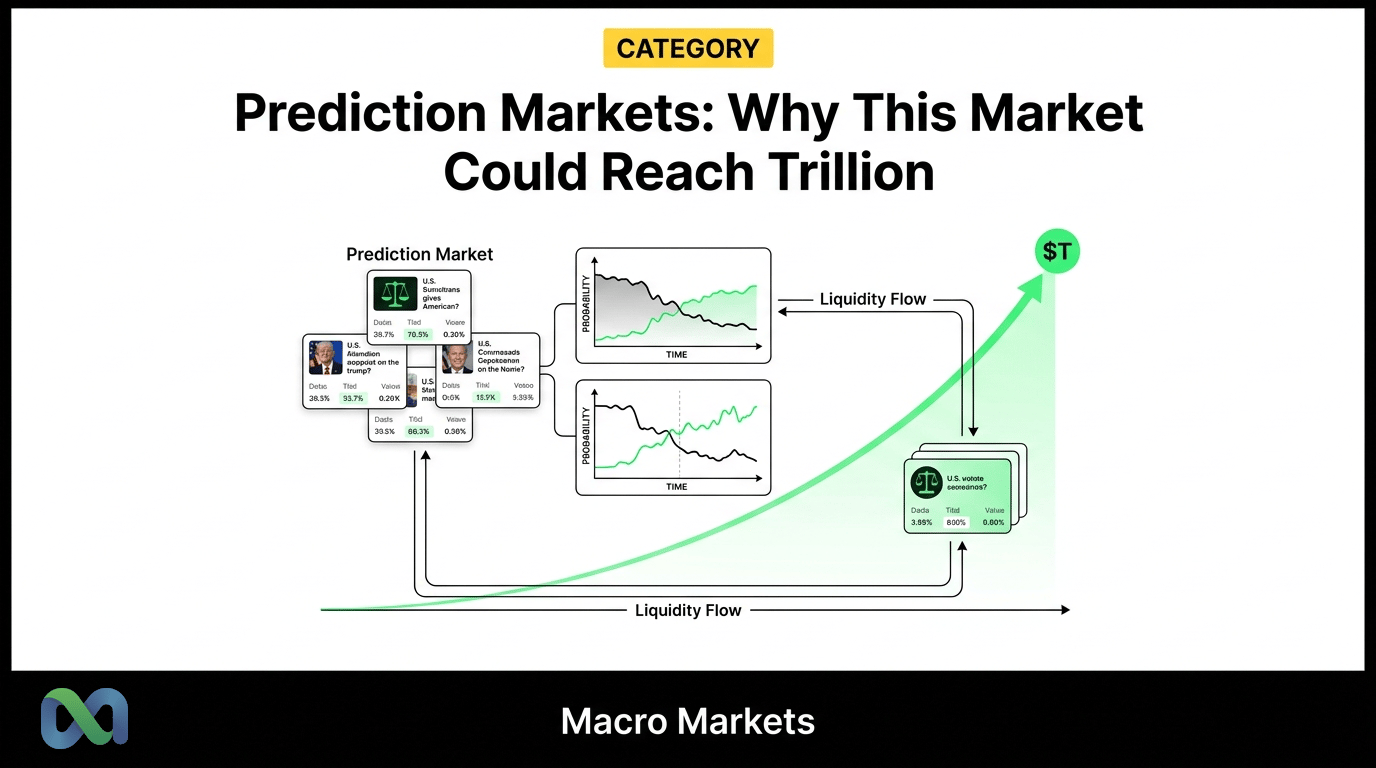
Prediction markets have moved out of a niche. They are now a clear way to price probability, risk, and expectations around events that have not happened yet. The sector is growing because it brings data, capital, and opinion into one live market.
The thesis became larger after Bernstein said, according to CNBC, that prediction markets could reach about $1 trillion in annual volume by 2030. The firm also sees $240 billion in 2026 and an average growth rate near 80% per year from 2025 to 2030.
That number stands out. However, it makes sense when you look at real use. Prediction markets help measure what the market believes about elections, interest rates, crypto, sports, inflation data, and many other topics.
This guide explains what prediction markets are, how they work, why they are growing, and where Brazil fits into this new phase.
What Are Prediction Markets?
Prediction markets are markets where traders buy and sell contracts tied to a future event. The event can be simple: “Will the central bank cut rates?” or “Will a team win the tournament?”
Each contract has a price. That price shows a probability. If a contract costs $0.60 and pays $1 if the event happens, the market is saying it sees roughly a 60% chance.
The price changes when new information arrives. A central bank speech can move a rate market. A poll can move an election market. An injury can move a sports market.
That is why prediction markets are useful. They do not only show who may win. They show how probability changes over time.
A poll measures what people say. A market measures what people do with capital at risk. That does not make the price perfect. However, it often makes the signal stronger than a loose opinion.
The best way to read prediction markets is simple: the price is a live group estimate. It can be wrong, but it always shows what the group knows, fears, or expects at that moment.
Why Are Prediction Markets Growing So Fast?
Prediction markets are growing because the world wants to measure risk before the final result. Companies, traders, media teams, funds, and regular users all need to make decisions under uncertainty.
This use became clear during election cycles. When many people want to know who has the better chance, the market becomes a public screen. The price compresses news, data, rumors, and analysis into one number.
Then the use case moved beyond politics. Today, there are prediction markets for crypto, inflation, interest rates, sports, weather, culture, and regulation. Each new category expands the possible volume.
The internet also helps. A platform can open a market quickly. Users across countries can see the same price. Capital can enter through crypto, through fiat, or through both routes.
In addition, more volume attracts more participants. More participants bring more liquidity. More liquidity improves price quality. Better prices attract more serious traders. This feedback loop explains the growth thesis.
However, volume alone is not enough. The sector needs clear rules, reliable outcome sources, and risk controls. Without them, prediction markets can grow without earning trust.
How Price Becomes Probability
The most useful part of prediction markets is the translation of price into probability. A contract priced at $0.42 shows about a 42% chance. A contract priced at $0.78 shows about a 78% chance.
This reading helps because it turns vague language into a number. Instead of “a rate cut is likely,” the market says “the cut is at 68%.” Instead of “the candidate is gaining,” the market shows how many points the candidate gained.
The price does not appear from nowhere. It comes from buying and selling. If many people buy the same side, the price rises. If many people sell, the price falls.
In many cases, the platform uses an Automated Market Maker (AMM). The AMM provides liquidity. It lets a trader buy or sell without waiting for another person to accept the order.
The AMM adjusts the price after each trade. A small order moves the price a little. A large order moves it more. Therefore, traders need to watch price, volume, and market impact.
This mechanism is useful for new markets. Even with limited early volume, the price can still move. Over time, more data enters and the probability becomes more useful.
Prediction Markets Are Not Just Entertainment
Prediction markets are very different from a traditional sportsbook. A sportsbook creates lines to protect its margin. The user sees a quote, but does not see the full price formation process.
In prediction markets, the focus is the probability created by the market. The price changes through trader action. The screen shows a more open view of what people with capital at risk believe.
There is also another point. A trader may exit before the end when the platform allows it. If the thesis changes, the trader can reduce risk. If the price moves in their favor, they can realize part of the gain.
This makes the experience closer to trading. You do not need to think only about the final outcome. You can also think about how the probability changes over time.
A good example is the COPOM, Brazil’s monetary policy committee. Before a meeting, data, speeches, and reports come out. The market can move before the official decision. Whoever reads the signal better may have an edge.
That is why the key word is analysis. Prediction markets measure market expectations. They help show whether a news item truly moved price or was only noise.
The Bernstein $1 Trillion Thesis
Bernstein’s projection shows a clear view: prediction markets can move from a niche product into a large global market.
According to CNBC, the firm expects $240 billion in volume in 2026. After that, it sees strong growth toward nearly $1 trillion per year in 2030.
This thesis depends on three forces. The first is more use in categories beyond elections. The second is the entry of more traders and more capital. The third is improvement in rules, product, and liquidity.
There is also a data thesis. Prediction markets generate price series about future events. These series can serve media companies, funds, apps, and risk dashboards.
Imagine a dashboard that shows the chance of a rate cut, an election victory, a law passing, or Bitcoin moving higher. That matters not only for people who trade. It also matters for people who only want to read the signal.
The sector is still young. Cases of prediction market restrictions in Brazil show that infrastructure and regulation still matter. Therefore, the projection is not guaranteed. But it shows why so many players are watching prediction markets now.
Why Brazil Has Room in This Sector
Brazil is a strong country for prediction markets. It has high-attention elections, interest rates that move everything, inflation at the center of public debate, major sports, and high fintech adoption.
Brazil also has many public questions. Who will be elected? Will the Central Bank cut rates? Will IPCA inflation come above expectations? Will the real strengthen? Will Brazil perform well in global tournaments?
Today, many people answer these questions with opinion. Prediction markets can turn those opinions into a public price. That creates a live signal that changes as information changes.
Brazil also needs a local bridge. Many global platforms speak English. Some require crypto. Others focus mostly on the United States.
Macro Markets wants to fill this gap with a Portuguese-first platform focused on themes that make sense for Brazilian users. The idea is to combine clear pricing, liquidity, chat, a flexible wallet, and local markets.
That bridge matters. Users who prefer crypto can use that path. Users who prefer fiat can start without learning blockchain first. Beginners can read markets in Portuguese and understand the rules more easily.
For rate decisions and official data, sources like the Central Bank of Brazil help. For elections, the Superior Electoral Court is the official source for results.
How to Read Prediction Markets More Carefully
The first step is to read the market rule. Look at the question, the final date, and the source that decides the outcome. Never trade only from the title.
Then look at the current price. Ask whether that probability makes sense. Compare it with data, news, polls, calendars, and history.
Next, look at volume. A low-volume market can move with little money. A market with solid volume tends to provide a stronger signal.
Also think about timing. You can be right about the final outcome and still enter at a bad price. In prediction markets, entry price matters a lot.
Use position sizing with care. Do not put everything into one thesis. Even an 80% probability still fails in many scenarios.
Finally, write down your reason before you trade. State why the price is wrong in one clear sentence. Then check later whether your thesis made sense. This habit improves your reading of the market.
Common Mistakes in Prediction Markets
The most common mistake is treating probability as certainty. A 70% price looks high, but it still leaves 30% for the other side. Rare events happen.
Another mistake is following a move without understanding the cause. Sometimes the price rises because important news came out. Sometimes it rises because of short-term flow. Without volume and source checks, it is easy to confuse the two.
A third mistake is ignoring the resolution rule. The question may look obvious, but the final source can change everything. Read the criterion before entering.
It is also a mistake to use prediction markets as your only source. They are useful signals, but they should be read alongside official data, news, and your own analysis.
Finally, avoid trading from loyalty or emotion. The market does not pay for what you want to happen. It rewards correct pricing, good reading, and risk control.
The Role of Macro Markets
Macro Markets was created to make prediction markets clearer for Brazilian users. The platform focuses on markets with pricing, data, chat, wallet access, and local experience.
The product aims to reduce friction. Users can view categories, track price changes, and trade through a direct interface. The goal is to help people read probability with more discipline.
The VIP system also creates an extra incentive for recurring use. With trading volume, the user gains progress. That makes the journey closer to a modern trading platform.
Another point is the flexible wallet. Support for crypto and fiat helps different audiences. Crypto traders can enter more easily. Users who prefer traditional money are not left out.
The thesis is simple: if prediction markets grow, Brazil needs a local layer. That layer should speak the user’s language, use local examples, and treat prediction as serious data.
The Future of Prediction Markets
The future of prediction markets should include more liquidity, clearer rules, and better products. Without those three points, the sector will not become a base layer for analysis.
With more liquidity, the price becomes more useful. With clear rules, trust rises. With simple products, more people can understand probability without becoming specialists.
We should also see more use of data. Probability charts, APIs, rankings, and price history can appear in newspapers, reports, and risk dashboards.
This future favors platforms that treat markets seriously. It is not enough to list questions. Platforms must create well-written markets with clear sources and strong support.
For users, the opportunity is to learn early. People who understand prediction markets now may use the signal better when the sector becomes larger.
Conclusion: Prediction Markets Are Prices for Uncertainty
Prediction markets turn uncertainty into price. They show, in real time, the probability that the market assigns to a future event.
The $1 trillion thesis by 2030 may be aggressive. Even so, it points to a real shift. More people want to measure risk before the final result.
In Brazil, that shift has room to grow. The country has many relevant events, high public attention, and a need for a strong local bridge.
Macro Markets wants to be that bridge. Explore the markets, read the probabilities, compare them with your data, and use prediction markets as a serious tool for understanding the future.
Practical Summary to Get Started
If you are new to this topic, start with simple markets. Choose an event you understand. It can be a rate meeting, an election, a match, or an inflation release.
Read the rule. Check the official source. Then read the price as probability, not as a promise. If the price looks wrong, write your thesis in one short sentence.
Only then think about position size. Start small. The focus should be learning how the price reacts to new information.
Over time, you will see patterns. Some markets react quickly to official data. Others react more to narrative. Knowing how to separate the two is part of the edge.
That discipline is what turns prediction into market analysis.
For English readers, the key takeaway is simple: prediction markets are becoming probability infrastructure, not a niche corner of finance.
