


Prediction Markets Glossary: Crypto, Platforms, Regulation, and Use Cases
Prediction markets now sit at the intersection of finance, crypto infrastructure, regulation, and vertical-specific forecasting. That creates a real search problem for readers: the language is dense, platform names overlap, and many terms are used loosely. This glossary solves that problem.
If you are trying to understand how prediction markets work, how decentralized platforms differ from regulated exchanges, or how market structure changes across politics, sports, crypto, and macro, this guide gives you a clean starting point. It is glossary-first by design, but it also works as a cluster hub for deeper articles on each subtopic.
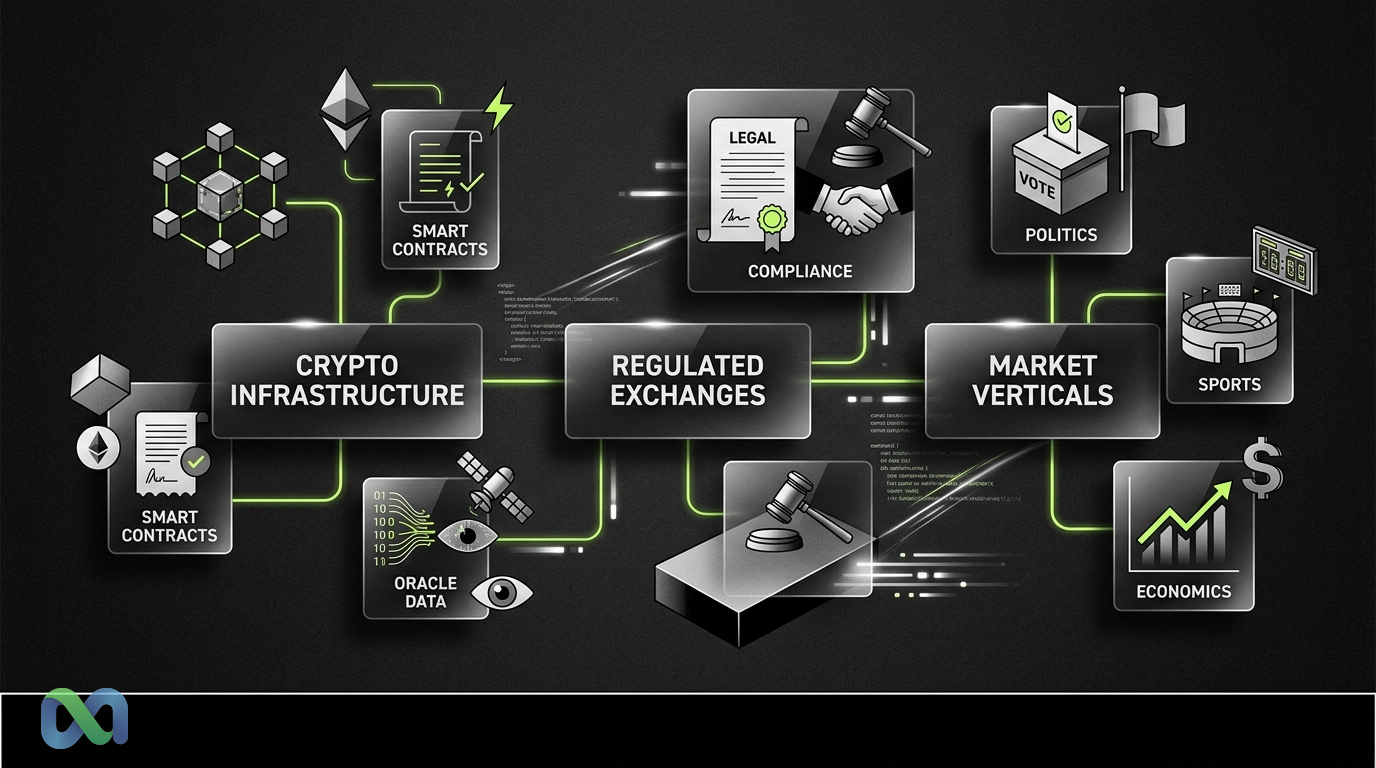
Instead of forcing dozens of unrelated concepts into one narrative, this page groups the core terms into four practical buckets: crypto infrastructure, platforms and exchange models, regulation and compliance, and market verticals. That approach reduces cannibalization and makes it easier to link this page to more focused glossary entries later.
How to Use This Prediction Markets Glossary
Use this page in two ways. First, treat it as a quick-reference glossary when you run into a term like on-chain resolution, event contracts exchange, or MEV. Second, treat it as a topic map that shows how the modern prediction market stack fits together.
A simple way to read the space is to separate three layers. The first layer is infrastructure, which includes smart contracts, oracle networks, stablecoins, Layer 2s, and automated market makers. The second layer is venue design, which includes decentralized protocols, centralized exchanges, regulated event markets, and white-label platforms. The third layer is market application, which includes elections, sports, macro data, earnings, and weather-linked contracts.
That framework matters because two platforms can both call themselves prediction exchanges while operating under very different technical and legal assumptions. One might settle through smart contracts and oracle votes. Another might list contracts inside a CFTC-supervised structure with formal compliance controls.
Crypto and On-Chain Infrastructure Terms
Decentralized prediction markets
Decentralized prediction markets are forecasting markets built on blockchain infrastructure rather than a fully centralized database and matching engine. In practice, trading, custody, settlement, or market resolution can happen through smart contracts, usually with crypto assets as collateral.
The main appeal is transparency. Users can inspect contract logic, wallet flows, and settlement rules on-chain. However, decentralization comes with tradeoffs, including wallet friction, gas costs, oracle risk, and more complicated compliance boundaries.
On-chain resolution
On-chain resolution is the process of finalizing a market outcome through blockchain-based rules or contracts. Instead of a platform operator simply toggling a result in a private database, the resolution event is pushed through an on-chain mechanism.
That mechanism often depends on oracle inputs, dispute windows, and contract-specific logic. The benefit is auditability. The downside is that incorrect or delayed oracle data can create friction at the exact moment a market needs certainty.
Smart contract
A smart contract is self-executing code deployed on a blockchain. In prediction markets, smart contracts can hold collateral, process trades, enforce payout rules, and distribute funds when an event resolves.
Smart contracts reduce the need for manual intervention, but they also create execution risk. If the contract design is flawed, the market can inherit those flaws at scale. That is why contract audits, dispute design, and oracle integration matter so much.
Oracle network
An oracle network delivers external data to on-chain systems. Prediction markets need oracles because blockchains cannot independently verify off-chain facts like election results, CPI releases, earnings calls, or sports scores.
A strong oracle design improves credibility. A weak one creates a single point of failure, even inside a system that otherwise markets itself as decentralized.
Chainlink
Chainlink is the best-known oracle network in crypto. It provides external data feeds to smart contracts and is often referenced when people discuss how prediction markets can import verified real-world information on-chain.
In prediction markets, Chainlink is more relevant as infrastructure than as a consumer-facing venue. It helps explain how a blockchain-based market can reference outside events without relying on a single manual operator.
UMA Protocol
UMA Protocol is a crypto protocol known for optimistic oracle design and dispute-based resolution systems. It is especially relevant in prediction market conversations because some on-chain markets use UMA-style mechanisms to resolve outcomes through claims, challenges, and economic incentives.
The practical idea is simple: a proposed answer stands unless challenged. That can be efficient, but it also means incentive design and participant monitoring are critical.
Stablecoin collateral
Stablecoin collateral is the crypto collateral posted in a relatively price-stable asset rather than a volatile token. In prediction markets, stablecoin collateral reduces the extra noise that comes from holding exposure in an asset that can swing independently of the event being traded.
This matters because a user should ideally be expressing a view on the event itself, not taking accidental balance-sheet risk through the collateral token.
USDC
USDC is a dollar-pegged stablecoin widely used in crypto markets. In prediction markets, it is commonly used for deposits, collateral, and settlement because it is designed to minimize price volatility relative to the US dollar.
For traders, USDC often makes market prices easier to interpret because the unit of account stays stable.
USDT
USDT is another major dollar-pegged stablecoin used across crypto venues. Like USDC, it can serve as collateral and settlement currency for blockchain-based prediction markets.
The practical difference for users often comes down to venue support, liquidity, and treasury preference rather than prediction market design alone.
On-chain settlement
On-chain settlement means the final transfer of value happens on the blockchain. Once a market resolves, the payout logic is executed through smart contracts, and balances update in wallets or on-chain positions rather than only in an internal company ledger.
The benefit is transparent settlement. The tradeoff is dependence on network conditions, gas fees, and smart contract performance.
Layer 2
A Layer 2 is a blockchain scaling system built on top of a base chain. In prediction markets, Layer 2 networks matter because they can reduce transaction costs and improve throughput, which is important for markets with many small trades.
Lower-cost execution can materially improve user experience, especially in event-driven trading where many participants want to reposition quickly.
Gas fees
Gas fees are transaction fees paid to execute operations on a blockchain. For prediction markets, high gas fees can distort the economics of smaller trades, reduce liquidity participation, and make active trading less attractive.
That is one reason why infrastructure choice matters. A market that looks elegant in theory can become impractical if routine actions cost too much.
MEV
MEV, or maximal extractable value, refers to value captured through transaction ordering and block production dynamics. In practical terms, it can affect how orders are sequenced and how much slippage or adverse execution a user faces.
For prediction markets, MEV is not the main concept a newcomer learns first, but it matters for market integrity on heavily used on-chain systems.
Decentralized exchange (DEX)
A decentralized exchange is a crypto trading venue that operates through smart contracts instead of a fully centralized order-matching operator. Some prediction market systems borrow DEX design principles, especially when they use liquidity pools or AMM-based execution.
Understanding DEX mechanics helps explain why some prediction markets feel more like DeFi infrastructure than like a traditional exchange account.
AMM protocol
An AMM protocol uses algorithmic pricing and liquidity pools rather than relying only on a central order book. In prediction markets, AMMs can support continuous trading, especially when direct counterparties are limited.
If you want a deeper explainer on pricing mechanics, see our guide to automated market makers. The short version is that AMMs trade off some order-book precision for always-on liquidity and cleaner market access.
Liquidity mining
Liquidity mining is an incentive system that rewards users for supplying liquidity to a protocol. In prediction markets, it can be used to attract early market makers or bootstrap participation in new categories.
The risk is that incentive-driven liquidity is sometimes temporary. When rewards end, depth can disappear.
Yield farming
Yield farming is the broader practice of moving crypto capital across protocols to earn returns through incentives, fees, or token rewards. In prediction markets, yield-farming language often appears when protocols try to attract liquidity providers or collateral.
For readers, the key point is that trading demand and incentive demand are not the same thing. A market can attract capital without yet proving lasting forecasting utility.
Token incentives
Token incentives are protocol-issued rewards designed to encourage behaviors like trading, governance participation, or liquidity provision. In prediction markets, they are often used to accelerate network growth.
However, token incentives can also blur the difference between genuine organic activity and subsidized usage.
Platforms, Protocols, and Exchange Models
Prediction exchange
A prediction exchange is a venue where participants trade contracts tied to future outcomes. The exchange can be decentralized, centralized, or regulated under a specific legal framework.
The term is broad, which is why context matters. A prediction exchange might run on smart contracts, an order book, an AMM, or a supervised derivatives structure.
Event contracts exchange
An event contracts exchange is a trading venue that lists contracts based on whether defined events will occur. These events can cover elections, economic releases, sports outcomes, policy decisions, or company milestones.
The phrase is especially common in regulatory and institutional discussions because it describes the contract form more precisely than general consumer language like prediction market.
CFTC-regulated
CFTC-regulated means the venue or activity operates under the oversight of the US Commodity Futures Trading Commission. In prediction markets, this label matters because it signals formal regulatory supervision in a category that often sits near derivatives law.
It does not automatically mean every contract is low risk or universally available. It means the venue must operate within a more structured compliance environment.
CFTC-regulated event contracts exchange
A CFTC-regulated event contracts exchange is an event-driven market venue that operates within the US derivatives regulatory perimeter. In plain English, it is a prediction-style exchange that lists event contracts while complying with CFTC rules, reporting, and surveillance expectations.
This model is materially different from a fully decentralized protocol. The user experience may feel more familiar to mainstream traders, but listing rules, access rules, and compliance obligations are much stricter.
Polymarket
Polymarket is the best-known crypto-native prediction market platform in the current cycle. It is strongly associated with blockchain-based event trading, stablecoin usage, and public attention around politics and macro events.
When readers mention prediction markets today, they often mean platforms like Polymarket. That makes it a reference point for decentralized or crypto-adjacent market design, even though it should not be treated as the whole category.
Augur
Augur is one of the earliest decentralized prediction market protocols. It helped define the original thesis that event markets could operate through smart contracts and community-driven resolution rather than a centralized operator.
Its historical importance is larger than its current mainstream footprint. For glossary purposes, it matters because many later systems borrowed from the same design conversation.
Gnosis
Gnosis is a crypto protocol ecosystem that has been connected to prediction market infrastructure, tooling, and adjacent applications. In prediction market discussions, Gnosis often appears as part of the broader on-chain experimentation around forecasting, markets, and conditional tokens.
It is better understood as ecosystem infrastructure than as a simple consumer exchange label.
Kalshi
Kalshi is the most prominent US-based regulated event contracts exchange. It is usually referenced when people want the clearest example of a CFTC-supervised prediction-style market structure.
For category mapping, Kalshi represents the regulated exchange model, not the decentralized protocol model.
Manifold Markets
Manifold Markets is a popular forecasting platform associated with play-money or lower-friction market participation. It is often used by communities interested in ideas, forecasting culture, and public reasoning rather than only financially settled trading.
That makes it relevant in the glossary because not all prediction markets optimize for the same user or the same regulatory profile.
PredictIt
PredictIt is a long-running political prediction market platform known for its role in public election forecasting discussions. It is often treated as a reference point for US election market participation and academic-adjacent forecasting.
It belongs in the glossary because many readers encounter prediction markets first through political examples rather than crypto markets.
Metaculus
Metaculus is a forecasting platform focused on probabilistic predictions and crowd judgment rather than exchange-style trading alone. It is useful to include because the broader prediction ecosystem includes both trading markets and non-market forecasting communities.
In other words, not every forecasting platform is an exchange, but they still influence how people think about prediction quality.
Betfair Exchange
Betfair Exchange is a major exchange-style venue often used as a comparison point for market-based pricing. It matters in the glossary because many users understand exchange mechanics there before they understand prediction markets in politics or macro.
However, sports exchange infrastructure and event forecasting infrastructure are not always governed by the same product or regulatory logic.
Smarkets
Smarkets is another exchange-style platform frequently referenced in discussions about market pricing, liquidity, and contract trading. Like Betfair, it helps users understand how exchange mechanics differ from fixed-odds systems.
Its relevance here is comparative: it provides a mental bridge between trading-based sports markets and broader event markets.
Hypermind
Hypermind is a forecasting platform centered on collective intelligence and probability estimation. It is relevant because some prediction ecosystems prioritize aggregate judgment over pure trading volume.
For cluster planning, Hypermind belongs with forecasting-community terms rather than DeFi infrastructure terms.
Good Judgment Open
Good Judgment Open is a public forecasting platform linked to the broader superforecasting tradition. It belongs in this glossary because it shows that the category includes structured forecasting communities, not just contract-based exchanges.
That matters when building a hub page, since search intent often spans both market trading and probabilistic forecasting.
White-label platform
A white-label prediction market platform is software infrastructure that lets another company, publisher, or operator launch a branded market product without building the entire system from scratch.
This matters in B2B discussions because the prediction market industry is not only consumer-facing. Some firms want forecasting tools, not public exchanges.
B2B prediction markets
B2B prediction markets are forecasting systems built for organizations rather than public retail traders. Typical use cases include internal forecasting, scenario planning, product launches, demand estimation, and risk monitoring.
This category matters because the same market logic used for public event trading can also support internal decision-making.
Licensed exchange
A licensed exchange is a trading venue operating under a formal licensing framework. In prediction markets, this term usually signals greater legal clarity, structured oversight, and stricter onboarding requirements than a fully open crypto protocol.
That does not make it automatically better for every use case, but it does change the institutional trust profile.
Regulation, Compliance, and Market Structure
CFTC
The CFTC is the US Commodity Futures Trading Commission, the federal regulator responsible for supervising many derivatives markets. It matters in prediction markets because event contracts can overlap with the legal treatment of derivatives.
When a platform is described in relation to the CFTC, the discussion usually concerns whether a market can be listed, who can access it, and how compliance is enforced.
Designated contract market (DCM)
A designated contract market, or DCM, is a regulated exchange category under US derivatives law. In practical terms, it is a formal venue type through which certain futures and event-related contracts may be listed and supervised.
For glossary readers, DCM is one of the key terms that separates regulated exchange architecture from informal or decentralized market design.
Exempt commercial market
An exempt commercial market is a historical regulatory term tied to certain commodity-market structures that operated under narrower conditions than fully designated exchanges. It is useful mainly as context when reading older discussions about market regulation.
It is less central for everyday consumer understanding, but it still appears in regulatory history and legal comparisons.
Event-based contracts
Event-based contracts are contracts whose value depends on whether a defined event happens. They sit at the heart of prediction market structure because the entire product category is built around pricing contingent outcomes.
The term matters because regulators, institutional traders, and lawyers often use it instead of consumer-facing phrases like prediction markets.
Prediction market regulation
Prediction market regulation is the legal framework that determines how event markets may be offered, who may access them, what disclosures are required, and how settlement and surveillance must work.
The main point for readers is that regulation does not sit outside the product. It shapes market design, user access, supported assets, and even the types of questions a platform can list.
KYC/AML
KYC means know your customer, and AML means anti-money laundering. Together, KYC/AML rules are the compliance processes used to verify users, monitor transactions, and reduce illicit finance risk.
In prediction markets, KYC/AML obligations often mark the practical line between open crypto access and more supervised exchange participation.
Geo-restriction
Geo-restriction is the practice of limiting access based on user location. Prediction market platforms often use geo-restrictions because licensing, sanctions, derivatives rules, and consumer-finance laws vary across jurisdictions.
This is why two users reading the same article may not be able to access the same venue.
Regulated derivatives
Regulated derivatives are financial contracts offered inside a supervised legal framework. Prediction markets often get discussed alongside regulated derivatives because event contracts can share structural features with futures and other contingent contracts.
The takeaway is not that every prediction market is a standard derivative. The takeaway is that the legal analysis often happens in that neighborhood.
Self-certification
Self-certification is a regulatory process through which an exchange may submit a contract or rule change under formal procedures rather than waiting for a completely separate approval process. In prediction-market contexts, this term appears when new event contracts are reviewed or challenged.
It is a legal-structure term, but it materially affects product speed and listing policy.
No-action letter
A no-action letter is a regulatory communication indicating that staff do not presently intend to recommend enforcement action under a specific fact pattern. In market history, no-action letters can shape how niche platforms operate before the law is fully settled.
Readers should treat the term carefully. It is not the same thing as blanket approval.
Compliance framework
A compliance framework is the internal system of policies, controls, monitoring, reporting, and governance used to operate within legal and regulatory obligations. In prediction markets, it can cover onboarding, surveillance, dispute handling, sanctions screening, and contract review.
This term matters because compliance is not just a legal footnote. It is part of product architecture.
Financial surveillance
Financial surveillance is the monitoring of trading behavior, transaction flows, and market activity for signs of abuse, manipulation, or suspicious conduct. In regulated event markets, surveillance is a core operating function rather than an optional layer.
For users, stronger surveillance often means more trust, but also stricter operating rules.
Market Verticals and Use Cases
Political prediction markets
Political prediction markets list contracts tied to elections, appointments, legislation, coalition outcomes, or policy events. They are among the most visible products in the category because they turn public uncertainty into tradeable probability.
This vertical often drives mainstream awareness, but it also draws the most legal and media scrutiny.
Election markets
Election markets are a subset of political prediction markets focused specifically on electoral outcomes. Typical contracts cover winners, vote share, primary outcomes, turnout, or control of a legislature.
Because election markets are easy to understand, they often serve as the public entry point into the broader prediction exchange category.
Sports prediction markets
Sports prediction markets apply market-based pricing to sports outcomes. These can range from championship winners to player awards and match-specific propositions.
They are useful in the glossary because many users arrive from sports exchange concepts before moving into politics, crypto, or macro event trading.
Sports betting
Sports betting is not identical to sports prediction markets, but the categories overlap in user intent. The key distinction is structural: prediction-style markets emphasize tradeable probabilities and exchange-like price discovery, while traditional sportsbooks usually quote fixed odds and take the other side indirectly.
That distinction matters if your content strategy wants to avoid blending exchange language with sportsbook language.
Esports markets
Esports markets are event markets tied to competitive gaming outcomes. They belong in this glossary because they show how prediction infrastructure can extend into digital-native communities with fast-moving, global audiences.
Crypto price markets
Crypto price markets are contracts tied to whether a token or crypto asset will reach, hold, or exceed a specified level by a defined date. They are popular because the underlying audience already understands volatility, timing, and on-chain settlement.
This vertical often acts as a bridge between DeFi-native users and broader event markets.
Economic indicator markets
Economic indicator markets let users trade expectations around releases like inflation, growth, labor data, or central bank decisions. They are especially relevant for readers interested in macro forecasting rather than headline-driven speculation.
Macro events
Macro events are major economy-wide developments that can be framed as tradeable questions, including inflation prints, recessions, policy decisions, and growth surprises. This category is important because it connects prediction markets to institutional-style analysis.
GDP forecast
A GDP forecast market is a market tied to expected economic growth outcomes, whether through official prints, thresholds, or directional surprises. It shows how prediction markets can convert macro debate into explicit probability.
CPI prediction
A CPI prediction market is a market tied to inflation outcomes, usually around published consumer price index data. These contracts matter because inflation releases move rates, currencies, and policy expectations across many other markets.
Fed rate decision
A Fed rate decision market prices expectations about whether the Federal Reserve will cut, hold, or raise interest rates. These markets are among the clearest examples of prediction exchanges operating as real-time probability aggregators for macro events.
Earnings prediction
Earnings prediction markets focus on company results, revenue thresholds, earnings beats or misses, or guidance outcomes. They extend the same event-contract logic into corporate reporting cycles.
Geopolitical risk markets
Geopolitical risk markets cover wars, sanctions, treaties, leadership changes, and major diplomatic developments. They are important because they attract strong attention during uncertainty spikes, but they also raise hard questions about sourcing, ethics, and resolution standards.
Weather derivatives
Weather derivatives are contracts tied to weather outcomes or weather-related indexes rather than simple casual forecasts. They are relevant in this glossary because they show the boundary between entertainment-style event markets and economically functional risk-transfer markets.
Building a Glossary Cluster Without Cannibalization
The term list in this project is too broad for a single article to dominate every query. The better strategy is to use this page as the central glossary hub, then create narrower supporting pages around clear intent groups.
A practical cluster structure would look like this:
- Crypto infrastructure glossary pages: decentralized prediction markets, on-chain resolution, oracle networks, UMA Protocol, Chainlink, stablecoin collateral, Layer 2, gas fees, MEV, AMM protocol.
- Platform and venue pages: Polymarket, Kalshi, Augur, Gnosis, PredictIt, Manifold Markets, Metaculus, Betfair Exchange, Smarkets, Hypermind, Good Judgment Open.
- Regulation pages: CFTC, DCM, event contracts exchange, prediction market regulation, KYC/AML, geo-restriction, self-certification, no-action letter, compliance framework.
- Vertical pages: election markets, political prediction markets, sports prediction markets, crypto price markets, economic indicator markets, Fed rate decision markets, weather derivatives.
This structure keeps the glossary hub broad while giving more specific articles room to rank for deeper intent. It also supports future internal-link expansion once more EN glossary pages exist in the hub.
Final Takeaway
Prediction markets are no longer one simple category. They now span DeFi infrastructure, regulated exchanges, compliance-heavy event contracts, and vertical-specific forecasting products. If you understand the difference between infrastructure terms, venue types, legal structure, and application verticals, the category becomes much easier to navigate.
Use this glossary as your starting map. Then move outward into dedicated pages for each platform, regulation concept, and market vertical. That is the best way to build a central glossary hub that is useful for readers, friendly to internal linking, and disciplined enough to avoid cannibalizing your own future content.
