


Tesla Alphabet AI Spending Concerns: What Changed
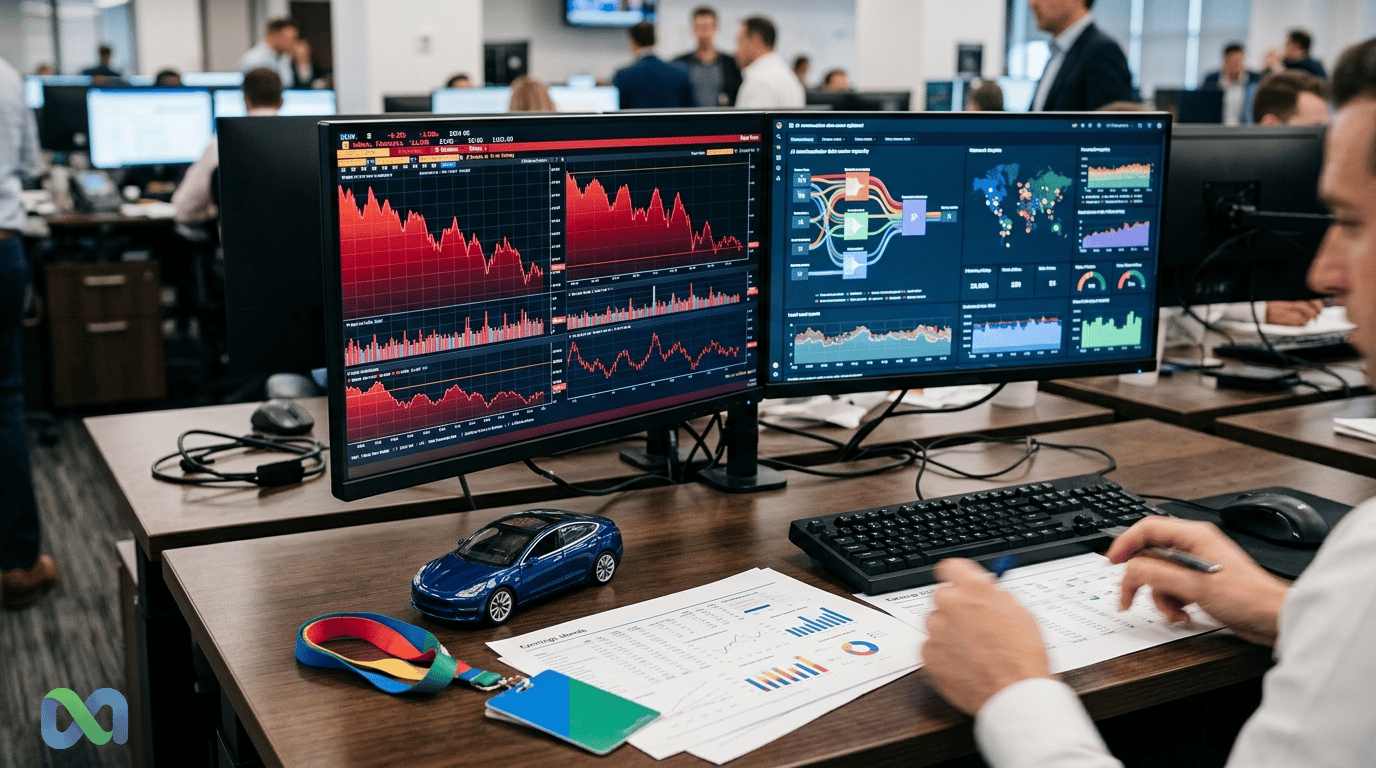
Tesla Alphabet AI spending concerns moved from a background risk to the center of the market narrative. Tesla fell 12% and Alphabet sank 6% after investors looked past AI ambition and focused on spending discipline.
The reaction does not mean investors are rejecting AI. It means the market is asking a harder question. Will each dollar spent on AI buildout, self-driving, chips, data centers, and product development turn into revenue, margins, and free cash flow?
That question matters because Tesla and Alphabet carry different AI stories. Alphabet is spending heavily to defend search, expand cloud, and build the systems needed for generative AI. Tesla is asking investors to value the company not only as an automaker, but also as a self-driving and robotics platform.
Both stories can still work. However, the burden of proof is higher when prices are rich and capital spending rises faster than visible returns. This article explains what happened, how the two cases differ, and which signals could change the market's mind.
This is market analysis, not investment advice. Public equity prices, earnings expectations, and AI spending plans can change quickly.
What Happened to Tesla and Alphabet Shares
Tesla and Alphabet both sold off after earnings because investors treated AI spending as a cash-flow test. The reported stock moves were sharp: Tesla down 12% and Alphabet down 6%, according to the news cluster tracked in the research brief.
The move was not only about one weak metric. It was about patience. Investors have rewarded companies that could attach a credible AI story to growth. Now they want to know when that story becomes measurable profit.
CNBC reported that Alphabet and Tesla tested Wall Street's patience as AI spending overshadowed growth. Yahoo Finance reported pressure on Alphabet shares as cloud growth questions and AI spending unsettled investors. The Wall Street Journal tied the wider tech retreat to AI spending and price concerns.
The common thread is simple. AI spending is no longer automatically bullish. If spending rises, investors want a visible path to revenue, margin lift, and free cash flow.
The headline moves: Tesla down 12%, Alphabet down 6%
Tesla's drop reflected earnings pressure, margin sensitivity, and doubt around the timeline for self-driving returns. The market has long given Tesla a premium because it is seen as more than a car company. That premium becomes fragile when vehicle fundamentals soften and AI proof remains future tense.
Alphabet's 6% fall had a different texture. The company can still show strong revenue engines across search, YouTube, and cloud. Yet higher AI buildout spending can weigh on free cash flow, even when revenue keeps growing.
That contrast is important. Tesla needs AI execution to support a premium price. Alphabet needs AI spending to protect and extend businesses that already generate large profits.
Why the reaction focused on AI spending
Investors have become more selective about AI budgets. In the first stage of the AI trade, bigger spending often signaled ambition. In the next stage, bigger spending can signal lower near-term cash conversion.
AI buildout is expensive. Data centers, chips, power contracts, networking equipment, model training, and engineering talent all require capital. Some spending supports future products. Some may be defensive, because companies must spend just to avoid falling behind.
Therefore, the same phrase can mean different things. AI investment can be a growth engine. It can also be a margin drag if revenue lags. The selloff showed investors are now separating those cases.
Tesla Alphabet AI Spending Concerns: The Key Difference
The shared market reaction can hide the real distinction between the two companies. Alphabet's selloff was mostly about the cost of defending and expanding a profitable empire. Tesla's selloff was about the evidence needed to justify an AI-driven premium.
For Tesla, the concern is self-driving proof. Investors need safety data, rollout milestones, delivery stability, and margin improvement.
For Alphabet, the concern is buildout cost. Investors need cloud growth, search resilience, AI spend discipline, and visible AI revenue.
For broader megacap tech, the concern is spending load. Investors need earnings revisions, margin guidance, rate expectations, and cash-flow conversion.
The table shows why investors should avoid a single AI-spending narrative. The same spending headline can signal growth, defense, or uncertainty.
For Alphabet, a higher AI spend budget may be rational if it protects search and powers cloud demand. For Tesla, AI spending matters only if self-driving and software revenue become visible enough to support the price.
Why AI Spending Is Now a Spending Discipline Test
AI spending, or AI spending, means long-term spending on assets needed to build and run AI systems. For large technology companies, that often means data centers, graphics processors, servers, networking gear, and energy capacity.
The accounting matters. AI spend does not hit earnings all at once. Instead, it becomes depreciation over time. However, the cash leaves the business when the investment is made, so free cash flow can fall even when reported earnings look healthy.
That is the heart of Tesla Alphabet AI spending concerns. Investors are asking whether the cash going into AI has a clear return path. The question is not whether AI is useful. The question is whether spending growth is outrunning revenue.
AI spend, depreciation, and free cash flow
Free cash flow is the cash a company generates after operating expenses and AI spending. It matters because it funds buybacks, debt reduction, acquisitions, and reinvestment without relying on outside capital.
When AI spending rises, free cash flow can compress. That can happen even when revenue is growing. If the market expected strong cash generation, a higher AI spend guide can force analysts to revise price models.
Depreciation adds another layer. Expensive chips and servers may become obsolete faster than traditional infrastructure. If assets need replacement sooner, the long-term spending cycle becomes more intense.
That is why investors care about the cadence of AI spending. A one-time investment wave is easier to value. A permanent step-up in spending load deserves a different multiple.
Why high prices leave less room for vague timelines
Price is a promise about the future. When a stock trades at a premium, the market is already pricing in strong execution. That leaves less room for unclear payback periods.
Alphabet and Tesla both face this issue, but in different ways. Alphabet must show that AI protects search economics, accelerates cloud growth, and creates new revenue. Tesla must show that self-driving, robotaxi, and AI products can move from vision to audited proof.
In a lower-rate environment, investors may tolerate longer timelines. When rates are restrictive or earnings expectations are stretched, they often demand near-term evidence.
The selloff was a reminder that AI narratives still need financial discipline. A strong theme can support a stock for a while. It cannot replace unit economics forever.
Alphabet's Problem: Cloud Growth Versus AI Buildout Costs
Alphabet's AI challenge starts from a position of strength. The company owns large cash-generating businesses, deep technical talent, a major cloud platform, and distribution through search, Android, YouTube, and enterprise tools.
That strength is why investors may tolerate large AI budgets. Alphabet can fund data centers and models internally. It can also spread AI tools across products that already have scale.
However, scale does not remove the free-cash-flow question. If AI spending keeps rising, investors need evidence that Google Cloud growth, search revenue, and enterprise AI demand can justify the spend.
What investors liked in the quarter
Investors can still find positives in Alphabet's core business. Search remains a large profit pool. YouTube has strategic value in advertising and subscriptions. Google Cloud gives Alphabet a direct way to monetize enterprise AI demand.
That matters because AI can help the company in several places. It can improve search answers, strengthen ad targeting, automate cloud workflows, and support developer tools. It can also defend Alphabet against competitors that use AI to attack search behavior.
The bullish case is clear. If Alphabet converts AI buildout into cloud growth and better revenue, the spending can reinforce the moat.
The market reaction shows the problem is timing. Investors want to know how long the heavy spending phase lasts before it translates into higher margins or stronger revenue growth.
What investors questioned after AI spend guidance
The bearish question is whether AI has changed Alphabet's spending load for good. Search used to be an unusually high-margin business. If defending that business now requires much larger buildout spending, the long-term economics could look less exceptional.
Cloud adds another concern. AI workloads can drive demand, but they can also require costly capacity. If cloud revenue grows while buildout costs rise at a similar pace, margin lift may disappoint.
Investors also worry about competitive pressure. If Alphabet spends heavily because Microsoft, OpenAI, Amazon, Meta, and others are spending heavily, some AI spend may be defensive. Defensive AI spend is still necessary, but the market usually pays a lower multiple for it.
This is why Alphabet's stock can fall even when the company remains highly profitable. The debate has moved from growth to returns.
Tesla's Problem: The Market Wants AI Proof, Not Just AI Vision
Tesla's AI story is more binary. Alphabet's AI spending protects existing profit pools. Tesla's AI story is central to why many investors value the company above a traditional automaker.
That makes execution risk more important. If Tesla can prove scaled self-driving, robotaxi economics, and high-margin software revenue, the long-term price case changes. If those milestones remain delayed, the market may focus more on vehicle deliveries, pricing pressure, and margins.
The 12% stock move showed that investors are less willing to pay for distant self-driving upside without near-term proof. Vision still matters. However, proof now matters more.
Robotaxi and self-driving milestones
Robotaxi is the clearest test of Tesla's AI premium. Investors need to see safety validation, regulatory progress, operating data, and a business model that can scale beyond pilots.
Statements about future self-driving can move sentiment, but markets eventually ask for evidence. That means miles driven, intervention rates, geographic expansion, insurance data, customer adoption, and margin contribution.
The same applies to Full Self-Driving. A subscription product can be valuable if adoption rises and performance improves. Yet price support depends on usage, pricing power, and repeatable revenue.
For Tesla, the key question is not whether AI is strategic. It is whether AI can create cash flows large enough to offset pressure in the core vehicle business.
Margins, deliveries, and price pressure
Tesla's vehicle business still drives current revenue. That means delivery growth, average selling prices, production costs, and gross margins remain central.
If margins weaken while self-driving remains uncertain, investors may compress the multiple. That is especially true when competitors pressure electric-vehicle prices and demand growth is uneven across regions.
The market also watches capital allocation. Spending on AI, robotics, factories, and new platforms can be valuable. Still, it competes with the need to stabilize core profitability.
This creates a different risk profile from Alphabet. Alphabet must prove that AI spending does not dilute a strong cash machine. Tesla must prove that AI can become a cash machine at all.
The Watchlist: What Would Change the Market's Mind
The next phase of the AI trade will likely depend on evidence, not slogans. Investors will watch whether companies can connect AI spending to clear business gains.
For traders and analysts, the useful approach is to build a watchlist. A watchlist turns a broad narrative into concrete signals. It also reduces the risk of reacting only to one earnings headline.
For Alphabet: cloud growth, AI revenue, and AI spend cadence
Alphabet's first signal is Google Cloud growth. Strong cloud revenue can support the case that AI buildout is meeting business demand. Weak growth would raise doubts about the pace of revenue.
The second signal is margin performance. Investors should watch whether cloud margins improve, stabilize, or fall as AI workloads scale. Search margins also matter because AI answers may change cost structures.
The third signal is AI spend cadence. If management signals that spending will keep stepping higher, free-cash-flow estimates may remain under pressure. If the company shows discipline, the market may regain confidence.
Finally, investors need product-level evidence. That includes adoption of AI tools in Workspace, cloud AI services, search features, and advertising products.
For Tesla: self-driving evidence, delivery trends, and margin stabilization
Tesla's first signal is self-driving evidence. Investors need more than launch language. They need measurable progress, regulatory visibility, and data that shows the system can scale safely.
The second signal is delivery growth. If vehicle demand improves, the market may give Tesla more time to execute on AI. If deliveries disappoint, the self-driving premium becomes harder to defend.
The third signal is gross margin. Tesla's price has often depended on the idea that software and scale can lift margins over time. Continued pressure would challenge that view.
Investors should also watch management's capital allocation. The market may support large AI spending if it comes with clear milestones. It may punish spending that feels disconnected from near-term operating performance.
For the broader AI trade: rates, earnings revisions, and cash-flow pressure
The Tesla and Alphabet reaction matters beyond two stocks. It shows that the AI trade is entering a more selective phase.
Rates are one variable. Higher discount rates reduce the present value of long-dated AI cash flows. That can hurt companies whose AI payoff sits far in the future.
Earnings revisions are another variable. If analysts raise revenue estimates but cut free-cash-flow estimates, the market may respond with mixed or negative price action.
Cash-flow pressure is the third variable. Investors will compare AI leaders based on how much spending is needed to generate each dollar of revenue.
Prediction-Market Angle: Turning AI spending Anxiety Into Tradable Questions
Prediction markets are useful because they force vague narratives into explicit outcomes. Instead of asking whether AI spending is good or bad, traders can ask which measurable events would confirm the thesis.
That framing is valuable for Tesla Alphabet AI spending concerns. The market reaction was emotional, but the next updates can be structured around clear milestones.
Which events could be priced as explicit outcomes
For Alphabet, a prediction-market question could focus on whether Google Cloud growth clears a specific threshold next quarter. Another could ask whether annual AI spend guidance rises again. A third could track whether operating margin expands or contracts after the next report.
For Tesla, questions could focus on robotaxi expansion, delivery targets, gross margin thresholds, or regulatory approvals. These outcomes are cleaner than a broad debate about whether Tesla is an AI company.
For the wider tech sector, markets could track whether another megacap company raises AI spending guidance. They could also track whether the Nasdaq reacts negatively to the next earnings batch, or whether analysts cut free-cash-flow estimates for AI leaders.
The point is not to predict without evidence. The point is to define the evidence before the next headline arrives.
How probabilities can update as earnings and guidance change
A probability should move when new information changes the expected path. If Alphabet reports stronger cloud growth with stable AI spend, confidence in AI returns could rise. If AI spend rises again without margin progress, confidence could fall.
For Tesla, self-driving data would matter more than broad AI language. Verified rollout progress, strong safety metrics, and higher software adoption could support the AI premium. Delays, margin pressure, or weak deliveries could reduce it.
This is where prediction markets can complement equity analysis. Equity prices combine many factors at once. Event contracts can isolate one question and show how expectations update over time.
A Plain Read for Traders
Here is the clean read. The market did not say AI is dead. It said proof now has a price. Big plans still matter, but cash matters too.
For Alphabet, the key test is simple. Can the company spend more on AI and still keep its cash engine strong? If cloud grows fast, search stays firm, and spend slows, the market may calm down. If spend keeps rising while cash flow slips, the stock can stay under stress.
For Tesla, the test is more direct. Ca self-driving move from promise to proof? The market wants real use, real data, and real money from software. If that proof arrives, the AI premium has support. If it does not, traders may judge Tesla more like a car maker.
This is why one bad day can still be useful. It shows which claims the market is willing to fund. It also shows which claims need more proof. The next earnings calls will matter, but so will small facts between calls. Watch guidance, margins, cloud demand, delivery data, and each update on self-driving.
A good trader does not need to solve the whole AI debate. The better task is to ask clear questions before the next report. Will spend rise again? Will margins hold? Will cloud growth speed up? Will Tesla show wider self-driving use? Those questions can be tracked, priced, and updated.
FAQ
Why did Tesla and Alphabet stocks fall?
Tesla and Alphabet stocks fell because investors questioned whether rising AI spending will translate into growth, margins, and free cash flow soon enough to justify prices. Tesla faced pressure around self-driving proof and vehicle margins. Alphabet faced pressure around AI buildout costs and free-cash-flow conversion.
Why is Tesla stock dropping so much?
Tesla can move sharply because its price includes a large self-driving and AI premium. When investors doubt the timing of robotaxi, software, or margin recovery, that premium can compress quickly.
Why is Alphabet stock falling if the company is profitable?
Alphabet remains highly profitable, but investors are focused on the cost of AI buildout. If AI spend keeps rising, free cash flow can come under pressure even when revenue grows.
What does AI spending mean for free cash flow?
AI spending can reduce free cash flow because cash leaves the business when companies buy chips, servers, data-center capacity, and related buildout. The investment may pay off later, but the near-term cash impact is real.
Conclusion: AI Spending Still Needs a Return Path
The Tesla and Alphabet selloff is best read as a demand for evidence. Investors are not walking away from AI. They are asking companies to prove that AI spending can become durable revenue, stronger margins, and free cash flow.
Alphabet needs to show that cloud growth, search resilience, and AI product adoption can justify a heavier buildout budget. Tesla needs to show that self-driving and software can move from vision to measurable proof.
For analysts, the next step is to watch concrete triggers: AI spend guidance, free cash flow, cloud growth, robotaxi milestones, deliveries, and margins. For prediction-market traders, the opportunity is to turn those triggers into clear event questions.
The AI trade is not over. It is becoming more strict. The market still sees value in AI. Yet it now asks for dates, cash, and proof. That is a fair bar. It helps traders sort strong claims from weak claims.
