


World Cup 2026 favorites: rankings, odds and what could change
13,645
# World Cup 2026 favorites: rankings, odds and what could change
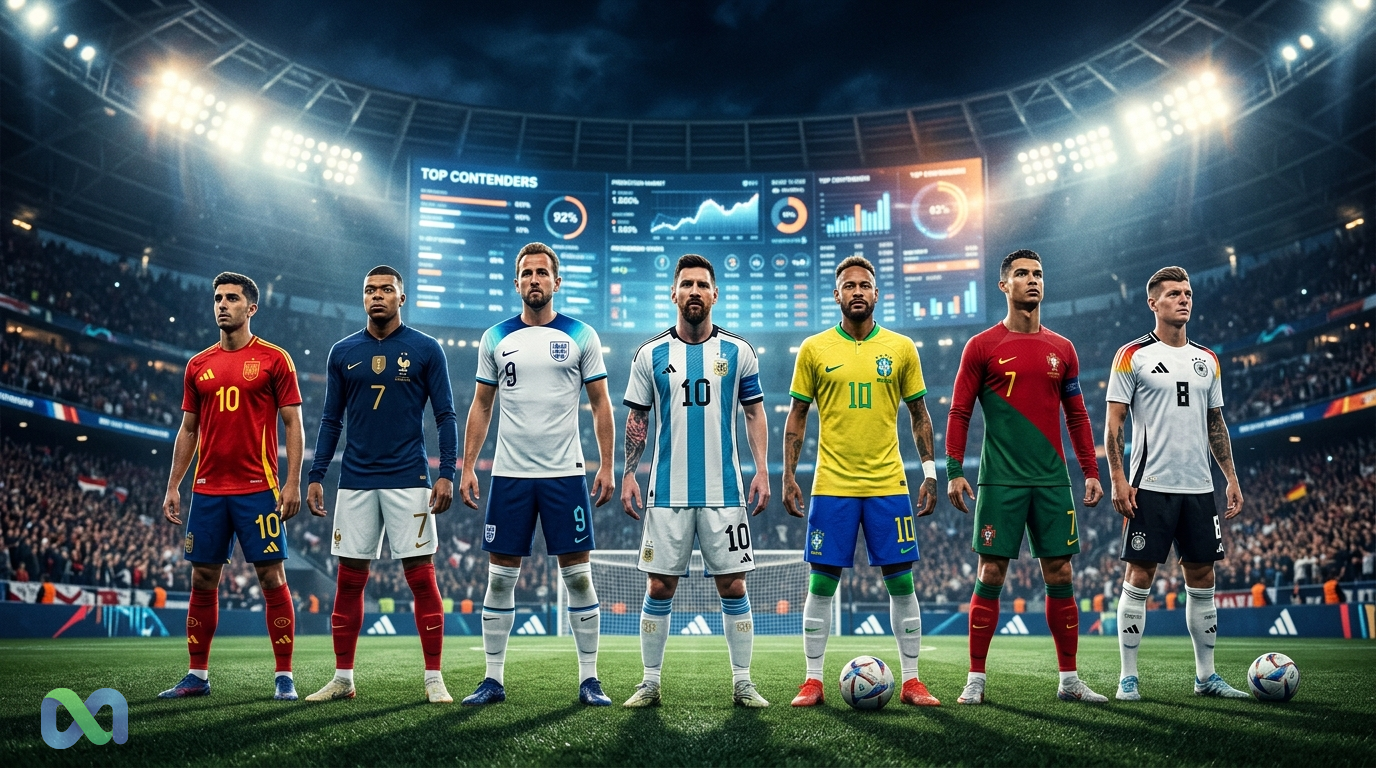
If the question is who the World Cup 2026 favorites are right now, the shortest answer is this: [Spain](https://macro.markets/blog/spain-world-cup-2026) and France lead the market consensus, with England, Argentina and [Brazil](https://macro.markets/blog/brazil-world-cup-2026-odds) close behind. That ranking is not fixed. It changes with injuries, recent form, the group-stage draw, knockout path and liquidity in prediction markets.
The key point is not to turn odds into certainty. It is to read pricing as a snapshot in time. On April 16, 2026, the observed data placed Spain at a 17.1% implied chance and France at 16.4%, followed by England, Argentina, Brazil, Portugal and Germany. For anyone following the tournament through markets, that snapshot is more useful than an isolated opinion.
World Cup 2026 favorites also need to be read through the new tournament structure. The 2026 edition will be the first with 48 national teams, 12 groups of four and 104 matches across the United States, Mexico and Canada. That format slightly reduces the risk of an early exit in the group stage, but it increases variance once the tournament reaches the round of 32.
## Current ranking of the World Cup 2026 favorites
The best way to answer the search for World Cup 2026 favorites is to separate market consensus, football context and price risk. The table below uses the market snapshot collected on April 16, 2026 and combines it with the most relevant sporting context for each national team.
National team| Market probability| Quick read
---|---|---
Spain| 17.1%| Young squad, dominant midfield and the highest market price
France| 16.4%| Deep roster, elite ceiling and strong recent history
England| 10.9%| Huge talent level, but historical pressure and knockout execution remain under review
[Argentina](https://macro.markets/blog/argentina-2026-world-cup-odds)| 8.8%| Champion core, competitive culture and uncertainty around the final stage of the cycle
Brazil| 8.6%| Massive talent, manageable group and questions about collective consistency
[Portugal](https://macro.markets/blog/portugal-2026-world-cup-odds)| 8.5%| High technical quality and match-winners, but with a narrower margin for error
Germany| 7.2%| Physical upside and tournament weight, but still short of the top tier in market pricing
This ranking does not mean the top two are clear of the field. The gap from Spain to Brazil is meaningful, but not decisive. In a short tournament, a difficult knockout bracket or one major injury can move the market fast.
## Why Spain and France are leading the market
Spain arrives with the cleanest combination of collective play, technical control and price support. The squad is younger than in previous cycles, but that is not a weakness here. It is part of the upside. The team has enough midfield control to lower match volatility, and that matters in a long tournament.
[France](https://macro.markets/blog/france-world-cup-2026) remains close because the ceiling is obvious. Few teams can match its combination of athleticism, squad depth and high-end individual talent. The market still prices that upside heavily, even when short-term form fluctuates. For many bettors, France is the strongest pure-talent case among the World Cup 2026 favorites.
Anyone asking which country is ranked #1 in football should be careful not to confuse FIFA ranking with outright market probability. Rankings matter as context, but betting markets price the chance to win the tournament, not just recent results. That is why Spain can lead this market snapshot even when other teams also have elite rankings or raw talent.
## England, Argentina and Brazil are still in the first tier
[England](https://macro.markets/blog/england-world-cup-2026-odds) is still part of the first conversation because the squad quality is too high to ignore. The concern is familiar. England often enters major tournaments with a top-tier roster, then faces doubts about control and decision-making in the biggest knockout moments. That does not remove it from the World Cup 2026 favorites group, but it does shape how the price is interpreted.
[Argentina](https://macro.markets/blog/argentina-2026-world-cup-odds) carries less pure upside than at the peak of the previous cycle, yet the market still respects its tournament culture. The team knows how to manage pressure, rhythm and narrow matches. That matters in a competition where a single sequence can define an entire path.
[Brazil](https://macro.markets/blog/brazil-world-cup-2026-odds) remains one of the most watched prices in global football. The talent pool is obvious, and the path through the group stage looks manageable. The hesitation comes from collective consistency. When the market prices Brazil just behind Argentina, it is reflecting that balance between squad strength and execution risk.
## Portugal and Germany are close enough to matter
[Portugal](https://macro.markets/blog/portugal-2026-world-cup-odds) and [Germany](https://macro.markets/blog/germany-world-cup-2026) sit just below the first tier, but both are close enough to matter. Portugal still has enough creativity and finishing talent to beat any opponent in a single match. Germany brings tournament pedigree, physical power and the ability to grow through the event.
For market readers, the real question is whether these teams are priced as value or as fair long shots. If the leaders drift after injuries or a difficult draw, Portugal and Germany could move up quickly in World Cup 2026 favorites conversations.
## How the 48-team format changes the odds
The expanded format is one of the biggest reasons this market needs a different lens. In theory, stronger teams have more room to survive the opening stage, because the route into the knockout bracket is wider. That can favor elite teams with deeper squads.
At the same time, once the round of 32 begins, the tournament becomes longer and noisier. More knockout matches create more opportunities for variance. A favorite can still be the best team on paper and lose because one match swings on finishing, refereeing or penalties.
This is why market prices should be read as probability bands, not declarations. The World Cup 2026 favorites may deserve to lead the board, but they are not anywhere close to certainty.
## What can change before the World Cup starts
There are at least five variables that can reshape this market before kickoff:
* **Injuries:** A single absence can change the entire ceiling of a national team.
* **Recent form:** Short windows can alter how the market reads momentum and balance.
* **Group draw:** A softer or harder path affects qualification risk and later bracket strength.
* **Knockout route:** Two favorites on the same side of the bracket compress each other’s chances.
* **Market liquidity:** Thin markets can exaggerate price moves, especially around major news.
That is why anyone tracking World Cup 2026 odds should focus less on one frozen list and more on how the hierarchy changes over time.
## Who are the favorites for the 2026 World Cup right now?
Right now, Spain and France are the clearest World Cup 2026 favorites according to market pricing, with England, Argentina and Brazil forming the next tier. Portugal and Germany remain close enough to matter, especially if the pricing shifts before the tournament begins.
The practical takeaway is simple. Use the market as a decision tool, not as a prophecy. Prices are valuable because they compress information, but they still move with every relevant update between now and kickoff.
For a broader view of how prediction markets frame event risk, see Macro Markets. For tournament-wide odds context, compare with ESPN's [2026 World Cup odds board](https://www.fifa.com/en/tournaments/mens/worldcup/canadamexicousa2026) and FIFA's [men's world ranking](https://inside.fifa.com/fifa-world-ranking/men).
Read also: 2026 World Cup complete guide

Categories