


World Cup 2026 Group B: Matches, Teams and Predictions
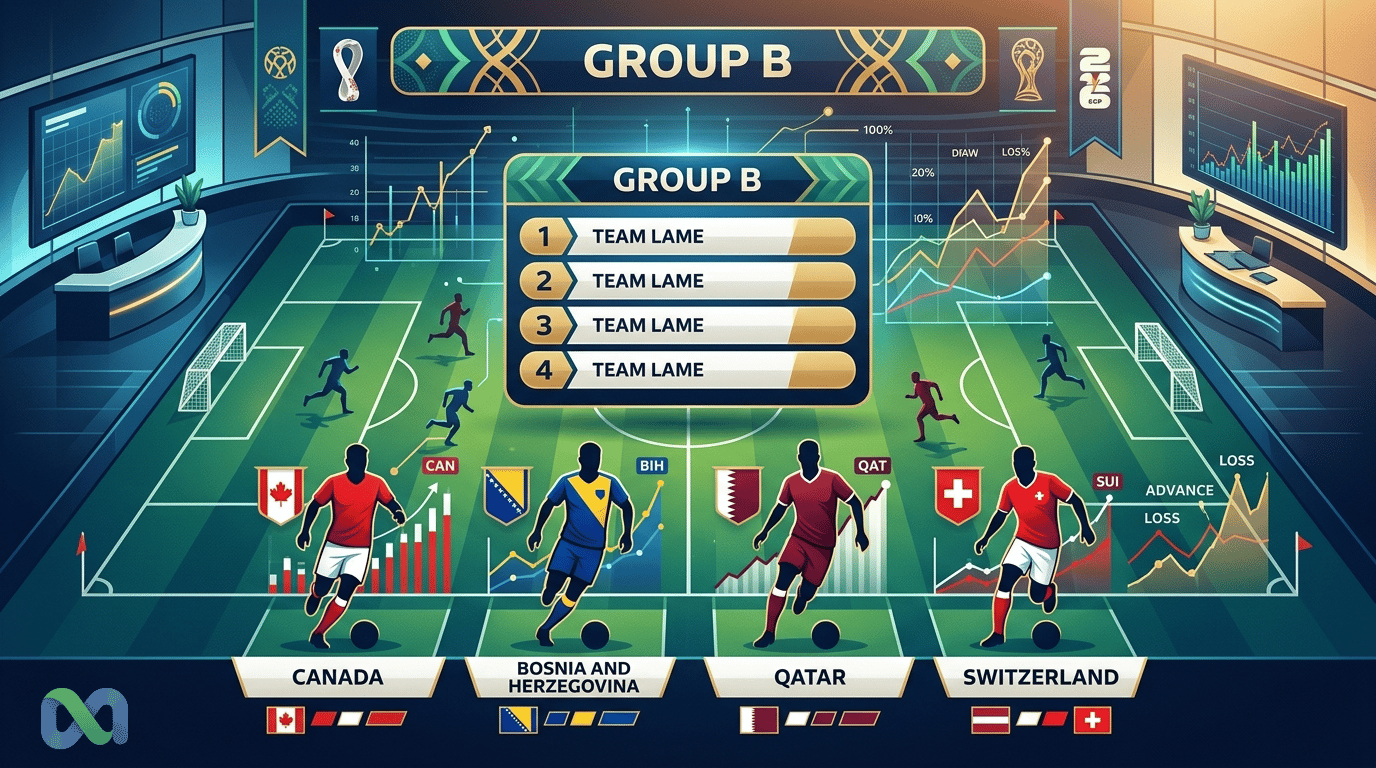
World Cup 2026 Group B brings together Canada, Bosnia and Herzegovina, Qatar, and Switzerland. The group starts on June 12 and ends on June 24. The top two teams advance to the round of 32. The third-place team can also advance if it ranks among the best third-place finishers.
This is a group without an obvious superpower. That means every match should carry real weight in the table. Switzerland enters as the most stable team. Canada has the host factor and knows part of the conditions better. Qatar brings recent World Cup experience. Bosnia and Herzegovina adds uncertainty to the group.
In this guide, you will find the World Cup 2026 Group B matches, analysis of the four teams, the main qualification scenarios, and the most useful prediction markets to track. The goal is not to lock in a result. The goal is to understand which events move probabilities during the group stage.
World Cup 2026 Group B Summary
World Cup 2026 Group B has four teams with very different profiles. Canada arrives as a co-host. Switzerland brings consistency in international tournaments. Qatar is trying to show progress after hosting the 2022 World Cup. Bosnia and Herzegovina enters with an interesting technical ceiling, but with higher volatility.
The group will be played from June 12 to June 24, 2026. The first round starts with Canada vs Bosnia and Herzegovina in Toronto. Then Qatar and Switzerland meet in Santa Clara. The final round will have simultaneous matches in Vancouver and Seattle.
Group B Teams
The Group B teams are:
- Canada
- Bosnia and Herzegovina
- Qatar
- Switzerland
The composition creates an open group. No team should treat the opener as an adjustment match. A poor draw in the first round could force a more aggressive approach in the second. An opening win, on the other hand, could move qualification prices quickly. For the full tournament map, compare this section with our 2026 World Cup groups guide.
Canada has one unique element: it opens in Toronto and returns to Vancouver in the second round. That reduces some emotional and logistical strain. Local support should also be real, even in a World Cup shared by three countries.
Switzerland should be the reference point. The team usually competes well against mid-tier opponents and rarely falls apart in major tournaments. That profile tends to matter a lot in balanced groups.
Qatar needs to prove that the 2022 experience became competitive progress. The team will not have the same home environment it had in that World Cup. Still, it arrives with recent big-tournament memory and a core used to national-team matches.
Bosnia and Herzegovina may be the hardest variable to price. If it turns technical talent into consistency, it can fight for a direct place. If it wobbles defensively, it may depend on the final round.
How qualification works
At the 2026 World Cup, the top two teams in each group advance to the round of 32. In addition, the eight best third-place teams also move on. That changes the way Group B should be read.
In previous World Cups, finishing third meant automatic elimination. Now, a third-place finish with four points can be very valuable. In some scenarios, three points and a strong goal difference may also keep a team alive.
Qualification starts with points. Then come tiebreakers such as goal difference, goals scored, head-to-head record, and fair play. So winning by two goals can matter beyond the three points. Goal difference can decide a third-place berth.
This rule increases the weight of matches against direct rivals. Canada vs Qatar and Bosnia and Herzegovina vs Qatar, for example, can decide more than internal positions. They can also decide whether Group B's third-place team has enough points to advance.
World Cup 2026 Group B Match Schedule
The World Cup 2026 Group B schedule is concentrated in Canada and the United States. The times below are in Brasília time and should be checked again before the tournament, as operational adjustments can happen.
| Date | Match | City and stadium | Brasília time |
|---|---|---|---|
| June 12 | Canada vs Bosnia and Herzegovina | Toronto, BMO Field | 4 p. m. |
| June 13 | Qatar vs Switzerland | Santa Clara, Levi's Stadium | 4 p. m. |
| June 18 | Switzerland vs Bosnia and Herzegovina | Inglewood, SoFi Stadium | 4 p. m. |
| June 18 | Canada vs Qatar | Vancouver, BC Place | 7 p. m. |
| June 24 | Switzerland vs Canada | Vancouver, BC Place | 4 p. m. |
| June 24 | Bosnia and Herzegovina vs Qatar | Seattle, Lumen Field | 4 p. m. |
FIFA keeps the official World Cup schedule on its tournament page. For competition and qualification details, FIFA's official page is the main reference. The tournament's general rules also appear in the World Cup 2026 regulations document.
Canada vs Bosnia and Herzegovina
The opener in Toronto is Canada's most important match. The continental home setting increases pressure, but it also offers an emotional edge. If Canada wins, it reaches the second round with room to play in a more controlled way against Qatar.
For Bosnia and Herzegovina, the opener is a signal of strength. A draw outside a European setting may be acceptable. A win, however, changes the whole group. In that case, the team would go into the match against Switzerland with a real chance to move close to qualification.
This match should set the tone for the group. If it is open, with many chances, goals markets and both-teams-score markets gain relevance. If it is tight, value shifts toward low-goal lines and narrow-result outcomes.
Qatar vs Switzerland
Qatar vs Switzerland is the match that can confirm the initial hierarchy. Switzerland should be treated as a relative favorite, but not as an unreachable team. Qatar needs to avoid a heavy defeat, because goal difference can matter in the best-third-place scenario.
For Switzerland, an opening win creates a simple path. It could manage the match against Bosnia and Herzegovina more comfortably. It would also reach the final round against Canada without a full must-win obligation.
For Qatar, a draw would be a useful asset. It would keep the team alive and shift pressure onto the match against Canada. A defeat, by contrast, requires an immediate response in the second round.
Switzerland vs Bosnia and Herzegovina
The second round could be the technical high point of the group. Switzerland and Bosnia and Herzegovina are likely to fight directly for position. Switzerland is usually more stable. Bosnia can offer more variation in the final third.
If Switzerland wins, it will probably be close to qualification. If Bosnia wins, the table can flip. A draw keeps the group open and increases the value of tiebreakers.
This match should also matter for card, tempo, and goals markets. Second-round pressure changes team behavior. Whoever lost the opener will have less patience for accepting a draw.
Canada vs Qatar
Canada vs Qatar may be the highest-impact match in the fight for third place. If Canada has already taken points in the opener, a win here could almost put the team in the knockout stage. If Qatar loses to Switzerland, this match becomes survival.
The match in Vancouver favors Canada in the environment. Travel, crowd, and familiarity should matter. Even so, Canada cannot treat the match as a formality. Qatar tends to be more dangerous when it can slow the tempo and protect the center.
For market analysis, this match should be monitored through context. A Canada team with three points will have a different price than a Canada team pressured by an opening defeat. The same applies to Qatar.
Switzerland vs Canada
Switzerland vs Canada closes the group stage for the two teams most likely to fight for the top. The match takes place in Vancouver, but during a simultaneous final round. That reduces the chance of simple calculation, because the other result can change everything in real time.
If both teams arrive well positioned, a draw may work for both. If one team is under pressure, the match becomes a decision point. Switzerland usually handles this type of scenario well. Canada, playing at home, may have more incentive to chase first place.
The Group B winner will have a different path than the runner-up. So even teams already qualified may have a reason to compete. That makes the final round more interesting to track live.
Bosnia and Herzegovina vs Qatar
Bosnia and Herzegovina vs Qatar could decide survival. In many scenarios, the team that wins this match will still have a chance to advance as second or third. A draw could be good or bad, depending on earlier results.
Bosnia should have a technical edge if it can impose tempo. Qatar may try to reduce space and turn the match into a detail-driven contest. That is why the first goal should move probabilities heavily.
If both teams arrive with few points, the match could open up in the second half. That creates opportunities in live markets, especially late goals, final result, and qualification.
Group B Team Analysis
World Cup 2026 Group B analysis starts with a simple question: which team has the most paths to points? In balanced groups, good players are not enough. A team needs a plan for three different matches.
Switzerland has the most reliable base. Canada has environment and speed. Qatar has recent tournament experience. Bosnia and Herzegovina has talent, but needs to reduce swings.
Canada: host factor and fast transitions
Canada arrives with an edge that is not only about the squad. The team plays at home, opens in Toronto, and returns to Vancouver. That should reduce strain and increase connection with the public.
On the field, Canada is usually more dangerous when it accelerates transitions. The team can attack space behind defenses. That profile works well against opponents that need to take the initiative.
The risk is emotional management. As a co-host, Canada will face high expectations. If the opener starts badly, pressure can affect simple decisions. That makes the first 20 minutes against Bosnia and Herzegovina important.
For qualification, Canada's path runs through taking points in the opener and beating Qatar. With four points before the final round, the team would have a strong chance to advance. With six points, it could fight for first place.
Switzerland: stability and international experience
Switzerland is the most predictable team in Group B in a positive sense. It usually competes with organization, discipline, and a low collapse rate. In short tournaments, that is a strong asset.
The main Swiss strength is consistency. The team rarely depends on one perfect match to survive. It can take points in tight games and usually protects small leads well.
That stability explains why Switzerland should appear as a relative favorite. It does not need to dominate every match. It needs to avoid major errors, win one game, and take points in another.
The risk is offensive. If Switzerland does not turn control into clear chances, it can keep opponents alive. In a group with tight margins, two draws can complicate the fight for the top.
Qatar: recent experience and the challenge outside Asia
Qatar enters Group B with a clear question: how much did the 2022 experience improve the team? Hosting a World Cup creates learning, but it also creates a unique context. In 2026, the environment will be different.
The Qatari team needs to show competitiveness outside Asia and away from home comfort. Against Switzerland, the challenge will be to survive without spending the entire match defending. Against Canada, it will be to handle crowd and pace.
Qatar's best scenario involves organization, patience, and efficiency. If it can turn limited chances into goals, it can take points. If it concedes early, it will struggle to change the match.
To advance, Qatar probably needs at least one win. The clearest path is beating Bosnia and Herzegovina or surprising Canada. A draw against Switzerland would also change the group reading substantially.
Bosnia and Herzegovina: technical ceiling and volatility
Bosnia and Herzegovina is the highest-variance team in Group B. Its technical ceiling may be enough to trouble Switzerland and Canada. At the same time, defensive consistency will be decisive.
The opener against Canada is the major test. Taking points outside a neutral environment would already be positive. Winning would create a strong qualification path. Losing, however, increases the pressure against Switzerland.
Bosnia can be dangerous in broken games. If it can draw pressure and attack space, it will have a chance. But if it lets the match run too long without control, it can suffer from opposition transitions.
The key point is discipline. Cards, fouls near the box, and lapses in concentration can be costly. In a balanced group, one detail can separate second place from elimination.
World Cup 2026 Group B Favorites
Before the ball rolls, the prudent reading puts Switzerland and Canada on the clearest paths to a direct place. Bosnia and Herzegovina sits just behind. Qatar needs to overcome competitive doubts to enter the race strongly.
This hierarchy is not fixed. In prediction markets, prices move when new information arrives. Lineups, injuries, opening results, goal difference, and tactical behavior can move probabilities quickly.
Base scenario
In the base scenario, Switzerland takes points against Qatar and Bosnia and Herzegovina, while Canada uses the host factor to win at least one match. That would leave both teams in a good position to advance.
Bosnia would remain in the fight for second or third. Qatar would need to take points early. In this scenario, the final round would decide the order, but not necessarily every qualification place.
The most likely order in this frame would be Switzerland and Canada fighting for the top, Bosnia chasing a third-place route, and Qatar trying to avoid being isolated. Even so, a draw in the first round would already change the table meaningfully.
Pro-Canada scenario
The pro-Canada scenario starts with a win over Bosnia and Herzegovina. That result creates a psychological and mathematical edge. Then the match against Qatar becomes a chance to qualify early.
If Canada reaches the final round with six points, it can face Switzerland for first place. Even with four points, it would still have good room to advance. The host factor may also increase confidence in balanced matches.
This is the most interesting scenario for group-winner markets. Canada does not need to be better than Switzerland in absolute terms. It needs to use the schedule, environment, and direct matches well.
Full-balance scenario
The full-balance scenario appears if the first-round matches end in draws or narrow wins. In that case, everyone remains alive going into the second round. Goal difference becomes central.
This type of group usually creates live volatility. A goal changes not only the match, but also the third-place projection. Therefore, qualification markets can move more than the group-winner market.
It is also the scenario where cards and tiebreakers gain weight. A red card or a late goal conceded can change the final position. That is why tracking the live table is essential.
How the third-place team can advance
The Group B third-place team can advance if it ranks among the eight best third-place teams in the group stage. Because the 2026 World Cup has 12 groups, four third-place teams will miss out.
Four points should be a very strong mark. Three points may be enough in some scenarios, but will depend on goal difference and goals scored. Two points should usually be too little.
This rule changes the incentive in the final round. A third-place team may chase goal difference, not just a win. Another may accept a draw if the parallel score helps. For the reader, that makes a simulator more useful than a static table.
World Cup 2026 Group B Markets and Probabilities
World Cup 2026 Group B is useful for analysis because it does not look settled before the opener. That creates several relevant markets. The most obvious one is group winner, but it is not the only one.
In prediction markets, the central point is to track probabilities, not root for a narrative. If a team receives bad news, loses a key player, or changes its lineup, the price should react. If the market does not react, there may be an information edge.
Group winner
The group-winner market should start with Switzerland and Canada at the center. Switzerland has stability. Canada has continental home advantage and a favorable path in the first two rounds.
Bosnia and Herzegovina may have value if the opener shows real strength. Qatar, meanwhile, would need to show competitiveness immediately against Switzerland. A draw in that match would change the group's curve.
This market should move heavily after the first round. Before it, the reading depends on expectation. After it, the reading depends on points, goal difference, and result needs.
Knockout qualification
The qualification market is broader than the group-winner market. A team can fail to win the group and still have a strong chance to advance. That matters even more with the best third-place teams.
For Canada and Switzerland, the initial focus will be direct qualification. For Bosnia and Herzegovina and Qatar, a competitive third place may be a real path. That is why four points becomes a strategic target.
Tracking qualification requires looking across all groups. Group B's third-place team will be compared with other third-place teams. So the probability can change even when no Group B match is in progress.
Team points
Team-points markets help separate narrative from table math. For example, a team may be favored to advance while still having a tight points line. That shows the margin is small.
In Group B, lines around four, five, or six points should be relevant. If Switzerland is projected for five points, the market expects a campaign without total dominance. If Canada is projected for four, the market sees qualification as possible but not guaranteed.
These markets also help assess risk. A team with a difficult schedule may have a low price for first place, but an interesting price for four or more points.
Match markets
Match markets will be more sensitive to lineups and context. Canada vs Bosnia and Herzegovina should react strongly to Canada's starting shape. Qatar vs Switzerland should react to Switzerland's plan for controlling tempo.
In the second round, context will matter even more. Whoever lost the opener will need to attack more. Whoever won can accept a more conservative match. That changes probabilities for result, goals, and both teams to score.
In the final round, simultaneous matches create an extra layer. If the other match changes, a team can alter its approach. Live markets tend to capture that shift faster than pre-match analysis.
Goals, spreads, and scorers
Goals and spread markets should be evaluated by style. Canada tends to be more dangerous in transition. Switzerland usually controls central zones better. Qatar may try to reduce tempo. Bosnia can swing between technical control and vertical play.
Team scorers depend heavily on lineups. Before the final squad list, the best path is to monitor recent form and minutes. After the call-up list, the market becomes more concrete.
The most important point is to avoid false certainty. The World Cup has a short sample. A penalty, injury, or red card changes everything. Use probabilities as an analysis tool, not as a promise of outcome.
Simulate World Cup 2026 Group B
A static page helps explain World Cup 2026 Group B, but a simulator helps with decisions. The user can test scores, see points, goal difference, and qualification paths. That is very useful in an open group.
At Macro Markets, the ideal read combines three layers: schedule, scenarios, and market probabilities. The schedule shows when information arrives. The scenarios show impact. The probabilities show how the market is pricing each path.
How to use the simulator
Start with the first round. Test a Canada win, a draw, and a Bosnia and Herzegovina win. Then see how each result changes the importance of Canada vs Qatar and Switzerland vs Bosnia.
Next, test the final round with simultaneous matches. The key point is understanding when a team must win and when a draw is enough. That changes the risk in each market.
It is also worth testing goal difference. A 1-0 win can have a different impact than a 3-0 win. In a group with best third-place qualification, goal difference can be the line between advancing and going out.
Results that change the table most
The first result that changes the table most is Canada vs Bosnia and Herzegovina. If Canada wins, it confirms the strong-host script. If Bosnia wins, the group opens up and pressure shifts to the Canadian team.
The second key result is Qatar vs Switzerland. A Swiss win reinforces the hierarchy. A draw gives Qatar value and increases pressure on the match against Canada.
The third point is the final round. Switzerland vs Canada can decide first place. Bosnia and Herzegovina vs Qatar can decide survival. Because the matches happen at the same time, every goal should move several probabilities.
Frequently Asked Questions About World Cup 2026 Group B
What will World Cup 2026 Group B be?
World Cup 2026 Group B will feature Canada, Bosnia and Herzegovina, Qatar, and Switzerland. The group will be played from June 12 to June 24, 2026. The top two advance, and the third-place team can still move on as one of the best third-place finishers.
What are the World Cup 2026 Group B matches?
The matches are Canada vs Bosnia and Herzegovina, Qatar vs Switzerland, Switzerland vs Bosnia and Herzegovina, Canada vs Qatar, Switzerland vs Canada, and Bosnia and Herzegovina vs Qatar. The final round will be on June 24, with simultaneous matches.
Who is favored in World Cup 2026 Group B?
The initial read puts Switzerland and Canada as relative favorites. Switzerland has more stability. Canada has the host factor. Bosnia and Herzegovina is a direct threat, while Qatar needs to surprise to fight for a place.
What is the World Cup Group B table?
Before the tournament, all teams start with zero points. During the World Cup, the table should be updated with points, wins, draws, losses, goal difference, goals scored, and tiebreakers.
How many Group B teams advance to the knockout stage?
Two teams advance directly. The third-place team can also advance if it ranks among the eight best third-place teams across all groups. That is why points and goal difference matter so much.
When is Canada vs Switzerland at the 2026 World Cup?
Canada vs Switzerland is scheduled for June 24, 2026, in Vancouver, at 4 p. m. Brasília time. The match takes place in the final round and could decide first place in Group B.
How can I simulate Group B scenarios?
Simulate each round in order. First, test the opening results. Then adjust the second round based on each team's pressure. Finally, use the final round to see the impact of goal difference, points, and best third-place qualification.
Quick read before the opener
If you want a simple rule, start with the first match. Canada vs Bosnia and Herzegovina can open or tighten the group. If Canada wins, the host case strengthens. If Bosnia wins, everything changes early.
Then look at Qatar vs Switzerland. Switzerland needs to confirm its role. Qatar needs to show it can take points. A draw already makes the group more tense.
In the second round, watch who needs to attack. The team that lost the opener tends to take more risk. The team that won can play with more calm. That difference changes price, tempo, and goal probability.
In the final round, do not look at just one match. Both matches happen at the same time. A goal in Seattle can change the life of the team playing in Vancouver. That is why the live table matters.
Goal difference is worth following too. A 1-0 helps. A 3-0 helps more. In a World Cup with best third-place qualification, every goal can be worth a place.
Finally, treat every forecast as a current reading. Nothing is fixed. Injury, card, lineup, and weather can change the scenario. The best use of the market is to compare price with new information.
How to read the table without mistakes
World Cup 2026 Group B requires a calm read. World Cup 2026 Group B does not have a clear owner. That is why every round can change everything.
Look first at points. Then check goal difference. Next, check goals scored. Those three data points tell the basic story.
Do not look only at the team's name. Look at the path too. One team can be second but still have a hard match ahead. Another can be third but have a lighter match next.
Also, do not look only at wins and losses. A draw can be excellent in one scenario. In another, it can be almost useless. It all depends on the round, goal difference, and the other match.
When the group is tight, every goal matters more. A late goal can swap two positions. It can also save a third-place team.
That is why simulation helps. You change one score and see the table. Then you change another and compare. This simple test shows risk, chance, and urgency.
If the market moves quickly, ask why. It may be news. It may be a lineup. It may be a goal in another match. Price without context says little.
World Cup 2026 Group B also demands patience. Do not buy into a thesis only because of a team's name. Look at match, travel, rest, and table. Then compare that with the market price.
Use a basic rule. If a team plays well and the table helps, its chance rises. If a team plays poorly and loses goal difference, its chance falls. If two matches intersect on the same day, expect quick movement. That applies to any group read.
Think in three signals. First, score. Second, goal difference. Third, team posture. If all three signals point in the same direction, the read gets stronger. If they conflict, reduce certainty.
There is another simple way to see the group. A good team needs to create chances. A safe team needs to concede little. A live team needs to take points. If a team fails on two of those points, risk grows. If it hits all three, the chance of a place improves.
This method does not predict everything. But it helps avoid noise. The World Cup has emotion, crowd, and pressure. The market has price, volume, and reaction. A good read combines both sides.
Conclusion
World Cup 2026 Group B combines balance, different styles, and many qualification paths. Switzerland starts as the stability reference. Canada has the host factor and an emotionally favorable schedule. Bosnia and Herzegovina can raise the competitive ceiling of the group. Qatar needs to turn recent experience into results away from home.
To follow the group well, it is not enough to look at the table after the matches. It is better to monitor scenarios before each round. Points, goal difference, cards, lineups, and tactical posture can change probabilities quickly.
Use this guide as a base for following the World Cup 2026 Group B matches. Then simulate results and track prediction markets on Macro Markets to understand how each goal changes the path to the knockout stage.
