


World Cup 2026 Group F: Teams, Fixtures and Scenarios
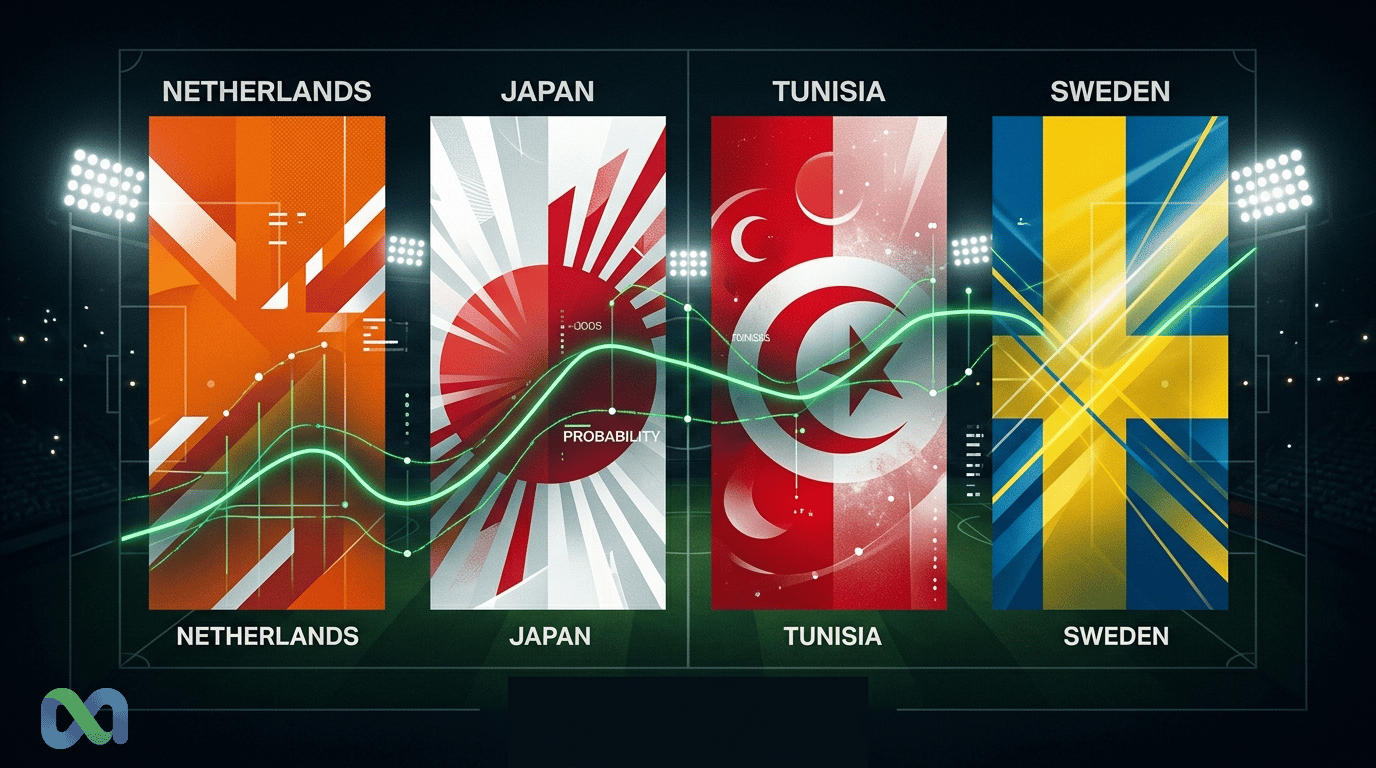
World Cup 2026 Group F brings together the Netherlands, Japan, Tunisia, and Sweden. The group runs from June 14 to June 25, with matches in Dallas, Monterrey, Houston, and Kansas City. The top two teams advance directly. The third-place team can also survive if it finishes among the eight best third-place sides in the group stage.
This guide puts the practical details first: teams, table, schedule, Brazil time, and qualification format. Then it moves into team strength, classification scenarios, and the markets that make sense to watch on Macro Markets.
The basic read is simple. The Netherlands arrive as the technical favorite. Japan and Sweden form the most sensitive fight for second place. Tunisia enter as the underdog, but they can change the whole calculation if they take points early.
Because the 2026 World Cup has 48 teams, third place carries more value. A group does not need three giants to become dangerous. One favorite can slip, one direct match can end level, and one disciplined team can keep its goal difference under control.
Before going deeper, fix the central idea. A search for World Cup 2026 Group F is not only a search for a schedule. It combines fixtures, standings, favorites, and market scenarios. This page treats World Cup 2026 Group F as a live guide that should be updated as results and probabilities move.
Quick read: the group is clear, but not easy. The Netherlands have the most talent. Japan play with rhythm. Sweden bring physical pressure. Tunisia need cold execution. The calendar matters. Goal difference matters. Every goal can change the calculation.
World Cup 2026 Group F Summary
World Cup 2026 Group F includes the Netherlands, Japan, Tunisia, and Sweden. The group starts on June 14 and ends on June 25. The top two teams qualify directly for the round of 32. The third-place team can qualify if it ranks among the eight best third-place teams.
That mix creates a group with different layers. There is a clear European favorite. There is a mature and organized Asian team. There is a Swedish side built for physical duels. There is also a Tunisia team that usually competes best when it can defend in a low block.
Teams in the Group
The four teams in Group F are:
| Team | Initial read | Likely role in the group |
|---|---|---|
| Netherlands | Favorite | Candidate to win the group |
| Japan | Strong top-two candidate | Transition team with structure and speed |
| Sweden | Strong top-two candidate | Physical team, direct style, dangerous in the air |
| Tunisia | Underdog | Can take points by closing space and slowing tempo |
The Netherlands and Sweden bring European weight and history. Japan arrive with a strong recent reputation for structure and discipline. Tunisia have a lower attacking ceiling, but they can be hard to beat in low-scoring games.
Qualification Format
The 2026 World Cup group stage sends the top two teams from each group into the knockout phase. It also sends the eight best third-place teams through. That changes how the table should be read.
In older World Cups, third place meant direct elimination. Now four points can be very strong. Three points can keep a team alive if goal difference does not collapse. That is why Group F needs two reads at the same time: the top-two race and the parallel race among third-place teams.
Why This Group Matters for Brazil Fans
Group F can also matter for Brazilian fans because of the bracket. Future matchups may involve teams coming from nearby paths, depending on final positions and the round-of-32 draw. That makes the group relevant for anyone mapping Brazil's possible knockout route.
The Netherlands, Japan, and Sweden also create very different risks. The Netherlands press with technical quality. Japan accelerate after regaining the ball. Sweden can turn corners and wide free kicks into real advantage.
Group F Table: Teams, Points, and Tiebreakers
Before kickoff, every team starts on zero. The table should be updated after each round with matches, wins, draws, losses, goals for, goals against, goal difference, and points.
| Position | Team | P | W | D | L | GF | GA | GD | Pts |
|---|---|---|---|---|---|---|---|---|---|
| 1 | Netherlands | 0 | 0 | 0 | 0 | 0 | 0 | 0 | 0 |
| 2 | Japan | 0 | 0 | 0 | 0 | 0 | 0 | 0 | 0 |
| 3 | Sweden | 0 | 0 | 0 | 0 | 0 | 0 | 0 | 0 |
| 4 | Tunisia | 0 | 0 | 0 | 0 | 0 | 0 | 0 | 0 |
The order above is not a final prediction. It is an initial pre-tournament read. The official standings should follow FIFA's table and competition rules.
How to Read the Table
For World Cup 2026 Group F, the key is to separate points from calendar quality. A team can lead after the first round because it faced the weakest opponent. Another team can sit third after losing to the favorite, while still having a clean path to qualify.
So watch three signals together. First, points earned. Second, goal difference. Third, opponents already played. In the 2026 format, goal difference can decide comparisons between third-place teams from different groups.
Tiebreakers and Fair Play
FIFA uses criteria such as points, goal difference, goals scored, and direct meetings. If a tie remains, disciplinary points and a drawing of lots can enter the calculation. The official source for live standings is FIFA's World Cup 2026 standings page.
In practice, this creates an incentive to play until the end. A late goal conceded may not change a team's position inside the group, but it can hurt that team in the third-place comparison.
When the Third-Place Team Can Advance
The third-place team from Group F should have a strong chance if it finishes with four points. That usually requires one win, one draw, and one controlled defeat. Three points can be enough in some scenarios, but it depends heavily on goal difference and results in other groups.
Tunisia, for example, can target one direct-match win and try to keep the favorite close. Japan and Sweden may also see third place as a backup plan if their direct match does not create a clear edge.
World Cup 2026 Group F Fixtures: Dates, Times, and Stadiums
The World Cup 2026 Group F schedule has six matches between June 14 and June 25, 2026. The times below use Brazil time from the research brief.
| Date | Match | Stadium | City | Brazil time |
|---|---|---|---|---|
| June 14 | Netherlands vs Japan | AT&T Stadium | Arlington/Dallas | 17:00 |
| June 14 | Sweden vs Tunisia | Estadio BBVA | Monterrey/Guadalupe | 23:00 |
| June 20 | Netherlands vs Sweden | NRG Stadium | Houston | 17:00 |
| June 20 | Tunisia vs Japan | Estadio BBVA | Monterrey/Guadalupe | 01:00 on June 21 |
| June 25 | Japan vs Sweden | AT&T Stadium | Arlington/Dallas | 20:00 |
| June 25 | Tunisia vs Netherlands | Arrowhead Stadium | Kansas City | 20:00 |
The match order gives the group a clear shape. Netherlands vs Japan opens the section with top-of-group weight. Sweden vs Tunisia closes the first round with direct pressure on the second tier. For anyone researching World Cup 2026 Group F, this sequence explains why the first round can reprice World Cup 2026 Group F.
Netherlands vs Japan, June 14, AT&T Stadium
This match can set the tone for World Cup 2026 Group F. If the Netherlands win, they confirm favorite status early. If Japan take points, the group opens from the first round.
For prediction markets, this match should move the group-winner price sharply. It also affects top-two markets, because Japan and Sweden are likely to compete within a narrow margin.
Sweden vs Tunisia, June 14, Estadio BBVA
Sweden vs Tunisia is a match Sweden probably cannot waste. A win puts Sweden in a good position before meetings with the Netherlands and Japan. A draw, however, gives Tunisia life.
For Tunisia, taking points in the opener is the cleanest route to a competitive third-place case. A heavy defeat would be the worst outcome, because it damages goal difference from the start.
Netherlands vs Sweden, June 20, NRG Stadium
This match tests the favorite against a physical opponent. Sweden can make the game uncomfortable if they control set pieces and second balls. The Netherlands need to turn possession into clear chances.
If Sweden win the opener, a draw here can carry high value. If they drop points against Tunisia, this game becomes a maximum-pressure spot.
Tunisia vs Japan, June 20, Estadio BBVA
Tunisia vs Japan may be a game of opposite styles. Japan should want rhythm, coordinated pressure, and acceleration. Tunisia may look for a low block, short transitions, and emotional control.
This match is vital for third place in World Cup 2026 Group F. If Japan do not beat the Netherlands in the opener, the Tunisia match becomes a practical must-win to keep a strong top-two path.
Japan vs Sweden, June 25, AT&T Stadium
Japan vs Sweden can become the direct match for second place. It can also decide which team enters the ranking of best third-place sides. Because of that, table context will be everything.
If both teams arrive alive, a draw may help both sides in some combinations. Yet that type of scenario is dangerous. One goal in the other match can change the math in seconds.
Tunisia vs Netherlands, June 25, Arrowhead Stadium
The Netherlands' final match can have two shapes. If they have already qualified, they may manage minutes. If they have dropped points earlier, they will need a stronger team and a stronger result.
For Tunisia, this is the hardest match in the group. Even so, an organized side can chase a draw if the context allows it. In a World Cup, that point can be worth a lot.
Team Analysis for Group F
World Cup 2026 Group F combines very different styles. That increases the chance of tight matches. It also makes pre-match analysis richer, because each matchup changes the relative edge.
Netherlands: Technical Favorite With the Highest Ceiling
The Netherlands enter as the natural favorite in Group F. The team usually has a strong defensive base, high-level European players, and the ability to control territory. In a short group, that combination matters.
The risk is efficiency. Favorites can dominate volume and still suffer if they do not convert early. Against Japan and Sweden, the first goal changes everything. If the Dutch fall behind, they may face longer and more physical matches.
Even with that risk, the base case still puts the Netherlands on top of World Cup 2026 Group F. They have the deepest squad and the highest technical ceiling in the group.
Japan: Structure, Fast Transitions, and Recent Consistency
Japan should be treated as a real top-two candidate. The team has improved in structure, intensity, and game reading. It also tends to compete well against stronger opponents when it can accelerate after winning the ball.
The key point will be final-third efficiency. Japan can create strong transition attacks, but it must turn good sequences into goals. Against the Netherlands and Sweden, wasted chances carry a high cost.
The match against Sweden may decide the group's second line. Japan should have more mobility. Sweden should have more physical power. The team that controls rhythm should gain the edge.
Sweden: Physical Strength, Aerial Threat, and a Direct Match
Sweden enter as Japan's direct rival for second place. The team can be dangerous through crosses, set pieces, and physical duels. That profile works in World Cups, because short tournaments punish simple mistakes.
The opener against Tunisia is very important. With three points, Sweden gain margin before facing the Netherlands and Japan. Without a win, pressure rises quickly.
The match against Japan in the final round can become an internal final for World Cup 2026 Group F. If Sweden arrive with four points, they may play with more control. If they arrive with three or fewer, they may need to open up.
Tunisia: Underdog, Compact Defense, and Routes to Points
Tunisia are not favorites, but they should not be ignored. Their route in World Cup 2026 Group F depends on defensive organization, few clear chances conceded, and strong use of specific moments.
In a group with one favorite and two strong middle teams, the underdog needs controlled chaos. That means losing narrowly when losing, drawing when an opponent is tense, and stealing a win in the right match.
The natural target is Sweden or Japan. If Tunisia take points early, they turn Group F into a calculation group, not only a favorite-driven group.
World Cup 2026 Group F Favorites and Qualification Scenarios
Before the matches, the cleanest read on World Cup 2026 Group F is by tiers. The Netherlands sit in the first tier. Japan and Sweden occupy the second. Tunisia are in the third, but they can interfere with the rivals' point totals.
This is not a promise of results. It is a risk map. In a World Cup, injury, red cards, weather, and match order can change everything.
Base Case: The Netherlands Win the Group
The base case has the Netherlands winning at least two matches or reaching seven points. That would likely give them the group and leave Japan and Sweden to fight for second.
A win over Japan in the opener would make this scenario much stronger. At the same time, a draw in the opener would create space for Sweden and Japan to pressure the lead.
Second-Place Race: Japan vs Sweden
Japan vs Sweden is the competitive axis of World Cup 2026 Group F. Japan should create more through speed and coordination. Sweden should bother opponents with physical presence and aerial balls.
If both beat Tunisia, their final-round direct match looks like a decision game. If one of them slips against Tunisia, the other can enter the field with more margin.
How Tunisia Can Survive the Group
Tunisia need a pragmatic path. First, avoid a heavy defeat. Second, take a point against Sweden or Japan. Third, reach the last round with a real third-place chance.
That path does not require dominant football. It requires discipline and precision. A draw with Sweden, for example, would change the probabilities across World Cup 2026 Group F.
Likely Points Needed for Third Place
Four points should be a strong target for any third-place team. Three points may be enough, but they create dependence on goal difference and outside results. Two points almost always leave a team in a weak position.
That is why World Cup 2026 Group F teams need to think about goal difference from the first match. A one-goal defeat is different from a three-goal defeat. In 2026, that difference can decide qualification.
Relevant Markets to Watch
World Cup 2026 Group F offers useful markets for anyone who follows football through probabilities. The goal is not to search for certainty. The goal is to understand what information moves price.
On Macro Markets, the best read combines schedule, tactical context, and market updates. Probabilities move when lineups come out, when injuries appear, and when other groups change the math for third-place teams.
Group F Winner
The World Cup 2026 Group F winner market should react strongly to Netherlands vs Japan. A Dutch win would confirm the initial thesis. A draw would open the door to alternatives.
Sweden can also gain price if they beat Tunisia clearly. In a short group, goal difference and visual control matter to traders.
Qualification for the Knockout Stage
The qualification market is different from the group-winner market. A team can have a low chance of winning the group and a strong chance of advancing. That is especially true for Japan and Sweden.
With the new format, even third place can hold value. So it is important to separate top two from overall advancement.
Team Points
Team-points markets summarize expectations. A high Netherlands line signals confidence in the favorite. Similar lines for Japan and Sweden signal a balanced race. A low Tunisia line shows the underdog role.
These markets also help frame scenarios. A team projected for four points may be closer to qualification than it looks.
Direct Match Results
Direct matches are the biggest repricing events. Netherlands vs Japan opens the group. Japan vs Sweden can close the race. Sweden vs Tunisia can show whether Tunisia are a side issue or a real problem.
In every case, the market should react more to context than to the name alone. A narrow win can be read differently from a controlled win.
Player Markets: Goals, Assists, and Cards
Player markets can grow near match day. They depend on lineups, roles, and the opponent. Forwards against a low block have a different profile from forwards in transition games.
Cards also deserve attention. Physical matches such as Sweden vs Tunisia or Sweden vs Japan can include more contact and more aerial duels. Still, any read should wait for the referee and confirmed lineups.
Prediction markets involve risk. Probabilities are not guarantees. They reflect available information, liquidity, and aggregated opinion at that moment.
Simulate World Cup 2026 Group F
The best way to understand World Cup 2026 Group F is to test scenarios. A short table can deceive. A draw in the first round can look neutral, but it can completely change the path for the third-place team.
Use a World Cup 2026 simulator to combine scorelines and compare their impact on the standings. Then compare your simulation with market probabilities when they become available. FIFA's match schedule guide is a useful reference for dates, venues, and order.
How to Use the Simulator
Start with the base case. Put the Netherlands beating Japan and Sweden. Then vary Japan vs Sweden and the matches against Tunisia. Watch how four points change the final position.
Next, test the chaos case. Give Tunisia one draw and one narrow defeat. See how goal difference becomes a central variable.
Scenarios to Test Before Kickoff
Three scenarios deserve attention:
- The Netherlands win the first two matches and rotate in the final round.
- Japan take points from the Netherlands and force Sweden to win the direct match.
- Tunisia draw with Sweden and turn the second-place race into a low-points fight.
These scenarios are not closed predictions. They are tests of sensitivity. The smaller the margin, the more valuable it becomes to update your read after each match.
Compare Simulation With Market Probabilities
A World Cup 2026 Group F simulation shows possible paths. The market shows the current price of those paths. When the two disagree, a useful question appears: do you have better information, or are you ignoring something the market has already priced?
That is the difference between cheering and analyzing. In Group F, the answer can change from round to round.
FAQ: World Cup 2026 Group F
What teams are in World Cup 2026 Group F?
World Cup 2026 Group F has the Netherlands, Japan, Tunisia, and Sweden. The matches take place from June 14 to June 25. The top two teams advance directly, and the third-place team can qualify if it ranks among the best third-place sides.
What is the Group F points table?
Before the tournament, every team starts with zero points. The table should be updated after every match with points, goal difference, and goals scored. Those criteria can be decisive for the third-place team.
Who was drawn into Group F?
The Netherlands, Japan, Tunisia, and Sweden were drawn into Group F. It is a group with a European favorite, a strong battle for second place, and an underdog that can complicate the math. For background, see the 2026 FIFA World Cup Group F page.
Have the 2026 World Cup groups been decided?
Yes. The 2026 World Cup has 12 groups in the first phase. Group F includes the Netherlands, Japan, Tunisia, and Sweden. Fans following World Cup 2026 Group F should follow official FIFA standings for live updates once matches begin.
Who could Brazil face from Group F?
The matchup depends on Brazil's final position, Group F's final position, and the round-of-32 bracket. That is why the scenario should be updated during the group stage, not treated as a fixed path before kickoff.
Conclusion
World Cup 2026 Group F is more interesting than it first appears. The Netherlands enter as favorites. Japan and Sweden should fight the most direct battle for second place. Tunisia are the underdog, but they can change everything if they take points early.
The group also shows why the 2026 format changes analysis. Third place can mean qualification. So goal difference, match order, and final-round context matter more than they did in previous World Cups.
To follow the group well, do not only memorize the schedule. Simulate scores, compare scenarios, and watch how the market adjusts probabilities after each new piece of information. That is how Group F stops being only a calendar and becomes a real World Cup read.
