


Argentina at the 2026 World Cup: real title chances
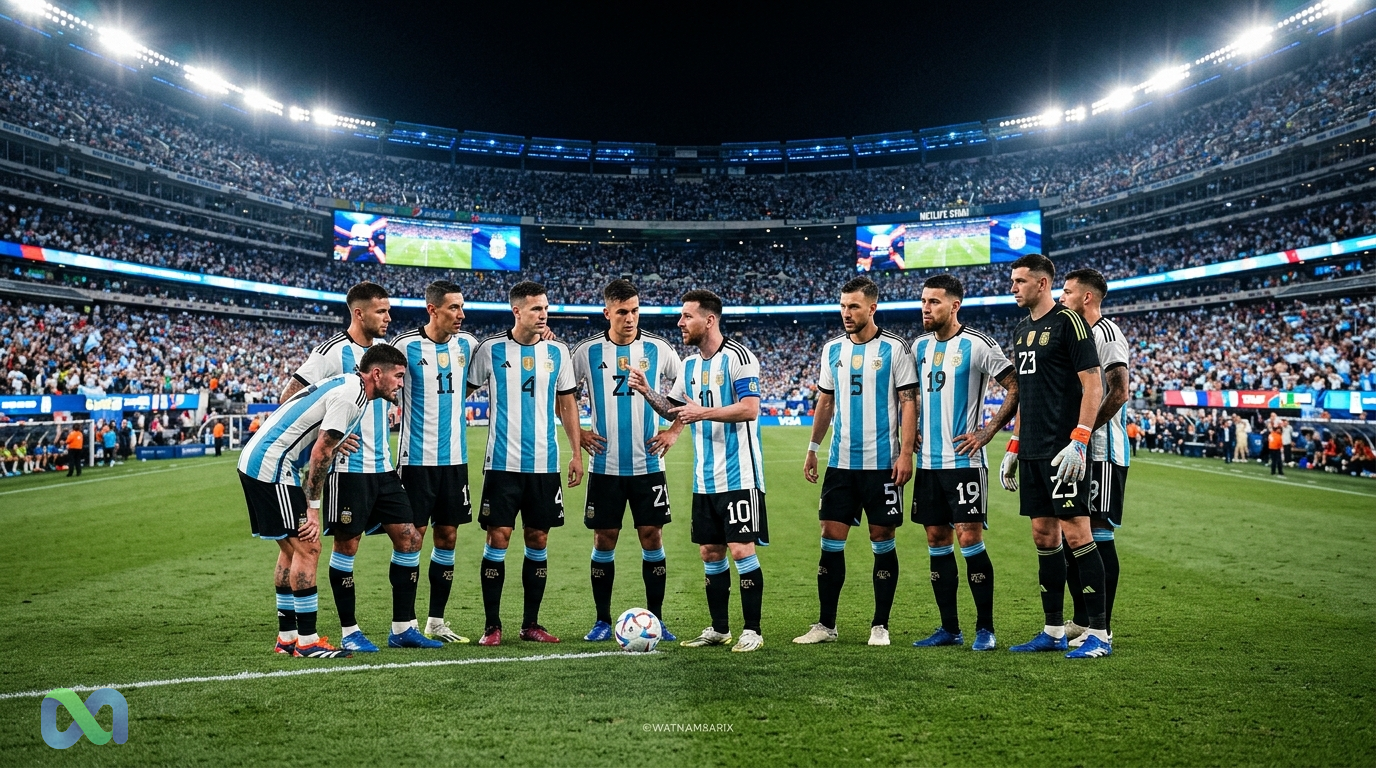
Argentina heads into the 2026 World Cup carrying a rare burden: defending the title and proving that the 2022 championship cycle still supports a genuinely competitive project. That puts the national team at the center of the debate among fans, media, and markets. The question is not only whether Argentina has talent. The real question is whether the squad still brings together enough depth, stability, and context to repeat a run in the hardest tournament in football.
To answer that, it helps to look beyond the hype. In a World Cup, favoritism depends on squad depth, qualification consistency, tactical flexibility, and the management of a generational transition. That is why Argentina 2026 World Cup odds and Argentina title chances 2026 remain such relevant topics for anyone who follows football with an analytical lens.
In this guide, we will evaluate the factors that matter most in the title race. We will also show where Argentina looks strongest, which risks could slow the campaign, and how to read Argentina World Cup 2026 chances more soberly and usefully.
Is Argentina still one of the favorites in 2026?
Yes, Argentina belongs in the top tier of contenders, but not in a class of its own. After winning in 2022, the team started being judged by a different standard. The benchmark is no longer a respectable run. It is whether Argentina can seriously compete with the best teams in the field.
That status has a concrete basis. Argentina has kept a competitive structure, preserved much of its tactical identity, and continues to produce high-level players. On top of that, the squad has already shown it can perform under knockout pressure, which matters in a World Cup more than almost anything else.
Still, Argentina 2026 World Cup odds are not built on memories alone. The tournament will include more teams, more fatigue scenarios, and several rivals with elite depth. That is why the best framing may be this: Argentina starts the tournament as a real contender, but its title chances will depend more on execution than reputation. To understand the broader setup of the event, it also helps to review this complete 2026 World Cup guide.
The weight of the 2022 championship core
One of Argentina’s biggest assets is continuity. Champion teams often lose force when they replace leadership too quickly or dismantle the spine of the side. In Argentina’s case, the transition still looks relatively controlled. A meaningful share of the group that won in 2022 continues to provide competitive experience and collective understanding.
That matters because short tournaments reward chemistry. The most talented squad does not always win. Quite often, the team that advances is the one that makes fewer mistakes in tight matches. Argentina showed that profile in Qatar and is trying to preserve the same edge for 2026.
At the same time, continuity cannot become dependency. A national team that tries to repeat the same structure without renewing intensity can lose sharpness. The challenge before 2026 is to balance competitive memory with physical renewal. That is exactly where the difference lies between a team that returns strong and a champion that arrives too late for the next cycle.
Does Messi still raise Argentina’s ceiling?
Any serious discussion about Argentina world cup 2026 odds still passes through Lionel Messi, even if the squad is less dependent on him than it was in 2022. If he is available and physically sharp, Messi still raises the technical ceiling of the side. Very few players in world football change the way an opponent prepares a match as much as he does.
But the central point is no longer building everything around the No. 10. Argentina looks better prepared to distribute creative and attacking responsibility across the squad. That is a healthy sign. Over a long tournament, relying less on one player makes a team more resilient.
On the other hand, Messi’s presence still changes the emotional reading of the competition. He brings calm, draws defensive attention, and creates a psychological edge. Even in a more selective role, he can be decisive in tight knockout matches. So the right question is not whether Argentina depends entirely on him. It is how much he still expands the upside of a team that is already competitive on its own.
Squad renewal and depth matter more than headlines
To sustain a credible title case, Argentina needs more than established stars. It needs real depth. Injuries, suspensions, and physical decline are part of every World Cup. Teams that go deep usually have answers on the bench.
The positive sign for Argentina is that the renewal process does not look empty. The national team keeps producing players who can fill important functions across different areas of the pitch. That gives the coaching staff more freedom to adjust pressure, speed, and intensity depending on the opponent.
Still, real depth is not just about quantity. It is about useful quality under knockout conditions. A backup has to enter and preserve the level of the team. If Argentina arrives in 2026 with reliable alternatives at fullback, in midfield, and in the wide attacking channels, its Argentina title chances 2026 improve meaningfully. If not, the squad could feel thin exactly when the tournament starts demanding quick solutions.
Why Argentina’s style of play can travel well in a short tournament
Recent Argentina teams have stood out for one important trait: flexibility without losing identity. That is a major advantage in a World Cup. National teams that are too rigid tend to suffer when they meet very different opponents in back-to-back rounds. More adaptable sides usually survive better in decisive stages.
Argentina has shown the ability to alternate between high pressure, a mid-block, and more patient possession phases. It has also varied how it uses the wings and when it accelerates transitions. That tactical elasticity reduces the risk of collapse after one bad matchup.
There is also an emotional component. Argentina learned how to compete with maturity. That means understanding when to attack aggressively and when to accept a tighter, more controlled game. In knockout football, that reading is worth almost as much as raw talent. If the team repeats that discipline in 2026, it will carry a real edge against rivals that may look brighter on paper but less balanced in practice.
The main risks to Argentina’s 2026 campaign
Not every threat comes from the opposition. In World Cups, champions also need to escape their own weak points. For Argentina, the first risk is physical wear. Veteran players may arrive with heavy mileage, especially in an increasingly dense club calendar.
The second risk is emotional pressure. Defending a title brings extra weight. Every opponent treats the reigning champion as both a reference point and a motivation boost. That changes the temperature of matches, including in the group stage. A side used to controlling games may face harsher and less comfortable environments.
The third risk is an incomplete transition. If the squad gets stuck between the old core and the new generation, cohesion can slip. That kind of noise may not show up clearly in friendlies, but it matters in knockout football. This is why the lead-up to 2026 will be less about flash and more about role clarity.
Which teams can knock Argentina off the top?
If Argentina wants to retain the title, it will have to come through a crowded field of heavy favorites. European sides with deeper player pools, traditional powers moving into stronger phases of their cycle, and fast-rising teams all make the landscape tougher than emotional narratives usually admit.
The relevant point is that Argentina does not need to be the best team in the world for four straight years. It needs to be the best over seven matches. That may sound obvious, but it changes everything. In a short tournament, structure, efficiency, and context-reading count for a lot. That was true in 2022, and it should be true again in 2026.
Even so, the deeper the tournament goes, the smaller the margin for error becomes. Against elite opposition, details decide who advances. A set piece, a wrong substitution, or one below-par day can undo favoritism. Argentina knows that. And perhaps because it knows it, the team may handle the pressure of the tournament better than rivals who are more used to talking about superiority than proving it.
What the market looks at when pricing a favorite
When markets assess a World Cup contender, they do not look only at history or shirt weight. The price of a team usually reflects a blend of factors: overall squad quality, recent form, coaching stability, tournament pedigree, and the likely path through the bracket.
In that sense, Argentina tends to draw respect because it combines three valuable traits. First, it has already shown it can win major matches. Second, it has a clear tactical identity. Third, it still has players who can decide games in a handful of moments.
But market pricing also penalizes aging risk, creative dependence, and physical volatility. That is why the smartest way to read Argentina 2026 World Cup odds is not as a binary call. The question is not simply whether Argentina will win or fail. The better question is which signs strengthen the title case and which signs force a reassessment as the tournament gets closer. If you like following that kind of setup, it also makes sense to watch how Macro Markets frames sports events and probabilities.
Should you trust Argentina in 2026?
Yes, as long as the reading stays balanced. Argentina has the structure, competitive repertoire, and recent track record to enter the 2026 World Cup as one of the strongest teams in the tournament. That does not guarantee a title, but it does justify serious respect.
The bullish case for Argentina is consistent. There is continuity in the work, a strong competitive culture, and enough talent to challenge any opponent. Few national teams arrive with such a solid combination of experience and battle-tested composure.
Even so, the picture needs monitoring. The age profile of the core, the integration of new names, and the physical level at the moment of the tournament will all be decisive. In short, Argentina is not just a strong story for 2026. It is a concrete contender. Anyone who follows the cycle carefully will be in a better position to separate hype from real probability.
If you like reading major tournaments through a market lens, it is worth tracking how consensus around the favorites changes over time. In environments like that, understanding context before price is usually the better edge. To widen the view, it also helps to revisit the complete 2026 World Cup guide, read FIFA coverage of the 2026 World Cup format, and compare broader football analysis from The Analyst.
