


Liquidity Pool: What It Is and How It Affects Prediction Markets
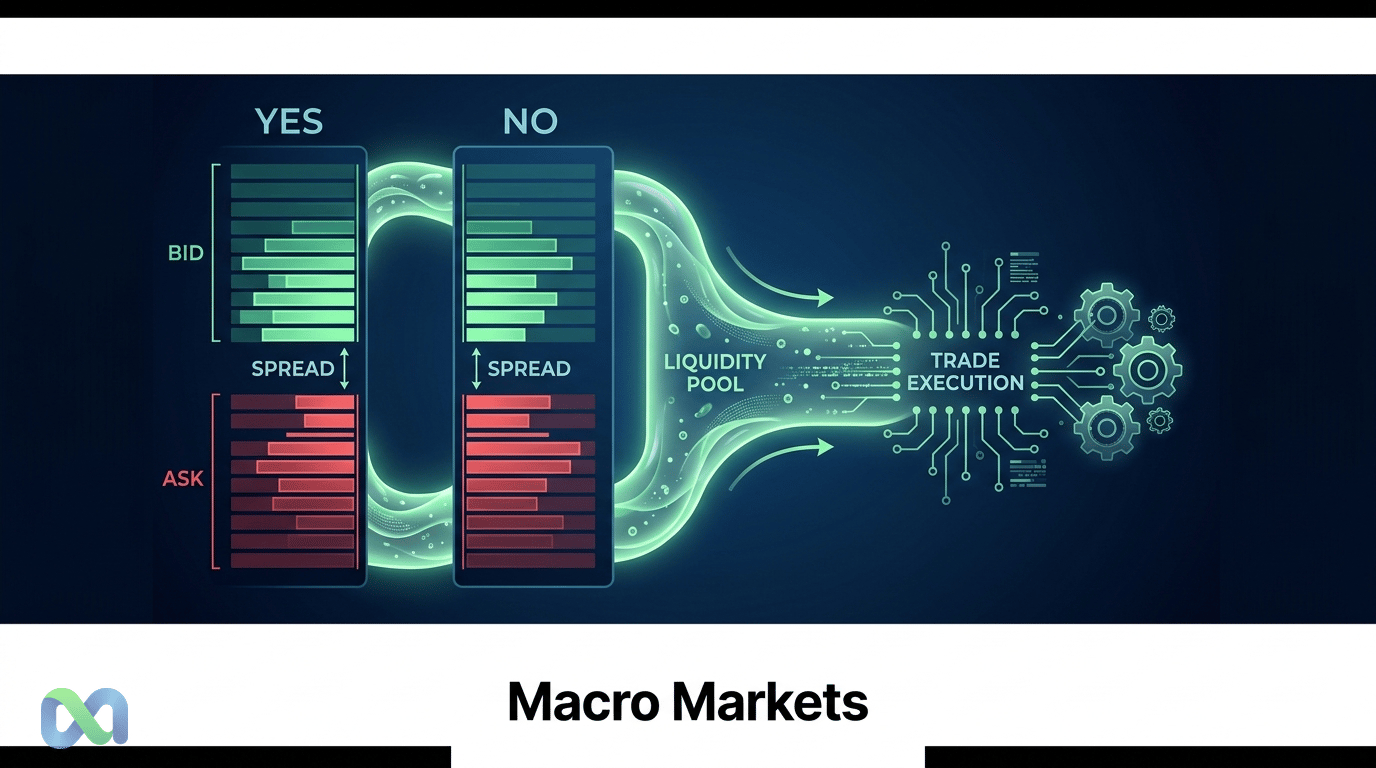
A liquidity pool is a reserve of capital, orders, or quotes. It allows trading without waiting for a perfect counterparty. In prediction markets, it affects entry, exit, spread, slippage, and the quality of the probability you see on screen.
The term became famous in DeFi, especially on decentralized exchanges. In prediction markets, however, it requires a more careful reading. Sometimes the pool is a literal reserve of capital. In other cases, it is the sum of orders in the book, the inventory of market makers, or an algorithmic curve that continuously offers prices.
That difference changes everything for the trader. A market may show “52%” for an outcome, but that number is not enough. You need to know how much you can buy at 52%. You also need to know the average price of a larger order. Finally, you need to know whether you could exit without moving the price against you.
This guide explains liquidity pool from a microstructure perspective. The idea is simple: liquidity is not a technical detail. It shows whether a probability is tradable. It also shows whether the cost is fair and whether the market can absorb new information.
In simple terms: more liquidity tends to make the trader’s life easier. Less liquidity tends to increase cost and reading error. That is the central point of this article.
Educational content. Not financial, legal, or trading advice. Numerical examples are hypothetical.
Quick explanation in plain English
Think of a street market. When there are many stalls, many customers, and many products, buying is easy. You compare prices and choose. If there is only one stall open, the price gets worse. You have less choice.
A liquidity pool plays a similar role in a digital market. It provides inventory so the trade can happen. That inventory can come from orders, capital, or a pricing bot.
For traders, the simple question is this: “If I buy now, do I pay close to the price shown on screen?” If the answer is yes, the market has good liquidity for your size. If the answer is no, the real cost may be higher.
Another question is: “If I want to exit, is there a buyer?” That point is just as important as entry. A good entry price loses value if the exit is expensive.
That is why you should not look only at the probability. Look at the path to execution. Check spread, depth, recent volume, and time until the event ends. Those four data points show whether the price is useful or only a weak reference.
The practical rule is simple. A busy market gives you choice. An empty market takes choice away. A good price on screen is not enough. You need to be able to buy and sell near that price. If you cannot, there is a hidden cost.
Use a small order as a mental test. Would it move the price? If it would not, there is good room to trade. If it would move the price a lot, the market is shallow. In that case, reduce size, wait for more liquidity, or accept that the real price will be worse.
Also think about the exit. A trade only ends when you sell or when the event resolves. If the exit has few buyers, your paper profit can disappear. Liquidity protects against that kind of surprise.
What is a liquidity pool?
A liquidity pool is a source of liquidity that allows buyers and sellers to trade with less friction. It can be formed by capital locked in an AMM, limit orders in a book, or quotes from a market maker. The larger and better distributed that liquidity is, the lower the execution cost tends to be.
Translation: pool of liquidity
In English, liquidity pool literally means a pool of liquidity. The phrase helps, but it can hide important details.
“Pool” suggests a single reservoir. In DeFi, that is often literal: users deposit two or more tokens into a contract. The algorithm uses that capital to allow swaps.
In prediction markets, the term can be broader. It can refer to several sources of liquidity.
- capital allocated by a platform to create initial liquidity;
- buy and sell orders waiting for execution;
- a market maker’s inventory;
- an AMM pricing curve;
- depth available at each price level.
Therefore, liquidity pool does not always mean the same technical structure. The common point is the function: allowing the market to trade.
Think of an open-air market. If there are many buyers and sellers, you find a price quickly. If there are few people, any purchase changes the price. The logic is similar. The liquidity pool is what gives the market breathing room.
Available liquidity, volume, and open interest
Three metrics are often confused.
Available liquidity is how much the market can accept right now at prices close to the current price. It shows immediate depth.
Trading volume is the total that has already changed hands. A market can have high historical volume and little liquidity now.
Open interest is the exposure that remains open. It shows outstanding positions, but it does not guarantee that you can enter or exit with little slippage.
This distinction is critical. Past volume tells a story. Available liquidity defines your current execution.
How a liquidity pool works in practice
A liquidity pool reduces the classic problem of finding a counterparty. Without liquidity, you may want to buy a “Yes” contract, but nobody wants to sell at the price you accept. With liquidity, there is capital or an order ready to absorb your trade.
Bid, ask, spread, and depth
In a simple binary event market, imagine a “Yes” contract on a central bank decision. The best buyer pays 48¢. The best seller asks 52¢.
- Bid: 48¢, the price at which someone wants to buy.
- Ask: 52¢, the price at which someone wants to sell.
- Spread: 4¢, the difference between the two.
- Depth: the quantity available at each price.
If you buy immediately, you pay the ask. If you sell immediately, you receive the bid. The spread is a friction cost.
In liquid markets, the spread tends to be smaller. In addition, there is more depth near the current price. That allows larger orders with less impact.
Slippage and price impact
Slippage is the difference between the expected price and the average executed price. Price impact is how much your own order pushes the price.
Imagine there is only $100 available at 52¢, another $150 at 55¢, and another $300 at 58¢. A small buy can execute at 52¢. A larger buy crosses levels and pays a higher average price.
The trader did not buy “at 52%.” They bought a basket of prices. That average defines the real break-even.
The role of the market maker or liquidity provider
The market maker offers buy and sell prices. They receive the spread or fees in some models, but they take risk.
If informed traders arrive before the market maker adjusts quotes, the market maker can end up on the wrong side. This risk is called adverse selection. In binary events, it can be severe because one piece of news can change the probability abruptly.
That is why liquidity is never free. It exists because someone takes inventory, capital, and information risk.
Liquidity pools in DeFi vs prediction markets
Brazilian SERPs often explain liquidity pool as a DeFi concept. That explanation is useful, but it is not enough for prediction markets.
AMMs and token pools
On a decentralized exchange, the liquidity pool usually holds pairs of tokens. A user deposits, for example, SOL and USDC. The contract allows swaps between the two assets. In return, providers may receive fees, incentives, or both.
This structure depends on a formula, relative price, and token variation risk. The focus is swapping one asset for another.
Yes/No contracts, probabilities, and resolution
In prediction markets, the asset is different. A “Yes” contract pays if the event happens. A “No” contract pays if it does not.
The price represents an implied probability adjusted for costs, spread, fees, and risk. If “Yes” trades near 60¢, the market suggests something close to 60% before costs. But that reading only makes sense if there is enough liquidity.
There is also resolution. The event ends, a source decides the result, and the contract pays out or goes to zero. That resolution risk does not appear in ordinary token pools.
When the pool is literal and when it is a metaphor
Sometimes, a platform uses an AMM with capital in a curve. In that case, the pool is literal.
In other cases, the platform uses a central limit order book, also called a CLOB. Liquidity comes from open orders. In that case, “pool” becomes a practical way to talk about aggregated depth.
The difference matters. An AMM always offers a price within its defined rule. A CLOB depends on real orders in the book. A market maker can remove quotes when risk changes.
CLOB, LMSR, and AMM: three ways to provide liquidity
Prediction markets can use different microstructure designs. Each solves the liquidity problem in a different way.
Order book/CLOB: liquidity through limit orders
CLOB means central limit order book. It is the classic order book model. Buyers and sellers post prices and quantities. The system matches compatible orders.
The advantage is transparency. You see bid, ask, and depth by level. The disadvantage is that small markets can become empty.
Polymarket’s public documentation describes trading through a CLOB in its technical trading area. This shows how a prediction market can depend on orders in the book, not only on an automatic pool.
LMSR/AMM: algorithmic liquidity and pricing curves
LMSR is a family of market scoring rules proposed by Robin Hanson. The goal is to create an automated market maker for information. The classic version appears in Hanson’s paper on market scoring rules.
In practice, an AMM defines a curve. The more traders buy an outcome, the higher that outcome’s price becomes. This way, the system guarantees a continuous quote, but the price changes with the order.
This design is useful for new markets. It avoids the empty-book problem. However, large orders can create meaningful price impact.
Market makers: capital, inventory, and risk
Human or automated market makers can also provide liquidity. They adjust prices based on flow, news, and exposure.
This model is common in financial markets. In prediction markets, the challenge is greater because events can jump from 40% to 80% in minutes. An election poll, a court decision, or an economic data release can change the distribution of outcomes.
Therefore, the market maker needs to control inventory. They also need to reduce exposure when information becomes asymmetric.
Why liquidity changes the quality of probabilities
A market probability looks objective. But it is a price. And every price carries friction.
A high spread can distort the reading
If the bid is 45¢ and the ask is 60¢, what is the real probability? The answer is not simple.
The midpoint of the spread would be 52.5¢. But perhaps nobody trades at that point. The last trade may have been small, old, or made before a news event.
In those cases, the displayed probability is a weak signal. It still informs something, but it must be read carefully.
A liquid market updates information faster
Liquid markets absorb information more efficiently. When a poll comes out, traders can reposition capital without destroying the price.
In illiquid markets, a single order can look like a large probability change. Under the surface, it may simply be a lack of depth.
That is the difference between signal and noise. Liquidity helps separate the two.
Liquidity near event resolution
Liquidity also changes over time. Near resolution, some traders reduce risk. Others enter because they have more current information.
The spread can widen or tighten. Depth can disappear. And the price can become more sensitive.
Before trading near expiry, check the resolution rules, official source, and time remaining. A market near the end can look “cheap,” but execution risk may be high.
Example in prediction markets: buying Yes in a thin market
Let’s use a hypothetical example. The market asks: “Will the central bank hold the rate at the next meeting?” The “Yes” contract pays $1 if that happens.
The book shows a bid of 48¢ and an ask of 52¢.
| Sell level | Quantity available | Price |
|---|---|---|
| 1 | $100 | 52¢ |
| 2 | $150 | 55¢ |
| 3 | $300 | 58¢ |
| 4 | $500 | 62¢ |
Small order
If you buy $50, the entire order executes at 52¢. Your average price is 52¢. To break even before fees, you need the real probability to be higher than 52%.
In this case, slippage is low. The liquidity pool available at the first level absorbed the order.
Large order
Now imagine a $400 buy. It consumes $100 at 52¢, $150 at 55¢, and $150 at 58¢.
The average price is close to 55.4¢. You did not enter at 52¢. Your own order raised the cost.
This changes the analysis. Maybe you thought there was value at 52%. However, the real execution requires conviction above 55.4%, before costs.
How more liquidity would change the result
If there were $1,000 available at 52¢, the same $400 order would execute with an average price of 52¢. The trade would have a different risk profile.
That is the practical value of the liquidity pool. It does not only “allow trading.” It changes the real entry and exit price.
Risks for liquidity providers
Providing a liquidity pool can look like passive income. That view is incomplete.
Adverse selection
Adverse selection occurs when informed traders trade against available liquidity. They buy before positive news or sell before negative news.
The liquidity provider receives flow, but may receive the wrong flow. In prediction markets, this matters a lot. New information changes probabilities quickly.
Binary events and tail risk
Binary events have discontinuous payoff. A contract can be worth near zero or near $1 after resolution.
This creates tail risk. A small pricing error can become a large loss if the outcome is confirmed.
In DeFi, the typical risk involves the relative price between tokens. In prediction markets, the risk involves information, resolution rules, and timing.
Rules, resolution, and platform risk
There is also operational risk. The market question must be clear. The resolution source must be reliable. The platform must execute rules consistently.
Before providing liquidity, read the resolution criteria. Check whether there is ambiguity. If the rule depends on a fragile source, the risk increases.
How to evaluate liquidity before trading
Use liquidity pool as a filter before any trade. The goal is not only to find the “right price.” It is to know whether that price is executable.
Quick checklist
- Spread: how much separates buy and sell?
- Depth: how much exists at each price level?
- Recent volume: has there been trading in the last minutes or hours?
- Time to resolution: is the market close to the end?
- Maximum order size: how much can you trade without moving the price?
- Market rules: is resolution clear?
- Recent news: is there new information that has not yet entered the price?
Practical reading
A 1¢ to 2¢ spread usually indicates cleaner execution. A 10¢ spread calls for caution. It does not mean the market is bad, but it means the displayed probability has less precision.
Depth also matters. A market can have a small spread for $20, but widen sharply for $500. In that case, larger traders need to calculate the average price, not only look at the top of the book.
Finally, compare liquidity with your thesis. If your estimated edge is 3 points but the spread costs 5 points, the trade may not make sense.
FAQ about liquidity pool
What does liquidity pool mean?
Liquidity pool means a reserve of capital, orders, or quotes that allows buying and selling with less friction. In prediction markets, it reduces spread, absorbs orders, and helps prices reflect new information.
Does a liquidity pool make money?
It can generate fees or incentives in some models, but there is no guaranteed return. Providers take price risk, inventory risk, adverse selection risk, event resolution risk, and operational failure risk.
Is liquidity pool better than staking?
They are different things. Staking usually involves locking an asset to support a network or protocol. Liquidity pool involves providing liquidity for trading. The latter usually has direct execution, price, and informed-flow risk.
Is a liquidity pool the same as a market maker?
No. The liquidity pool is the available liquidity. The market maker is the agent, algorithm, or mechanism that provides quotes. An AMM can use a pool. A CLOB can aggregate orders. A market maker can operate with its own inventory.
Does liquidity pool exist on Polymarket and Kalshi?
It depends on the specific mechanism of each market and the moment. Some platforms use CLOBs, others use AMMs, market makers, or hybrid models. When analyzing a platform, consult the official documentation and observe bid, ask, depth, and execution rules.
Conclusion
Liquidity pool is the layer that makes a prediction market tradable. Without liquidity, the spread widens, slippage weighs on execution, and the implied probability loses quality.
For the trader, the question is not only “what is the price?” The correct question is: “how much can I trade at this price, and how much does the price move if I act?”
In prediction markets, that reading separates analysis from noise. Before buying Yes or No, evaluate liquidity pool, spread, depth, recent volume, and resolution rules. Only then turn your thesis into a position.
To continue, use the Macro Markets microstructure glossary and connect liquidity pool with CLOB, LMSR, spread, slippage, market maker, and implied probabilities.
Useful sources and further reading
- Robin Hanson, Logarithmic Market Scoring Rules for Modular Combinatorial Information Aggregation.
- Polymarket Docs, Trading on the Polymarket CLOB.
