


São Paulo Runoff Election: Who Wins?
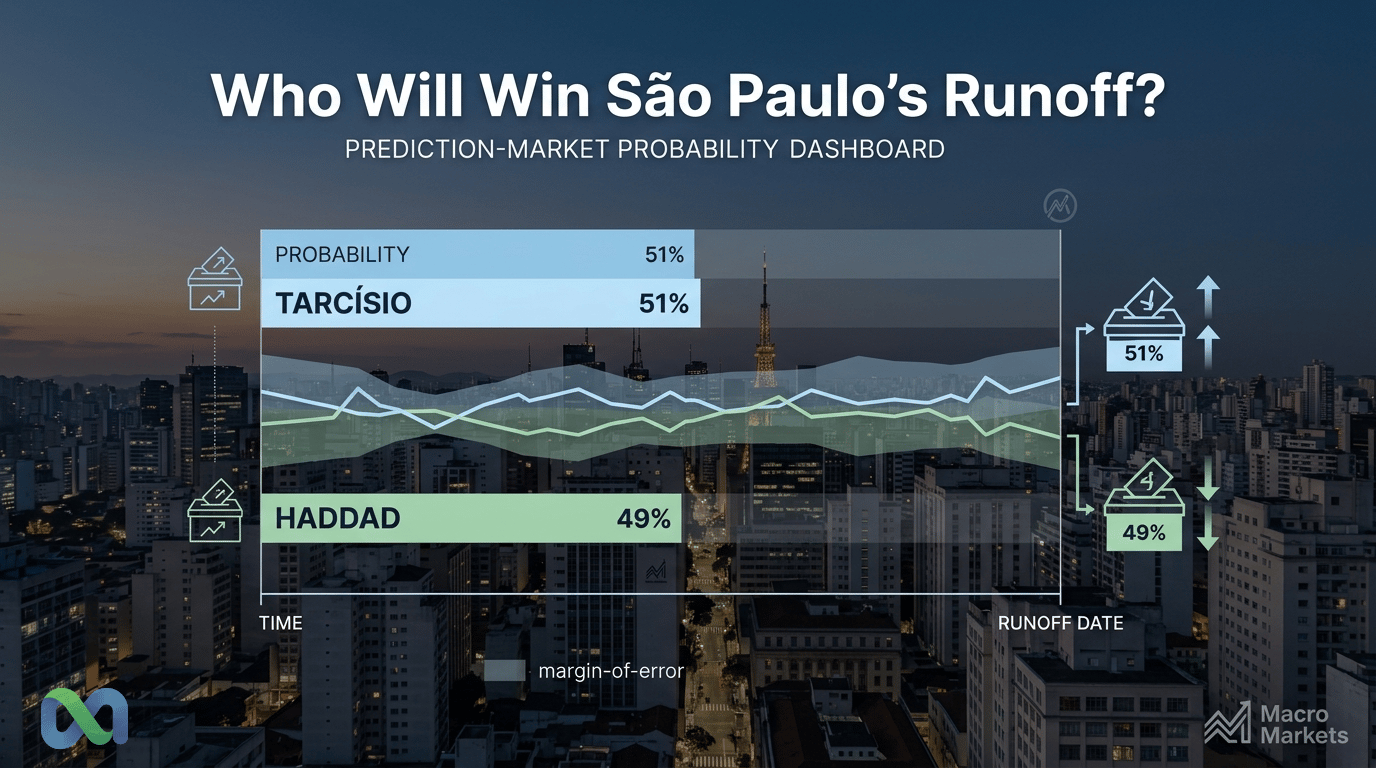
The short answer is this: based on recent polls cited in public debate, Tarcísio de Freitas appears ahead in São Paulo runoff scenarios against Fernando Haddad. But that does not mean victory is guaranteed. An election poll measures declared voting intention on a specific date, with a margin of error, a limited sample, and a political environment that remains open.
The São Paulo runoff election question, “who will win the runoff in São Paulo” has to be read as a probabilistic question, not as a final sentence. Voters want a direct answer. Analysts need to show the degree of uncertainty. A prediction market trader needs to go beyond the headline and ask: what information is already priced in, and what could still change the probability?
This guide organizes that reading. First, it explains who is ahead. Then it shows how to interpret Quaest polls, rejection, margin of error, vote migration, alliances, territory, the economy, campaign dynamics, and prediction markets. The goal is to separate signal from noise.
Direct Answer: Who Is Ahead in the São Paulo Runoff?
Today, the best reading is that Tarcísio appears ahead of Haddad in recent São Paulo runoff scenarios, according to press coverage of Quaest polls. The lead, however, should be treated as a snapshot of the moment. It does not erase margin of error, campaign shifts, rejection, alliances, or new events.
That point is crucial. A poll can show a clear lead and still not close the race. A runoff is a different election from the first round. Voters who supported another candidate need to migrate, cast a blank or null vote, abstain, or choose one of the finalists. That movement changes the game.
There is also ambiguity in the search query. Many people search “who will win the runoff in São Paulo” without making clear whether they mean the state, the city, a past election, or a future scenario. The SERP mixes content about the state government, the presidential election, old vote-count pages, and rejection analysis. That is why this article focuses on the São Paulo state scenario in the brief: Tarcísio versus Haddad in 2026.
What the most recent polls say
CNN Brasil coverage placed Tarcísio ahead in matchups against Haddad in São Paulo. The source is on cnnbrasil. com. br. G1 also highlighted Quaest data for the 2026 cycle. The source is on g1. globo. com. Those references help verify the context, but the reading should not stop at the headline.
The practical reading is simple: anyone asking who will win the São Paulo runoff finds a scenario in which Tarcísio starts in a better position against Haddad. He has governor recall, the state machine, a management-oriented message, and a competitive base in the interior. Haddad, in turn, has a well-known name, a strong electoral history in the capital, and ties to the Lula-aligned field.
None of those factors decides the race alone. They only help explain why one candidate leads now and which variables could narrow or widen the gap.
Why a poll lead is not a guaranteed win
A poll is a measurement tool. It is not a contract with the future. Even when the method is serious, the result depends on the sample, fieldwork date, question wording, tested candidates, undecided rate, and political environment.
The campaign also reorganizes priorities. Public safety, transport, inflation, jobs, state health care, education, and the evaluation of the federal government can gain different weight over the cycle. A poor debate, a local crisis, or an unexpected alliance can also change the reading.
So the correct answer to who will win the São Paulo runoff is conditional. Tarcísio looks like the favorite in the current snapshot. Haddad still has paths to strength. Uncertainty is not a detail; it is central to the analysis.
What the Quaest Poll Shows About Tarcísio and Haddad
The Quaest poll became a reference because it put numbers on a race that was already on the political radar. For the general reader, the headline shows who is ahead. For anyone analyzing markets, the more important question is different: is the lead robust, or does it depend on a fragile set of conditions?
In São Paulo, the race has its own characteristics. The state has the largest electorate in Brazil. It also combines very different regions. The capital has a different political rhythm from the interior. The ABC region has labor-party memory. Agribusiness and mid-sized cities matter. Evangelical, middle-class, peripheral, university, and business voters do not move as a single bloc.
That is why a statewide poll has to be read in layers. The overall score matters. But the structure behind that score matters almost as much as the final number.
First-round and runoff scenarios
In the first round, voters can choose based on ideological identity, strategic voting, memory of a government, rejection of a political field, or a bet on renewal. In the runoff, the calculation changes. Only two options remain. Rejection matters more. Vote migration becomes decisive.
If Tarcísio leads Haddad in a head-to-head scenario, that suggests three hypotheses. First, he is keeping a disciplined conservative and center-right base. Second, he is crossing into part of the centrist electorate. Third, Haddad faces a ceiling caused by rejection outside the capital and by association with the federal government.
But there is another side. Haddad can grow if he consolidates the progressive vote, lowers rejection through a more economic and less ideological campaign, and turns the runoff into a referendum against the state administration. That possibility should not be ignored.
When voters ask who will win the São Paulo runoff, the answer is not only in the score. It is in the elasticity of the two candidates.
Method, sample, and margin of error
Before accepting any headline, look at four items: sample, date, margin of error, and surveyed universe. The sample shows how many people were interviewed. The date shows whether the poll captured a recent event. The margin of error indicates the likely interval around the result. The universe shows whether the poll represents the entire state, the capital, or another subset.
The margin of error changes how a lead should be read. A small lead can be a statistical tie. A larger lead can be more stable, but still not final. It is also important to watch the sum of blank votes, null votes, undecided voters, and those who say they would not vote for any name.
Another detail: prompted and spontaneous polls measure different things. In a prompted poll, the respondent chooses among names presented. In a spontaneous poll, the respondent has to remember a name without help. Candidates with high recall tend to do better in spontaneous polling. Less-known candidates can grow once the campaign begins.
How to Interpret a Runoff: Margin of Error, Rejection, and Vote Migration
A runoff is a competition for voters who were not fully committed to the finalists. That is why the question “who will win the São Paulo runoff” requires a reading of three forces: margin of error, rejection, and vote migration.
The margin of error shows how much the score can vary without a real change in public opinion. Rejection indicates each candidate’s growth limit. Vote migration shows how the bases of eliminated candidates may move.
Those three forces create very different scenarios. One candidate may lead in total vote intention but have high rejection. Another may be behind but have more room to grow. A third actor in the first round can define the race by transferring support, a stage, TV time, or local structure.
Statistical tie versus real advantage
A statistical tie does not mean a perfect political tie. It means the difference between candidates is inside the margin of error. If the margin is three points, a two-point difference does not allow a safe claim of leadership.
A lead above the margin tends to matter more. Even so, it can fall if the political climate changes. A real advantage is one that holds across several rounds, different pollsters, different methods, and low volatility.
To assess who will win the São Paulo runoff, look for sequence. One isolated poll is a weak signal. Three or four polls pointing in the same direction form a stronger signal. If the trend also appears in regional and demographic slices, the signal improves further.
Rejection and growth ceiling
Rejection is one of the most important runoff data points. When two candidates reach the final round, winning does not depend only on attracting supporters. It depends on being acceptable to voters who preferred another name.
Haddad is nationally known and has already run in a presidential election. That creates recall, but it also raises rejection among anti-PT sectors. Tarcísio has the advantage of incumbency in the state, but he can suffer wear if management problems become central to the campaign.
The correct question is not only “who leads?” It is “who has more room to grow without hitting the rejection ceiling?” A candidate with 45% and low rejection can be more competitive than another with 48% and very high rejection.
Interior, coast, and São Paulo capital
São Paulo does not vote as a simple unit. The capital has enormous weight and often reacts to urban themes such as transport, public safety, housing, health care, and cost of living. The interior has local political networks, agriculture, services, universities, industries, churches, and mayors with direct influence.
The coast has its own rhythm. Public safety, tourism, infrastructure, housing, and floods can affect views of government. The ABC and the broader metropolitan region also have specific political traditions.
That is why a statewide lead has to be crossed with the regional map. If Tarcísio leads strongly in the interior but Haddad offsets that in the capital, the race can tighten. If Tarcísio holds an advantage in both blocs, his favoritism rises. If Haddad reduces rejection outside the capital, the scenario changes.
What Factors Can Change the Result Before Election Day
The election does not happen in a vacuum. It passes through alliances, campaign execution, the economy, public safety, government approval, debates, national events, and the narrative of each political field. These factors can move the answer to who will win the São Paulo runoff.
In prediction markets, that movement appears as a change in probability. A new poll can move probabilities. An alliance can change the price. A scandal can increase volatility. A strong debate can change the view of competence.
That turns the race into a moving process. Anyone who looks only at today’s score misses part of the signal.
Alliances and campaign coalitions
In a runoff, alliances matter because they bring TV time, mayors, city council members, parties, local machines, and access to specific audiences. Formal support does not always transfer votes automatically, but it helps organize a campaign.
Tarcísio can seek a broad center-right coalition, part of the center, interior mayors, and business sectors. Haddad can gather the PT, the left, social movements, unions, and part of the electorate that rejects Bolsonarism.
The center is the decisive field. If it moves with Tarcísio, his favoritism grows. If it splits or moves closer to Haddad, the race becomes more open.
Economy, public safety, and government approval
The economy defines electoral mood. Jobs, inflation, income, credit, and cost of living weigh on the decision. Even in a state race, voters blend their evaluation of the state government, federal government, and city hall.
Public safety also weighs heavily in São Paulo. Violence cases, police actions, transport crises, or a sense of disorder can change the agenda. Tarcísio tends to benefit if the election revolves around an approved state management record. Haddad tends to grow if he can turn the race into a critique of concrete failures in the administration.
The evaluation of the federal government is another factor. If Lula is strong in São Paulo, Haddad gains traction. If the federal government faces wear, Tarcísio can nationalize the race against the PT.
Campaign, debates, and unexpected events
Campaigns matter because they organize voter attention. Before the campaign, many people answer based on vague memory. During the campaign, voters see direct comparison, advertising, attacks, proposals, and debates.
Debates may not turn an election by themselves, but they create clips, headlines, and perceptions of preparedness. A bad phrase goes viral. A good answer changes the narrative. A campaign mistake can reinforce rejection.
Unexpected events also count. Public safety crises, court decisions, inflation, strikes, allegations, floods, or changes in the economy can reposition the candidates. That is why serious election forecasting has to be updated, not just published once.
Election Polls Are Not Probabilities: How Prediction Markets Help the Reading
Election polls and prediction markets seem to talk about the same thing, but they measure different phenomena. A poll asks a sample of voters whom they would vote for. A prediction market aggregates the probabilities of traders who trade positions on the outcome.
That difference changes everything. A poll answers: “what is the declared vote now?” A market answers: “what aggregated probability do traders assign to the outcome?” The two readings can agree. They can also diverge.
When they diverge, the divergence is information. If a poll shows Tarcísio far ahead but the market prices a close race, traders may be seeing campaign risk, rejection risk, or reversal risk. If a poll shows a tie but the market gives a large advantage to one candidate, there may be information about structure, history, or trend that is not captured by the headline.
Difference between declared vote and market probability
Voting intention is a declared response. Market probability is a synthesis of odds. The first depends on the sample. The second depends on traders, liquidity, incentives, and available information.
Neither is perfect. Polls can miss because of sample, abstention, shy voters, late movement, or an inadequate model. Markets can miss because of low liquidity, trader bias, too much narrative, or lack of local information.
The market’s advantage is continuous updating. Instead of waiting for a new poll round, the trader follows how probability changes with each important fact. That is especially useful in long elections, where the campaign moves through several phases.
Why probabilities change in real time
Probabilities change because new information reaches the market. A Quaest poll, a candidate statement, a party decision, or an economic data point changes the probability set. The price adjusts when traders accept trading at that new level.
On Macro Markets, prediction market logic lets users observe that change as an aggregated reading. Users do not need to treat every headline as final truth. They can compare the new data with the market reaction.
For a race like São Paulo, this helps answer who will win the São Paulo runoff more clearly. Not as a static guess, but as a probability in motion.
To broaden the context, it is worth comparing this case with content on Brazil’s 2026 presidential election: candidates, dates, and scenarios. It also helps to read about whether only 3% of traders explain prediction market accuracy and about CLOB, or Central Limit Order Book, in prediction markets. Those themes show why votes, prices, liquidity, and probabilities can tell different stories.
Reading Table: What Raises or Lowers Favoritism
The table below summarizes the main factors that should move the reading of who is closer to victory in São Paulo.
- Successive polls: Tarcísio gains strength if he leads above the margin. Haddad gains strength if he cuts the gap.
- Rejection: Tarcísio gains strength if his rejection falls. Haddad gains strength if he reduces rejection toward the PT.
- Interior: Tarcísio gains strength if he dominates mid-sized cities. Haddad gains strength if he advances with local mayors.
- Capital: Tarcísio gains strength if he competes well in the city. Haddad gains strength if he opens a lead where he already has recall.
- Economy: Tarcísio gains strength with better income and approved management. Haddad gains strength with state-level wear.
- Public safety: Tarcísio gains strength with a sense of order. Haddad gains strength if crises become the central issue.
- Alliances: Tarcísio gains strength with a united center. Haddad gains strength if the center splits.
- Debates: Tarcísio gains strength with an image of management competence. Haddad gains strength with clear economic preparedness.
The strongest reading emerges when several factors point in the same direction. If polls, rejection, territory, and alliances favor the same candidate, favoritism is more robust. If each factor points to a different side, the race becomes volatile.
How to Follow the Race Without Falling for Overstated Headlines
The best way to follow the election is to build a simple mental dashboard. Do not look at only one news item. Look at trend, method, differences among pollsters, and market reaction.
Start with registered polls and outlets that report sample, date, margin of error, and sponsor. The Superior Electoral Court is the official source for rules, calendar, candidacies, and official results. Vote-count pages, such as Folha’s page for previous São Paulo elections, help compare historical patterns, but they do not replace current data.
Then watch whether the numbers converge. One isolated poll can be noise. Three similar polls are a stronger signal. If a poll is far outside consensus, it is worth investigating method, date, and sample.
Finally, follow probability. Market price is not a guarantee, but it shows where traders are placing conviction. In an uncertain race, that reading can be more useful than headlines that treat every poll as the final turn.
Quick Guide to Reading Each New Poll
Use a simple method whenever a new poll comes out. First, check the date. Old data can be out of step with the current climate. Then check the sample. A larger sample tends to provide more security. Next, check the margin of error. It shows the limits of the reading. Finally, see whether the same signal appears in other polling groups.
This step avoids a common mistake. Many people see one headline and change their whole opinion. That is bad. A large election changes gradually. New data should enter the map, but it should not erase everything else.
It is also worth separating firm votes from soft votes. Firm votes change little. Soft votes change with debates, news, local support, or fear of the rival’s victory. In a runoff, that soft vote can decide the result.
Another point is abstention. São Paulo has millions of voters. If one group stays home more than another, the score changes. That is why polls that measure real likelihood of turnout are useful. They show not only preference, but electoral energy.
Voters also change when the race becomes binary. In the first round, they can vote for a smaller name. In the runoff, they have to choose between two paths. That is why vote migration is not simple addition. Some voters migrate. Some cast null votes. Some stay home.
For Tarcísio, the positive signal is keeping a lead outside the margin across several rounds. It also matters to show strength in the interior and not lose too much in the capital. For Haddad, the positive signal is cutting the gap, lowering rejection, and advancing in mid-sized cities.
The best question after each poll is: what changed? If nothing changed, the poll only confirms the scenario. If the gap narrowed, the market should reassess. If rejection changed, the runoff may become more open. If undecided voters moved to one side, the signal is stronger.
But be careful with small slices. Age, income, religion, and region help explain the race. But each slice has a larger error. Use those data points as clues, not as final proof.
In short, read polls as a dashboard. The overall score is the first screen. The margin of error is the second. Rejection is the third. Region is the fourth. The prediction market is the fifth, because it shows how all of this becomes perceived probability.
Possible Scenarios for the Final Stretch
There are three simple scenarios for the final stretch. In the first, Tarcísio keeps a clear lead. In that case, he reaches the runoff as the favorite. The campaign tries to avoid mistakes, broaden centrist support, and hold down rejection.
In the second scenario, Haddad narrows the gap. The race enters a more uncertain range. Debates, alliances, and the economy gain more weight. The market tends to price more risk for Tarcísio.
In the third scenario, a new fact emerges. It could be a public safety crisis, a sharp improvement for the federal government, a campaign error, or a new alliance. This kind of event can change the reading within a few days.
No scenario should be treated as destiny. An election is a live process. Today’s advantage matters, but the path to the ballot box still matters. That is why anyone who wants to know who will win the São Paulo runoff should follow the trend, not only the snapshot.
The practical rule is simple. Favoritism rises when there is a stable lead, low rejection, broad support, and good government approval. Favoritism falls when the gap narrows, rejection rises, allies hesitate, or the public agenda turns against the candidate.
A Simple Checklist to Avoid Misreading the Race
Still, there is a simple way to read the race. It works for any new round. It also helps people who do not follow politics every day.
First, see who leads. That is the basic point. Then see by how much. A small lead may not say much. A large lead carries more weight.
Second, check the margin of error. If the difference fits inside the margin, treat the scenario calmly. If it sits outside the margin, the signal improves. Even then, it is not certainty.
Third, check rejection. This data point shows who has the bigger brake. A highly rejected name must persuade people who already resist that candidate. That requires a strong campaign.
Fourth, check the undecided voters. They are the open space. If there are many undecided voters, the election can change. If there are few, a comeback becomes harder.
Fifth, check region. The capital and the interior do not have the same political weight. A candidate can perform well in one area and badly in another. The total hides that detail.
Sixth, check the trend. Did the number rise or fall? The line is more useful than a loose point. An upward curve is worth more than an isolated headline.
Seventh, check the context. A poll taken after a crisis measures a different climate. A poll taken before a debate does not measure the debate’s effect.
Eighth, check the market reaction. If probability changes a lot, there is a new signal. If it does not change, the news may already have been priced in.
This checklist does not lock in the winner. It reduces error. It forces the reader to view the election as a process. Therefore, the question of who will win the São Paulo runoff becomes clearer and less emotional.
Common Mistakes When Reading the São Paulo Election
The first mistake is confusing advantage with victory. Advantage is the current position. Victory exists only after the official count. Until then, everything is a scenario.
The second mistake is ignoring the margin of error. A small difference can disappear inside the data interval. That is why “ahead” does not always mean “safe.”
The third mistake is looking only at the capital. The city of São Paulo matters a lot, but the state is larger. The interior, coast, ABC, and metropolitan region change the score.
The fourth mistake is treating rejection as a detail. In a runoff, rejection matters a lot. It defines where the centrist vote can go.
The fifth mistake is thinking that a poll is a forecast. A poll measures intention. A forecast estimates probability. They talk to each other, but they are not the same thing.
The sixth mistake is following only your side. In elections, rooting gets in the way. The best method is cold. Look at data, method, trend, and probability.
The seventh mistake is forgetting abstention. Many people do not vote. If one group stays home more, the result changes. This matters even more in a close race.
The eighth mistake is calling the race too early. People who call it early may sound confident. But they almost always ignore risk. In markets, ignored risk becomes a bad price.
That is why simple phrases work better. “Tarcísio is the favorite now” is better than “Tarcísio has won.” “Haddad has a path, but needs to reduce rejection” is better than “Haddad has no chance.” That precision improves the analysis.
Frequently Asked Questions About the São Paulo Runoff
Is Tarcísio already elected if he leads the polls?
No. Leading in polls increases favoritism, but it is not the same as being elected. An election depends on officially counted votes, the campaign, abstention, alliances, rejection, and events up to voting day. The current lead should be seen as an advantage, not as the final result.
Can Haddad come back in the runoff?
Yes, he can. To come back, Haddad would need to reduce rejection, grow outside his strongholds, unify the left, attract part of the center, and turn the campaign into an unfavorable comparison with Tarcísio’s management. It is a difficult path if the current lead holds, but not an impossible one.
Which poll is the most reliable?
The most reliable poll is one with a transparent method, adequate sample, clear date, regular registration, and a solid track record. Even so, no poll should be read alone. The ideal approach is to compare polling groups and observe the trend over time.
Is the São Paulo runoff about the capital or the state?
It depends on the election. The search is ambiguous. It can refer to the city of São Paulo, the state of São Paulo, or old vote-count pages. In this article, the focus is the São Paulo state scenario tied to the Tarcísio versus Haddad race in the 2026 cycle.
How should I follow changes until the election?
Follow registered polls, the TSE electoral calendar, debates, alliances, government approval, and prediction markets. The point is to observe changes in probability, not just isolated headlines. If the market moves before the press consolidates the narrative, that can be an important signal.
So, Who Will Win the São Paulo Runoff?
The most honest answer is: Tarcísio appears to be the favorite in the current scenario against Haddad, but the race still depends on campaign execution, rejection, alliances, territory, the economy, public safety, and new polls. Anyone who calls the result now ignores the live nature of an election.
For the reader, the best practice is to follow the sequence of data. See whether the lead stays outside the margin of error. Watch whether Haddad reduces rejection. Compare capital and interior. Pay attention to centrist alliances. And treat each poll as a snapshot, not as the complete movie.
For anyone using prediction markets, the question changes. It stops being only “who will win the São Paulo runoff?” It becomes: what is each candidate’s current probability? And what could move that probability in the coming days? That is the more professional way to follow a competitive election.
On Macro Markets, Brazilian elections can be followed as prediction markets, with probabilities that change as new data appears. That does not remove uncertainty. But it makes uncertainty measurable, clear, and far more useful than a loose guess.
Reading in Very Simple Language
Think of the race as a game of light. Today, the light is stronger for Tarcísio. That means he starts ahead. It does not mean he has already won.
Haddad can still grow. To do that, he needs to talk to voters who are unsure. He needs to lower rejection of his name. He needs to win votes outside the loyal base. He also needs the day’s agenda to help his thesis.
Tarcísio, on the other hand, needs to stay calm. If he is ahead, his risk is making mistakes. He needs to hold support, show works, show order, and avoid a crisis.
In a runoff, many people vote against someone. That is why rejection matters so much. A name can have strong support and still have a low ceiling. Another name can have fewer fans, but more chance of being accepted.
There is also strategic voting. In the end, part of the electorate chooses whoever seems more likely to win. That effect can amplify a wave. But it only appears close to the ballot box.
The campaign exists to change perception. It shows faces, speeches, plans, errors, successes, support, and fear. In a long race, that matters. That is why today’s poll does not close the movie.
Use this rule: if Tarcísio keeps a cushion for months, he becomes stronger. If Haddad cuts that cushion with each new round, the race opens. If the line stays flat, the favorite remains the favorite.
Another rule: do not look only at who is rising. See who is falling. Sometimes a candidate does not gain votes. The rival loses strength. That fall also changes the final probability.
One more rule: see who can talk to the center. The center is not a single group. But in a runoff, it often decides. If one side loses the center, winning becomes harder.
Finally, watch the tone. It is not “already won.” It is not “no chance.” The right phrase is: Tarcísio is in a better position now. Haddad needs clear improvement to turn it around. That is the cleanest reading.
Final Rule for the Reader
If you have little time, use three steps. See who leads. See whether the cushion is larger than the margin. See whether the line repeats in more than one poll.
If all three points are good for Tarcísio, he is the favorite. If two points worsen, the game opens. If Haddad improves on all three, a comeback enters the radar.
This rule is not perfect. But it is clear. It avoids panic from a single headline. It also avoids blind rooting.
Data should guide the reading. Emotion should stay out. In politics, that is hard. In markets, it is vital.
When in doubt, wait for the next round. One data point can fail. A series of data is better. Votes change. Prices change. Probabilities change. A good reader changes with the data.
That is the thesis. Read a little at a time. Add signals. Cut noise. Return to the data. Watch price. Watch vote. Watch rejection. Watch the map. If everything points to one side, there is a favorite. If it does not, there is a race.
