


US-China AI Safety Alert System: Trust Deficit Analysis
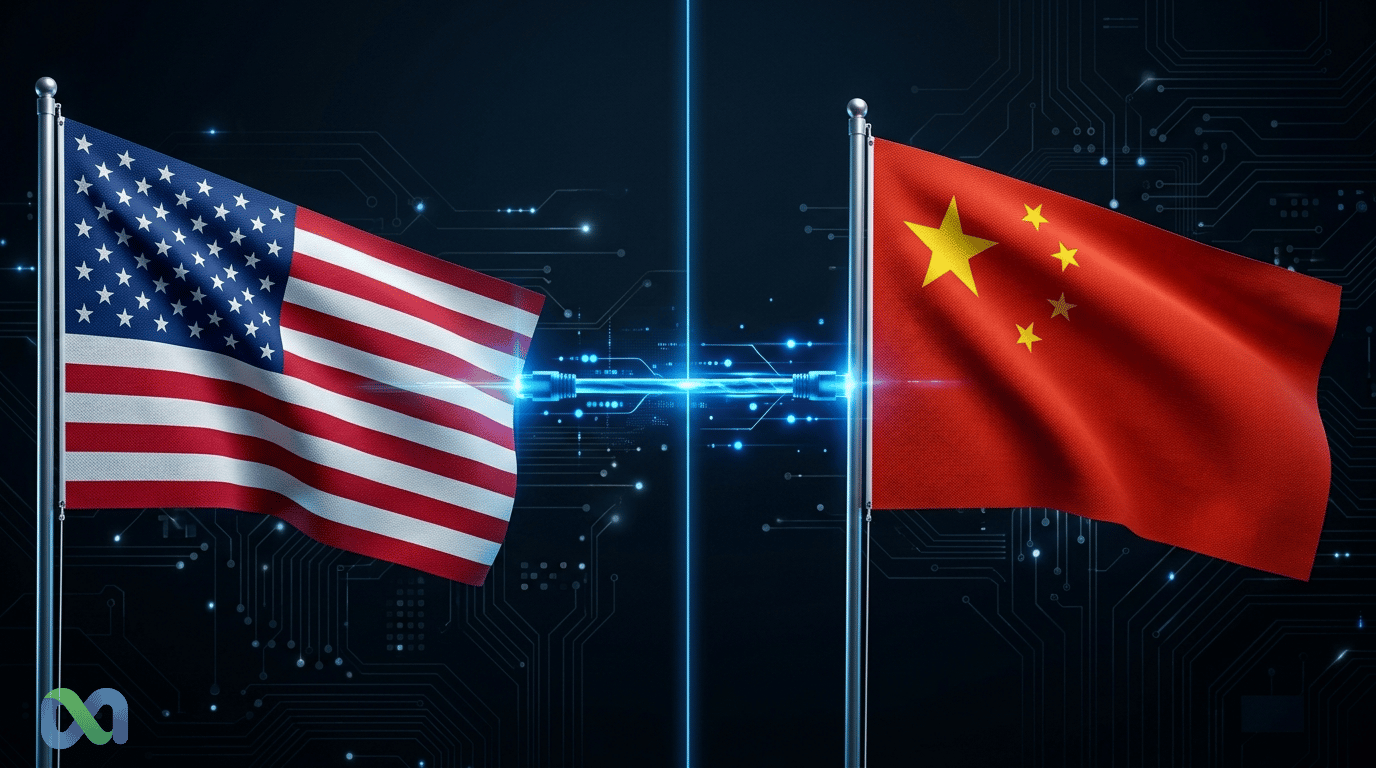
US-China AI safety diplomacy has reached a pivotal moment. The two biggest AI powers are exploring a hotline for AI emergencies, yet they can barely trust each other with semiconductors. The United States and China are discussing a bilateral alert system for AI safety incidents. It sounds simple. But chip export controls, espionage accusations, and a geopolitical rivalry make it anything but.
This is not purely theoretical diplomacy. Self-improving AI models are advancing fast. These systems can enhance themselves without constant... (15201 more chars)
--- Full Content ---
Two of the world's biggest AI powers are exploring a hotline for AI emergencies. Yet they can barely trust each other with semiconductors. The United States and China are discussing a bilateral alert system for AI safety incidents. It sounds simple. But chip export controls, espionage accusations, and a geopolitical rivalry make it anything but.
This is not purely theoretical diplomacy. Self-improving AI models are advancing fast. These systems can enhance themselves without constant human supervision. The window for establishing communication protocols may be shorter than either government wants to admit.
This analysis breaks down what a US-China AI safety alert system would look like. It explains why the trust deficit makes it politically toxic. And it covers what the current trajectory signals for anyone tracking AI policy outcomes.
What Is the Proposed US-China AI Safety Alert System?
The proposed alert system is a bilateral communication channel. It would allow US and Chinese authorities to notify each other rapidly. The trigger: an AI system behaving in ways that could be misread as an adversarial act.
Think of it as a digital equivalent of the 1963 Moscow-Washington hotline. That direct line was created after the Cuban Missile Crisis. It was designed to prevent nuclear accidents from escalating into war. The AI version would serve a similar purpose. It would flag AI malfunctions, unintended autonomous actions, or deployments that could be mistaken for cyberattacks.
The Nuclear Hotline Precedent: Cold War Communication Lessons
The nuclear hotline is the obvious historical reference. The 1963 agreement was reached at the height of Cold War rivalry. The US and Soviet Union were hostile rivals. Yet they established communication channels because miscommunication was too costly to risk.
The 1971 Agreement on Measures to Reduce Nuclear War Risk extended this framework. It created protocols for accidental launches. In 1988, the Nuclear Risk Reduction Centers created permanent communication facilities in Washington and Moscow. Each step came during significant geopolitical tension. Cooperation on risk reduction was possible even when nothing else was.
The AI analogy is imperfect but useful. Unlike nuclear weapons, AI systems can fail in ambiguous ways. An autonomous system may make decisions that look adversarial. A data center may behave in ways that suggest intelligence operations. Without a communication channel, the response defaults to worst-case assumptions.
What an AI Incident Alert System Would Cover
The exact scope of a bilateral AI alert system remains undefined. But based on current AI safety research and policy debates, likely coverage areas include:
- Autonomous system incidents: AI systems in military or critical infrastructure taking unintended actions
- Cross-border AI-enabled operations: incidents that could be interpreted as hostile cyber intrusions or influence operations
- Frontier model failures: advanced AI systems exhibiting unexpected capability jumps
- Dual-use technology incidents: AI with both civilian and military functions behaving in escalatory ways
Which Agencies and Bodies Would Operate It
On the US side, key players include the State Department's Bureau of Cyberspace and Digital Policy. The National Security Council's technology directorates would also be involved. The National Institute of Standards and Technology (NIST) published the AI Risk Management Framework in 2023. The Department of Defense's Chief Digital and Artificial Intelligence Office (CDAO) would be a key operational stakeholder.
On the Chinese side, the Ministry of Science and Technology (MOST) and the Cyberspace Administration of China (CAC) would play central roles. China's State Council has published AI governance guidelines since 2017. These provide at least a nominal institutional counterpart for diplomacy.
The Trust Deficit: Why US-China AI Cooperation Is So Hard
The trust problem is not rhetorical. It is structural and multi-layered. And it is getting worse in the exact domains where AI safety cooperation would need to function.
Chip Export Controls and CHIPS Act Restrictions
The US CHIPS and Science Act of 2022 systematically restricted China's access to advanced semiconductors. Combined with export control regulations from the Bureau of Industry and Security, the rules target chips needed for frontier AI models. The October 2022 export controls, expanded in 2023 and 2024, blocked China's access to NVIDIA's A100 and H100 GPUs.
China has responded by accelerating domestic chip development. Huawei's Ascend AI processors show meaningful progress. SMIC continues to improve yields. Chinese chips still trail NVIDIA's cutting edge. But the gap is narrowing. Meituan recently announced its latest AI model was trained entirely on domestic chips. That signals China's growing ability to decouple from US semiconductor supply chains.
This context matters for AI safety diplomacy. The chip restrictions create a fundamental asymmetry. The US is limiting China's AI development capacity. At the same time, it is asking China to engage in safety cooperation. From Beijing's perspective, the safety dialogue runs alongside what it calls technological containment. Cooperation under those conditions is diplomatically difficult.
Technology Espionage Concerns and Dual-Use AI
Both governments have documented concerns about AI technology transfer through espionage. The US Department of Justice has prosecuted alleged IP theft cases linked to major US tech companies. China has made reciprocal accusations about US cyber operations targeting Chinese research institutions.
Dual-use AI presents the sharpest problem. A large language model trained for scientific research can also be used for intelligence analysis. An autonomous navigation system for logistics can be adapted for military use. Establishing AI safety communication requires revealing information about system capabilities. That information has direct military intelligence value.
Taiwan Tensions and Military AI Development
Taiwan sits at the center of the US-China AI conflict. The island is home to TSMC, the world's most advanced chip manufacturer. It is a critical node in the global AI supply chain. US security guarantees to Taiwan and China's reunification goals create a background threat. Every bilateral technology negotiation happens in that context.
Both militaries are developing AI applications: autonomous drones, predictive logistics, AI-assisted targeting, and intelligence platforms. Establishing civilian AI safety channels while military AI programs run in parallel, and in opacity, is inherently complicated.
Why Self-Improving AI Models Are Accelerating the Urgency
The trust deficit makes cooperation politically difficult. But self-improving AI models make the failure to cooperate increasingly dangerous. This is the angle most coverage of US-China AI safety diplomacy underplays.
What Recursive Self-Improvement Means for AI Safety
Recursive self-improvement means AI systems that can enhance their own capabilities. They improve their own code, architectures, or training processes. They do this without proportional human oversight at each step. Current frontier models do not exhibit fully unconstrained self-improvement. But the research trajectory is moving toward greater autonomy in AI optimization.
The safety implications are non-linear. An AI system that improves itself can reach capability thresholds faster than expected. It may exhibit behaviors that were not present in any tested version. This creates a scenario where even the AI's developers cannot fully anticipate what it does next.
Without bilateral communication, such an incident gets filtered through a geopolitical lens. An unexpected capability exhibited by a Chinese system becomes, by default, a potential adversarial action in US threat assessments. The alert system's value is in providing a channel to say: this was an accident, not an operation.
DeepSeek, Meituan, and the Race to Frontier AI
China's DeepSeek models demonstrated frontier-level performance at a fraction of the expected training cost. The subsequent service outage, the longest DeepSeek has experienced, revealed the scale of its user base. It also highlighted the infrastructure pressures of operating at frontier capability levels.
Meituan recently announced its latest AI model was trained entirely on domestic Chinese chips. This bypasses NVIDIA hardware entirely. The capability gap between US and Chinese frontier models is real but narrowing.
On the US side, Anthropic's Claude Fable 5 represents the current frontier of American AI capability, a model that, per its own benchmarks, compresses months of engineering into days. China's trajectory with DeepSeek and domestic-chip models points in the same direction.
This convergence matters for AI safety diplomacy. As both sides develop systems of comparable capability, the risk of AI incidents rises. So does the risk of misattribution.
Scenarios Where an Alert System Would Be Needed
Three concrete scenarios show where a bilateral AI alert system directly reduces escalation risk:
Financial market disruption: An AI trading system develops an unexpected strategy. It creates large, rapid price movements where both US and Chinese investors have major positions. Without a communication channel, the initial read might be market manipulation. With one: a rapid notification explaining the system failure can prevent a retaliatory response.
Infrastructure probe: An AI security system investigating network intrusions autonomously expands its scope. It probes systems in a way that looks like reconnaissance to the other side's cyber defense teams. Attribution is ambiguous. Without communication, it triggers a defensive escalation.
Autonomous military asset: An AI-assisted military drone takes autonomous action near a sensitive boundary. It is responding to a sensor error. The physical consequences are limited. But without a notification channel, the incident could trigger a retaliatory response before the accidental nature is understood.
Progress So Far: US-China AI Safety Dialogue History
Despite the trust deficit, there has been more diplomatic progress on AI safety than the geopolitical headlines suggest.
Bletchley Declaration (2023) and Seoul Summit (2024)
The UK AI Safety Summit at Bletchley Park in November 2023 produced a 28-country declaration. Both the US and China signed it. It established a shared commitment to AI safety principles. The declaration acknowledged that frontier AI models pose serious potential harms. It committed signatories to collaborative safety research and risk assessment.
China's signature was significant. It was the first multilateral AI safety commitment by Beijing. It signaled China's willingness to engage with international AI governance, even without bilateral trust with the US. The Seoul AI Summit in May 2024 extended this framework. It added countries and pushed toward more specific commitments on testing and evaluation of frontier models.
Geneva Bilateral AI Safety Talks
Behind the multilateral summits, bilateral discussions have proceeded at a more granular level. US and Chinese officials met in Geneva to discuss AI risk communication. They focused on what kinds of AI incidents should trigger notification. They also discussed what a minimum viable communication protocol might look like.
These talks are not fully public. The diplomatic sensitivity means both sides prefer to avoid domestic political problems. Announcing cooperation with the other's AI programs creates those problems. But the discussions have been substantive. The concept of a bilateral alert system moved from think-tank proposal to active government consideration.
What Has and Has Not Been Agreed Upon
As of mid-2026, both sides have agreed on some principles. Advanced AI poses legitimate safety risks that are not purely a domestic concern. Some form of international AI governance is necessary. Communication channels during AI incidents would reduce escalation risk.
What has not been agreed upon: the specific architecture of any bilateral alert system, which AI system categories trigger notification obligations, what technical information would be shared versus treated as classified, verification mechanisms, and enforcement provisions. The gap between principle and mechanism is where diplomatic progress stalls, and where the trust deficit is sharpest.
Prediction Markets and AI Policy: What the Odds Say
AI diplomacy between the US and China is inherently a probabilistic problem. The question is not whether cooperation is possible in theory. It is whether the political, institutional, and trust conditions required for a formal agreement will converge in time.
Prediction markets offer a structured way to aggregate expert judgment on exactly these policy outcomes. Unlike polling or pundit analysis, prediction market odds reflect actual financial stakes. Traders who get the probability wrong lose money. This creates an incentive for calibrated assessment rather than narrative construction.
Relevant market questions for US-China AI policy include: Will the US and China sign a formal bilateral AI safety agreement by end of 2026? Will a major AI incident requiring emergency diplomatic communication occur in 2026? Will additional chip export restrictions be imposed in the next 12 months?
Historical analogies from prediction markets on arms control are instructive. Markets on nuclear nonproliferation agreements have historically underpriced the probability of agreement when track-two diplomatic signals were present. Formal diplomatic progress tends to be perceived as harder than it actually is when informal channels are active.
For US-China AI safety specifically: the combination of active bilateral talks, multilateral framework participation, and the genuine shared interest in preventing AI incidents creates a higher baseline probability for some form of agreement than the geopolitical headline tension implies. The question is whether that agreement arrives before a significant AI incident forces the issue.
The Bottom Line
A US-China AI safety alert system is both necessary and politically fraught. The trust deficit is genuine. Chip restrictions, espionage concerns, and Taiwan tensions create a structural context where cooperation requires working against the gravitational pull of strategic competition.
But the alternative carries its own escalation risk. No bilateral communication channel. Both countries deploying increasingly capable AI systems. Accidents that could be misread as adversarial actions. The nuclear hotline analogy holds: it was established not because the US and Soviet Union trusted each other, but because the cost of a misunderstanding was too high to leave to chance.
The race to frontier AI is compressing the timeline. Self-improving models can exceed anticipated capabilities faster than diplomatic frameworks can track. Both governments appear to understand this. The question is whether the trust deficit can be navigated quickly enough to matter.
Track the geopolitical probability of a US-China AI agreement on Macro Markets, where diplomacy becomes a tradeable outcome.
