


2026 World Cup Format: How the New Rules Work
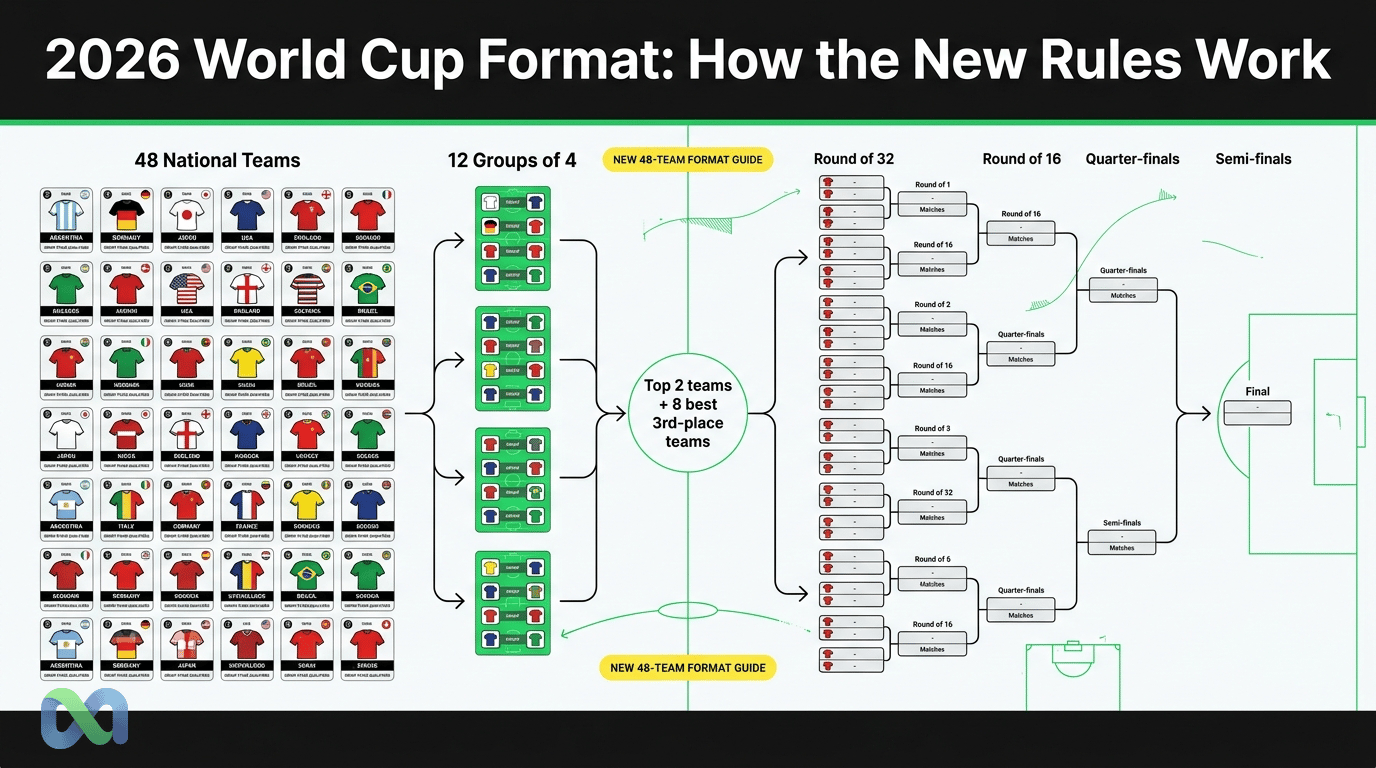
The 2026 World Cup format is the biggest structural change the tournament has seen since 1998. For the first time, the World Cup will include 48 national teams instead of 32. That means more groups, more matches, more knockout places, and one extra elimination round before the round of 16.
The tournament will be hosted across the United States, Mexico, and Canada. The expansion gives more countries a path into the finals, but it also changes how fans, analysts, and prediction markets should read the tournament. A poor group-stage result may no longer kill a team’s campaign. At the same time, the champion will need to survive a longer knockout path.
This guide explains how the 2026 World Cup format works with 48 teams. You will see how many groups there are, how many teams advance, how the best third-place teams are chosen, and why 104 matches change the way favorites should be priced.
Quick Summary of the New 2026 World Cup Format
The new rules for 2026 follow one simple idea: expand the tournament without removing four-team groups. FIFA considered three-team groups, but the final model kept four teams in each group. So the 2026 World Cup format keeps the familiar group-stage structure while expanding the knockout bracket.
In practice, the tournament will have:
- 48 qualified teams.
- 12 groups of four teams.
- Three group-stage matches for each team.
- The top two teams from each group advancing.
- The eight best third-place teams advancing.
- A knockout stage starting with the round of 32.
- 104 matches in total.
This creates a longer and more open World Cup. The group stage will have 72 matches. After that, 32 teams will enter the knockout stage. From that point, every match is single elimination until the final.
The most important change is the entry of the best third-place teams. In the 32-team World Cup format, only the top two teams in each group advanced. In 2026, finishing third does not automatically mean elimination. That should keep more groups alive until the final matchday.
How the 2026 World Cup Format Works
The 2026 World Cup format will divide 48 teams into 12 groups. Each group will have four teams. Inside each group, every team plays every other team once. So each national team plays three matches in the first phase.
That matters because the basic logic remains familiar. Fans will still see four-team groups, three matchdays, and a points table. The difference is scale. Instead of eight groups, there will be 12. Instead of 32 teams, there will be 48.
The group stage uses the standard points system:
- A win is worth three points.
- A draw is worth one point.
- A loss is worth zero points.
After three matchdays, the table in each group defines the ranking. The top two teams advance automatically. Then FIFA compares the third-place teams from all 12 groups and selects the best eight.
That produces 32 teams for the knockout phase. There are 24 automatic places from the top two teams in each group, plus eight places for third-place teams. The remaining 16 teams are eliminated after the group stage.
FIFA’s goal was to expand the tournament without weakening the value of each match. Three-team groups could create sporting risks. For example, one team could rest on the final matchday while the other two already know the exact result they need. Four-team groups reduce that problem.
What 48 Teams Change in Practice
The move to 48 teams is the core change in the 2026 World Cup format. It opens more spots for confederations outside the traditional power centers and gives more emerging nations a chance to play on the biggest stage.
For fans, this means more debuts, more national markets involved, and more matches across different time zones. It also means the gap in quality between some teams may be wider. In certain groups, strong favorites may face opponents with less World Cup experience.
However, expansion does not automatically make the tournament easier for title contenders. The champion may need to play eight matches instead of seven. There is also one extra knockout round. A favorite that wins its group can still face a dangerous opponent in the round of 32.
This changes the risk profile. In a shorter World Cup, the biggest danger often starts in the round of 16. In 2026, knockout risk begins earlier. The longer the knockout path becomes, the less room there is for one bad day. The 2026 World Cup format increases that risk for every team.
There is also a physical impact. More matches, more travel, and more competition days make squad depth more important. Teams with strong benches may gain an edge. Coaches will need to manage cards, injuries, travel, and rest more carefully.
How Qualification Works in the 2026 World Cup Format
Qualification for the knockout stage has two layers. First, the top two teams in each group advance. Since there are 12 groups, that creates 24 qualifiers.
Then the eight best third-place teams enter the bracket. FIFA will compare all 12 third-place teams. The best eight continue, while the four weakest third-place teams are eliminated.
This part of the 2026 World Cup format is similar to systems used in continental tournaments, including some editions of the Euros and Copa América. It creates a middle zone. A team may fail to finish in the top two of its group but still survive with a strong record.
In practical terms, four points should be a strong target for third-place teams. A record of one win, one draw, and one loss usually keeps a team competitive in that comparison. Three points may be enough in some scenarios, but it depends on goal difference and results in other groups.
The 2026 World Cup format makes every goal more valuable. A third-place team with a positive goal difference can finish ahead of another team on the same points. Even in defeat, keeping the score close can matter. This should change how teams behave on the final matchday.
Criteria for the Best Third-Place Teams
FIFA uses tiebreakers to rank teams inside groups and compare campaigns. The exact order should always be checked in the official competition rules. Still, the general logic usually starts with points, goal difference, and goals scored.
For the best third-place teams, the first filter is points. Then criteria such as goal difference, goals scored, and discipline can come into play. If teams remain tied, further rules from the official regulations may apply.
That makes score management more important. Imagine a team in third place with three points. Losing 1-0 is very different from losing 4-0. Goal difference can separate qualification from elimination.
It also changes the final matchday. One team may enter the pitch knowing a draw is enough. Another may need to win by two goals. A third team may depend on results from groups that have not finished yet.
This 2026 World Cup format should create more matches with real tension. Teams will not only fight for first and second. Many will also fight to enter the block of the eight best third-place teams. That is why the 2026 World Cup format should keep more groups open until the end.
Practical Example of Qualification
Imagine a group with four teams: A, B, C, and D. After three matchdays, the table finishes like this:
| Position | Team | Points | Goal Difference |
|---|---|---|---|
| 1st | A | 7 | +4 |
| 2nd | B | 5 | +2 |
| 3rd | C | 4 | 0 |
| 4th | D | 0 | -6 |
In this case, A and B advance automatically. Team C finishes third, but it still has a strong chance to qualify. It will be compared with the third-place teams from the other 11 groups.
Now imagine another group where the third-place team finishes with two points and a negative goal difference. That team will probably need many results to break its way. The team with four points and a neutral goal difference is in a much stronger position.
This example shows why the 2026 World Cup format reduces early elimination risk for mid-tier teams. A team can lose to the favorite, beat the weakest opponent, and draw the direct rival. That path may be enough to reach the knockout stage.
At the same time, the model punishes heavy defeats. Goal difference matters in the third-place comparison. So no match can be treated as disposable.
How the Bracket Works in the 2026 World Cup Format
The 2026 knockout stage starts with 32 teams. This is the biggest new feature in the 2026 World Cup format. In the 32-team era, the tournament moved directly from the group stage to the round of 16. Now there is one round before that.
The order will be:
- Round of 32.
- Round of 16.
- Quarterfinals.
- Semifinals.
- Third-place match.
- Final.
In the round of 32, qualified teams will be paired according to the official bracket. That bracket considers group positions and combinations involving the best third-place teams. For that reason, it may not always be easy to know the exact opponent before every group is finished.
Once the knockout stage begins, there is no second chance. If a match is tied after regulation time, it goes to extra time. If it is still tied, it goes to a penalty shootout. That logic is the same as in recent World Cup knockout rounds.
The 2026 champion will need to survive five knockout matches. In 2022, the champion had four knockout matches: round of 16, quarterfinal, semifinal, and final. The extra round increases variance. Even a dominant favorite must avoid one more bad match.
How Many Matches the 2026 World Cup Format Creates
The 2026 World Cup will have 104 matches. That is a major jump from the previous format, which had 64 matches. The official FIFA tournament page confirms the scale of the new calendar.
The math is direct. In the group stage, there are 12 groups with four teams each. Every group has six matches because each team plays the other three once. So the first phase has 72 matches.
Then come the knockout matches:
- 16 matches in the round of 32.
- 8 matches in the round of 16.
- 4 quarterfinals.
- 2 semifinals.
- 1 third-place match.
- 1 final.
The 2026 World Cup format adds 32 knockout matches. Combine 72 group matches with 32 knockout matches, and the total reaches 104.
The 2026 World Cup format changes the calendar. The World Cup will use more days, more venues, and more broadcast windows. It also creates more data for analysis. Anyone following probabilities, projections, and prediction markets will have more signals during the tournament.
How Many Matches a Finalist Can Play
A finalist can play eight matches in the 2026 World Cup. The maximum path is three group-stage matches, the round of 32, the round of 16, the quarterfinal, the semifinal, and the final.
This detail in the 2026 World Cup format matters for physical preparation. Even seven matches were demanding in recent World Cups. With eight, squad management becomes even more critical.
Teams with depth can rotate players in the group stage. But that depends on the table. A favorite that wins its first two matches may rest starters in the third match. A team under pressure may need to use full strength from the start.
There is also an effect on top-scorer races and records. More matches create more opportunities for forwards, but they do not guarantee higher totals. If coaches rest players or knockout matches become tighter, the extra volume may be diluted.
For prediction markets, this point is central. Champion, top scorer, and finalist markets need to price a longer path. The fair price of a team does not depend only on talent. It also depends on the likely route through the bracket.
What the 2026 World Cup Format Changes Compared With 2022
The 2022 World Cup had 32 teams, eight groups, and 64 matches. In each group, the top two teams advanced. The knockout stage started in the round of 16.
In 2026, almost all of those numbers change. The competition moves to 48 teams, 12 groups, and 104 matches. The knockout stage starts in the round of 32. Third-place teams can also advance. That is the practical difference in the 2026 World Cup format.
The most visible difference in the 2026 World Cup format is size. There will be more countries, more matches, and more qualification combinations. But the most important difference is strategic.
In 2022, a team that finished third was out. In 2026, it can still qualify. That changes how coaches handle risk. A draw that once looked poor may be enough. A narrow defeat may keep a team alive.
On the other hand, finishing first remains valuable. In theory, a group winner should get a better path. But the new bracket can create complex matchups, especially because of the best third-place teams.
Comparison With Older FIFA Formats
The World Cup has used several formats. The tournament started small, grew to 16 teams, then 24, then 32, and now 48.
The 24-team format, used between 1982 and 1994, also allowed some third-place teams to advance in certain editions. So the idea is not completely new. The difference is scale. In 2026, the model will be used in a much larger tournament.
The 32-team format, used from 1998 to 2022, became known for symmetry. There were eight groups, 16 qualifiers, and four knockout rounds. It was simple to explain and easy to follow.
The 2026 World Cup format trades part of that simplicity for global reach. More national teams enter. More fans see their countries in the tournament. More domestic markets connect to the event.
That trade-off has costs. The bracket is harder to read. Comparing third-place teams may confuse casual fans. The average quality of group-stage matches may also vary more.
Even so, the World Cup keeps its competitive core. To become champion, a team still has to win high-pressure matches. Expansion changes the path. It does not remove the knockout filter.
Why FIFA Changed the Format
The change combines sporting, commercial, and political incentives. FIFA wanted to expand global participation. More places mean more confederations represented and more countries involved in the tournament.
There is also a clear economic incentive. More matches mean more broadcast rights, more tickets, more sponsorship inventory, and more content for digital platforms. A 104-match World Cup is a much larger product than a 64-match World Cup.
From a sporting point of view, expansion gives space to teams that used to sit on the edge of qualification. Countries from Africa, Asia, Concacaf, and Oceania should gain more presence. That can support local development and increase global interest.
The main criticism is that expansion may dilute the elite level. Some matches may have a larger technical gap. However, recent World Cups have also shown that organized mid-tier teams can compete well.
The 2026 World Cup format is therefore a trade. FIFA gains scale. Fans get more matches. National teams get more access. The challenge will be maintaining clarity, rhythm, and competitive quality.
Quick Guide to Remember the 2026 World Cup Format
The central rule in the 2026 World Cup format is simple. There are 48 teams. There are 12 groups. Each group has four teams. Each team plays three times in the first phase.
Then the field is cut. The top two teams from every group advance. Eight third-place teams also advance. That leaves 32 teams alive.
From there, there can be no draw as a final result. Each knockout match needs a winner. If the score is tied after regulation, there is extra time. If it remains tied, there are penalties.
The champion has a longer road. Before, the maximum path was seven matches. Now it can be eight. That is why depth, rest, and bracket path matter more.
For fans, the easiest way to follow the tournament is simple. First, check the group position. Then compare the third-place teams. Finally, look at the bracket side. That step-by-step view explains the 2026 World Cup format without making it harder than it needs to be.
FAQ About the 2026 World Cup Format
How does the 2026 World Cup work?
The 2026 World Cup will have 48 teams divided into 12 groups of four. Each team plays three group-stage matches. The top two teams in each group advance, along with the eight best third-place teams. Then 32 teams play knockout matches until the final.
How many groups will the 2026 World Cup have?
There will be 12 groups. Each group will have four teams. The group stage will have 72 matches in total.
How many matches will the 2026 World Cup have?
The 2026 World Cup will have 104 matches. There will be 72 matches in the group stage and 32 in the knockout stage.
How many teams advance to the knockout stage?
A total of 32 teams advance. They are the top two teams from each of the 12 groups, plus the eight best third-place teams.
Will the 2026 World Cup have a round of 16?
Yes. But there will be a round of 32 before it. Winners from that new round move into the round of 16.
Will the 2026 World Cup have extra time and penalties?
In the group stage, draws still give one point to each team. In the knockout stage, if a match is tied after regulation, it goes to extra time and then penalties if needed.
Will the champion play more matches?
Yes. The champion can play eight matches. In recent World Cups, the champion played seven.
What the 2026 World Cup Format Changes for Favorites and Prediction Markets
The 2026 World Cup format changes how favorites should be read. A strong team still has an edge, but the road to the title is longer. That increases the importance of squad depth, bracket path, and the probability of avoiding an upset. In other words, the new format changes the price of risk.
In prediction markets, champion prices should not be read only as a ranking of squads. They also reflect expected path, injury risk, group difficulty, and possible knockout matchups. With 48 teams and 104 matches, the tournament will create more update points.
After each matchday, the market can reprice favorites. A team that wins convincingly may shorten. A team that qualifies in third may remain alive but face a tougher path. A favorite that lands on a heavy side of the bracket may lose value even if it is playing well.
That is the central point for following the 2026 World Cup format: the rules are not just an administrative detail. They change the probability of each scenario. Understanding groups, best third-place teams, and the round of 32 helps readers understand the competition more clearly.
The 2026 World Cup will be bigger, longer, and harder to map. Fans will see more teams and more matches. Anyone following forecasts and probabilities will see a tournament with more information, more noise, and more opportunities to interpret the path to the champion.
For official tournament details, check FIFA’s 2026 World Cup hub and the official match schedule. For broader context on the event, the English overview of the 2026 FIFA World Cup is also useful.
