


FIFA World Cup 2026: dates, format, and what to expect
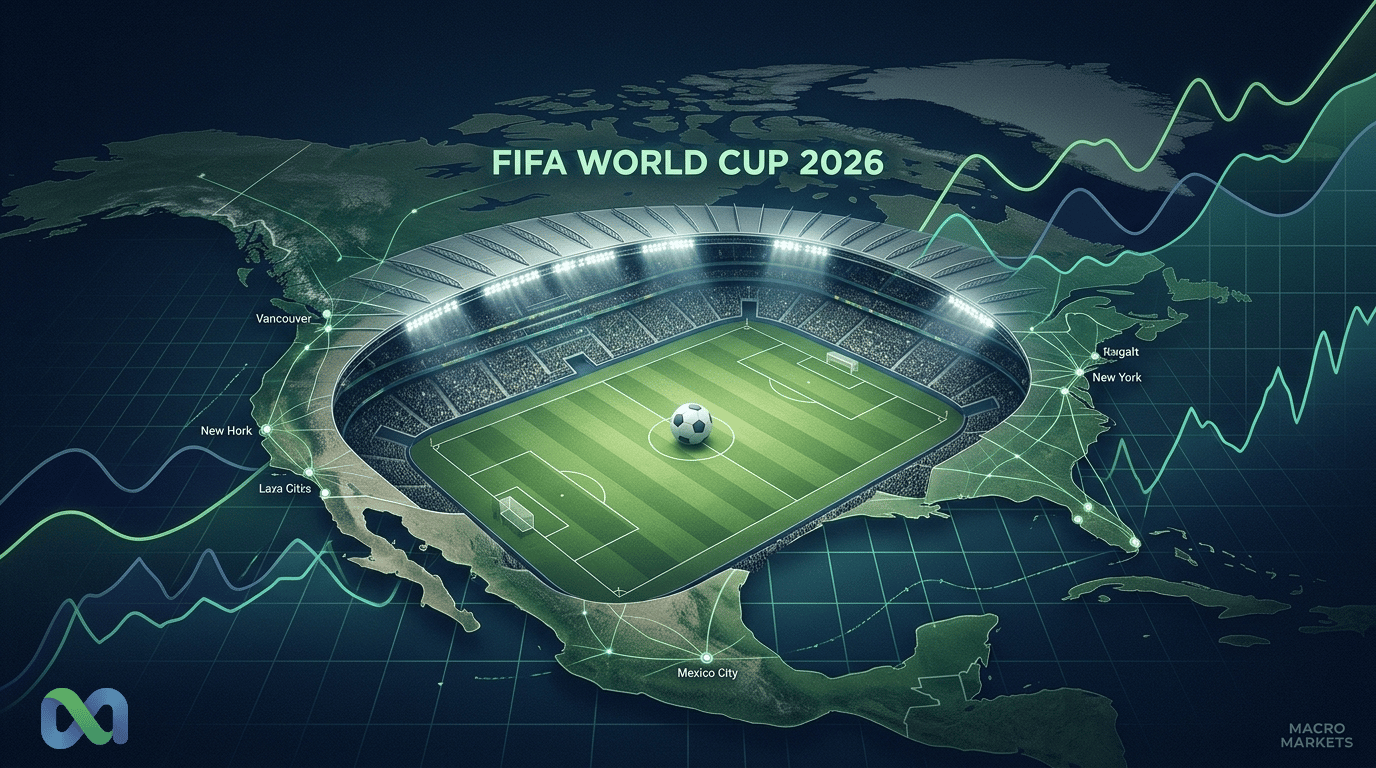
The FIFA World Cup 2026 will be the largest edition in tournament history. For the first time, 48 national teams will compete for the title across three host countries: the United States, Mexico, and Canada.
That new design changes the tournament for fans, analysts, traders, broadcasters, and national teams. It increases the number of matches, expands the host map, raises the importance of the group stage, and creates more routes for teams outside the usual elite.
This guide answers the core questions about the FIFA World Cup 2026. You will find the dates, host cities, format, playoff path, schedule logic, qualifiers, favorites, and the factors that can move probabilities before the opening match.
Quick summary for fans
The FIFA World Cup 2026 will be bigger than any previous World Cup. It will have 48 teams, more matches, and more qualification spots. The tournament will be hosted by three countries: the United States, Mexico, and Canada.
The opening date is June 11, 2026. The final is scheduled for July 19, 2026. The opening match will be played in Mexico. The final will be played in the United States.
The format is easy to follow. There will be 12 groups of four teams. The top two teams in each group advance. The eight best third-place teams also move on. After that, the tournament becomes a knockout bracket.
For Brazil, the focus will be the path to the final. The draw will decide which opponents land in the group. The schedule will show where the team plays. The rhythm of the matches will show how much rest each squad gets.
Before the ball starts rolling, watch five points: form, squad list, injuries, group, and bracket. These factors change the tournament outlook. They also change how the public reads each favorite.
The best way to follow the event is to keep a short checklist. Track the date, venue, group, opponent, and round. That makes it easier to know which match matters most and which result changes the picture.
What is the FIFA World Cup, and why will 2026 be historic?
The FIFA World Cup is the main tournament for men's national football teams. It brings together countries that qualify through continental competitions and decides the world champion in a final event organized by FIFA.
The 2026 edition will be historic for three clear reasons. First, it will be the first World Cup with 48 teams. Second, it will be the first hosted by three countries. Third, it will have a record number of matches.
According to the official FIFA page for the 2026 tournament, the World Cup will be played in the United States, Mexico, and Canada. That makes the logistics broader than in any previous edition.
The global importance of the tournament
The FIFA World Cup concentrates global attention because it combines sport, national identity, and cultural impact. For about a month, teams, fans, brands, broadcasters, and digital platforms orbit the same event.
For Brazil, the tournament has special weight. The Brazilian national team remains a historical reference, with five titles and a unique cultural relationship with the World Cup. Even when Brazil is not the clear top favorite, it attracts major attention.
The World Cup also works as a showcase for players. A strong tournament can change a player's career in weeks. On the other hand, an early exit can reopen debates about cycles, coaches, and squad renewal.
The jump to 48 teams
The expansion from 32 to 48 teams is the largest structural change since 1998. In practice, more countries will reach the tournament, and more regions will have representation.
This increase changes the competitive read. Some traditional teams may face less familiar opponents in the opening phase. However, the tournament may also become more unpredictable, because there are more matches and more qualification scenarios.
For fans, the upside is clear. There will be more games, more stories, and more teams trying to take space. For analysts, the change requires more attention to the draw, the calendar, travel, and squad depth.
When is the FIFA World Cup 2026?
The FIFA World Cup 2026 is scheduled to run from June 11 to July 19, 2026. The opening match will take place in Mexico, and the final will be played in the United States.
Those dates put the tournament back in its traditional mid-year window. The 2022 World Cup in Qatar was an exception because it took place in November and December due to local climate conditions.
Expected tournament dates
The 2026 edition should follow this broad timeline:
- Opening match: June 11, 2026, with the first game in Mexico.
- Group stage: June 2026, with 48 teams in the first phase.
- Knockout rounds: late June and July, with an expanded elimination bracket.
- Final: July 19, 2026, with the title match in New Jersey.
FIFA can still update operational details before the tournament. For that reason, fans should follow the official calendar once the full match schedule is released.
The most important phases of the calendar
The first phase will be decisive for measuring the real balance of the new format. With 48 teams, strong sides may advance without playing their best football, while smaller teams may turn one strong result into a historic qualification.
After that, the knockout rounds should raise the pressure. One individual mistake, one injury, or one refereeing call can change an entire team's route. That is one reason why the FIFA World Cup rarely follows a clean script.
The final, scheduled for July 19, will close a longer and more geographically spread edition. The champion will need squad depth, logistical adaptation, and consistency in high-pressure matches.
Where will the 2026 World Cup be held?
The 2026 World Cup will be held in the United States, Mexico, and Canada. It will be the first men's FIFA World Cup organized by three host nations.
That choice creates a continental tournament. Instead of concentrating all matches in a smaller area, the competition will spread across different cities and time zones.
United States, Mexico, and Canada
The United States will host most of the matches. The country has large stadiums, strong commercial infrastructure, and experience with global-scale events.
Mexico will play a symbolic role. The country hosted World Cups in 1970 and 1986, two editions that remain important in football memory. The opening match at Estadio Azteca adds to that historical weight.
Canada completes the trio as a modern host and a growing football market. For Canada, the 2026 World Cup is also a showcase for the growth of the national team and the sport at home.
How the host split changes the tournament
The split across three countries creates a travel challenge. Teams may face long trips, different climates, and time-zone changes.
That raises the value of planning. Coaching staffs will need to manage rest, training, recovery, and logistics with care. A talented squad is not enough if the team reaches decisive matches in worse physical shape.
For fans, the experience also changes. The World Cup may feel different from city to city. Matches in the United States should mix immigrant communities, tourists, local fans, and neutral supporters in large stadium environments.
How will the FIFA World Cup 2026 format work?
The FIFA World Cup 2026 format will have 48 teams divided into 12 groups of four. The top two teams from each group will advance, along with the eight best third-place teams.
After that, a 32-team knockout stage begins. In other words, the elimination bracket will be larger than in previous World Cups.
Distribution of the 48 teams
The new format increases the presence of every confederation. FIFA's idea is to make the World Cup more global and create room for countries that often came close to qualifying but missed the final tournament.
In practice, that can produce groups with different technical levels. Some will have clear favorites. Others may be more open, especially when mid-tier teams are close in ranking and current form.
To follow the group stage well, watch three points:
- Goal difference, because it can decide the best third-place teams.
- Match order, because facing the favorite in the final round can change strategy.
- Squad depth, because the tournament will be longer and more demanding.
Changes in the knockout stage
The addition of a round of 32 changes the path to the title. The champion will need to survive more elimination matches.
That reduces the margin for error. In a short tournament, a team can grow from match to match. In a bigger knockout bracket, it needs to avoid dips for longer.
There will also be more room for surprises. A team that qualifies as a third-place side can gain momentum, win a major knockout match, and reshape the story of the tournament.
Playoffs, qualifiers, and the schedule: what fans should track
The race for FIFA World Cup 2026 qualification will be one of the biggest storylines before the tournament. Expansion increases the number of places, but it does not remove pressure from traditional teams.
The schedule also becomes more important. With more matches and more groups, fans need to track dates, times, venues, and possible bracket crossings.
How the World Cup playoff works
The FIFA World Cup 2026 playoff will define remaining places for teams that do not qualify directly. It acts as a final route into the tournament.
The exact format depends on FIFA rules and confederation allocations. In general, the playoff puts teams from different regions into direct contests or a small qualifying tournament.
For Brazilian fans, the playoff matters for two reasons. First, it can define group-stage opponents. Second, it can bring popular or dangerous teams into the final field.
Where to follow qualifiers and the match schedule
The best source for the official schedule, venues, and final updates is FIFA. Sports hubs and confederation pages can also help readers follow regional qualifying paths.
When the full schedule is released, three questions should guide the read:
- What is the likely path from the group to the knockout stage?
- Which matches carry the highest upset risk?
- Which teams could gain or lose strength because of the calendar?
How to follow the World Cup without getting lost
Use one basic rule: read the tournament match by match. The World Cup is short. One goal changes a group. One card changes a team. One qualification place can come down to goal difference.
In the group stage, do not look only at the name of the opponent. Check the date, location, climate, and rest time. A strong team can suffer if it travels more. A mid-tier team can grow if it plays close to its base.
In the knockout stage, the plan changes. There is no second leg. If the score is level, tension rises. Bench strength, set pieces, goalkeeping, and penalty preparation gain weight.
To follow Brazil, make a simple list. Who is the opponent? Where is the match? How many rest days are available? Who is one yellow card away from suspension? Who could return from injury?
To follow the rivals, use the same map. France, Argentina, Spain, Germany, England, and Portugal will get heavy media attention. But names alone do not win matches. Form and bracket position matter.
It also helps to separate hope from data. Fandom is part of the World Cup. It gives color to the month. Still, a good read needs scores, squad news, form, and the path to the final.
Simple checklist before each match
Before each match, make six checks. The first is the starting lineup. A good team can change a lot without its main playmaker or striker.
The second is location. Field, climate, and travel matter. The third is rest. Tired teams make more late mistakes.
The fourth is group context. Sometimes a draw is enough. In other cases, only a win works. The fifth is the bench. A long World Cup requires more than 11 names.
The sixth is the price of the chance. If a team's probability rises without a good reason, be careful. If it falls after real news, understand why.
This method does not predict everything. Football has randomness. But it reduces noise. It helps you see what actually changed.
Favorites, probabilities, and what to watch before kickoff
The FIFA World Cup always starts before the first whistle. Months before the tournament, fans, analysts, and markets are already trying to measure which national teams look strongest.
That favoritism changes over time. Injuries, coaching changes, the group draw, recent form, and qualifying performance can move probabilities quickly.
The most watched teams before the tournament
Brazil, Argentina, France, Germany, Spain, England, and Portugal usually appear among the teams that attract the most attention. However, every cycle has its own logic.
Argentina enters the cycle with the weight of a recent champion. France combines talent, depth, and consistency in recent World Cups. Brazil remains strong because of its history and the number of elite players available.
Spain, England, Germany, and Portugal can move up or down depending on renewal, squad balance, and the form of key players. For that reason, favorite status should not be read as certainty. It is only a snapshot of the moment.
How probabilities change with injuries, draw, and knockout path
Probabilities change because new information arrives all the time. An injury to a starting forward can reduce confidence in one team. A favorable draw can improve the perceived path to the quarterfinals.
Recent performance matters too. If a team dominates qualifiers, beats strong opponents, and shows tactical range, perception improves. But a bad run before the World Cup can create doubts.
In prediction markets, this movement appears as price. Each trade reflects a view about the event. The price helps turn dispersed opinions into a collective expectation.
That is a useful angle for following the World Cup. Instead of reading only narratives, fans can watch how probabilities change when new information enters the system.
How the FIFA World Cup affects sports prediction markets
The FIFA World Cup is ideal for prediction markets because it combines public information, emotion, and real uncertainty. Nobody knows the champion in advance, but everyone can update their view as new data arrives.
That creates markets on the tournament winner, group winners, top scorer, team performance, and knockout scenarios. Each market turns an objective question into a tradable probability.
What separates prediction from an informal pick
An informal pick depends on one person's opinion. A prediction market aggregates many opinions with economic incentives.
When participants trade, they put capital behind a thesis. That detail changes behavior. Analysis tends to matter more than personal preference, although emotion still exists in sports events.
For the World Cup, this is important. Fans can overrate their favorite national teams. Markets help show when that excitement is, or is not, shared by other participants.
What to watch before trading a prediction
Before trading a sports prediction, read the context. Look at the bracket, calendar, injuries, rest, squad quality, and recent history.
Also compare narrative and price. Sometimes a team dominates headlines, but the market barely moves. In other cases, a quiet piece of news shifts probabilities before it becomes a popular topic.
This kind of reading is especially useful in short tournaments. The World Cup rewards timing, not only football knowledge.
In short, stay calm. Watch the match. Watch the data. Watch the bracket. Do not follow reputation alone. A good team can fall early. A team with less media coverage can go far. The World Cup has late goals, simple mistakes, great saves, and cruel penalties. That is why the tournament is so powerful, emotional, global, and difficult to price in advance.
FAQ: common questions about the FIFA World Cup
What are the dates of the 2026 World Cup?
The FIFA World Cup 2026 is scheduled to take place from June 11 to July 19, 2026. The opening match will be in Mexico, and the final will be in the United States.
Where is the next World Cup in 2026?
The 2026 World Cup will be played in three countries: the United States, Mexico, and Canada. It will be the first men's edition of the tournament with three national hosts.
What will the 2026 World Cup format look like?
The edition will have 48 teams, 12 groups of four, qualification for the top two in each group, and advancement for the eight best third-place teams. After that, a 32-team knockout bracket begins.
How many FIFA World Cups have been held?
The first FIFA World Cup was played in 1930. Since then, the tournament has usually taken place every four years, with historical exceptions caused by the Second World War. The 2026 edition will continue that sequence.
What will be the opening match and the final venue?
The opening match is scheduled for Estadio Azteca in Mexico City. The final is expected to be played at MetLife Stadium in New Jersey. FIFA can update operational details before the tournament.
How does the FIFA World Cup 2026 playoff work?
The playoff defines remaining spots for teams that do not qualify directly. It can involve matches between countries from different confederations, according to FIFA's qualification rules.
Sources and official references\n\nFor official tournament details, check the FIFA World Cup 2026 hub. For historical context and past editions, see Encyclopaedia Britannica’s FIFA World Cup overview.\n\n## Conclusion
The FIFA World Cup 2026 will be different from every previous edition. The tournament will have 48 teams, three host countries, more matches, and an expanded knockout stage.
For fans, that means more football and more stories. For people who follow probabilities, it means more moments to update the read before and during the tournament.
The best path is to track the calendar, qualifiers, draw, injuries, schedule, and the evolution of the favorites. The World Cup begins on the field in June 2026, but the real reading of the tournament starts much earlier.
