


World Cup 2026 Group J: Fixtures, Table and Favorites
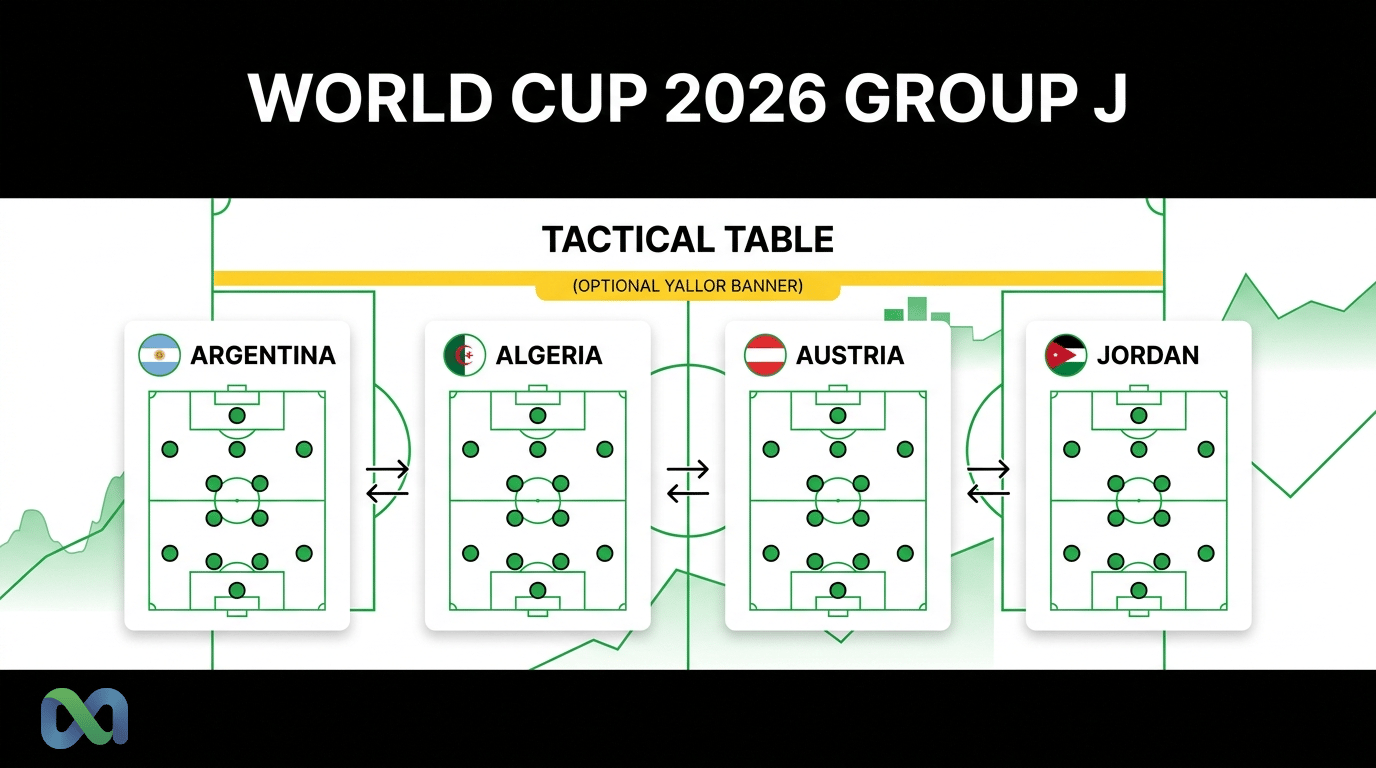
World Cup 2026 Group J brings together Argentina, Algeria, Austria and Jordan. The group has one clear favorite, two strong candidates for second place, and one debutant that can change the math if it steals points early.
The group runs from June 16 to June 27, 2026, with matches in Kansas City, Santa Clara and Arlington. The top two teams advance directly. The third-place team can also move on if it ranks among the best third-place teams in the group stage.
This guide covers the Group J table, fixtures, favorites, qualification scenarios and the markets worth tracking. The goal is to separate confirmed facts from probabilistic reading. The schedule, stadiums and format come from the official World Cup structure, while the scenarios help explain where the group can swing.
In simple terms, Argentina starts as the technical benchmark. Austria and Algeria should fight over thin margins. Jordan must turn low-probability matches into real points.
World Cup 2026 Group J: Who Is in the Group?
World Cup 2026 Group J includes Argentina, Algeria, Austria and Jordan. The matches take place from June 16 to June 27. Two teams advance directly, and the third-place team can still qualify among the best third-place sides.
For context, it helps to understand Argentina's World Cup profile, Jordan's debut path, the expanded 2026 World Cup format, and the full tournament guide. Those topics explain roster strength, qualification routes and the new knockout structure.
That direct answer covers the main search intent. However, World Cup 2026 Group J becomes more useful when each team is read through its tactical role and its impact on the table.
Argentina: Defending Champion and Technical Benchmark
Argentina enters as the strongest team in Group J. The favorite status does not come only from the previous world title. It also comes from competitive continuity, big-match experience and the ability to control tempo.
In a short group, that matters. A favorite that wins the opener reduces pressure before the second match. On the other hand, an opening draw against Algeria would make the group far more volatile.
Argentina should have more possession, more quality between the lines and more emotional control. Still, the World Cup does not reward reputation alone. Injuries, starting lineups and physical form in June can change any forecast.
Algeria: African Strength and Physical Risk
Algeria enters as a team that can compete with intensity. It should be dangerous in physical duels, quick transitions and set pieces. That profile often bothers favorites that want to dominate from the first minute.
The opener against Argentina is the most sensitive point. A narrow loss would still keep Algeria alive. A draw would change the price of the whole group. A win, even if unlikely, would create an immediate leadership scenario.
In World Cup 2026 Group J, Algeria probably targets four points as an initial goal. That requires beating Jordan and taking a point from either Argentina or Austria.
Austria: High Pressing and European Organization
Austria arrives with the profile of an organized European side. Its strength is coordinated pressing, discipline without the ball and the ability to turn high recoveries into clear chances. Against teams that make mistakes in buildup, that style has real value.
The match against Jordan opens a direct route. If Austria wins well, it gains goal difference and reaches the Argentina game with margin. If it stumbles, it may need a heavy direct match against Algeria in the final round.
That is why probabilities should not be read only by team names. The schedule matters. Austria and Algeria meet in the final match, which can become a playoff for second place.
Jordan: Historic Debut and Surprise Potential
Jordan has the lowest relative strength in Group J. Even so, that does not mean it has no chance. In a short group stage, one draw in the right match can matter more than many expect.
Jordan's path starts against Austria. If it earns a point, it forces Algeria and Austria to take more risk. If it loses, it must chase points against Algeria and survive the final match against Argentina.
The key for Jordan is to keep scorelines tight. Heavy defeats damage goal difference. Draws and narrow losses keep alive the chance to compete as a third-place team.
Group J Table and Fixtures
The World Cup 2026 Group J table has six matches across three dates: June 16, June 22 and June 27. The sequence creates a clear arc: a high-risk opener, an adjustment round and a final round with a possible direct decider.
- June 16, 2026: Argentina vs Algeria, Arrowhead Stadium, Kansas City, 20:00 UTC-5. Match 19.
- June 16, 2026: Austria vs Jordan, Levi's Stadium, Santa Clara, 21:00 UTC-7. Match 20.
- June 22, 2026: Argentina vs Austria, AT&T Stadium, Arlington, 12:00 UTC-5. Match 43.
- June 22, 2026: Jordan vs Algeria, Levi's Stadium, Santa Clara, 20:00 UTC-7. Match 44.
- June 27, 2026: Algeria vs Austria, Arrowhead Stadium, Kansas City, 21:00 UTC-5. Match 69.
- June 27, 2026: Jordan vs Argentina, AT&T Stadium, Arlington, 21:00 UTC-5. Match 70.
FIFA maintains official competition and standings pages for the 2026 World Cup. For schedule checks and updates, use the official FIFA standings page. The 2026 FIFA World Cup Group J page is also useful when it is updated.
June 16: Argentina vs Algeria; Austria vs Jordan
The first round sets the tone for World Cup 2026 Group J. Argentina vs Algeria tests the real gap between the favorite and a dangerous challenger. Austria vs Jordan shows whether the European side can confirm its advantage without leaving room for a surprise.
If Argentina and Austria win, the table follows the baseline scenario. If either team drops points, the second round becomes much heavier for the side that fell behind.
June 22: Argentina vs Austria; Jordan vs Algeria
The second round often separates contenders from survivors. Argentina vs Austria can decide the lead if both teams win their openers. Jordan vs Algeria can keep the fight for third place alive.
This day is important for prediction markets. For example, an Argentina win combined with an Algeria win would leave Algeria and Austria in a direct fight in the final round.
June 27: Algeria vs Austria; Jordan vs Argentina
The final round has the strongest tension potential. Algeria vs Austria may decide direct qualification. Jordan vs Argentina could be a management match for the favorite, or a decisive test if Argentina has already dropped points.
The detail is that the final round also affects goal difference. Under the best-third-place format, goal difference can separate a qualified team from an eliminated one.
World Cup 2026 Group J Favorites and Probabilities
The favorite in World Cup 2026 Group J is Argentina. Austria and Algeria are the natural candidates for second place. Jordan is the outsider and needs early points to turn a surprise into a real scenario.
That hierarchy is the starting point, not a verdict. Market probabilities change with news, lineups, injuries, recent form and trading volume. Therefore, the analysis must be updated close to matchday.
Argentina as the Structural Favorite
Argentina has the best chance to finish first because it combines talent, experience and game control. In short groups, favorites with strong emotional management tend to reduce variance.
The baseline path is simple: beat Algeria or Austria, avoid defeat in the other major match, and close against Jordan with margin. Seven points almost guarantee first place. Six points should also be enough in most scenarios.
However, risk appears if Argentina draws the opener. In that case, the Austria match stops being a management spot and becomes real pressure for a win.
Austria vs Algeria for Second Place
The race between Austria and Algeria is the competitive center of World Cup 2026 Group J. Austria should offer structure and pressure. Algeria should bring intensity, contact and transition threat.
Their direct match in the final round makes this reading even more important. If both teams arrive with three or four points, that game can decide second place, third place or elimination.
For anyone following probabilities, the question is not only “which team is better?” The better question is: which team reaches the final round with stronger goal difference, less pressure and a clearer risk profile?
What Jordan Needs to Advance
Jordan needs a specific script. First, avoid a heavy loss in the opener. Second, take points from Algeria. Third, reach the final game with a mathematical chance.
Four points would put Jordan in a very competitive position. Three points could keep hope alive, but would depend on goal difference and comparison with other groups. Two points rarely look enough.
The most realistic surprise path is a draw against Austria or Algeria, followed by a win in the other winnable match. It is difficult, but not impossible.
Group J Qualification Scenarios
Group J qualification follows the 2026 World Cup model: the top two teams advance, and the best third-place teams can also continue. That means four points can be enough in some scenarios, but goal difference carries huge weight.
The expansion to 48 teams changes the calculation. In older formats, third place almost always meant elimination. Now it can be a real route into the round of 32.
How Many Points Are Usually Enough?
Seven points should guarantee first place or, at minimum, direct qualification. Six points almost always puts a team in a strong position. Four points can be enough to advance, especially with positive goal difference.
Three points are unstable. A team on three points must hope against third-place teams from other groups. It also must avoid a very negative goal difference. So losing by a small margin can matter almost as much as winning one isolated match.
- 9 points: almost certain group win with a perfect campaign.
- 7 points: very likely direct qualification with two wins and one draw.
- 6 points: strong qualification position, although goal difference can decide first place.
- 4 points: tension zone; possible qualification, but group-dependent.
- 3 points: high risk, with heavy dependence on goal difference and outside results.
- 0 to 2 points: likely elimination, except in an extreme scenario.
Goal Difference and Fair Play as Tiebreakers
In balanced groups, goal difference becomes a strategic asset. A 1-0 loss can be acceptable. A 4-0 loss can destroy the chance of advancing as a third-place team.
Tiebreakers include points, goal difference, goals scored, head-to-head results and disciplinary criteria. Therefore, cards can also matter in extreme cases.
That rule affects match decisions. A team losing by one goal in the final minutes may not be able to open itself completely. Protecting goal difference can be rational.
Possible Round-of-32 Crossovers
The next round depends on final position and the composition of the qualified third-place teams. Because the format is broader, the exact route can change as other groups finish.
Even so, finishing first is usually better. The group winner tends to avoid some of the heavier crossovers. A third-place team advances with less control over opponent and travel logistics.
Therefore, Argentina should not treat first place as a detail. Austria and Algeria may see second place as the difference between an acceptable route and a very hard bracket.
Markets Worth Tracking
World Cup 2026 Group J offers four relevant market types: group winner, qualification to the knockout stage, match result, and points or goal-difference metrics. Each answers a different question.
On Macro Markets, the reading should be professional. Probabilities are not promises of a result. They are a synthesis of what the market is pricing at that moment.
Group Winner
The group winner market measures who finishes first. It should concentrate the most attention on Argentina, but Austria and Algeria can gain strength if they take points early.
This market is sensitive to the opener. An Argentina win reduces uncertainty. A draw or loss increases the chance of a more open group.
Qualification to the Knockout Stage
The qualification market is broader. It considers finishing first, second or advancing as a third-place team. Therefore, a team can have a low chance to top the group and still have a strong chance to survive.
Austria and Algeria are good examples. They may not be favorites for first place, but they can have competitive probabilities to advance.
Match Result
Match result markets capture more immediate information. Starting lineups, rest, injuries, travel and table context all influence price.
Argentina vs Algeria and Algeria vs Austria should be the most relevant games for the balance of the group. Austria vs Jordan also matters because it can create early goal-difference margin.
Points and Goal Difference
Markets tied to points and goal difference help read third-place scenarios. They become useful when direct qualification gets tight.
For example, a team with four points and positive goal difference breathes better. A team with four points and negative goal difference can still suffer in the overall comparison.
How to Simulate World Cup 2026 Group J
Simulating World Cup 2026 Group J is the clearest way to test combinations. You change results, watch the table and understand how each scoreline changes the route for Argentina, Algeria, Austria and Jordan.
Simulation also reduces guesswork. Instead of discussing only team names, you measure points, goal difference and win requirements.
Use a Simulator to Test Result Combinations
Start with the baseline scenario: Argentina beat Algeria, Austria beat Jordan, Argentina draw with Austria, Algeria beat Jordan, Argentina beat Jordan, and Austria draw with Algeria.
In that script, Argentina win the group. Austria and Algeria stay close, and goal difference can separate positions. Then change only one result at a time. That makes it clear which match moves the table most.
World Cup 2026 Group J should be sensitive to the direct match between Algeria and Austria. It can decide a direct place or determine who depends on the third-place table.
Scenarios That Change Qualification the Most
Three scenarios deserve attention. The first is a draw between Argentina and Algeria in the opener. The second is a Jordan win over Austria. The third is a blowout in any match involving a likely third-place candidate.
Each changes a different axis. A draw against the favorite increases uncertainty. A Jordan win disrupts the hierarchy. A blowout changes goal difference and can affect comparison with other groups.
That is why tracking probabilities in real time matters. Market price changes when information changes.
Quick Summary of World Cup 2026 Group J
Use this block as a pocket guide before the matches. It summarizes what matters most in the group. The core point is simple. Argentina starts ahead. Austria and Algeria fight for a place. Jordan looks for an early point.
In the first round, watch Argentina's rhythm. If the team creates chances early, the group becomes clearer. If Algeria keeps the match tight, everything changes. In the other match, Austria must win. A draw with Jordan already creates pressure.
In the second round, check the table before kickoff. Whoever lost the opener cannot miss again. Whoever won can play with more calm. That is why each point changes plan, risk and market price.
In the final round, goal difference becomes central. One extra goal can be worth a place. One late goal conceded can cost the round of 32. Therefore, do not read only win and loss. Read scoreline, goal difference, cards and group position.
For Argentina, the ideal plan is to win early and manage energy later. For Austria, the plan is to beat Jordan and reach the final match alive. For Algeria, the plan is to take a point from Argentina or beat Jordan well. For Jordan, the plan is to avoid a blowout and find one clear chance.
The best use of a simulator is to test one change at a time. Change only Argentina vs Algeria. Then change only Austria vs Jordan. After that, change Algeria vs Austria. That shows which game moves the table most.
World Cup 2026 Group J should not be treated as a fixed table. It is a live map. With every match, news item and goal, the chance changes. That is the logic of prediction markets: a new price for new information.
Pre-Match Reading Checklist
Before each match, use a short list. Who has more points? Who has better goal difference? Who can play for a draw? Who must attack? Those four questions already reveal much of the risk.
In Argentina matches, watch the midfield. If Argentina keep possession and enter the box, the group tends to follow the baseline script. If the team circulates the ball far from goal, the opponent gains time and confidence.
In Austria matches, watch the press. If high pressing wins the ball near the box, Austria's chance grows. If the line sits too far back, Austria becomes more ordinary and loses force.
In Algeria matches, watch duels and set pieces. A corner, a wide free kick or a counterattack can change the score. Algeria do not need long possession to hurt an opponent.
In Jordan matches, watch the score through the first 30 minutes. If the game stays 0-0, the underdog gains value. If Jordan concede early, the plan becomes much harder.
Also watch the bench. A World Cup is not only eleven against eleven. Heat, travel, rhythm and fatigue matter. A fast substitute late in the game can find the goal that changes goal difference and qualification.
Use this simple rule: three points change the table; one point changes the pressure; goal difference changes the tiebreaker. In a short group, nothing is small. Even one card can matter if everything finishes level.
The clearest point in World Cup 2026 Group J is the order of risk. Argentina try to avoid chaos. Austria try to impose rhythm. Algeria try to pull the match into duels. Jordan try to keep the match alive.
If you only want a quick map, think this way. Argentina on top is the baseline. Austria and Algeria in the final match is the key to the place. Jordan with an early point is the warning sign. Goal difference is the hidden referee.
This checklist does not predict the future. It helps read the present. When the match changes, the chance changes. When the chance changes, the market price changes too.
Score, Points and Places: the Simple Way to Read the Group
World Cup football is short. One goal changes everything. One point changes the plan. One place can come down to a detail. That is why Group J requires calm.
If Argentina win the first match, they gain peace. If they draw, they gain pressure. If they lose, the group becomes chaos. That is the main axis.
If Austria beat Jordan, they enter strongly. If they draw, they lose margin. If they lose, they need a major performance against Argentina or Algeria.
If Algeria hold Argentina, they change the group. If they lose narrowly, they stay alive. If they lose heavily, goal difference becomes a risk.
If Jordan score first in any match, everything changes. The opponent pushes higher. The field opens. The chance of mistakes grows.
Think in three lines. Line one: who has points. Line two: who has goal difference. Line three: who has the easier match ahead. The sum of those lines shows real strength.
Do not look only at names. Names matter, but matches decide. A strong team can play badly. A smaller team can find one goal. The World Cup lives on that.
Do not treat every draw as failure either. For Jordan, a draw can be huge. For Argentina, it can be a warning. For Austria and Algeria, it can be good or bad depending on the round.
The best scenario for fans is an open final round. Algeria vs Austria already looks like a final. If both teams arrive alive, that match becomes the center of the group.
The best scenario for the market is new data. An early goal is new data. A card is new data. An injury is new data. A rotated lineup is new data. Each data point changes the chance.
Finally, think about qualification, not only first place. First is excellent. Second is safe. Third may be enough. Fourth ends everything.
This simple reading helps anyone searching for World Cup 2026 Group J without wasting time. First read the table. Then read goal difference. Only then read the probabilities.
Warning Signs During the Group
Some signals matter more than possession. The first is a clear chance. A weak shot from distance says little. A clean ball in the box says much more.
The second signal is a foul near the box. In a locked match, set pieces become a plan. Algeria and Austria can gain a lot from that type of action.
The third signal is rhythm. If Argentina accelerate and step into the box, the opponent suffers. If the game slows down, the underdog breathes.
The fourth signal is the bench. If a coach changes early, he has seen risk. If he waits too long, he may lose time. The World Cup punishes delay.
The fifth signal is goal difference. A team that wins by two goals creates margin. A team that loses by two goals carries weight. In the end, that weight can become the cut.
Keep one easy rule. Points keep a team alive. Goals bring a team closer. Goal difference makes a team safer. Without that, the table can lie.
In World Cup 2026 Group J, these signals help you read the game without noise. You do not need to predict everything. You only need to see what changes the chance to qualify.
Rule of Thumb for Fans
Want to read the group without a spreadsheet? Use three steps. Check the score. Check goal difference. Check the next match.
If a team has points and goal difference, it controls risk. If it has points without goal difference, it still suffers. If it has no points, it must open the match.
This applies to everyone. It applies to Argentina. It applies to Austria. It applies to Algeria. It applies to Jordan.
The World Cup is short. Mistakes carry weight. Goals save teams. Places go to those who score early and avoid heavy damage.
World Cup 2026 Group J asks for simple reading. World Cup 2026 Group J changes with every goal. World Cup 2026 Group J can produce both direct qualification and a third-place route.
Watch match by match. Watch goal by goal. Watch point by point. Nothing is fixed. Everything moves quickly.
In the end, the group is clear. A team that scores early gets air. A team that concedes early suffers. A team that takes points stays alive. A team that loses goal difference gets trapped.
Use calm. Use data. Use the score. Use the table. Do not use reputation as the only base. Reputation helps, but it does not enter the pitch.
Goals matter. Points matter. Places matter. Everything counts.
Matchday requires focus. Watch who attacks. Watch who drops back. Watch who gets tired. Watch who misses easy passes. Watch who wins duels on the ground and in the air. That shows more than reputation.
If the score stays tight, the ending matters. If the score opens, goal difference matters. If the match locks up, set pieces matter. The group lives on those signals.
See a goal? Recalculate. See a card? Recalculate. See an injury? Recalculate.
One more practical point: separate pre-match strength from in-match information. Before kickoff, Argentina's squad quality matters most. After kickoff, space, pressure, fatigue and substitutions matter more. A smart Group J read updates both layers. The favorite can still be favorite while the live match becomes uncomfortable. The underdog can still be weaker while one specific situation creates value.
Frequently Asked Questions About Group J
Which teams are in World Cup 2026 Group J?
Group J has Argentina, Algeria, Austria and Jordan. Argentina are the initial favorite. Austria and Algeria should fight for second place. Jordan will try to surprise the group and find at least a third-place route.
What are the Group J fixtures for the 2026 World Cup?
The fixtures are Argentina vs Algeria, Austria vs Jordan, Argentina vs Austria, Jordan vs Algeria, Algeria vs Austria, and Jordan vs Argentina. The matches take place on June 16, June 22 and June 27, 2026.
Who is favored in Group J at the 2026 World Cup?
Argentina are favored to win Group J. The team has the strongest technical base and recent World Cup experience. However, Austria and Algeria can change the scenario if they take points early.
Can Argentina be eliminated in Group J?
Yes, but it would be a low-probability scenario. Argentina would need to stumble repeatedly, suffer on goal difference or reach the final match under pressure. The best-third-place format also reduces that risk.
Do Austria or Algeria have a better chance to advance?
The answer depends on recent form, available players and the first-round result. Austria should offer more organization. Algeria can create more physical discomfort and transition danger. The direct match should be decisive.
Can Jordan qualify from Group J?
Yes, but Jordan need early points. The most realistic route involves taking points from Austria or Algeria, avoiding a blowout and reaching the final match with goal difference still competitive.
How does third-place qualification work?
In addition to the top two teams from each group, some third-place teams advance to the round of 32. The comparison considers points, goal difference, goals scored and tiebreakers. That is why every goal can matter.
Conclusion
World Cup 2026 Group J starts with Argentina as the structural favorite. The more open race is between Austria and Algeria, who should fight for second place and goal-difference advantage. Jordan enter as the underdog, but they can influence the group if they take points early.
The best reading of the group combines three elements: the table, team context and market probabilities. The schedule shows where the turning points are. The teams show how each match can be played. The markets show how collective expectations change when new information arrives.
To follow the group better, simulate result combinations before the opener. Then compare your scenario with real-time probabilities on Macro Markets. That turns Group J into a decision map, not just a static table.
