


AI Scare Trade Banks: What Prediction Markets Tell Bargain Hunters
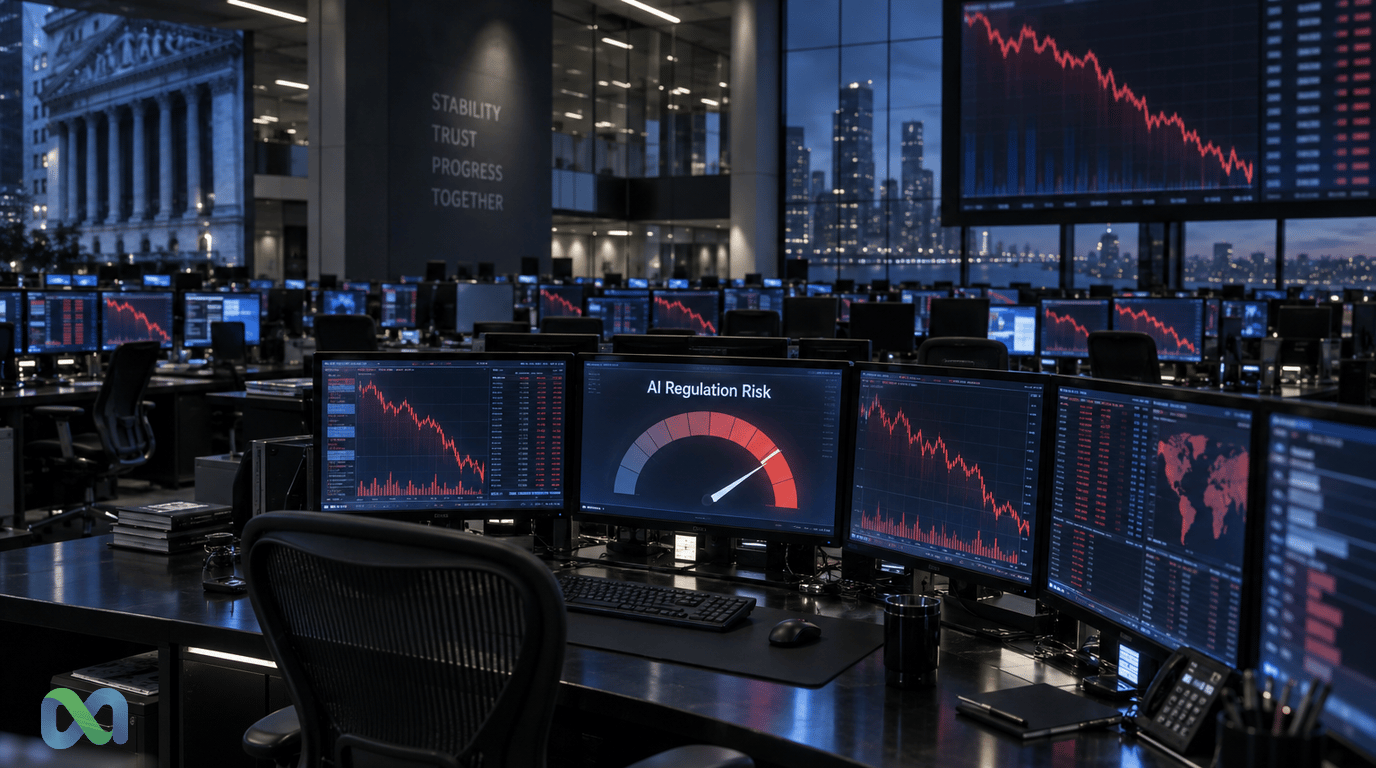
AI Scare Trade Banks: What Prediction Markets Tell Bargain Hunters
The AI scare trade is finally hitting banks, and the data tells a more nuanced story than the headlines.
Bank stocks are falling on AI fears. Investors worry about mass job cuts, lost revenue, and outdated business models. But prediction markets suggest the fear has gone too far.
Is the fear justified? Or are bargain hunters looking at a rare buying chance?
In this analysis, we break down the AI scare trade in banks. We look at what prediction markets say about AI rules and risk. And we examine why the case for bargain hunting may be stronger than the market thinks.
What Is the AI Scare Trade and Why Is It Hitting Banks Now?
A scare trade happens when investors sell a sector based on fear of new tech, often before any real harm has arrived. The AI scare trade in banking reflects fear that AI will cut banking jobs and revenue streams before banks can adjust.
This pattern is not new. The internet was going to kill retail banks in 1999. Mobile banking was going to end branch networks in 2012. Fintech was going to eat banks' lunch in 2017. Each time, fear outran the facts.
Now the trigger is AI. The story: AI-first fintech firms will take business from banks across lending, trading, and legal work. Faster and cheaper than big banks can fight back.
How Scare Trades Work in Financial Markets
Scare trades follow a clear pattern. A new tech emerges. Analysts project worst-case timelines. Investors price in full damage before data confirms it. Stocks fall hard.
Then one of two things happens. The harm arrives, and the selloff was fair. Or the big firms adapt, the timeline slows, and the sold-off stocks bounce back sharply.
For bank investors, the question is: which path are we on now?
The Fintech and AI Narrative Driving Bank Selloffs
The sell story has key parts. AI lenders claim they can approve loans faster and at lower cost than legacy banks. AI trading desks at hedge funds claim better returns than old-school bank teams. AI tools promise to automate 70-80% of the legal and rule work that banks staff with thousands of people.
If even half of this is true, and it plays out fast, the revenue hit on banks is real.
How the AI Rules Debate Adds to the Fear
The Anthropic-Meta-Trump debate has added more noise. Dario Amodei's call for an AI slowdown clashes with Mark Zuckerberg's hands-off stance. The current US policy stance removes guardrails that could have paced AI change at a safe speed.
For bank investors, high uncertainty about AI rules means high risk is priced in. Markets hate not knowing. They sell first and ask questions later.
How Real Is the AI Threat to Traditional Banking?
The threat is real. But the scale and speed are being overstated by the scare trade.
Let's look at where AI truly harms bank revenue, and where banks have real strengths that AI cannot easily beat.
Where AI Genuinely Threatens Bank Revenue
Lending. AI loan review is faster and can be more accurate for certain loan types. Banks that don't upgrade their credit tools face real pressure from AI-first lenders.
Trading. Algorithm-driven trading has already cut into bank trading desks' edge on fast, high-volume plays. The pressure is real.
Compliance. This is where AI makes the strongest case. KYC, AML screening, and legal reporting are rule-heavy, labor-intense tasks. AI tools can take over large parts of this work. McKinsey estimates 30-40% of banking tasks could be done by AI with today's tools. Additionally, the Bank for International Settlements has warned that AI adoption in finance poses both opportunity and systemic risk for regulators to weigh carefully.
What Major Banks Are Actually Doing With AI
Here's the key fact the scare trade misses: the biggest banks are not AI victims. They are AI users.
JPMorgan's COiN platform reviews 12,000 credit deals per year. That work used to take 360,000 lawyer-hours. JPMorgan CEO Jamie Dimon has called AI a top priority in his annual shareholder letters.
Goldman Sachs uses an AI coding tool to help engineers write, check, and fix code. The firm says it adds the output of a junior developer for each senior developer who uses it.
Citigroup uses AI tools across its legal and compliance work. This cuts false alerts in fraud checks and speeds up review time. The savings are put back into growth areas.
These are not defensive moves. They are bold AI plays that cut costs and improve margins.
Why Banks Have Strengths AI Can't Easily Beat
Banks hold key advantages that AI-first fintech cannot copy quickly.
Banking licenses. A banking license takes years and hundreds of millions of dollars to get. An AI startup cannot become a federally chartered bank overnight. These legal barriers protect big banks even as tech moves fast.
Trust and deposits. People store their life savings with banks they trust. JPMorgan manages $3.7 trillion in assets because customers trust the brand, the FDIC safety net, and the balance sheet behind it.
Data edge. Big banks have decades of real transaction data. AI startups simply don't have that. More data means better AI for credit risk, fraud checks, and customer behavior.
The AI Rules Debate: What It Means for Bank Stocks
The rules outcome changes the risk and reward for bank stocks in a big way. Two paths matter.
Path A: Strict AI rules. If governments impose real AI limits, AI-first fintech moves more slowly. Banks get more time to adapt. Legal barriers grow stronger. Bank stocks bounce back.
Path B: Loose AI rules. If the hands-off camp wins, with no limits on AI speed, the threat grows faster. Banks face quicker-moving rivals with less time to adjust. The scare trade story gets validated.
The current selloff reflects not knowing which path wins. That uncertainty is not crazy. However, it is causing a sentiment overshoot, where stocks price in Path B even when the likely outcome may be closer to Path A.
Therefore, this is where prediction markets add real value. They offer real-time crowd wisdom on the odds of different rules outcomes.
What Prediction Markets Are Telling Us About AI and Banks
Prediction markets pull in information from thousands of traders who put real money on the line. They are not polls or pundit views. They are crowd-based odds from people with skin in the game.
On AI rules, prediction markets now show a high chance of some form of significant AI governance in the US and EU within 24 months. That chance has grown as elections shift and public worry about AI rises.
For bank investors, this matters directly. Higher AI rules probability means longer timelines for harm. Furthermore, more time for banks to adjust means more runway for AI-leaders like JPMorgan and Goldman to grow their edge. Less need to price in the worst case.
How to Use Prediction Markets to Track This Trade
Investors tracking bank stocks can watch AI rules odds as a real-time signal. When the chance of rules rises above a key level, big bank stocks tend to beat AI-first fintech rivals. When it falls, the reverse tends to happen.
This kind of odds-based thinking separates data-driven bargain hunting from pure fear trading.
History of Scare Trades: When Fear Created Opportunity in Bank Stocks
The current AI scare trade is the fourth big tech-driven selloff for bank stocks in 25 years. How past scare trades played out is the most useful context for today's bargain hunter.
The Internet Banking Scare of the Late 1990s
In 1999, analysts said internet banks would replace traditional branch networks within a decade. Big bank stocks lagged the tech rally.
What happened? Traditional banks built online banking. Internet-only banks struggled with customer costs and loan quality. By 2005, the big banks had absorbed the internet and extended their reach with new digital tools.
Investors who bought bank stocks during the scare made strong returns as stocks bounced back.
The Fintech Wave of 2015-2020
PayPal, Venmo, Square, Stripe, and Robinhood were said to be existential threats to traditional banking. Analysts said bank fee income would collapse as fintechs took over payments, wealth management, and personal finance.
What happened? Banks upgraded their digital payment tools. Most bought or teamed up with fintech firms. JPMorgan bought WePay. Goldman launched Marcus. Bank of America built Erica. Total bank profits hit records in 2019.
The fintech scare trade, like the internet scare before it, created a buying window that paid off for patient, data-driven investors.
Pattern Recognition: What Past Cycles Tell Today's Investor
Three patterns emerge from past scare trades in banking:
-
Timelines are always longer than feared. Legal barriers, trust, and capital needs slow how long change takes, no matter how fast the tech moves.
-
Banks adapt by using tech, not fighting it. Every tech that was said to destroy banks became a tool banks absorbed. The internet. Mobile. APIs. Now AI.
-
Selloffs go too far. Fear-driven selling prices in the worst case. When timelines extend and banks adapt, stocks bounce back sharply, giving strong returns to investors who bought during the scare.
Should Bargain Hunters Buy Bank Stocks Now? A Data-Driven Look
Here is where the analysis gets concrete.
Major US bank stocks are now trading at or below their long-run average price-to-book (P/B) ratios. JPMorgan, Bank of America, and Citigroup have all seen P/B drop as AI fear grows. For context: during the 2008 crisis, banks traded at 0.5-0.7x book. Current levels show fear, but not crisis-level distress.
Which Bank Subsectors Face Highest vs. Lowest AI Risk
Highest risk: mid-market lending (where AI gains are clearest), traditional brokerage (where AI advisors are growing fast), and compliance-heavy staffing models.
Lowest risk: large universal banks with their own AI programs (JPMorgan, Goldman, Citi), banks with strong legal capital buffers, and institutions with deep proprietary data.
The scare trade treats all bank stocks the same. But risk varies a lot by business model. Large-cap banks with their own AI programs are NOT the same risk as regional banks with old systems and no AI spend.
Risk Factors That Could Extend the Scare Trade
Fair disclosure: three things could make the scare trade right rather than wrong.
- AI rules never arrive. AI-first fintech moves faster than banks can match.
- A major bank suffers an AI-related credit loss. A model failure causes big loan losses and triggers a rules review of bank AI programs.
- Macro headwinds add to AI fears. Rising rates, a slowdown, or credit issues combine with the AI story to keep pressure on stocks.
Each of these is a real risk. Bargain hunting in a scare trade means accepting that fear could be partly right, and sizing positions with care.
FAQ
What is the AI scare trade in banking?
A scare trade happens when investors sell a sector based on fear of new tech before the threat fully arrives. The AI scare trade in banking reflects fear that AI will cut bank revenue streams. Past scare trades show that fear often goes too far, creating buying chances for patient investors.
Will AI replace bank workers?
AI will take over a large part of banking tasks. However, past cases, ATMs, internet banking, mobile banking, show that productivity gains tend to grow banks rather than shrink them. Banks have consistently used new tech and moved staff to higher-value work.
Are bank stocks cheap after the AI selloff?
Major US bank stocks are at or below long-run average P/B ratios. Whether this is a good buy depends on how fast the threat arrives. Prediction markets can help investors track AI rules odds in real time, a key factor in when bank stocks may bounce back.
How are major banks using AI?
JPMorgan's COiN processes 12,000 credit deals per year. Goldman Sachs uses AI coding tools across its tech teams. Citigroup uses AI across compliance and fraud work. The major banks are AI users, not just AI threat targets.
What will AI rules mean for bank stocks?
Strict AI rules slow AI-first fintech rivals, which tends to help bank stocks. Loose rules speed up the threat. Prediction markets give real-time odds on which path is more likely, offering a data-based edge for investors tracking this trade.
Disclaimer: This article is for informational purposes only and does not constitute financial advice. Investment decisions should be based on your own research and risk assessment. Macro Markets is a prediction market platform, not an investment advisor. Data and market references reflect conditions as of publication date.