


ChatGPT Claude Throat-Clearing Habit: Both AI Giants Finally Fixed It
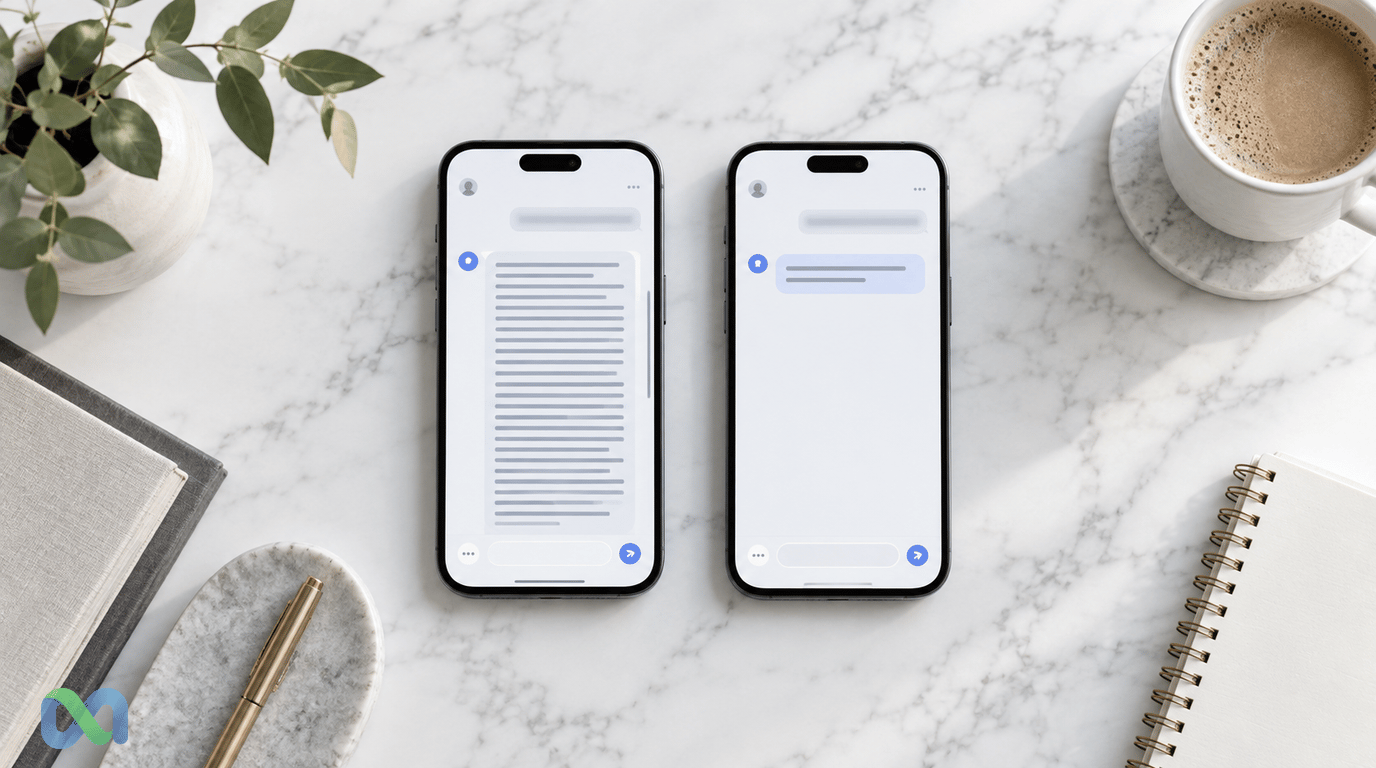
The ChatGPT and Claude throat-clearing habit is dead. After years of "Certainly! I'd be happy to help you with that..." filler, both OpenAI and Anthropic changed how their models respond. GPT-5.2 and Claude 4.5 Opus now skip the warm-up and answer directly. The change rolled out in September 2026, and users noticed fast.
This matters beyond the UX win. Why did both companies make the same change at the same time? What does this chatgpt claude throat-clearing habit fix signal about the AI race? And what should prediction market traders make of it?
What Is the ChatGPT Claude Throat-Clearing Habit?
The term "throat-clearing" comes from public speaking. It describes filler behavior before getting to the point. In AI, the chatgpt claude throat-clearing habit looks like this:
- Repeating your question back: "You've asked me about photosynthesis..."
- Filler openers: "Certainly! I'd be happy to help."
- Excessive caveats before every reply: "Please note that I'm just an AI and..."
- Preamble questions: "Before I answer, let me clarify what you mean by..."
- Over-polite closers: "I hope this helps! Let me know if you need anything else."
Every one of these phrases wastes time. Users hated them. Reddit and Hacker News filled with complaints about the chatgpt claude throat-clearing habit. Many users built custom prompts just to stop it. "Don't repeat my question" and "skip the preamble" became standard starter lines.
Here's the irony: AI models learned this habit through training. Reinforcement learning from human feedback (RLHF) shapes how models behave. Early human raters gave high scores to responses that seemed warm and helpful. So models learned to perform helpfulness, not just deliver it. Throat-clearing was the result.
What OpenAI and Anthropic Actually Changed
In September 2026, both companies updated their flagship models.
GPT-5.2 from OpenAI changed its default style. The model now leads with actual content, not acknowledgment phrases. OpenAI tied this to user feedback data showing the chatgpt claude throat-clearing habit hurt engagement. The change hit both the ChatGPT app and the API.
Claude 4.5 Opus from Anthropic made the same move. Anthropic cut default preamble and reduced repetitive acknowledgment of user queries. Claude now jumps straight to the answer.
Inc. com reported on both updates, noting the companies aimed to "skip the throat-clearing and get straight to the point."
The technical fix is almost certainly RLHF-level. Both labs changed what gets rewarded in the training loop. Instead of training models to sound helpful, they tuned models to be helpful. That means cutting the chatgpt claude throat-clearing habit at the source.
This was not a quick config change. Retraining behavioral defaults takes months. Both companies planned and shipped in the same window. That's a signal worth tracking.
Before vs. After: Real Examples of the Change
The difference is immediate in practice.
Prompt: "What's the capital of France?"
Old response (with throat-clearing):
"Certainly! That's a great question. The capital of France is something many people ask about. France is a country in Western Europe. The capital is Paris. I hope this helps! Feel free to ask more."
New response (direct):
"Paris."
For complex questions the gap is smaller, but still meaningful. Old responses spent 30 to 50 tokens on preamble before reaching any value. New ones start with content.
For regular users, this adds up. Someone using ChatGPT 50 times a day might save 10 to 15 minutes per week from skipping filler alone. For enterprise teams running AI at scale, the token cost savings are real, less preamble means fewer tokens per API call.
And the quality? It holds up. Direct responses match the accuracy of longer-winded ones. Removing the warm-up doesn't reduce substance. It just cuts the performance layer that no one wanted.
Why Did Both Companies Move at the Same Time?
This is the key question for prediction market traders.
Competitive pressure. With two dominant players in the market, any UX win by one forces the other to respond. If ChatGPT fixed the chatgpt claude throat-clearing habit and users switched or complained, Anthropic had to act fast. This is the same pattern as every major tech feature war. One player moves, the other follows, or falls behind.
Shared data signals. Both companies collect massive usage data. OpenAI processes billions of ChatGPT sessions each month. Anthropic tracks Claude interactions at scale. Both datasets showed the same pattern: users hated preamble, complained about filler, and dropped sessions after getting repetitive warm-ups. When the data says the same thing, both teams land on the same fix.
The companies didn't need to talk. The chatgpt claude throat-clearing habit annoyed users equally on both platforms. The signal was identical. The fix was obvious.
Faster iteration cycles. In 2023, model updates took months. By 2026, RLHF tweaks can ship in weeks. Both companies moved fast because they now can move fast. Speed itself is a competitive advantage, and it's accelerating.
What This Means for the OpenAI vs. Anthropic Race
For traders watching AI company outcomes on Macro Markets, this update carries useful context.
Both companies matched each other on speed. Neither company got a meaningful head start here. Response time to the same market signal was roughly equivalent. That suggests similar feedback loop quality and deployment velocity, a tie on this particular metric.
Claude still leads on capability for many users. Community data on Bluesky and Reddit shows that power users still prefer Claude 4.5 Opus for complex tasks. The chatgpt claude throat-clearing habit fix helps ChatGPT's UX score. However, it doesn't change model capability gaps where Anthropic holds an edge.
Enterprise vs. consumer impact differs. API users usually suppress defaults with system prompts anyway. This change matters most for consumer users on ChatGPT. com and Claude. ai, where default behavior is the product experience.
Net market share effect is likely small. A throat-clearing fix is a UX win, not a capability leap. It's unlikely to shift major market share on its own. The bigger competitive levers remain model quality, pricing, and enterprise sales. However, as a signal of how quickly both companies read and act on user data, it's a useful reference point for any prediction market model.
Which AI Habits Could Be Fixed Next?
The chatgpt claude throat-clearing habit was one of the most hated AI patterns. However, users have a longer list. Here's what could be next:
Safety caveats on low-risk queries. Ask about historical violence for a history paper and get three sentences of disclaimers before any content. For clearly educational queries, this is pure friction.
Forced markdown formatting. Ask a casual question and receive bullet points and bold headers as if the response were a business report. Matching format to context is still a gap.
Unnecessary clarifying questions. "Before I answer, could you tell me more about your goals?" is useful for a complex project. For "what's the boiling point of water," it's not.
Explaining things the user clearly knows. Telling a developer what an API is when they asked about rate limits is condescending. Over-explanation is still common.
Filler closers. "Is there anything else I can help you with?" ends most responses on both platforms. It adds nothing when the user can already continue the conversation.
Gemini and Grok still show more throat-clearing than GPT-5.2 or Claude 4.5 Opus. If the OpenAI and Anthropic updates drive measurable gains, Google and xAI will face the same pressure to act.
How to Get the Most Direct Answers Right Now
Even with the new defaults, you can push further. These methods work today.
Use direct format requests. Start prompts with "Answer directly:" or "In two sentences:" Explicit format instructions work because RLHF-trained models respond well to user signals.
Set a system prompt that bans filler. In ChatGPT or Claude. ai settings, write a custom instruction such as: "Never use filler phrases like 'Certainly', 'Of course', or 'I'd be happy to help'. Start every response with the actual answer." This fully overrides remaining defaults.
Structure requests with answer-first format. Instead of open-ended questions, try: "In one sentence: what is X? Then explain context." This guides model format before the AI decides.
Use API access for tightest control. For developers, API calls with a strict system prompt give cleaner output than app defaults. Even with the recent chatgpt claude throat-clearing habit fix, the API path is most precise.
Test both models on your actual tasks. Claude 4.5 Opus and GPT-5.2 both moved in the same direction. However, their strengths still differ. Claude tends to be stronger on analysis and long-form reasoning. GPT-5.2 handles creative and general tasks well. Run the same prompt on both, use the one that performs better for your specific workflow.
UX Is Now a Front in the AI Race
The chatgpt claude throat-clearing habit fix is a signal, not just a feature update. It shows that major AI labs now compete on user experience quality, not just model benchmarks.
For the first part of the AI boom, competition was about raw capability. Who could pass the bar exam? Who wrote better code? Those questions still matter. But as both ChatGPT and Claude handle most everyday tasks at a high level, the differentiator shifts.
Friction matters now. A 30-token preamble before every answer is friction. Users notice. Users complain. Users switch. Both OpenAI and Anthropic know this.
The simultaneous fix shows both companies are watching the same metrics with similar urgency. For anyone modeling the AI market on prediction markets, that's worth noting. The capability race is still on; but the UX race is now running in parallel.
Who leads on UX by end of 2026? That's still an open market.
For traders on Macro Markets, the chatgpt claude throat-clearing habit fix is one of many product signals worth tracking across the OpenAI and Anthropic race. Prediction markets let you quantify your view on which company wins the next product cycle, whether on UX, capability, or enterprise adoption. As both models converge on similar quality tiers, UX differentiation becomes a more meaningful input to market share models.
Watch for user satisfaction data from third-party sources over Q4 2026. If one platform shows significantly better retention after the chatgpt claude throat-clearing habit update, that will surface in the prediction market odds. The two companies moved together here, but one may execute the follow-up better than the other.
The Token Cost Angle: Why Directness Also Helps Developers
There is one more dimension that rarely gets covered in the consumer-facing coverage: token efficiency.
Every filler phrase in an AI response costs tokens. "Certainly! I'd be happy to help. Let me first make sure I understand your question." That's 18 tokens, before any actual content. At scale, that adds up fast.
For developers using the ChatGPT or Claude API at high volume, removing the chatgpt claude throat-clearing habit reduces output tokens per call. That means lower API costs and faster response times. At enterprise scale, millions of API calls per month, the savings are material.
This is likely one reason API users have long suppressed preamble with system prompts. The recent behavioral update brings default API behavior closer to what serious users were already engineering manually. That's a quality-of-life win for developers building on top of both platforms.
Frequently Asked Questions
What is the AI throat-clearing habit?
AI throat-clearing means using filler phrases and preamble before answering. Common examples include "Certainly! I'd be happy to help" or repeating the user's question back before the actual reply.
Did GPT-5.2 fix the preamble problem?
Yes. GPT-5.2 updated its default response style to cut preamble phrases and start answers directly. The change rolled out in September 2026.
Is Claude 4.5 Opus better than GPT-5.2?
Both updated to cut throat-clearing. Claude 4.5 Opus is often preferred for complex analysis. GPT-5.2 does well on creative and general tasks. The best choice depends on your use case.
How do I make ChatGPT stop saying "Certainly"?
Set a custom system prompt: "Never use phrases like 'Certainly', 'Of course', or 'I'd be happy to help'. Begin every answer with the actual content."
Why did OpenAI and Anthropic fix this at the same time?
Both companies collected user data that showed the same frustration signal. Competitive pressure added urgency, if one company fixes a widely-hated habit, the other must follow or lose users.
Do Gemini or Grok still have this habit?
Yes. As of September 2026, Google's Gemini and xAI's Grok still show more preamble than GPT-5.2 or Claude 4.5 Opus. Perplexity has long prioritized directness as part of its design, giving it a natural edge on this metric.
