


Mexico World Cup 2026: Group, Fixtures and Squad
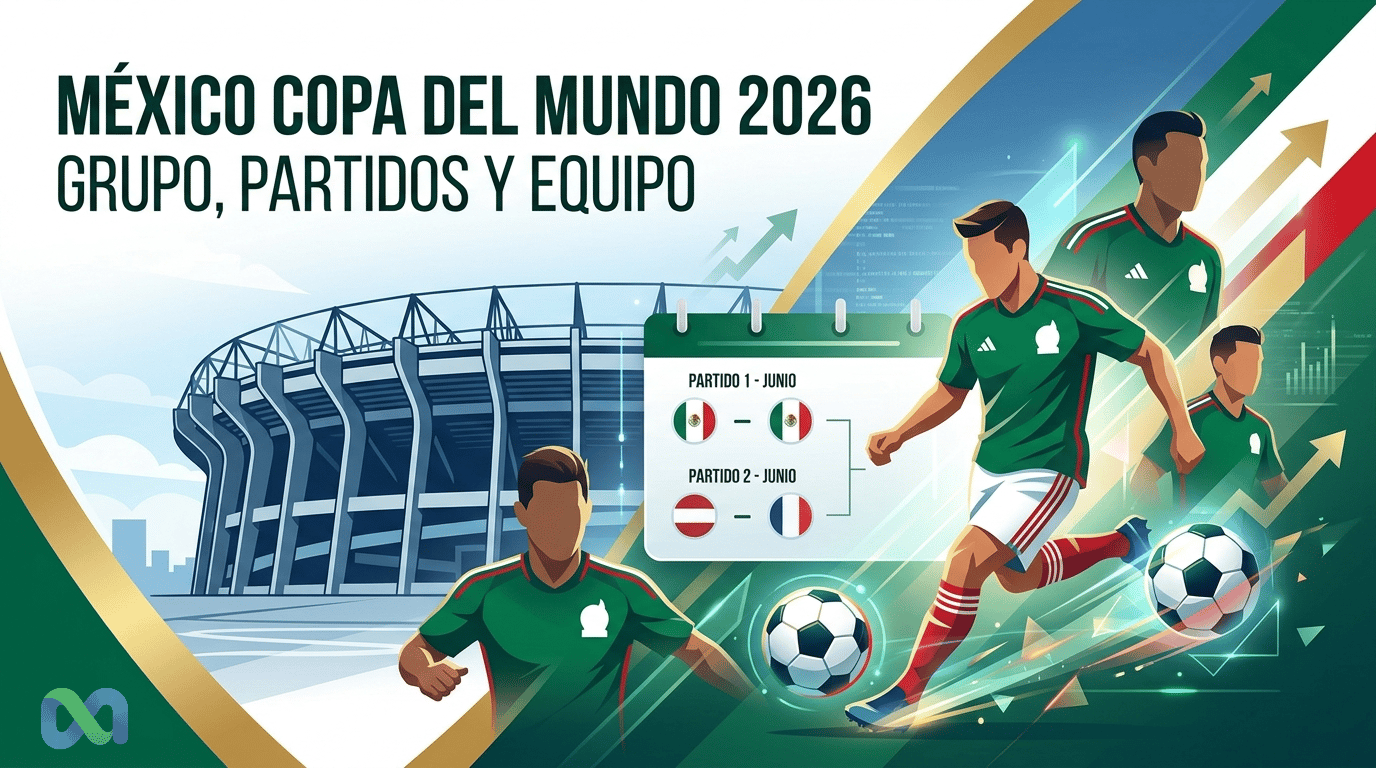
Mexico World Cup 2026 brings together three forces that change any pre-tournament read: home advantage, a known schedule, and historic pressure. Mexico will co-host the World Cup with the United States and Canada. That means it did not go through qualifying and arrives with a different preparation path from most rivals.
The central question is not only whether Mexico can advance. The better question is what price the market should assign to home advantage, Group A, and the real ceiling of Javier Aguirre's team. In a 48-team World Cup, third-place teams can also survive. That widens the scenarios, but it does not remove risk.
This guide brings together Mexico's group, fixtures, stadiums, manager, history, likely squad, key players, tactical plan, and market probabilities. Use it as a reference page for following Mexico at the 2026 World Cup and updating your read as the squad, injuries, and results change.
Mexico at the 2026 World Cup: Quick Summary
Mexico is in Group A at the 2026 World Cup with South Africa, South Korea, and Czechia. Its opener is against South Africa on June 11 at Estadio Azteca in Mexico City. Javier Aguirre is the manager.
That summary already shows why Mexico World Cup 2026 is a strong topic for analysis. The team will have local support, favorable logistics, and two matches in a stadium with huge symbolic weight. At the same time, this is not an automatic group. South Korea and Czechia bring organization, discipline, and international experience.
Group A: Mexico, South Africa, South Korea, and Czechia
Group A gives Mexico three different styles to solve. South Africa should bring physical power, quick transitions, and opening-game energy. South Korea usually combines pressing, wide speed, and tactical discipline. Czechia brings height, direct play, and set-piece threat.
For Mexico, that demands versatility. Possession alone will not be enough. The team must create chances against mid blocks, protect transitions, and defend crosses. The order of the games also matters. A strong opener against South Africa would reduce pressure before the more open match against South Korea.
Manager: Javier Aguirre
Javier Aguirre leads Mexico in another spell with the national team. He is experienced, pragmatic, and used to high-pressure tournaments. His strength is building competitive teams, protecting central areas, and simplifying decisions in big matches.
That choice says a lot about Mexico's plan. The federation did not choose a possession revolution or extreme pressing project. It chose emotional control, knockout-game reading, and squad management. At home, that approach can help. Public pressure will be huge from the opener.
Host status and home advantage
Mexico will host the World Cup for the third time, this time in a shared tournament. The country hosted in 1970 and 1986. In 2026, Estadio Azteca returns to the center of the story. According to FIFA, the tournament will be the first with 48 teams.
Home advantage does not guarantee wins. But it changes logistics, adaptation, crowd energy, and familiarity. For prediction markets, that should be treated as a measurable variable, not a cliché. The effect can show up in the price before the opener and grow if Mexico wins its first match.
Mexico World Cup 2026: Group Stage Fixtures
Mexico's 2026 World Cup schedule is one of the most searched pieces of information because it shapes rest, travel, and pressure. The team will play two matches at Estadio Azteca and one at Estadio BBVA in Monterrey. That reduces travel and keeps a strong connection with the crowd.
- 06/11/2026, 16:00: Mexico vs South Africa, Estadio Azteca, Mexico City.
- 06/18/2026, 22:00: Mexico vs South Korea, Estadio BBVA, Monterrey.
- 06/24/2026, 22:00: Czechia vs Mexico, Estadio Azteca, Mexico City.
The distribution helps Mexico. There are seven days between the opener and the second match. Then there are six days before the final group game. That window allows tactical adjustment, player recovery, and a response to the table. In short tournaments, rest is a real variable.
Mexico vs South Africa, 06/11, 16:00, Estadio Azteca
The opener is the most symbolic match. Mexico and South Africa opened the 2010 World Cup, also with major emotional weight. In 2026, Mexico will be at home and should take more responsibility on the ball. That brings territorial upside, but also more pressure to take the initiative.
The market can treat this match as the first thermometer. If Mexico wins with control, its probability of qualifying should rise quickly. If it draws or loses, the read changes. South Korea and Czechia are not easy opponents for a recovery mission.
Mexico vs South Korea, 06/18, 22:00, Estadio BBVA
The second match may be the most technical game in the group. South Korea is often quick, intense, and dangerous in transition. For Mexico, the challenge is to avoid turning possession into exposure. Losing the ball in central channels could open the field for fast attacks.
This match should also influence the Group A winner market. A Mexico win would put the team in a strong position. A draw would keep the group open. A loss would shift value toward rivals and make the third round much more nervous.
Czechia vs Mexico, 06/24, 22:00, Estadio Azteca
The final match against Czechia could decide position, qualification, and route. Czechia is likely to be dangerous on set pieces and aerial duels. Mexico will need to defend the box carefully, especially if it enters the game needing points.
One detail matters: with 48 teams, third-place teams can advance. That can change the behavior of the match. If Mexico already has four points, it may play for control. If it has three or fewer, it will need to take more risk. The market price should reflect that context.
Mexico's Path: How to Simulate Qualification and Knockouts
The new World Cup requires looking beyond the group. Mexico World Cup 2026 can produce very different paths depending on where the team finishes in Group A. Winning the group increases the chance of a more favorable draw. Finishing second can still be fine. Finishing third leaves the route dependent on combinations.
That is why scenario simulation is more useful than trying to predict one single line. The same team can look strong in group projections and fragile in the bracket. The reverse can also be true. In prediction markets, value often appears when the public prices reputation but ignores the draw.
What changes if Mexico finishes 1st, 2nd, or 3rd
If Mexico wins Group A, it gets the narrative of a strong host and may avoid some harder routes immediately. That does not mean the path is easy. In a larger World Cup, the variation created by third-place qualifiers makes matchups less intuitive.
If Mexico finishes second, it can still advance with decent momentum. But the market may discount the team for failing to dominate the group at home. That discount could be too harsh if second place comes with strong performance and goal difference.
If Mexico finishes third, the analysis becomes more defensive. Qualification may depend on goal difference, goals scored, and comparison with other groups. In that case, knockout-qualification markets should become highly sensitive to every goal.
Use the World Cup 2026 simulator
The best practical use is to build scenarios before the opener. Test plausible results, view the points table, and assess how each score changes the route. Then compare that with market probabilities. If the gap is large, the market may be mispricing the situation.
For Mexico, three scenarios deserve attention. The first is a win in the opener and a draw against South Korea. The second is a draw in the opener and a win against Czechia. The third is an opening defeat, which forces Mexico to chase a result in Monterrey. Each scenario changes rhythm, lineup choices, and risk.
Mexico's World Cup History
Mexico's World Cup history has a clear pattern: regular group-stage performance and difficulty breaking through the round-of-16 ceiling. The team has produced strong campaigns, but the national obsession is reaching the so-called fifth game. That means returning to the quarterfinals.
That history matters for Mexico World Cup 2026 because the country plays at home. The crowd does not just want a respectable appearance. It wants a run that breaks decades of frustration. For market analysis, that creates tension: home advantage can lift performance, but it also increases pressure.
Best finish: quarterfinals in 1970 and 1986
Mexico's best World Cup campaigns came in 1970 and 1986. In both cases, the country was the host. That data point supports the home-advantage case. Mexico tends to compete better when environment, crowd, and adaptation work in its favor.
Still, using 1970 and 1986 as direct proof would be too much. Football has changed. The format has changed. Global depth has increased. The correct point is narrower: Mexico has already shown that hosting can raise its competitive floor at World Cups.
The round-of-16 streak and the 2022 fall
For many cycles, Mexico built a reputation for advancing from the group and losing in the round of 16. In 2022, that streak was broken. Group-stage elimination created a domestic shock and reinforced the need for renewal.
That context turns 2026 into a repair tournament. Mexico does not only want to use its automatic place. It must show it still belongs in the second competitive tier of world football. That tier does not include the absolute favorites, but it does include teams capable of advancing and causing problems.
The weight of the fifth game
The "fifth game" is more than a phrase. It is the symbol of the leap Mexico is trying to make. In a traditional World Cup, the fifth game meant the quarterfinals. In the new format, the math changes, but the ambition remains: win the first knockout match and go deeper.
That ambition can affect decisions. Aguirre may choose a safer structure early. He may also protect veterans for critical moments. In markets, emotional narratives matter less than concrete signals. Watch the lineup, intensity, and physical health.
Likely Mexico Squad and Call-Ups
Mexico's final squad for the 2026 World Cup should still be treated as dynamic information until the official list is released. Responsible analysis must separate confirmed facts from projections. The likely group mixes veterans, players in European leagues, and rising young talent.
The base should be built around an experienced defense, a physical midfield, and an attack looking for a clear reference point. The question is whether Mexico will have enough creativity to break down compact blocks. That will be decisive against South Africa and Czechia.
- Goalkeepers: Guillermo Ochoa, Luis Malagón, and Carlos Acevedo. The focus is experience, leadership, and the fight for the starting role.
- Defense: César Montes, Johan Vásquez, Jorge Sánchez, and Jesús Gallardo. The focus is aerial strength, clean buildup, and fullback protection.
- Midfield: Edson Álvarez, Luis Chávez, Erick Sánchez, and Orbelín Pineda. The focus is balance, ball-winning, and second-line arrivals.
- Attack: Raúl Jiménez, Santiago Giménez, Hirving Lozano, and Uriel Antuna. The focus is depth, finishing, and box presence.
- Young players: Gilberto Mora and other Liga MX names. The focus is upside, energy, and impact off the bench.
This table is not the final squad. It is a tracking map. The definitive list must be checked through official federation and FIFA channels before any final forecast is published.
Likely base in a 4-3-3
The 4-3-3 is a likely base because it balances width, pressure, and central protection. Edson Álvarez can play as the anchor. The interiors can alternate between buildup and box arrival. The wingers must provide depth so the center forward is not isolated.
That shape also allows adjustments. Without the ball, the team can become a 4-1-4-1. When ahead, it can drop the block and protect the box. When behind, it can add attackers and crosses. The issue is executing without losing emotional control.
Partial list and preparation: what is already known
As a host country, Mexico did not use qualifying as a competitive filter. Preparation runs through friendlies, regional competitions, and player monitoring at clubs. That creates a less clean sample for the market. Not every good friendly result should be overvalued.
The key point is collective development. Mexico needs to arrive with clear roles. Who starts attacks? Who accelerates? Who presses the first pass? Who defends the box? Those answers matter more than isolated names.
How to update after the final squad
When the official squad is released, the analysis should be updated in three layers. First, confirm relevant absences. Second, measure balance by position. Third, revise qualification and advancement probabilities based on the likely starters.
A missing center back could matter against Czechia. An attacking absence could reduce value against low blocks. A young player in strong form could raise upside. Markets tend to react quickly to injury news, but they do not always react well to tactical fit.
Mexico's Key Players for 2026
Mexico's key players at the 2026 World Cup should combine experience and renewal. The squad does not depend on only one name, but some profiles can move the campaign. In short tournaments, defensive leaders, goalkeepers, and reference forwards carry outsized weight.
For traders, players matter because they change probabilities before kickoff. Confirmed lineups, injuries, and recent minutes can move match, qualification, and campaign markets. The key is separating fame from real function.
Raúl Jiménez: attacking reference
Raúl Jiménez remains a technical and emotional reference for Mexico's attack. His international experience helps in high-pressure games. Even when he does not score, he can play as a wall pass option, draw defenders, and organize attacks through central channels.
The risk is physical condition and rhythm. If Jiménez arrives well, Mexico gains box presence. If he arrives limited, Aguirre may need more mobile alternatives. That decision changes the team's attacking profile.
Gilberto Mora: young player with the highest upside
Gilberto Mora represents the upside side of the squad. Young players should not carry savior expectations, but they can change locked games. In a home World Cup, impact minutes can transform public perception and market price.
Mora's usage will depend on maturity, training, and the staff's trust. If he performs well in friendlies or in the opener, his relevance could grow quickly. For analysis, watch not only goals, but also decision-making and resistance to pressure.
Guillermo Ochoa: experience and a possible sixth World Cup
Guillermo Ochoa is one of Mexico's most recognizable World Cup names. His presence carries memory, leadership, and important reflexes in big matches. A goalkeeper in strong form can support campaigns beyond expectation.
On the other hand, the starting battle must be analyzed without nostalgia. If another goalkeeper is performing better, Aguirre will face a hard decision. The market should price current performance, not only historic reputation.
Edson Álvarez: midfield balance
Edson Álvarez is central to protecting the defense and organizing the first pass. His off-ball reading helps against transitions. His physical presence will matter against South Korea and Czechia, who can exploit space with speed or aerial play.
If Edson is at a high level, Mexico gains stability. If he is suspended, injured, or physically below par, the structure loses protection. This type of information can move probabilities more than a headline about the attack.
César Montes and Johan Vásquez: defensive core
César Montes and Johan Vásquez could form the team's most important defensive core. The World Cup demands center backs who can win duels, defend crosses, and start moves calmly. Against direct rivals, one individual mistake can be expensive.
Set pieces will be a critical theme. Czechia and South Africa can attack that zone. If Mexico defends the box well, its floor rises. If it struggles on corners and wide free kicks, home advantage can disappear.
Javier Aguirre: Playing Style and Tactical Plan
Javier Aguirre tends to prioritize competitiveness. That does not mean passive football. It means reducing mistakes, controlling dangerous zones, and increasing efficiency. In a home World Cup, that style can be valuable because it prevents emotion from becoming disorder.
Mexico should look for balance. Possession when it has superiority, transition when space appears, and a compact block when it must protect a result. The big question is whether the team will have enough creativity to dominate matches when the opponent accepts defending deep.
4-3-3, transitions, and emotional control
In the 4-3-3, the wingers must stretch the pitch. The fullbacks need to support carefully. The holding midfielder protects against counterattacks. This structure allows coordinated pressure, but it requires timing. If one unit jumps without cover, Mexico becomes vulnerable.
Emotional control will be as important as tactics. The Azteca can push the team, but it can also raise anxiety. If Mexico does not score early, the crowd can feel it. Aguirre has to prevent urgency from turning into low-quality crossing.
How home advantage can change pressure and tempo
Home advantage can speed Mexico up in the opening minutes. That is useful if it creates volume and corners. It is dangerous if it leaves space behind. The balance between energy and patience will be decisive.
For markets, watch the first 15 minutes of the opener. If Mexico presses with organization, that is a positive signal. If it presses chaotically, risk increases. In World Cup matches, the shape of dominance matters as much as possession.
Mexico World Cup 2026: Market Probabilities
Market probabilities for Mexico at the 2026 World Cup should be read as dynamic information. They are not a promise of results. They reflect aggregated expectations at a specific moment. Injuries, lineups, news, and results change the price.
At Macro Markets, the ideal analysis treats every market as a specific question. "Will Mexico win the World Cup?" is very different from "Will Mexico advance from the group?" The first requires a champion's ceiling. The second measures competitive floor. Mixing those reads creates errors.
Relevant markets: qualification, Group A winner, quarterfinals, and campaign
Four markets should attract attention. The first is qualification for the knockouts. The second is Group A winner. The third is reaching the quarterfinals. The fourth is best campaign or stage reached.
Each one answers a different hypothesis. Qualification measures basic consistency. Winning the group measures relative dominance. Quarterfinals measure knockout capacity. Campaign markets measure ceiling. For Mexico, the best value may sit between qualification and quarterfinals, not necessarily in the title market.
How to interpret probabilities before the opener
Before the opener, probabilities carry narrative, history, and expectation. Home advantage will likely lift the price. A moderate group also helps. But the memory of 2022 and squad questions may limit enthusiasm.
The right read is to compare price with scenario. If the market treats Mexico as too comfortable a favorite, the risk may be on the other side. If it discounts Mexico too much because of 2022, it may ignore home advantage and schedule. Value comes from that gap.
Events that can move the market
Several events can move the market before and during the World Cup. The final squad is the first. Injuries to starters are the second. Preparation friendlies are the third. The opening result is the fourth and maybe the strongest.
There are external factors too. South Korea's performance, South Africa's physical level, and Czechia's form all change the group. In prediction markets, price does not depend only on Mexico. It depends on the network of rivals, calendar, and bracket.
Risks, Variables, and How to Follow Mexico
Any guide to Mexico World Cup 2026 must deal with uncertainty. The tournament will still bring updates on squad selection, physical form, and rival context. Good analysis does not freeze an opinion. It creates a method for monitoring.
The first risk is overvaluing home advantage. Playing at home helps, but it does not turn a team into a global favorite. The second is underestimating rivals. South Korea and Czechia have competitive structure. The third is confusing emotion with probability.
Short-term variables
Short-term variables include injuries, club minutes, friendlies, and defensive performance. They also include news about the starting goalkeeper, midfield fit, and attacking form. These signals should be monitored in the final weeks.
Concacaf is a useful source for regional context. The Mexican Football Federation helps track official updates. For the global calendar, always use official FIFA sources.
Variables during the tournament
During the tournament, the first round changes everything. A win in the opener should reduce pressure and open a management scenario. A draw keeps uncertainty alive. A defeat increases volatility and may force tactical changes.
Cards also matter. A suspension for a defensive midfielder or center back can affect the next game. Goal difference becomes more important in a format with third-place qualifiers. One extra late goal can matter a lot for qualification and market price.
Simple Read: The Points That Matter Most
Mexico has a clear mission. It needs early points. It needs to use the crowd well. It needs to avoid cheap mistakes. It needs to stay alive into the final match. That is the basic plan.
The group is not weak. It is also not the worst possible route. South Africa, South Korea, and Czechia can take points. Still, Mexico has a good path to advance if it plays with calm.
The first match matters a lot. A win makes the team lighter. A draw keeps pressure high. A defeat changes everything. That is why the opener should carry major weight in market probabilities.
The second point is defense. Mexico can have good spells on the ball. But the World Cup punishes every mistake. A poorly marked corner or a bad buildup error can change the group.
The third point is attack. The team needs to create clear chances. Lots of crosses are not enough. Long shots are not enough. Mexico needs to enter the box with numbers, timing, and good choices.
The fourth point is squad health. If the leaders arrive fit, the team gains floor. If key names carry injuries, risk rises. That read must be updated until kickoff.
The fifth point is the bench. In a bigger World Cup, depth counts. Mexico may need young players to change the tempo. It may also need veterans to protect a result.
In short, Mexico World Cup 2026 should be analyzed game by game. Home advantage helps, but it does not decide alone. The group allows ambition, but it demands execution. The market should move quickly after each piece of news and each scoreline.
Quick Match-by-Match Guide to Mexico World Cup 2026
The opener requires calm. Mexico should have the ball. It should use the width of the pitch. It should shoot well and without rushing. If it scores early, the game becomes lighter. If the goal does not come, the team cannot open itself too much.
Against South Africa, the key is not giving away space. The opponent can run well. It can find space if Mexico misses passes in midfield. Simple passing matters. Mexico should attack, but it must keep players behind the ball.
The match with South Korea needs a different plan. South Korea can bring more tempo. It can press hard. It can break at high speed. Mexico needs to switch play and avoid losing the ball in bad zones.
In that match, midfield is vital. Edson Álvarez must cut passing lanes. The midfielders need to offer short support. The wingers must recover without the ball. If Mexico goes too direct, it loses control. If it is too slow, it creates little.
Against Czechia, the game could be tense. High balls matter. Set pieces matter. Mexico needs to win the first ball and the second ball. It also needs to avoid cheap fouls near the box.
If Mexico reaches the final round in good shape, it can play with more calm. If it arrives under pressure, the choice changes. The team may need to attack more. That opens space. That is why the table before match three changes the entire read.
For market followers, the score is not the only data point. Watch how the team plays. Watch whether it creates clear chances. Watch whether it allows little. Watch whether the goalkeeper has to save too much. A good score with a bad performance can mislead. A draw with a strong performance can carry useful signal.
Also watch cards. A center back on a yellow changes risk. A suspended holding midfielder changes midfield. A minor injury can become the story of the next game. In a short World Cup, those facts have a price.
Mexico needs to do the basics very well. Defend well. Pass without careless errors. Attack with numbers. Defend the box. Run together. Avoid panic. If it does that, it can advance. If it loses that thread, the group becomes hard.
Fans should look at the dream. Traders should look at the price. They are different things. The dream wants to see Mexico go far. The price measures chance, risk, and timing. Good analysis respects both, but does not confuse one for the other.
Checklist Before Evaluating Mexico
Before the opener, check the final squad. See who is fit. See who played little for their club. See who arrives in good form. A famous name without rhythm may matter less than a simpler player in excellent shape.
Then check the manager's plan. Will the team build short? Will it use long balls? Will it press high? Will it wait? Each choice changes risk and probability. There is no right plan for every match. There is a right plan for each opponent.
Also check the bench. The World Cup has heat, travel, and fatigue. The bench decides games. A fast winger in the second half can change everything. A backup center back may be forced to enter early. The whole squad matters.
Finally, check the price on the day. Old probability is not enough. Markets change with news. They change with lineups. They change with rumors. They change with injuries. Use new data, not only the read made weeks earlier.
If Mexico's chance rises sharply before the opener, ask whether the move has a basis. Was it lineup news? Was it a rival injury? Was it only excitement? If the price falls sharply, ask the same question. Was it real news or public fear?
This simple method helps read Mexico World Cup 2026 without exaggeration. The team has a path. It has support. It has pressure. It has risk. The best lens is cold, clear, and always open to new evidence.
FAQ: Mexico at the 2026 World Cup
What is Mexico's group at the 2026 World Cup?
Mexico is in Group A at the 2026 World Cup with South Africa, South Korea, and Czechia. The team opens against South Africa on June 11 at Estadio Azteca and closes the group stage against Czechia.
When does Mexico play at the 2026 World Cup?
Mexico plays South Africa on June 11, South Korea on June 18, and Czechia on June 24. Two matches will be at Estadio Azteca and one will be at Estadio BBVA in Monterrey.
Who is Mexico's manager for the 2026 World Cup?
Mexico's manager is Javier Aguirre. He is an experienced coach with a record in clubs and national teams. His approach should prioritize organization, competitiveness, and emotional control in high-pressure games.
How many times has Mexico hosted the World Cup?
Before 2026, Mexico hosted the World Cup in 1970 and 1986. In 2026, it will host for the third time, in a tournament shared with the United States and Canada. Estadio Azteca will again have a central role.
Why did Mexico not play qualifiers?
Mexico did not play qualifiers because it is one of the host countries for the 2026 World Cup. Host nations receive automatic places. That is why Mexico's preparation depended more on friendlies, regional tournaments, and squad monitoring.
Could Mexico be a surprise in 2026?
Mexico could be a surprise if it combines home advantage, stable defending, and efficient attacking. The group allows ambition, but it does not guarantee advancement. The team's ceiling will depend on the squad, fitness, tactical fit, and performance in decisive matches.
Who are Mexico's key players?
Raúl Jiménez, Edson Álvarez, César Montes, Johan Vásquez, Guillermo Ochoa, and young players such as Gilberto Mora are among the most important names to watch. The final list can change, so the official squad should be checked before the tournament.
Is Mexico a favorite to win the 2026 World Cup?
Mexico should not be treated as a global title favorite. The team has home advantage and a competitive group path, but it remains behind powers such as Argentina, Brazil, France, England, and Spain in squad ceiling.
Conclusion: Mexico World Cup 2026
Mexico World Cup 2026 is one of the central stories of the tournament. The team will have home advantage, crowd support, a known schedule, and a real chance to turn Group A into a platform for a longer run. At the same time, it carries historic pressure and squad questions.
The most balanced read is to treat Mexico as a strong candidate to advance, competitive for Group A, and dependent on the draw if it wants to dream of the quarterfinals. The title looks distant, but a campaign above the recent pattern is plausible if Aguirre finds stability.
To follow it better, update three points: the final squad, friendly performances, and market price before the opener. Then reassess everything after each match. In a 48-team World Cup, small details can change qualification, route, and probability within hours.
Prediction markets involve risk and do not guarantee outcomes. Use probabilities as an analysis tool, not as certainty. Simulate Mexico's path, compare scenarios, and track updated data on Macro Markets before making any trading decision.
