


US x Iran Permanent Peace Deal: What Prediction Markets Say
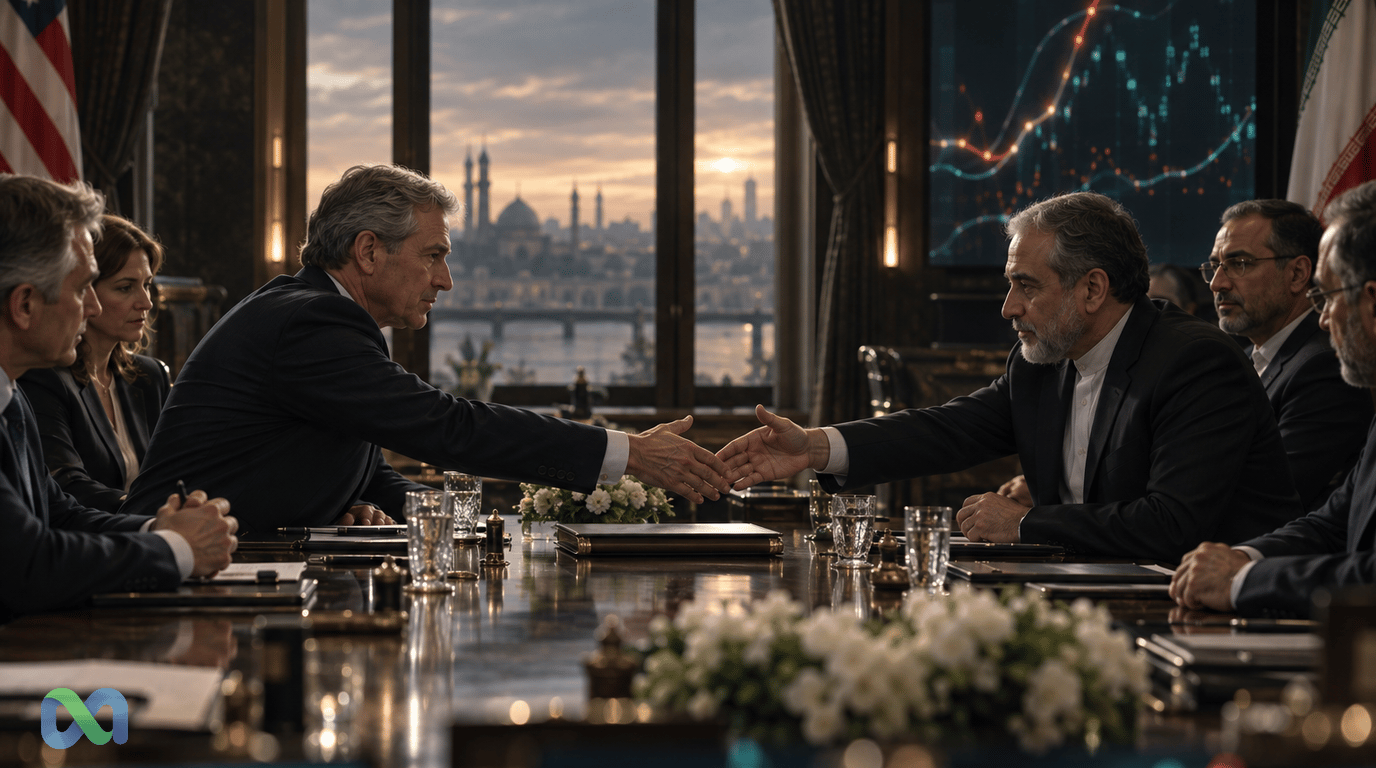
The US x Iran permanent peace deal market is one of the clearest on Macro Markets. Traders have placed over $429 million in volume. The result is simple: the market says NO, at roughly 99.9% confidence, for every date in 2026.
This guide explains what the market is telling you, why the odds sit where they do, and how to think about trading this position.
What the Market Is Pricing Right Now
The market offers six resolution dates for a US x Iran permanent peace deal. These dates run from June 15 to December 31, 2026. Every date is priced at 99.85% to 99.95% NO.
That means YES is priced at 0.05% to 0.15%.
To put that in plain terms: if you bet $1,000 on YES in 1,000 identical markets, you would win once on average. The market is not saying peace is impossible; it is saying peace this year is about as close to impossible as a liquid market will price.
The $429 million in volume matters here. This is not a thin, illiquid market where one large bet drives the price. This is a deep market with real price discovery. When a market this large shows 99.9% NO, it reflects a well-informed consensus.
Notice also that all six date outcomes are priced nearly the same. None shows a higher YES price than the others. This tells you the market sees no special window, no event, no negotiation round, no political shift, that makes any particular date in 2026 more likely to produce a deal.
The History Behind the US-Iran Conflict
To understand the market, you need to understand what drives the price.
The US and Iran have not had formal diplomatic ties since 1980. The break came after the 1979 Islamic Revolution and a 444-day hostage crisis. Since then, the two countries have dealt through back channels and third-party brokers. Direct relations have never been restored.
The nuclear issue added another layer. Iran started expanding its uranium enrichment program in the 2000s. The US and Europe responded with sanctions. In 2015, the two sides reached the JCPOA, the Iran nuclear deal. Iran agreed to limit enrichment to 3.67% purity. In return, it received sanctions relief.
That deal lasted three years. The US withdrew in 2018. Iran then began exceeding its enrichment limits. By 2025, Iran was enriching uranium at 60% purity, far above the 3.67% limit and close to weapons grade at 90%.
This trajectory is the core reason the market prices a US x Iran permanent peace deal at near zero. The distance between the two sides has grown, not shrunk.
What a "Permanent Peace Deal" Actually Requires
The phrase "permanent peace deal" sets a very high bar. It is not a ceasefire. It is not an interim nuclear agreement. It is not de-escalation. It requires all of the following at once.
Full diplomatic normal relations. Both countries must restore official diplomatic relations. Embassies must reopen. Ambassadors must be exchanged. The legal frameworks for normal relations must be in place. This process alone takes months under ideal conditions.
A binding nuclear resolution. Iran's enrichment program must be permanently limited or fully dismantled. This requires international inspectors, inspection protocols, and years of implementation after a political agreement is signed.
Permanent sanctions removal. Some US sanctions are executive orders. A president can waive those. However, key sanctions like the Iran Sanctions Act require an act of Congress. Getting Congress to vote for permanent Iran sanctions relief is not realistic in 2026's political climate.
A regional security framework. Iran funds and arms proxy groups across the Middle East, in Lebanon, Yemen, Iraq, and Syria. These groups directly threaten US allies, including Israel. A permanent peace deal must address this. Iran views its proxy network as essential to its security. Neither side can quickly walk this back.
Domestic buy-in. In the US, a formal treaty needs two-thirds of the Senate. An executive agreement, like the JCPOA, can be reversed by the next president, as 2018 proved. In Iran, the Islamic Revolutionary Guard Corps holds real power. Any deal that limits Iranian influence faces strong internal opposition.
All five of these requirements must be met at the same time. None of them is close to being met. Together, they make a 2026 permanent peace deal effectively impossible.
Why the Odds Are Near Zero
Market participants have priced the US x Iran permanent peace deal near zero for concrete reasons. Here are the main ones.
An MOU is not a permanent peace deal. In 2026, the US and Iran signed a Memorandum of Understanding (MOU), a framework agreement, not a treaty. The MOU committed Iran to reopening the Strait of Hormuz and halting nuclear expansion in exchange for potential sanctions relief. As Notus reported, the full terms were not released right away. An MOU is a statement of intent, not a treaty. It is not a permanent peace deal.
The nuclear enrichment gap remains. Getting Iran back to 3.67% enrichment requires dismantling centrifuges and removing enriched material. The IAEA inspection process for this alone takes 12 to 18 months after a binding deal is signed. The MOU does not commit to this level of inspection. The gap between an MOU and a real nuclear rollback is huge.
Congress is skeptical. Permanent sanctions relief requires Congressional approval. Senate Republicans have held back. As Notus reported, they said they are "awaiting more information" before backing the deal. Without a bipartisan vote, permanent sanctions removal cannot happen in 2026.
The proxy war continues. Iran's regional proxies remain active. They have attacked US forces in Iraq and Syria. They have threatened Israel. As long as these attacks continue, the political environment for a permanent peace deal does not exist in Washington.
Hardliners benefit from the conflict on both sides. In Iran, the IRGC gets its budget and its institutional power from the anti-US posture. In the US, tough-on-Iran politics plays well across party lines. Both sides have incentives to maintain the conflict framing, not to end it.
Time alone blocks it. Even if every political obstacle disappeared tomorrow, the legal processes required, treaty drafting, Senate formal approval, legislative action, inspection implementation, take years. The 2026 calendar does not have enough runway for even the fastest realistic version of these steps.
The prediction market is correctly pricing all of this.
What Could Push the Odds Higher
Even at 0.1%, the YES price is not zero. Prediction markets stay open because extraordinary events happen. Here are the realistic triggers that could move the odds.
Regime change in Iran. The market "Will the Iranian regime fall by June 30?" is priced at 0.05% YES, itself a near-zero outcome. However, a genuine collapse of the Islamic Republic would create unpredictable dynamics. A new government might seek rapid normal relations. More likely, a successor regime would be more nationalist, not less. However, the uncertainty alone would cause YES prices to rise.
A military escalation that forces talks. History shows that some peace frameworks follow near-war scenarios. If the US and Iran came close to direct military conflict, emergency back-channel talks could follow. This path runs through conflict first, not peace. Additionally, any resulting agreement from emergency talks would be a ceasefire or framework, not a permanent peace deal.
Third-party mediation. Oman has brokered back-channel talks before. Saudi Arabia normalized relations with Iran in 2023 through Chinese mediation. If Gulf states push hard for regional stability, they could facilitate talks. However, talks are not a deal. The bar for "permanent peace deal" is far above any de-escalation agreement.
A major shift in US foreign policy. A radical change in US posture, from any source, could alter the incentive structure. However, even a full US policy reversal cannot compress the institutional timelines that a permanent deal requires.
None of these scenarios alone is enough to push YES above single digits in 2026.
How to Trade the US x Iran Permanent Peace Deal Market
For traders on Macro Markets, the strategic question is not whether peace is good or bad. The question is how to position correctly in a near-certainty market.
Holding NO collects premium. At 99.9% NO, you collect a small return for being right about a near-certain outcome. The risk is tail events; events that are unpredictable by design. However, that risk is real and should be sized accordingly.
The tail risk is real, not theoretical. In 1979, the Shah of Iran fell faster than most Western analysts predicted. In 2018, the JCPOA collapsed faster than many observers expected. Black swans happen in geopolitics. Holding NO positions in high-certainty markets is sound, but sizing matters. Do not overconcentrate.
High volume is not a buy signal. The $429 million in volume does not indicate optimism about peace. It reflects traders using this market as a structured vehicle for geopolitical exposure. High NO volume in a near-certainty market is normal and expected.
Watch date-bucket divergence. Today, all six dates are priced within a few basis points of each other. If one date shows a materially higher YES price, say, December 31 suddenly moves to 0.5%, that signals the market is pricing in a specific event window. Monitor for any divergence.
Contrarianism needs a thesis. The YES side is tempting for contrarian traders. However, contrarianism without a specific mechanism is not a strategy, it is a guess. If you want to hold YES, you need to articulate the specific event that makes a permanent peace deal possible in 2026. Without that, the crowded NO trade is the correct trade.
What Would Need to Happen for YES to Reach 10%
Let us run a hypothetical. What would it take to push the YES price from 0.1% to 10%?
It would require six things at the same time. First, Iran would need a major internal political shift that weakens IRGC control over foreign policy. Second, the US would need to move faster on normal relations than any deal in history. Third, Congress would need to approve permanent sanctions relief. Fourth, both sides would need a real nuclear freeze with fast international checks in place. Fifth, a regional security deal acceptable to Israel and Gulf Arab states would need to be ready. Sixth, the whole deal structure would need to survive domestic politics in both countries.
Even if all of this happened at once, 10% would be a generous price for a calendar-year closure. Peace deals between adversaries with 45 years of hostile relations take decades, not months.
The prediction market is doing its job: reflecting reality as it is, not as we might wish it to be.
Conclusion
The US x Iran permanent peace deal market gives traders a clear signal. With $430 million in volume and 99.9% NO across every 2026 resolution date, the market consensus is firm. The structural barriers, on nuclear enrichment, sanctions law, proxy conflicts, and institutional timelines, are real and well understood.
The NO side reflects rational, evidence-based positioning. The YES side requires a specific thesis, and no credible thesis exists for 2026.
Watch this market for date-bucket divergence, Iranian internal political shifts, and third-party mediation signals. Those are the only realistic catalysts for YES price movement. Each of those catalysts is itself priced near zero on this platform.
The signal is clear. Trade accordingly.
The Role of Third-Party Actors
No analysis of the US x Iran permanent peace deal market is complete without examining third parties. Several actors have both the interest and the influence to facilitate, or block, a diplomatic shift.
Saudi Arabia. In 2023, Saudi Arabia and Iran restored ties. China brokered that deal. This was a real shift in regional dynamics. It reduced the daily hostility between two major Middle East powers. However, Saudi Arabia has its own complex relationship with the US and with Iran's nuclear ambitions. Riyadh does not want a nuclear-armed Iran. It also does not want a US-Iran deal that validates Iranian regional power without security constraints.
China. Beijing has positioned itself as a broker in Middle East diplomacy. It brokered the Saudi-Iran normalization and has economic ties with Tehran. A China-brokered US-Iran framework is possible in theory, but it would require a level of US-China cooperation that does not currently exist. Given US-China competition across technology, trade, and Taiwan, a joint diplomatic initiative between Beijing and Washington seems extremely unlikely.
Israel. Israel's position is a hard constraint. Any US-Iran deal that leaves Iran's nuclear program above the threshold Israel considers safe is likely to provoke a Israeli military strike. This is not a minor consideration. US policymakers know that a deal acceptable to Iran may trigger an Israeli strike that kills the deal. This is one reason the diplomatic window is far narrower than the parties involved would admit.
Oman. The Sultanate of Oman has historically served as a quiet back channel between Tehran and Washington. Oman has small geographic size but strategic influence. It hosted secret talks before the JCPOA was announced. If any breakthrough communication happens between the US and Iran, Oman will likely be involved. Watch for Oman diplomatic activity as an early indicator of any genuine thaw.
Comparing the US x Iran Market to Similar Geopolitical Markets
The US x Iran permanent peace deal market does not exist alone. Looking at related markets on Macro Markets shows a consistent pattern of near-zero YES pricing for outcomes requiring major political shifts.
"Kharg Island no longer under Iranian control by...?" This market is priced at 0.45% to 5.5% YES. Kharg handles roughly 90% of Iranian oil exports. Its loss would be very harmful for Iran. The market prices this slightly higher than the peace deal, but still as a very unlikely scenario.
"Will the U. S. invade Iran before 2027?" Priced at 14.5% YES. This is the most likely of the extreme US-Iran outcomes on the platform, reflecting that conflict is more plausible than peace, though still priced as unlikely.
"Iran closes its airspace by...?" Priced near 99.95% NO, virtually identical to the peace deal market. Closing airspace would be an extreme measure.
The pattern is clear: the market assigns near-zero probability to both deep peace and most extreme conflict scenarios, while assigning slightly higher probability to an US invasion scenario. The peace deal sits in the most extreme low-probability category.
This comparison helps set your position. If you want geopolitical Iran exposure that has slightly more YES probability, the invasion market at 14.5% offers a different risk-reward profile. The peace deal market is for traders who specifically want to collect premium on near-certainty NO outcomes.
