


Bid Ask Spread: What It Is and How to Read It in Prediction Markets
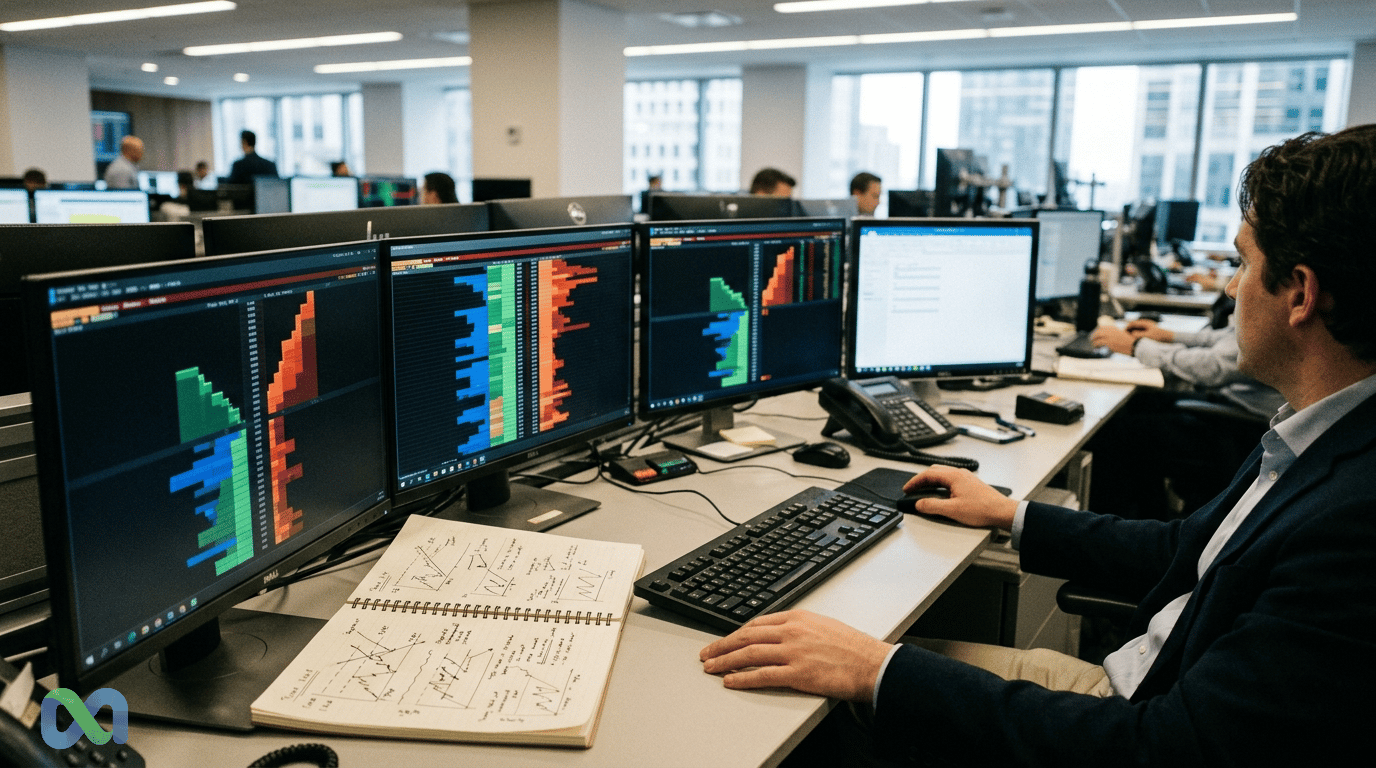
Bid ask spread is one of the fastest ways to measure the real cost of trading in prediction markets. It is the distance between the best available price to buy and the best available price to sell. In practical terms, the spread tells you how much liquidity exists now, not how much liquidity the market may have in theory.
For anyone trading probabilities, this matters. A market can look active, but if the best bid is far below the best ask, entering or exiting quickly can be expensive. The spread affects your entry, your exit, and the quality of the market signal you are reading.
This guide explains bid, ask, spread, midpoint, liquidity, slippage, and practical execution examples in binary prediction markets.
Last reviewed: May 2026. At Macro Markets, we use this reading as a basic execution check, not as a promise of return.
What Is the Bid Ask Spread?
The bid ask spread is the difference between the lowest price a seller is willing to accept, called the ask, and the highest price a buyer is willing to pay, called the bid. The narrower the spread, the more liquid the market usually is. The wider the spread, the higher the implicit cost of immediate execution.
The concept is common in stocks, currencies, ETFs, options, and crypto assets. The general definition of bid-ask spread is the difference between quoted buying and selling prices for an asset. In prediction markets, the same microstructure logic applies, but the price also carries a probability interpretation.
Bid: the best price buyers are offering
The bid is the best available buy price. It shows the highest price a buyer is currently willing to pay.
Imagine a binary market where YES contracts trade between 0 and 100 cents. If the best bid is 44¢, at least one order is willing to buy YES at 44¢. A trader who wants to sell immediately would usually execute against that bid.
This makes the bid especially important when you need to exit. If you already own YES and want out now, the bid is the closest immediate exit price. It can be below the last traded price, especially when liquidity is thin.
Ask: the best price sellers are offering
The ask is the best available sell price. It shows the lowest price a seller is currently willing to accept.
In the same binary market, if the best ask is 47¢, at least one order is willing to sell YES at 47¢. A trader who wants to buy immediately would usually pay that ask.
The ask matters when you want to enter fast. It answers a simple question: what price do I need to pay if I do not want to wait?
Spread: the distance between bid and ask
The spread is the distance between ask and bid. If the bid is 44¢ and the ask is 47¢, the bid-ask spread is 3¢.
That distance is an implicit cost. If you buy immediately at the ask and then sell immediately at the bid, you lose the spread before any fees or price movement. This is why the spread works like a toll for fast execution.
It also shows competition. Many buyers and sellers close to each other tend to tighten the spread. Few participants, shallow depth, or high uncertainty tend to widen it.
How to Calculate the Bid-Ask Spread
The basic formula is simple:
Spread = Ask - Bid
If the best ask is 47¢ and the best bid is 44¢, the spread is 3¢. In dollars, reais, or probability cents, the logic is the same. The number measures the gap between buying now and selling now.
Simple formula: ask minus bid
Use the absolute spread when contracts are on the same price scale. That is common in binary prediction markets, where contracts often trade between 0¢ and 100¢.
| Item | Price |
|---|---|
| Best YES bid | 44¢ |
| Best YES ask | 47¢ |
| Absolute spread | 3¢ |
| Midpoint | 45.5¢ |
The midpoint is the average of bid and ask. In this case, (44 + 47) / 2 = 45.5¢. It is useful as a reference, but it is not a guaranteed execution price.
Absolute spread vs. percentage spread
The absolute spread shows the price gap in cents. The percentage spread shows that gap relative to a reference price, usually the midpoint.
Percentage spread = absolute spread / midpoint
In the example above, 3 / 45.5 = 6.59%. That is high for very liquid assets, but it can appear in smaller prediction markets, new markets, or markets close to uncertain events.
Be careful with percentages. A 2¢ spread near 50¢ is very different from a 2¢ spread near 10¢. The lower the price, the larger that same spread becomes as a share of the position.
Example: bid 44¢, ask 47¢, spread 3¢
Suppose a market is pricing whether a central bank will hold rates at the next meeting. The YES contract has a bid of 44¢ and an ask of 47¢.
If you buy YES immediately, you pay 47¢. If you need to sell right after, you may receive 44¢, assuming the bid depth is still there. The 3¢ difference is the implicit round-trip cost.
If your fair value estimate is 55¢, paying 47¢ may still make sense. If your fair value estimate is 48¢, the spread consumes almost all of your expected edge. The spread does not tell you what will happen. It tells you how expensive it is to act now.
Why Spread Measures Liquidity
The spread measures liquidity because it shows how close buyers and sellers are. When many participants compete, someone is usually willing to improve the bid or lower the ask. When few participants are active, each side demands more compensation to trade.
Liquidity is not only historical volume. A market can have decent past volume and still have poor depth at the current moment. The live order book matters.
Liquid markets: tighter spreads and cleaner execution
In a liquid market, bid and ask are close. There are also orders at multiple price levels. That usually lets traders enter or exit with less price impact.
A tight spread helps in three ways:
- It lowers the cost of immediate entry.
- It makes exits less expensive.
- It makes the midpoint more informative.
Still, a small spread does not remove event risk. Orders can disappear quickly after news or near resolution.
Illiquid markets: wider spreads, less depth, higher cost
In an illiquid market, the spread can be wide. The best bid might be 38¢ and the best ask 52¢. The midpoint is 45¢, but nobody is actually offering execution at 45¢.
This is where traders get trapped by screen prices. The last trade may have happened at 45¢, but that does not mean you can buy or sell there now. If you send an aggressive order, you may cross the whole spread and get a poor price.
Depth matters too. If only a few contracts sit at the best ask, a larger order can consume that level and execute at worse prices. Then the cost is not only spread. It is spread plus slippage.
News, volatility, and markets near resolution
Spreads often widen when uncertainty rises. News, rumors, economic data, and events close to resolution can make liquidity providers step back. They demand a larger margin because the fair price can move in seconds.
In prediction markets, this can happen before elections, inflation releases, central bank decisions, and sports finals. High activity does not automatically mean tight spreads. Sometimes volume and spread rise together because many traders want to act, but few want to provide the other side without a premium.
Bid-Ask Spread in Prediction Markets
Prediction markets add one important layer: price is often read as an implied probability. A YES contract at 47¢ can be interpreted as roughly 47%, before accounting for fees, market structure, and platform rules.
But there is no single perfect probability when bid and ask are apart. There is a range. If the bid is 44¢ and the ask is 47¢, immediate sellers receive 44%, while immediate buyers pay 47%.
Price as probability
In binary contracts, the payoff depends on an outcome. If YES happens, the YES contract pays 100¢. If it does not happen, it pays 0¢. That is why a 47¢ price can be read as a probability near 47%.
The word near is important. The executable price depends on which side you take. Buying now happens at the ask. Selling now happens at the bid. The spread is the uncertainty band between them.
YES and NO books
Many binary markets have a direct relationship between YES and NO. If YES trades near 47¢, NO is near 53¢. But order books may display the two sides differently.
The Kalshi order book documentation shows bids for YES and NO. In a binary market, a bid to buy YES at X¢ can be interpreted as a related offer on the opposite side at 100 - X¢. This is why traders should read the full book, not only one headline price.
CLOB, AMM, and where spread comes from
In a central limit order book, or CLOB, the spread comes from participant orders. Buyers leave bids. Sellers leave asks. The system matches orders when prices cross.
The Polymarket CLOB documentation describes an order-book infrastructure where participant orders are organized for execution. In this type of market, the observed spread is the distance between the best buyer and the best seller.
In an Automated Market Maker (AMM), the experience can be different. Traders buy or sell against a pricing curve. The cost may appear more as price impact and slippage than as a visible two-sided order-book spread. The intuition is the same: if entering and exiting quickly is expensive, effective liquidity is lower.
Midpoint is not guaranteed execution
The midpoint is useful, but it is not an executable price by default. If the bid is 44¢ and the ask is 47¢, the midpoint is 45.5¢. You do not automatically buy at 45.5¢.
To execute near the midpoint, another participant must accept your limit order. That may happen, or it may not. Use midpoint as a reference. Use bid, ask, depth, and order size for execution.
Spread, Fees, Slippage, and Tick Size
Spread, fees, slippage, and tick size are connected, but they are not the same thing.
Spread is the gap between available buy and sell prices. Fees are explicit platform or protocol costs. Slippage is the worse price you receive when your order consumes depth or moves a curve. Tick size is the smallest allowed price increment.
Spread is implicit; fees are explicit
The spread is implicit because it is embedded in execution price. You pay it when you buy at the ask and would sell lower at the bid.
Fees are explicit. They may be percentage-based, fixed, or tied to settlement rules. Always read the platform and market rules before trading.
Slippage comes from depth
Slippage appears when your order is larger than the quantity available at the best price.
Example: the ask shows 47¢ for 100 contracts. You send a buy order for 500 contracts. The first 100 may fill at 47¢. The rest may fill at 48¢, 49¢, or higher if those are the next asks.
In that case, the initial spread was only part of the cost. The final average price depends on book depth.
Tick size sets the smallest step
Tick size is the minimum price increment. If the minimum step is 1¢, the smallest practical spread may be 1¢. This matters more at low prices, where 1¢ can be a large percentage of the contract price.
How to Use Spread Before Trading
The bid-ask spread should be part of your pre-trade checklist. It does not replace event analysis. It helps you decide how to execute your view.
Ask four questions: is the spread tight or wide? Is there enough depth for my size? Is the market close to news or resolution? Do I need execution now, or can I use a limit order?
Compare spread with your edge
If your fair value is 60¢ and the ask is 47¢, the spread may be acceptable. If your fair value is 48¢ and the ask is 47¢, the spread may erase the opportunity.
The smaller your margin of safety, the more important execution cost becomes.
Use limit orders when spreads are wide
A market order prioritizes execution. A limit order prioritizes price. When the spread is wide, a limit order can help you avoid crossing the full gap.
If the bid is 44¢ and the ask is 47¢, you might try to buy at 45¢ or 46¢. The order may not fill, but you control the maximum price.
Check depth, not just the top price
The best bid and best ask are only the first line of the book. Depth shows how much quantity exists at each level.
A 1¢ spread with tiny size can be fragile. A 2¢ spread with deeper levels may be more usable. Always compare your order size with available quantity.
Be careful with low-volume or late-stage markets
Low-volume markets can show stale prices, wide spreads, and little depth. Markets close to resolution can also change quickly as orders disappear.
The central question is: am I being paid enough to accept this execution cost? If not, reduce size, use a limit order, or wait.
Common Mistakes
Treating last price as executable price
The last price shows where the previous trade happened. It does not show where you can trade now. If the last trade was 50¢ but the current book is 44¢ bid and 56¢ ask, immediate execution is far from 50¢.
Ignoring exit cost
Many traders focus only on entry. But exits also happen through the spread. If you plan to exit before resolution, a wide spread requires a larger move just to break even.
Confusing spread with forecast quality
A wide spread is not a prediction that the event is unlikely. It may simply show poor liquidity, uncertainty, or disagreement. A tight spread does not prove the market is correct either. It only shows that the current trading range is tighter.
Trying to capture spread without understanding market making
Capturing spreads is market making. It can be profitable, but it is not free money. Market makers face adverse selection, inventory risk, and sudden information shocks.
FAQ
Do I buy at the bid or the ask?
If you want to buy immediately, you usually buy at the ask. If you want to sell immediately, you usually sell at the bid. With a limit order, you can try to buy below the ask or sell above the bid, but execution is not guaranteed.
What does a 5% spread mean?
A 5% spread means the gap between ask and bid equals 5% of the reference price, usually the midpoint. That can be wide in liquid markets and more common in smaller or volatile markets.
Can traders profit from bid-ask spreads?
They can try, but it is market making, not guaranteed profit. Price can move against the inventory, and better-informed traders can execute against stale orders.
Is a smaller spread always better?
A smaller spread usually indicates better liquidity, but it does not guarantee a good trade, clear rules, or accurate pricing. You still need to assess the event, fees, depth, and resolution risk.
What is the difference between spread and slippage?
Spread is the distance between best bid and best ask. Slippage is the difference between expected price and actual average execution price, often because the order consumed multiple levels of the book.
Conclusion
The bid-ask spread answers one execution question: how much does it cost to act now? In prediction markets, that answer matters because prices also communicate probabilities. A tight spread makes the signal cleaner. A wide spread demands caution.
Before trading, check bid, ask, midpoint, depth, order size, fees, and likely slippage. Then compare the cost with your edge. The spread does not predict the future. It shows the quality of the entry and exit door in the present.
