


2026 FIFA World Cup Schedule: Dates, Times, and Bracket Guide
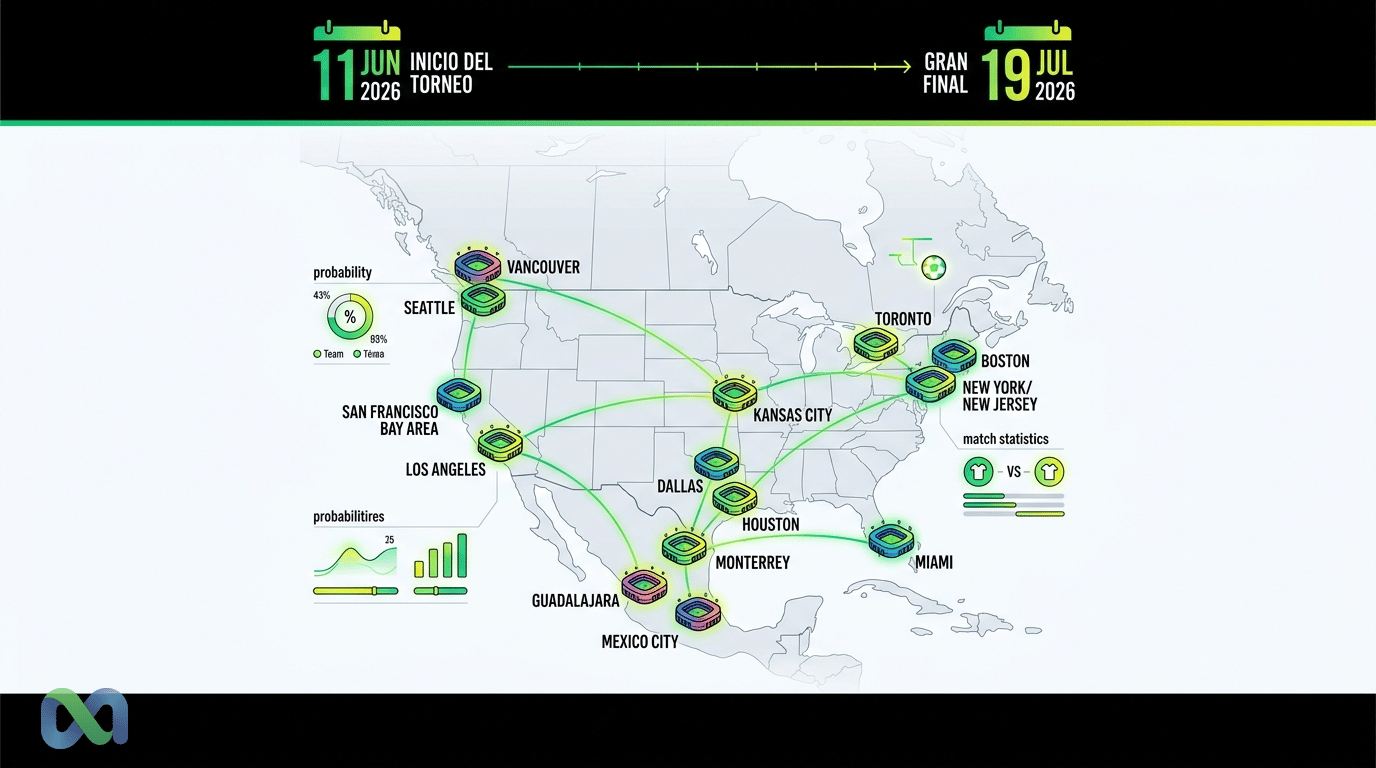
The 2026 FIFA World Cup schedule is already a central map for anyone who follows football with discipline. The tournament will have 48 national teams, 104 matches, 16 host cities, and three host countries: the United States, Mexico, and Canada.
For most fans, the schedule shows when to watch. For anyone who studies prediction markets, it shows something deeper: rest windows, long travel, time zones, group pressure, and likely paths into the knockout rounds.
This guide brings together the main dates, the logic of the new format, Brazil's group-stage fixtures, the tournament phases, and the details that can change how the competition should be read. The goal is simple: use the 2026 FIFA World Cup schedule as a map, not just as a calendar.
Quick Summary of the 2026 FIFA World Cup Schedule
The 2026 FIFA World Cup starts on June 11, 2026, and ends on July 19, 2026. The opening match will be played in Mexico, and the final is scheduled for MetLife Stadium in the New York/New Jersey area.
The 2026 edition will be the largest World Cup ever. FIFA expanded the tournament from 32 to 48 teams. As a result, the group stage now has 12 groups of four teams, and the knockout stage starts with a round of 32.
Here is the broad calendar:
- Group stage: June 11 to June 27, with 72 matches and the first qualification decisions.
- Round of 32: June 28 to July 3, the first edition of the expanded knockout phase.
- Round of 16: July 4 to July 7, when favorites start meeting tougher paths.
- Quarterfinals: July 9 to July 11, with only eight teams still alive.
- Semifinals: July 14 and July 15, in maximum-pressure matches.
- Third-place match: July 18.
- Final: July 19, at MetLife Stadium.
The official 2026 FIFA World Cup schedule is available on the FIFA World Cup 2026 schedule page. The Olympics tournament guide also summarizes the dates, format, and qualification context for the 2026 World Cup.
Where the 2026 World Cup Will Be Played
The 2026 World Cup will be played across three countries. Mexico, the United States, and Canada will share hosting duties. That matters because the distance between cities can affect rest, logistics, and team rhythm.
Mexico will host matches in cities with deep World Cup history. Mexico City returns to the center of global football through Estadio Azteca, one of the sport's most symbolic stadiums. Guadalajara and Monterrey are also important host cities.
The United States will host the largest share of matches. Games will be played in cities such as New York/New Jersey, Miami, Dallas, Los Angeles, Atlanta, Houston, Kansas City, Philadelphia, Seattle, the San Francisco Bay Area, and Boston/Foxborough.
Canada completes the map with Toronto and Vancouver. Those two cities create a northern axis that can matter for groups with longer travel paths.
For readers tracking the 2026 FIFA World Cup schedule, this layout matters for three reasons. First, the tournament spans several time zones. Second, some teams may need to cross long distances between matches. Third, climate conditions vary widely by city. A match in Miami can create a different physical load than a match in Vancouver.
How the New 48-Team Format Works
The 2026 FIFA World Cup schedule must be read together with the new format. Looking only at dates and kickoff times is not enough. You need to understand how each result changes the path.
There will be 12 groups of four teams. Each team plays three group-stage matches. The top two teams in each group advance. In addition, the eight best third-placed teams also qualify.
That sends 32 teams into the knockout phase. This extra round gives teams more ways to survive a slow start. However, it also makes the road to the title longer.
In practice, the champion will need to play eight matches instead of seven. That detail changes physical management. Deeper squads gain value. Coaches who rotate well may arrive stronger in the final week.
The new format also changes incentives in the third group-stage match. In the old format, two direct qualification spots created cleaner decision points. In 2026, third place may be enough. Goal difference, goals scored, discipline, and emotional control can matter earlier than usual.
For anyone tracking 2026 FIFA World Cup standings, the table will be dynamic. A third-placed team's position can depend on results from other groups. That creates nights of cross-group math, fast scenario changes, and sharp probability moves.
Brazil's 2026 World Cup Schedule
Brazil was drawn into Group C. According to the published schedule, Brazil will face Morocco, Haiti, and Scotland in the group stage. The times below should be read through the Brazilian schedule lens, because the source article uses Brasilia time.
- June 13: Brazil vs Morocco, 7:00 p. m. Brasilia time, at MetLife Stadium in New York/New Jersey.
- June 19: Brazil vs Haiti, 9:30 p. m. Brasilia time, at Lincoln Financial Field in Philadelphia.
- June 24: Scotland vs Brazil, 7:00 p. m. Brasilia time, at Hard Rock Stadium in Miami.
The opener against Morocco may be the most sensitive match in the group. Morocco enters with a strong recent reputation and usually competes well without the ball. For Brazil, starting with a win reduces pressure and makes the next two rounds easier to manage.
The second match, against Haiti, has a different profile. On paper, Brazil should control more possession and create more attacking volume. Still, World Cup matches rarely reward lazy assumptions. A favorite that takes too long to score can carry pressure deep into the game.
The third match against Scotland could decide position, goal difference, and the knockout path. Depending on earlier results, Brazil could enter already qualified, under pressure, or fighting for first place. Each situation changes lineup choices, intensity, and risk.
That is why Brazil's 2026 FIFA World Cup schedule is not just a list of games. It defines rest windows, travel along the U. S. East Coast, and possible squad-management scenarios.
How to Read the Table Beyond Kickoff Times
Most people read the 2026 FIFA World Cup schedule as a list. Better analysts read it as a chain of consequences. Each match has both direct and indirect effects.
The first point in the 2026 FIFA World Cup schedule is rest. A team with six days between matches can recover starters. A team with four days, a long flight, and a physical match may lose intensity. That often appears in the second half, not only in the starting lineup.
The second point in the 2026 FIFA World Cup schedule is opponent order. Facing the strongest rival in the first round is different from facing that rival in the third. In the opener, both sides start from zero. In the final group match, one team may need to win while the other can manage the result.
The third point in the 2026 FIFA World Cup schedule is venue. Distances in North America are large. Trips between the East Coast, West Coast, Canada, and Mexico can change preparation. Teams used to shorter logistics may suffer more.
The fourth point in the 2026 FIFA World Cup schedule is kickoff time. Prime-time matches in Brazil can concentrate audience, public discussion, and emotional reaction. That does not decide the score, but it can influence the pressure around favorites.
The fifth point in the 2026 FIFA World Cup schedule is the bracket. Final group position defines the path forward. Winning the group can avoid a favorite early. In some scenarios, however, finishing second can open a less difficult route. The schedule must be updated after every round.
Schedule by Phase: What to Expect at Each Stage
Group Stage: June 11 to June 27
The 2026 FIFA World Cup schedule gives the group stage 72 matches. It is the largest block of the 2026 FIFA World Cup schedule. There will be games almost every day, across multiple kickoff windows and host cities.
This phase separates real favorites from inflated reputations. In short tournaments, a team can look strong on paper and still fall into simple traps: travel, heat, a low defensive block, set pieces, or an unexpected draw.
The third round will be especially important. Because eight third-placed teams advance, many teams will still be alive. That should create open games, because goal difference may matter as much as a single win.
Round of 32: June 28 to July 3
The round of 32 is the biggest practical change in the 2026 FIFA World Cup schedule. It increases the number of elimination matches and creates another risk layer for favorites.
In previous World Cups, a strong team could leave the group stage and immediately focus on the round of 16. Now, there is one extra knockout match before that traditional stage. That increases the chance of surprises.
For prediction markets, this phase should create major repricing. A favorite that draws a dangerous third-placed team can lose value quickly. A team with a cleaner bracket can gain support before it even kicks off.
Round of 16 and Quarterfinals: July 4 to July 11
The 2026 FIFA World Cup schedule sends the round of 16 into action on July 4. From this point on, reputation matters less and execution matters more. Individual mistakes, cards, injuries, and coaching decisions often change the tournament read.
By the quarterfinals, the field is narrow. Only eight teams still have a title path. This is usually when contenders stop being judged only by squad quality and start being judged by route.
Semifinals and Final: July 14 to July 19
The 2026 FIFA World Cup schedule places the semifinals on July 14 and July 15. The gap before the final is short, but long enough for basic recovery. The final will be played on July 19 at MetLife Stadium.
That match closes a 39-day World Cup. Because the champion will play eight times, physical consistency and squad depth should matter more than in previous editions.
2026 World Cup Schedule PDF: Is It Worth Downloading?
Many people search for a 2026 FIFA World Cup schedule PDF. That makes sense. A saved file helps fans track groups, write down results, and plan viewing times.
However, a fixed table has limits. It shows dates and fixtures, but it does not update standings, goal difference, suspensions, injuries, or likely knockout matchups.
The best approach is to combine both formats. Use a PDF for the broad view. Use live pages for results, standings, and bracket changes. FIFA's scores and fixtures page is the official reference for updates.
If you follow probabilities, avoid depending only on a static table. The World Cup moves fast. A late goal in one match can alter two groups, an entire bracket route, and the price of several national teams.
What the Schedule Says About Favorites
The 2026 FIFA World Cup schedule does not identify a champion by itself. However, it helps separate strong favorites from fragile narratives.
Teams with deep squads should be better prepared for eight matches. France, Argentina, Brazil, Spain, Germany, England, and Portugal enter the tournament under high pressure. But each one will face different challenges in group order, travel, and rotation.
Brazil has a manageable opening schedule by distance. The team plays in New York/New Jersey, Philadelphia, and Miami. That East Coast concentration reduces travel stress compared with teams that may need to cross the continent.
Even so, the real path depends on group position. Winning Group C may open one route. Finishing second, or advancing through a tighter scenario, could change everything.
For market analysis, the central point is to follow probability changes, not only favorite names. A strong team can be too expensive. A less popular team can have a more favorable path than the public realizes.
How to Use the Schedule in Prediction Markets
The 2026 FIFA World Cup schedule makes the tournament a strong event for prediction markets because it combines public information, collective emotion, and rapid updates. The schedule provides the structure. The market turns that structure into probabilities.
Before the tournament, the 2026 FIFA World Cup schedule helps compare paths. A simpler group can raise a team's chance of going deep. A likely crossover against another favorite can reduce the value of a title case.
During the group stage, the 2026 FIFA World Cup schedule helps measure urgency. A team that draws its opener may need to attack more in the second match. That changes risk, attacking volume, and result probability.
In the knockout stage, the 2026 FIFA World Cup schedule adds another layer. Rest, suspensions, and injuries start to matter more. A team that plays extra time can carry a physical cost into the next round.
On Macro Markets, this reading becomes clearer when the trader separates support from probability. Cheering for Brazil is natural. Trading Brazil requires comparing price, calendar, opponent, and context.
Frequently Asked Questions About the 2026 FIFA World Cup Schedule
What are the dates for the 2026 World Cup?
The 2026 FIFA World Cup schedule starts on June 11 and ends on July 19, 2026. The tournament will be played in the United States, Mexico, and Canada.
When does the 2026 World Cup end?
The 2026 World Cup ends on July 19, 2026. The final will be played at MetLife Stadium in the New York/New Jersey area.
Where will the 2026 World Cup be held?
The 2026 World Cup will be held in three countries: the United States, Mexico, and Canada. There will be 16 host cities in total.
How many matches will the 2026 FIFA World Cup have?
The 2026 edition will have 104 matches. The number increased because the tournament expanded to 48 teams and added a round of 32 before the round of 16.
What are Brazil's first-round matches?
Brazil faces Morocco on June 13, Haiti on June 19, and Scotland on June 24. The source schedule lists the kickoff times as 7:00 p. m., 9:30 p. m., and 7:00 p. m. in Brasilia time.
Why is the 2026 table different?
The 2026 FIFA World Cup schedule is different because the World Cup will have 48 teams. There will be 12 groups, the eight best third-placed teams will advance, and there will be one extra knockout round before the round of 16.
Conclusion
The 2026 FIFA World Cup schedule is more than a list of matches. It shows dates, venues, and kickoff times, but it also reveals rest, travel, group pressure, and likely paths to the final.
For fans, that helps plan when to watch. For anyone analyzing prediction markets, it helps identify where probability can move before the wider public notices.
The World Cup starts on June 11, ends on July 19, and will use the largest format in tournament history. Brazil opens against Morocco, then faces Haiti and Scotland. From there, every result changes the map.
The best way to follow the tournament will be dynamic. Save the table, track official sources, watch the standings, and update your read after each round. In a World Cup with 104 matches, the calendar is only the beginning of the analysis.
