


2030 FIFA World Cup: Hosts, Format and Guide
Last updated: May 17, 2026.
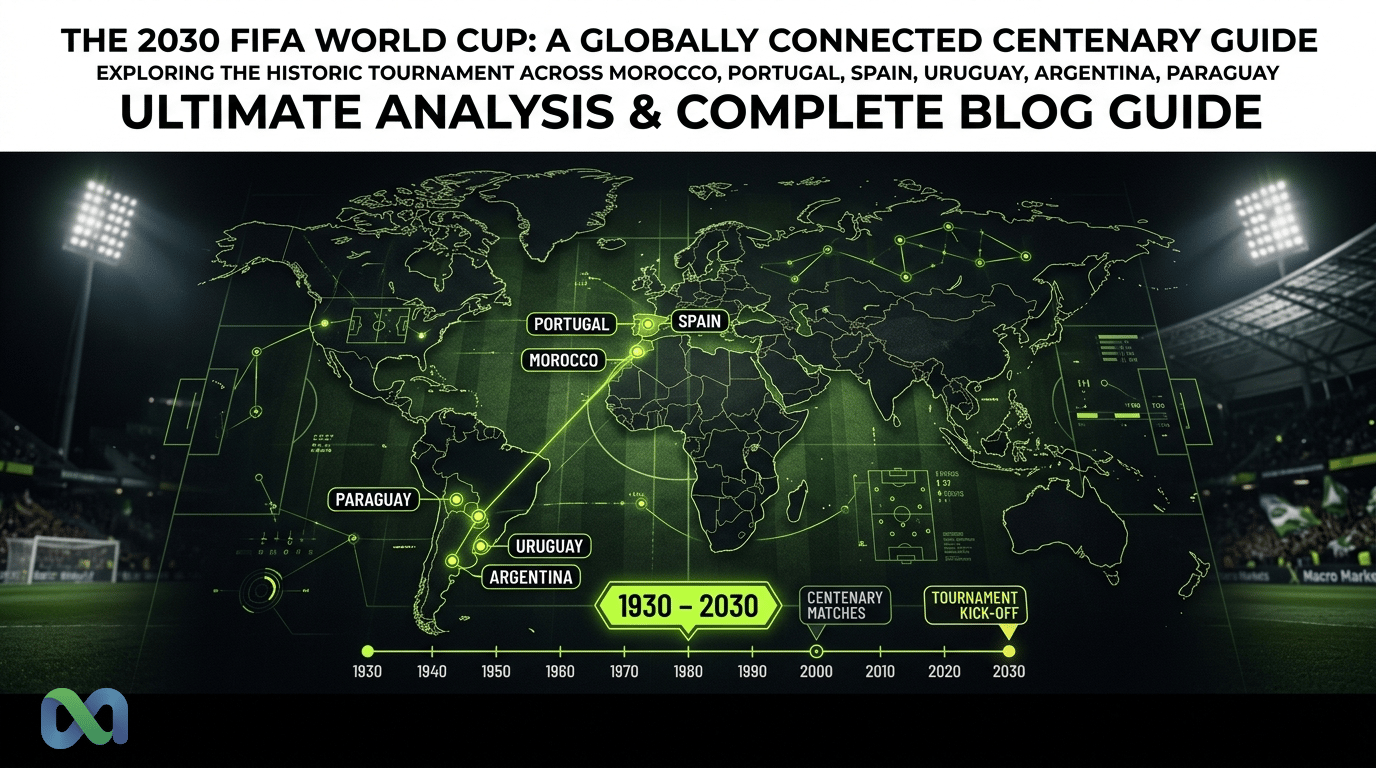
The 2030 FIFA World Cup will mark the 100th anniversary of the tournament. FIFA has confirmed Morocco, Portugal, and Spain as the main hosts. Argentina, Paraguay, and Uruguay will stage centenary matches in South America.
That setup is new. The tournament will touch three continents, include six countries in the plan, and use the expanded 48-team format. It also carries unusual historical weight because Uruguay hosted the first World Cup in 1930.
This guide explains where the 2030 FIFA World Cup will be played, how the format should work, what is already confirmed, and what can still change. The goal is simple: separate official information from rumor.
Where Will the 2030 FIFA World Cup Be Held?
The 2030 FIFA World Cup will be based mainly in Morocco, Portugal, and Spain. In addition, Argentina, Paraguay, and Uruguay will host matches tied to the centenary celebration. The idea is to connect the 2030 edition with the first World Cup, which was played in Uruguay.
That is the short answer for search intent. The World Cup will not sit inside one country. Its operating base will be in Europe and North Africa. South America enters at the start as part of the historic celebration.
FIFA’s official guide to the 2030 World Cup hosts is the final source for hosts, dates, stadiums, and qualification details.
Main hosts: Morocco, Portugal, and Spain
Spain should carry a large share of the tournament. It has major stadiums, strong rail links, and deep football history. Madrid, Barcelona, Bilbao, and Seville are names that fans often discuss, but FIFA still needs to confirm the final venue list.
Portugal will also be a main host. This will be a landmark for the country because it has never hosted the men’s World Cup before. Lisbon and Porto should stay on the watch list, but the official city list must come from FIFA.
Morocco completes the main hosting trio. The country has chased a World Cup before and has a strong plan for major matches. Its role brings the 2030 FIFA World Cup into North Africa.
Centenary matches in South America
Uruguay, Argentina, and Paraguay are involved because of history. Uruguay hosted and won the first World Cup in 1930. Argentina reached that first final. Paraguay is home to CONMEBOL headquarters.
Therefore, these matches are symbolic. They do not mean the 2030 FIFA World Cup will be split equally across six countries. Most of the tournament should still take place in Morocco, Portugal, and Spain.
Why Will the 2030 FIFA World Cup Have Matches on Three Continents?
The main reason is the centenary. The World Cup began in Montevideo in 1930. In 2030, FIFA wanted to link the modern edition with the tournament’s origin point.
There is also a practical reason. World Cups have become larger and more expensive. Shared hosting lets organizers use more stadiums, hotels, training centers, airports, and travel routes.
Uruguay’s role in the 1930 World Cup
Uruguay is not just an honorary guest. It is where the World Cup began. In 1930, Montevideo hosted the tournament and saw the home team beat Argentina in the final.
That is why a match in Uruguay has memory value. It connects today’s huge global event with the tournament that started it all.
How Argentina and Paraguay fit into the opening plan
Argentina’s role comes from its link to the first final. Paraguay’s role comes from CONMEBOL. Together, the three South American countries give the opening phase a clear historical frame.
After that, the World Cup should move toward the Europe and Africa axis. That plan needs careful management of travel, sleep, climate, and training. In short tournaments, every recovery day can matter.
2030 FIFA World Cup Format: Teams, Groups, and Knockouts
The 2030 FIFA World Cup is expected to follow the 48-team format. This model begins with the 2026 World Cup. It changes how fans and analysts should read the tournament.
More national teams enter. More countries get a realistic path to the main stage. The first round becomes larger. As a result, the draw and the route to the knockouts become even more important.
48 teams and more matches
With 48 teams, countries that used to finish just outside qualification can enter the field. That opens more room for teams from Asia, Africa, CONCACAF, and Oceania. It also increases the number of matches.
For fans, there will be more games to watch. For analysts, there will be more noise to filter. One favorite can land in a soft group. Another can meet a strong rival early.
Squad depth also matters more. A long World Cup tests fitness, travel routines, and focus. Strong benches can decide as much as star players.
What still needs official confirmation
Several details remain open. FIFA still needs to confirm the final city list, match order, full schedule, stadium allocation, and final venue.
Use three levels when tracking the 2030 FIFA World Cup:
- Confirmed fact: main host countries and centenary matches.
- Likely scenario: major cities with suitable stadiums and infrastructure.
- Open question: final venue, calendar, groups, and qualified teams.
This framework prevents mistakes. It also avoids treating every rumor as official news.
2030 World Cup Hosts and Stadiums
The stadium question has two parts. The first already has an answer: Morocco, Portugal, and Spain are the main hosts. The second can still change: which cities will stage each phase.
Here is the current status by country:
- Morocco: main host. The final city list is still pending.
- Portugal: main host. Lisbon and Porto should be monitored.
- Spain: main host. FIFA still needs to confirm the final stadium list.
- Uruguay: centenary match. The role is historical.
- Argentina: centenary match. The stadium still needs official confirmation.
- Paraguay: centenary match. The role is tied to CONMEBOL.
Country by country: what is confirmed
Morocco, Portugal, and Spain carry the central operation. Most matches, team bases, media logistics, and fan flows should sit in those three countries.
South America enters as a tribute. That does not make the matches less important. It simply shows that each country has a different role in the plan.
BBC Sport’s explainer on the 2030 World Cup also notes the host structure and the automatic qualification question. Still, FIFA should remain the final source when details change.
Where could the 2030 World Cup final be played?
The 2030 World Cup final should not be treated as fixed without an official source. Spain and Morocco often appear in public discussion because both have large stadiums and ambitious plans. However, that is still scenario work.
The correct answer today is narrower: the final should be in one of the main host countries, but the exact stadium depends on FIFA. Once the full schedule comes out, this section should be updated.
What the 2030 FIFA World Cup Means for Brazil and South America
For Brazil, the 2030 FIFA World Cup has two readings. The first is about the national team. Brazil will move through the 2026 World Cup, another cycle of qualifiers, and a new squad phase before 2030.
The second reading is regional. Even though Brazil is not hosting the tournament, South America will stage opening centenary games. That should raise attention across the continent.
Impact of the centenary matches on the continent
The matches in Uruguay, Argentina, and Paraguay reinforce CONMEBOL history. They remind fans that the World Cup began in South America.
There is also a practical impact. Teams that play in South America and then travel to Europe or Africa will face a long trip. Sleep, training rhythm, weather, and recovery can affect performance.
Those factors do not decide a champion by themselves. However, they enter the model. In a World Cup, small details can become an edge.
How to follow Brazil’s path to 2030
Brazil still has many tests ahead. The 2026 World Cup will be the first major checkpoint. Then come qualifiers, Copa América, high-level friendlies, and a possible generational shift.
Watch four signals:
- Squad profile: age of starters and depth by position.
- Playing model: a clear plan with and without the ball.
- High-quality results: matches against elite opponents matter more.
- Physical health: injuries and club workload can change the ceiling.
These signals are more useful than very early favorite lists. By 2030, a lot will change.
How to Track Probabilities for the 2030 FIFA World Cup
The 2030 FIFA World Cup will be a strong case for tracking probabilities over time. Before the tournament, the read can shift with injuries, the draw, rankings, club form, and official matches.
Prediction markets help organize those changes. They show an implied probability that moves when new information arrives. That is different from loose opinion on social media.
Signals that move probabilities before the tournament
Some signals matter more than others:
- Group draw: an easier path can reduce wear.
- Injuries: losing key players changes a team’s ceiling.
- Recent form: good matches against strong rivals carry weight.
- Manager changes: they can improve a team but also create uncertainty.
- Bench strength: long tournaments reward depth.
- Logistics: travel, climate, and training base can matter.
No signal guarantees the result. Each one only changes the probability range. Therefore, the useful question is: which new information changes each team’s chance?
Public opinion versus implied probability
Public opinion often reacts to shirts, names, and recent memory. Implied probability tries to add more data. The two views can diverge.
For example, a popular team can generate noise while carrying a weak defense. Another team can get less media attention but have a more stable squad and a better group path.
At Macro Markets, this reading should stay calm. Probabilities are not promises. They are estimates that change over time. The value is in watching the movement and understanding the cause.
For market watchers, timing matters as much as the headline. A confirmed stadium list may move expectations only a little. A draw that gives one contender an easier route can move them more. A star injury, a coaching change, or a difficult travel path can matter even more. That is why the 2030 FIFA World Cup should be tracked as a sequence of updates, not as one fixed forecast.
FAQ: Quick Questions About the 2030 FIFA World Cup
Where will the 2030 FIFA World Cup be held?
The 2030 FIFA World Cup will be hosted mainly by Morocco, Portugal, and Spain. Argentina, Paraguay, and Uruguay will host centenary matches linked to the 100th anniversary of the first World Cup.
Will Portugal host the 2030 World Cup?
Yes. Portugal will be one of the main hosts of the 2030 FIFA World Cup, alongside Morocco and Spain. It will be the country’s first time hosting the men’s World Cup.
Where will the 2030 World Cup final be?
The final venue still needs official confirmation. The match should be in a main host country. Until FIFA publishes the complete schedule, any specific city is only a scenario.
Which teams have qualified for the 2030 World Cup?
The full field will come after qualifiers and final FIFA rules. Host countries are usually guaranteed places, but it is better to wait for formal confirmation on qualification rules.
Will the 2030 FIFA World Cup have 48 teams?
Yes. The expectation is that the 2030 FIFA World Cup will use the 48-team format. This expands the tournament and makes the draw, logistics, and squad depth more important.
Will the 2030 World Cup be entirely in South America?
No. South America will host centenary matches in Uruguay, Argentina, and Paraguay. The main tournament operation will be in Morocco, Portugal, and Spain.
Also, this page should be reviewed when new dates appear. The 2030 FIFA World Cup is still several years away. Every new venue list, FIFA rule, and qualification phase can change the read. For readers, the key is to follow official sources and avoid rumor traps.
Conclusion
The 2030 FIFA World Cup will be unique because of its history and scale. Morocco, Portugal, and Spain will be the main hosts. Argentina, Paraguay, and Uruguay enter to mark the centenary.
The 48-team format expands the field. It also makes the draw, travel, bench depth, and physical health more important. For Brazil, the path to 2030 should be read in stages.
The best way to follow the tournament is to keep two lists: confirmed facts and signals that can still move. The main hosts are already defined. Stadiums, the schedule, the final, qualified teams, and groups still need shape.
As those details change, probabilities will also move. Tracking that flow with official sources and a market-based read is better than locking in favorites years before the ball starts rolling.
