


Maker Taker Model: Fees and Liquidity Explained
Updated on May 9, 2026.
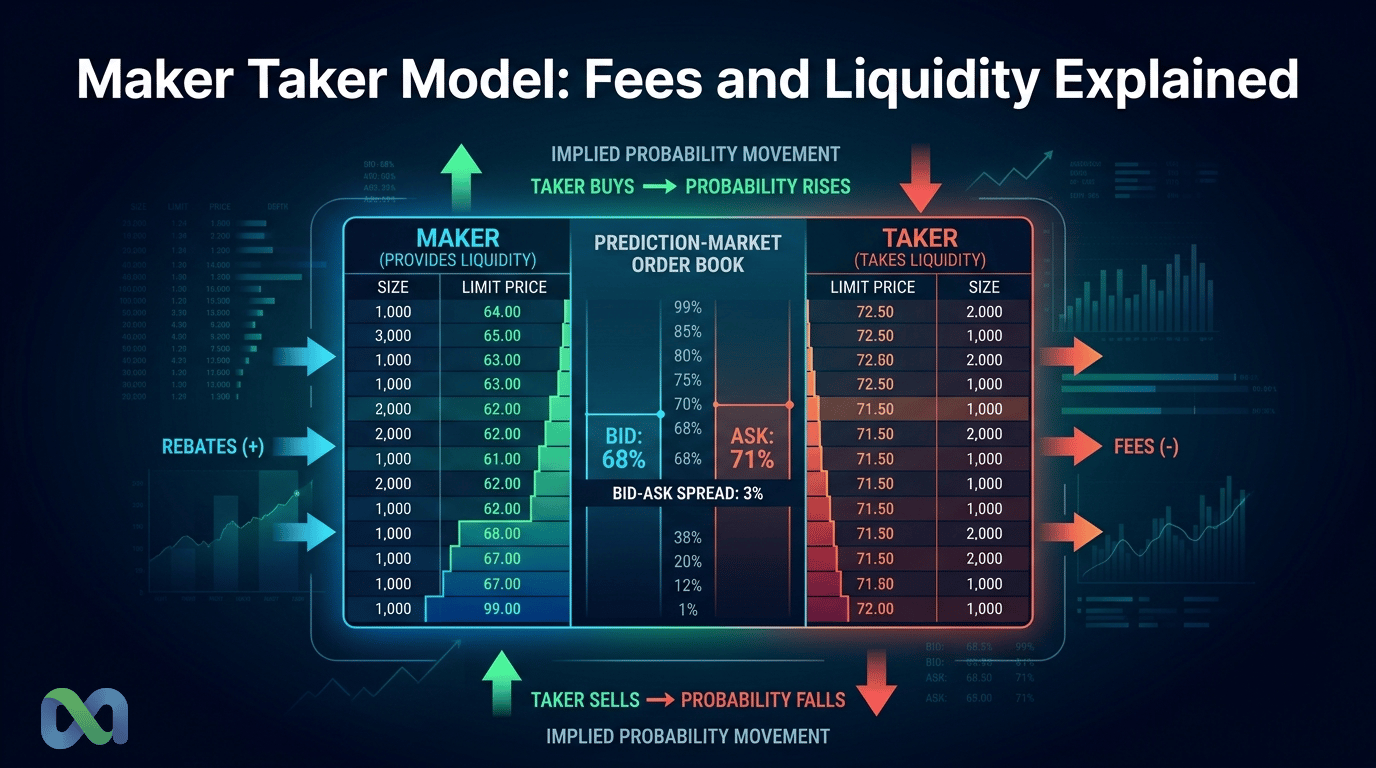
The maker taker model is a way to organize costs and incentives in an order book. The maker adds liquidity with an order that remains available for other traders. The taker removes liquidity by executing against an order that already exists. In prediction markets, that difference affects price, implied probability, spread, execution quality, and net result.
In simple terms, the maker offers a quote to the market. The taker accepts a quote that is already available. That choice can look small, but it changes the real cost of a trade. It also changes the probability of execution and the risk of buying or selling at the worst moment.
This guide explains the concept without unnecessary jargon. First, we will separate maker, taker, fee, and rebate. Then we will apply the logic to Yes/No contracts, CLOBs, AMMs, and LMSR designs. The focus is educational. Costs, rules, and incentives vary by platform, market, volume, jurisdiction, and date. Always check the official documentation before placing a trade.
What Is the Maker Taker Model?
The maker taker model is a system in which a venue treats participants differently depending on whether they add liquidity or remove liquidity. The maker places a limit order that rests in the book. The taker sends an executable order that crosses the spread and trades against an order already available.
The basic explanation appears in market structure references such as the QuestDB glossary on maker-taker. The central idea is straightforward: a market needs visible quotes to work well. Because of that, many exchanges create incentives for participants who leave orders in the book.
Maker: the participant who adds liquidity
Maker comes from "market maker," but not every maker is a professional institution. In a specific trade, you become a maker when your order enters the book and waits for someone else to execute against it.
Imagine a prediction contract that pays 1.00 if an event happens and 0 if it does not. You want to buy Yes at 0.60, but the best seller is asking 0.62. If you send a limit buy order at 0.60 and it waits in the book, you have added liquidity. Other traders can now sell to you at 0.60.
You did not receive immediate execution. In exchange, you may get a better price. On some platforms, you may also pay a lower fee or receive an incentive. None of that removes the risk that the order never fills.
Taker: the participant who removes liquidity
A taker accepts the liquidity already available. If the best seller is at 0.62 and you buy now at 0.62, you have removed that offer from the book. Execution was fast, but you paid the other side of the spread.
This role often has a higher explicit cost. The taker consumes liquidity the book already has. That is why many models charge the taker a higher fee. Investopedia describes maker-taker pricing as an arrangement of fees, rebates, and liquidity incentives.
Being a taker is not wrong. Often it is the right choice. If information changes quickly, waiting can cost more than the fee. If the market is about to reprice, immediate execution may matter more than saving a few basis points.
Why an exchange creates this difference
An order book without liquidity is bad for everyone. The spread becomes wide. Small orders move the price. The probability signal becomes weaker. In prediction markets, that is especially visible because the price is often read as an implied probability.
The exchange wants traders to publish bids and asks. Those orders help other participants trade. They also make the price more informative. The maker taker model tries to solve this problem with a simple rule: reward, or at least reduce costs for, the participant who supplies liquidity, and charge more to the participant who demands immediate execution.
How Maker and Taker Work in the Order Book
The order book shows buy and sell intentions. Bids, or buy offers, sit on one side. Asks, or sell offers, sit on the other. The difference between the best bid and the best ask is the spread.
In a Yes/No market, the book might show a best bid near 0.60 and a best ask near 0.62. If you buy immediately, you pay 0.62. If you try to buy as a maker, you might place an order at 0.60 or 0.61. The right choice depends on urgency, conviction, liquidity, and the cost of missing the trade.
A limit order that rests in the book
A limit order defines the worst price you are willing to accept. If you want to buy Yes up to 0.60, your order should not execute above that level. If there is no seller at 0.60 or lower, the order can rest in the book.
At that moment, you have become a maker. You are offering liquidity to someone who wants to sell. Your advantage is price control. Your risk is receiving no execution, or receiving execution only when the market starts moving against you.
That second risk is called adverse selection. It happens when your resting order is filled because someone knows, or believes, that the fair price has changed. For that reason, being a maker is not the same as trading cheaply. The cost can appear in the execution price, not only in the fee line.
An order that crosses the spread
An order crosses the spread when it buys at the ask or sells at the bid. It does not wait. It executes against available liquidity.
If a Yes contract has a bid of 0.60 and an ask of 0.62, an immediate buy will tend to execute at 0.62. An immediate sale will tend to execute at 0.60. The 0.02 spread is a form of cost. Even with no explicit fee, the trader who demands speed pays for it.
In liquid markets, that cost may be small. In narrow, new, controversial, or event-driven markets, it can be large. The difference becomes even more important when you trade a size larger than the quantity available at the best price.
Effective price: spread plus fees
The displayed price is not enough. A trader needs to calculate the effective price. A simple version is:
Effective buy price = execution price + taker fee - maker rebate
For sales, the cash-flow direction changes, but the idea is the same. Total cost includes spread, fees, rebates, slippage, and the probability of non-execution.
Consider a simple example. You want to buy 100 Yes contracts. The best ask is 0.62. The hypothetical taker fee is 1% on some fee base. If you buy now, you pay the ask and the fee. If you try to buy at 0.60 as a maker, you may pay less or even receive an incentive. But you may also buy nothing.
The correct decision is not "always be the maker." The correct decision is to compare cost, urgency, and probability of execution.
The Maker Taker Model in Prediction Markets
Prediction markets have one important difference: the price is also a signal. A Yes contract trading at 0.60 suggests an implied probability near 60%, before fees and other frictions. That is why market microstructure matters so much.
When the spread is wide, the signal becomes less precise. A bid of 0.58 and an ask of 0.66 do not say that the exact probability is 58% or 66%. They say buyers and sellers are still separated. Liquidity must improve before the price becomes more useful.
Binary contracts and implied probability
In a binary contract, the payoff is usually simple. If the event happens, the winning contract pays 1.00. If the event does not happen, it pays 0. Therefore, a price of 0.64 appears to indicate something like a 64% chance.
But the tradable price depends on the side of the trade. If you buy at the ask at 0.66, your breakeven rate is different from the trader who bought as a maker at 0.64. Fees can also change that calculation.
That is why, when reading a prediction market, you should look at three things: last traded price, best bids and asks, and book depth. The last price may be stale. The midpoint of the spread may be a better estimate, but it still does not guarantee execution.
CLOB, AMM, and LMSR: where maker/taker applies
The maker taker model applies most directly to a CLOB, or central limit order book. In that model, participants publish buy and sell orders. Other participants execute against those orders.
In an AMM, or automated market maker, the economic counterparty is a curve or pool. The trader trades against a pricing rule. In LMSR, a mechanism used in some prediction-market designs and described in resources such as Wikipedia's prediction market overview, the price also comes from a mathematical function. In those cases, maker/taker language can become less precise.
There may still be liquidity providers, fees, and incentives. However, the mechanics are not identical to an order book. In a CLOB, makers are resting orders in the book. In an AMM, liquidity is usually held in a curve or pool. Understanding that difference prevents a lot of confusion.
Practical example with a Yes/No market
Suppose there is a market: "Will the central bank cut rates at the next meeting?" The Yes contract has a bid of 0.48 and an ask of 0.51.
If you believe the fair probability is 55%, buying at 0.51 may look attractive. As a taker, you execute quickly. However, you pay the ask and any applicable fees. If you buy at 0.51 and the total cost is equivalent to 0.512, your edge versus 0.55 still exists, but it is smaller.
As a maker, you can place a buy order at 0.49 or 0.50. If it fills, your price improves. But there is a risk that it will not fill before a news update. There is also a risk that it fills because someone sold with better information.
Now think about the opposite side. If you believe the fair probability is 45%, you may sell Yes. Selling as a taker at the 0.48 bid executes immediately. Selling as a maker at the 0.51 ask waits for a buyer. The better price comes with waiting risk.
Fees, Rebates, and Liquidity Incentives
Maker/taker fees are not just charges. They shape behavior. When a platform charges the maker less, it encourages quotes. When it charges the taker more, it charges for liquidity removal.
Many educational resources explain makers and takers through orders that add or remove liquidity. Although common examples often come from crypto or equities, the same microstructure logic helps explain prediction markets that use order books.
What is a maker rebate?
A maker rebate is an incentive paid or credited to the participant who adds liquidity. Instead of paying a fee, the maker may receive a small credit when the order is executed.
The rebate exists because the maker's order improves the book. It gives other traders an executable option. It can also narrow the spread. In theory, that improves the market experience for everyone.
In practice, the rebate is not guaranteed profit. An order can receive a rebate and still lose money if the price moves against it. It may also be filled only at bad moments. A rebate is part of effective cost, not a complete strategy.
How taker fees can finance liquidity
In many models, the taker fee helps pay the incentive to the maker. The taker pays for convenience. The maker receives an incentive for offering price and quantity.
This structure can improve liquidity. It can also create debate. Investopedia notes that maker-taker models have received scrutiny because of potential conflicts, order routing questions, and effects on execution quality.
In prediction markets, the point is similar. If incentives are poorly designed, the book can look more liquid than it really is. Orders can disappear quickly. Traders can publish size they do not want to maintain during volatile moments.
When a low fee can mislead
A low nominal fee does not guarantee better execution. A maker may pay zero explicit fee but receive no fill. A taker may pay a higher fee but capture a price that would disappear within seconds.
There is also slippage. If you buy more contracts than are available at the best ask, part of the order executes at worse prices. The fee may be small, but the average price can be poor.
That is why you should always compare total cost. Include spread, depth, fee, rebate, slippage, and time. In trading, the lowest explicit cost is not always the lowest real cost.
Polymarket, Kalshi, and What to Check Before Trading
Platforms change rules. Some use order books. Others use hybrid models. Some charge fees by market. Others change incentives by category, program, participant type, or date.
When studying platforms such as Polymarket and Kalshi, use official documents. Do not rely on old screenshots, isolated posts, or third-party summaries. This section is a conceptual checklist, not a fixed statement about current fees.
Polymarket: CLOB, fees, and incentives
Polymarket is often discussed as an example of a prediction market with order-book infrastructure and hybrid rails. The important question for this guide is the one a trader should ask: does the order add liquidity or remove liquidity?
If the answer is "adds," maker logic may apply. If the answer is "removes," taker logic may apply. But the details of fees, rebates, and calculations must come from the official documentation for the specific market and date.
Before trading, check whether the market has fees enabled. See how the platform calculates the fee. Check whether there is an incentive program for makers. Also verify whether the cost changes when buying, selling, redeeming, or closing a position.
Kalshi: regulated order book and caution with fee schedules
Kalshi operates in a regulated context in the United States. It also offers markets with an order book. Even so, that does not justify copying a generic maker/taker structure and assuming all fees follow that model.
The caution is simple: read the current fee schedule. Review the order documentation. Check how the platform treats limit orders, marketable orders, and costs. If you cannot find a clear rule, do not turn an assumption into a fact.
This caution applies to any platform. "It has an order book" does not mean "it has a maker rebate." "It has a fee" does not mean "it uses a classic taker fee." Microstructure and commercial policy are related, but they are not the same thing.
Source checklist before citing platforms
Use this checklist before making a claim about an exchange or prediction market:
- Does the official page confirm that the market uses a CLOB, AMM, LMSR, or hybrid model?
- Does the documentation define maker and taker?
- Is there a current fee table?
- Does the fee change by market, category, volume, participant status, or date?
- Is there a rebate, incentive, or liquidity program?
- Does the calculation use price, payoff, profit, risk notional, or another base value?
- Does the rule apply to all users or only to approved participants?
If any answer is uncertain, write with caution. In financial content, precision is worth more than a strong sentence.
When Should You Be Maker and When Should You Be Taker?
The choice between maker and taker is a trade-off between price and time. Maker seeks a better price and possible incentive. Taker seeks immediate execution.
Neither choice is universal. The same trader can be a maker in a calm market and a taker in a news-driven market. The decision depends on context.
Use maker when price matters more than speed
Being a maker tends to make sense when you can be patient. It also helps when the spread is wide and you do not want to pay the ask or sell at the bid.
Use maker when:
- you can wait;
- the market has enough depth;
- your thesis does not depend on seconds;
- the spread is too wide to cross comfortably;
- you want to define a maximum buy price or minimum sell price;
- the risk of non-execution is acceptable.
Even then, monitor the order. A forgotten order can become a problem. News changes fair value. If the market changes, your old order can become vulnerable.
Use taker when immediate execution matters more
Being a taker tends to make sense when information is urgent. It can also be better when the spread is tight and the fee does not change the result much.
Use taker when:
- you need to enter or exit now;
- the spread is small;
- the quantity at the best price is enough;
- news can move the market quickly;
- the risk of non-execution is larger than the fee cost;
- you are reducing risk, not trying to save cents.
Taker execution is especially useful for risk control. Sometimes exiting a bad position now is better than trying to sell slightly higher while remaining exposed.
Comparative table: maker vs. taker
| Feature | Maker | Taker |
|---|---|---|
| Liquidity effect | Adds liquidity to the book | Removes liquidity from the book |
| Typical order type | Resting limit order | Marketable order or aggressive limit order |
| Main benefit | Better price control, possible lower fee or rebate | Fast execution and higher certainty |
| Main risk | No fill, partial fill, or adverse selection | Paying spread, higher fee, and possible slippage |
| Best used when | Price matters more than speed | Speed and certainty matter more than price improvement |
The table summarizes the logic, but it does not replace analysis. Always look at the current book. The same market can change profile within minutes.
Common Mistakes When Interpreting Maker/Taker
The topic sounds technical, but many mistakes come from oversimplification. Avoiding those mistakes improves market reading and cost control.
Confusing nominal fee with total cost
The visible fee is only one part of cost. The spread can matter more. Slippage can matter even more. The probability of non-execution also has economic value.
A trader who saves a fee as a maker but misses the move can end up worse. Another trader who pays a taker fee but executes before a major price change can end up better.
Ignoring non-execution risk
Maker orders may not fill. That is not a detail. It is the price of trying to improve execution.
If your thesis depends on entering before an event, a resting order can fail. If you need to exit to reduce risk, waiting can increase the loss. The right question is: how much is execution certainty worth right now?
Assuming every market uses the same model
Not every market uses a CLOB. Not every CLOB uses rebates. Not every taker fee is calculated the same way. Even inside the same platform, rules can vary.
MarketsWiki records the term taker-maker pricing model as a variation in pricing structure. That reminder matters: there are different models. Do not treat maker/taker as one universal rule.
There is also a difference between execution role and profession. A professional market maker can act as a taker in a specific order. A retail trader can be a maker if their order rests in the book.
Mini-FAQ About Maker and Taker
Who is the maker and who is the taker?
The maker adds liquidity to the book. The taker removes liquidity by trading against an existing order. The distinction is about execution role, not personal identity or professional status.
Does maker/taker guarantee profit?
No. The model describes execution, fees, and incentives. Profit depends on fair price, timing, risk, liquidity, and position management. A rebate does not rescue a bad thesis.
Is maker always better than taker?
No. Maker can provide a better price but may not execute. Taker can cost more but provides speed. The best choice depends on urgency, spread, depth, and risk.
Why do so many day traders lose money?
There is no single reason. Accumulated costs, spread, fees, overtrading, leverage, adverse selection, and emotional decisions can all matter. Maker/taker helps explain costs, but it does not solve discipline or analysis.
How can you avoid easy-profit promises?
Be skeptical of claims such as "make X per day" or "earn from rebates." In real markets, cost and risk move together. Use maker/taker as a framework for reading execution, not as an income promise.
Conclusion
The maker taker model is a key for understanding market microstructure. Makers offer liquidity and help form the book. Takers buy speed and certainty of execution. In prediction markets, that difference changes the tradable probability, the spread, P&L, and the quality of the market signal.
The practical rule is simple. If you add an order that waits in the book, think like a maker. If you cross the spread to execute now, think like a taker. Then calculate total cost: price, spread, fee, rebate, slippage, and non-execution risk.
In prediction markets, this reading is especially important. Price is not just a trading number. It also communicates a probability. The better the liquidity, the more useful that signal tends to be. The wider the spread and the higher the friction, the more careful the trader needs to be.
Use this guide as an educational base. Before trading, check the platform's official rules, read the order book, and decide whether speed or price matters more for that specific decision.
Quick Guide Before Trading
Read the book calmly. Look at the best price. Look at the available size. Look at the spread. Do not look only at the probability shown on screen. The final cost matters.
Start small. Test execution. See whether the order fills. See whether there is slippage. If the average price worsens too much, reduce the size.
Use a limit order when price is the priority. Use a market order only when time is the priority and the book can support it. In a thin book, avoid rushing. A large order can sweep through several levels.
Record the result. What was the price before? What was the average price? Was the order partial? Was the spread wide? This routine improves the next decision.
The rule is simple. Microstructure becomes cost. Cost changes return. A trader who understands flow trades more carefully. A trader who ignores the book can pay too much without noticing.
Ask three questions. Is there real liquidity? Is there price competition? Is there enough size? If one answer fails, the market calls for a smaller order or a stricter limit.
Simple Reading in Five Steps
First, look at the price. Then look at the spread. Then look at the size. Then look at the pace. Finally, decide whether the order makes sense.
There is no rush. A good market will still be there after a few seconds. If the book changes quickly, reduce the size. If the spread widens, wait or use a limit.
The best trade starts with a short question. How much can I pay? If the answer is not clear, do not use an aggressive order. Use a limit price and protect the cost.
The market does not need to be perfect. It needs to be legible. Price, size, and execution should tell the same story. When they do not, there is noise.
This rule helps with political, macro, and crypto markets. It also helps in small markets. The lower the liquidity, the more careful each click must be.
Simple Maker Taker Model
The maker taker model becomes clear with a short routine. Look at the price. Look at the spread. Look at the size. Look at the queue. Only then send the order.
If the market is thin, use a limit. If the market is calm, wait for a better price. If the news flow is strong, reduce size. The goal is to avoid hidden cost.
A good order is simple. It has a maximum price. It has a size. It has a reason. It does not depend on luck. It respects the book.
The common mistake is looking only at probability. Probability is not execution. Execution depends on who is on the other side. It also depends on liquidity at that moment.
With this routine, the maker taker model stops being jargon. It becomes a practical way to read risk, cost, and opportunity before the click.
