


Order Flow: What Order Flow Means in Prediction Markets
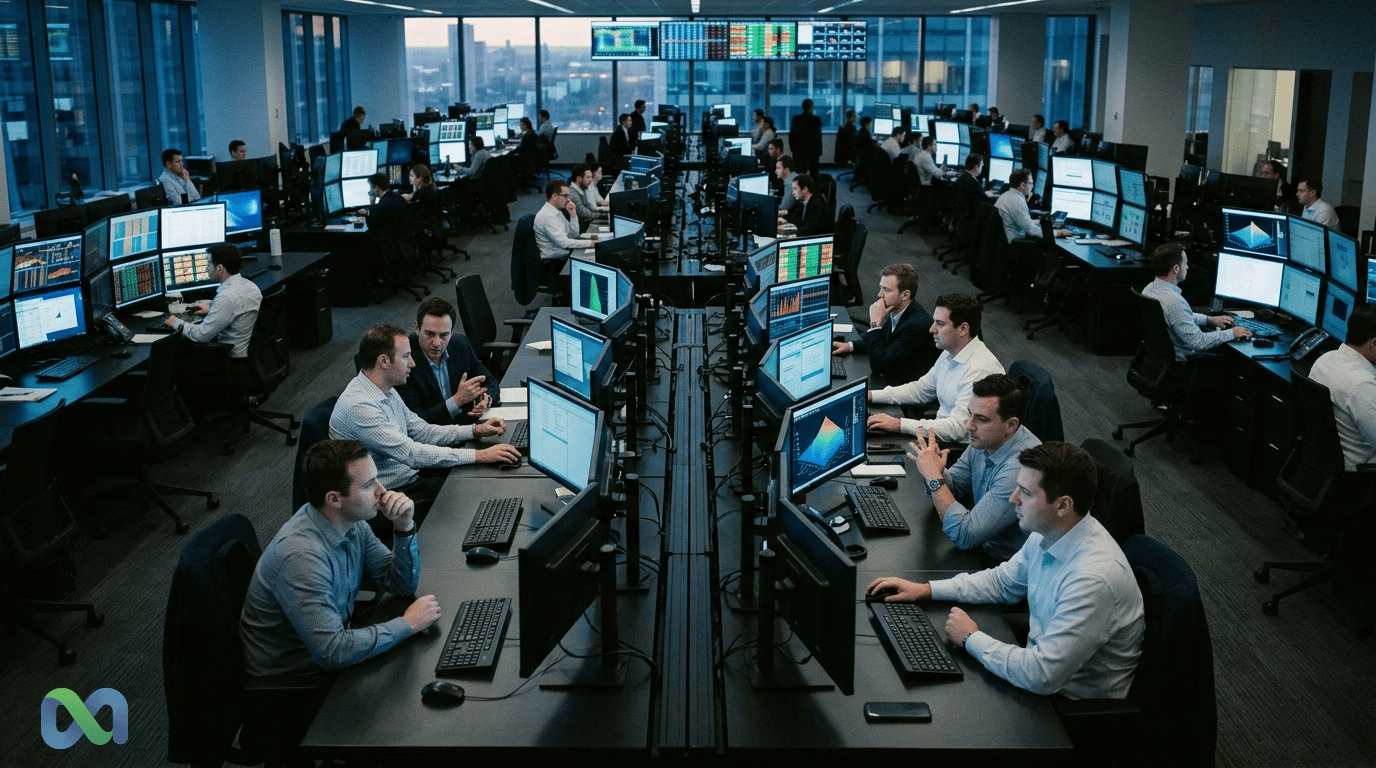
Order flow is the sequence of buys, sells, limit orders, cancellations, and executions that reaches a market over time. In prediction markets, that flow shows more than price movement. It shows how participants react to new information and how implied probability absorbs buying or selling pressure.
That matters because the final price of a contract does not appear out of nowhere. It is produced by real orders, available liquidity, and participants willing to trade at specific levels. When a market on an election, a central bank decision, or a sporting event moves from 52% to 58%, someone entered the book, took liquidity, or adjusted quotes.
Still, order flow is not a crystal ball. It helps explain market microstructure, but it does not prove that the next move is correct. In prediction markets, order flow has to be read alongside depth, slippage, spread, order size, and the information context.
What is order flow?
Order flow is the chronological flow of buy and sell orders entering a market. It shows who is pressuring price, when that pressure appears, and how much liquidity gets consumed.
In traditional trading, order flow analysis looks at trades, visible orders in the book, buyer aggression, seller aggression, and changes in market depth. The idea is to use real-time orders and executions to understand supply and demand. A useful reference point is the general concept of order flow trading, which frames the method around the interaction between orders, trades, and liquidity.
In prediction markets, the idea is similar, but the interpretation changes. The price of a contract often represents an implied probability. If a YES contract trades at 0.62, the market is suggesting roughly 62% before fees, spreads, and other frictions. Order flow shows how that probability is bought, sold, challenged, and defended.
Order flow, volume, and price are not the same thing
Volume alone can mislead. A market can show high volume while buyers and sellers remain balanced. It can also show low volume while one aggressive order moves price because there was little liquidity in the way.
Order flow adds context. It asks: who crossed the spread? Did the order consume liquidity or wait in the book? Did the move come from many small executions or one large order? Did the book refill after the trade, or did it stay thin?
How order flow works in practice
To understand order flow, start with orders. A limit order states a price and size. It sits in the book until it is executed, canceled, or expires. A market order, or an equivalent aggressive order, accepts available prices in exchange for faster execution.
When buyers accept sellers' prices, aggressive buy flow appears. When sellers accept buyers' prices, aggressive sell flow appears. That detail matters because price can rise not just because someone wants to buy, but because buyers are willing to pay what is available on the ask side of the book.
The opposite also happens. If sellers keep hitting bids, price can fall. In thin markets, only a few price levels may separate the current quote from a large move. A moderate order can then create a jump that looks more informative than it really is.
Limit orders, aggressive orders, and execution
Imagine a binary contract trading between 0 and 1. Buyers of YES are bidding 0.55, and sellers of YES are asking 0.57. The spread is 0.02. If someone wants to enter quickly, they can buy at 0.57 and remove part of the seller liquidity.
If that buy consumes the entire 0.57 level and also hits offers at 0.58, the traded price rises. The chart will show an uptick. But order flow shows something more specific: the move came from an aggressive order that crossed available liquidity.
Now imagine that new sellers appear at 0.57 and 0.58 after that purchase. The book refills. In that case, the flow may show buyer interest, but also enough supply to absorb pressure. If the book does not refill, the reading changes. The market has become more vulnerable to the next aggressive order.
Buy-sell imbalance
One common use of order flow is to observe imbalance. If several aggressive buys arrive in sequence and price barely rises, there may be heavy sell-side liquidity absorbing demand. If a few buys move price sharply, liquidity may be fragile.
That contrast is crucial. Strong flow with little impact can indicate absorption. Small flow with large impact can indicate a thin book. Neither should be read in isolation.
In prediction markets, imbalance often appears after news. A poll, a court decision, an inflation print, or an athlete injury can change expectations. Order flow helps reveal whether the market reacted through broad participation or through a few concentrated trades.
Order flow in prediction markets
Prediction markets turn questions about events into tradable contracts. In many cases, the contract pays if an outcome happens and expires worthless if it does not. That is why price can often be read as an approximate probability.
When someone buys YES, they express demand for the positive outcome. When someone buys NO, they express demand for the opposite outcome. In an efficient and liquid market, this flow helps incorporate dispersed information. In a thin market, it may only show the action of a few participants.
That difference is the core of the topic. Order flow in prediction markets is not just an entry-and-exit technique. It is a trail of how the market processes information.
Each trade updates an implied probability
Suppose there is a market on whether a central bank will cut rates at its next meeting. Before a speech, the YES contract trades at 44%. After the speech, aggressive buying pushes the price to 51%. The chart shows a seven-point move.
Order flow asks more precise questions. Did the move come in a burst of small orders? Did it come from one trader? Did the spread widen? Did depth disappear? Were traders buying YES while sellers canceled asks?
Those questions separate price movement from movement quality. A rally supported by persistent flow and reasonable liquidity means something different from a jump caused by weak depth.
YES, NO, and binary contracts
In binary contracts, YES and NO are complementary sides. If YES is trading around 60, NO tends to reflect the other side after accounting for spread and market structure. That creates a different reading from equities or futures.
Kalshi's market orderbook documentation shows the logic of YES and NO bids. It also explains how YES bids can relate to NO asks through complementary prices, such as 100 minus the price. That detail helps explain why flow on one side affects how traders read the other.
Strong YES buying may mean the market is incorporating positive information about the event. It may also reflect hedging, rebalancing, or execution error. That is why order flow should be analyzed with market size, recent history, and available depth.
CLOB, AMM, and LMSR: where order flow appears
Order flow depends on market structure. In a CLOB, or central limit order book, participants place orders at specific prices. In an AMM or LMSR model, an algorithmic curve adjusts prices as participants buy or sell.
Flow matters in both cases, but it appears in different forms. In a CLOB, you can observe book levels, spread, and resting orders. In an AMM, you observe order impact, curve liquidity, and the price change caused by the trade.
Polymarket's CLOB documentation describes a hybrid architecture with off-chain matching and on-chain settlement. That illustrates how prediction markets can combine an order-book user experience with blockchain settlement.
CLOB: queue, book, spread, and maker/taker
In a CLOB, each price level can have a queue of orders. Whoever posts liquidity acts as a maker. Whoever crosses the spread and executes against existing orders acts as a taker. This distinction affects cost, priority, and how the flow should be read.
If takers repeatedly buy and remove offers, the market shows buying pressure. If makers replenish offers at the same price, the move can stall. If makers pull liquidity before news, the spread can widen and the next trade can move price more.
For that reason, order flow in a CLOB is not just the trade tape. It includes changes in the book. Cancellations, liquidity replenishment, and concentration at certain price levels can say as much as executions.
AMM and LMSR: price curve and order impact
In Polymarket trading contracts use CLOB-style infrastructure, while AMMs, the participant trades against a pricing function or pool. There is no identical visible queue of limit orders. Even so, each buy or sell moves the curve. Order flow appears as a sequence of interactions with the mechanism.
In LMSR, a common reference model for prediction markets, price changes as more quantity is bought in each outcome. Liquidity depends on the market parameter. With low liquidity, a smaller order can create a larger impact.
This structure reduces some empty-book problems, but creates others. The trader may always receive a quote, yet pays order impact. Reading the flow correctly requires knowing whether the market uses a book, pool, curve, or hybrid model.
How to read order flow without falling into traps
The first trap is confusing flow with truth. Buy flow may signal new information. It may also signal urgency, hedging, arbitrage, thin liquidity, or overreaction.
The second trap is looking only at the last trade. A large print gets attention, but it is not enough. It is better to observe sequence, context, depth, and what happens afterward. If the market quickly returns to the previous price, the trade may have been more noise than conviction.
The third trap is ignoring costs. Spread and slippage change the reading. A market may show a 60% probability, but it may be expensive to enter if the spread is wide and depth is poor.
Slippage and market depth
Slippage is the difference between the expected price and the actual execution price. It increases when the order is large relative to available liquidity. In prediction markets, that can materially change the interpretation of probability.
Imagine a contract with a last price of 60%. If there is little liquidity at 60 and 61, a larger buy may execute all the way up to 66. The buyer has not “proved” that the real probability is 66%. They paid to cross a shallow book.
Market depth shows how much size is available at each level. Without depth, order flow is incomplete. A sequence of buys in a deep market means something different from a similar sequence in an almost empty market.
Spoofing, cancellations, and false signals
Books can also display intentions that never become trades. Orders can be canceled. In some markets, participants may post liquidity to influence perception and remove it before execution. This risk is a standard part of market microstructure discussions.
You do not need to accuse any specific platform to take it seriously. The point is simple: visible orders are not the same as executed trades. Confirmed trades carry more weight, but they still need context.
There is also natural noise. One participant may need to close a position. Another may be running arbitrage between markets. Another may react late to old news. Flow shows action, but it does not reveal motivation with certainty.
Practical examples in Polymarket, Kalshi, and Macro Markets
Think about three market types: a political event book, a regulated binary contract market, and a real-time probability interface. In all of them, order flow helps answer one simple question: what did participants do after new information appeared?
On Polymarket, the official documentation describes a hybrid CLOB with signed orders, off-chain matching, and on-chain settlement. That makes it natural to observe flow by price, size, and execution. The reading resembles other order books, but with event contracts.
On Kalshi, the YES and NO logic in the order book is central. Analysis has to look at both sides. A strong YES bid and a strong NO bid can reveal where participants are willing to take risk. They can also show spreads and the levels where liquidity is concentrated.
At Macro Markets, the editorial angle is the interpretation of real-time activity. The point is not to turn every trade into a definitive signal. The point is to observe how probability, flow, and liquidity interact when the market reacts to news, data, and narrative shifts.
Example 1: political news
A debate ends, and a candidate performs better than expected. Soon after, election-linked contracts show YES buying. If the flow is distributed, persistent, and accompanied by renewed bids, the reading suggests a broader repricing.
If the rally came from a single order with a wide spread and little depth, the reading should be more cautious. The market may simply be discovering a new price. Or one participant may have accepted a high cost to enter quickly.
Example 2: macroeconomic data
An inflation print comes in above consensus. Markets on rate cuts may react. Buying NO or selling YES can indicate lower expectations of a cut.
Even so, the first reaction can overshoot. Some participants trade headlines. Others wait for details. The order flow in the following minutes may be more informative than the first print.
Example 3: sporting event
In a sports market, an injury or lineup change can move probabilities quickly. Flow can be intense, but liquidity can also evaporate. Late traders may pay heavy slippage.
In that case, order flow shows urgency. It does not prove that the new price is fair. Traders still need to compare it with depth, time remaining, the source of the news, and related markets.
Checklist for analyzing order flow in prediction markets
Before interpreting a move, use a simple checklist. It reduces the odds of turning noise into a thesis.
- Did the move come from many trades or one isolated order? A sequence usually carries more weight than one print.
- Was the spread tight or wide? A wide spread makes price less reliable.
- Was there enough depth? Low liquidity increases order impact.
- Did the book refill afterward? Replenishment suggests absorption. An empty book suggests fragility.
- Was there new information? Without context, flow may be rebalancing or noise.
- Do YES and NO tell the same story? In binary markets, both sides help confirm the read.
- Did execution cost change? High slippage can make the visible probability less actionable.
It is also important to know when to ignore the signal. Reduce its weight when the market has very low volume, a very wide spread, few orders in the book, or a move with no confirmation. Do the same when the news source is uncertain.
Frequently asked questions about order flow
What is order flow?
Order flow is the stream of orders entering a market. It includes buys, sells, limit orders, executions, and changes in liquidity. In prediction markets, it shows how participants trade implied probabilities around events.
What does order flow mean?
Order flow describes the sequence and direction of orders. It goes beyond volume because it considers timing, aggressiveness, price, and available liquidity.
What is flow in financial markets?
Flow is the observed order activity in an asset, contract, or market. It can indicate buying pressure, selling pressure, or a change in liquidity. However, flow alone does not reveal each participant's true intent.
Does order flow work better in a CLOB or an AMM?
It works differently in each structure. In a CLOB, flow appears through trades, bids, asks, and depth. In an AMM, it appears through the impact of trades on the pricing curve. In both cases, liquidity determines the quality of the signal.
Is order flow a trading strategy?
It can be part of a strategy, but it should not be treated as a flawless system. It is a market microstructure tool. For real decisions, it needs to be combined with risk management, context, and clear rules.
Conclusion
Order flow is one of the best ways to see inside a market. It shows how orders arrive, how liquidity reacts, and how implied probabilities adjust when new information appears.
In prediction markets, that reading is especially useful. Each trade can represent a dispute about the future of an event. But the signal only gains value when you account for depth, spread, slippage, execution structure, and context.
Use order flow as a lens, not a promise. It helps you ask better questions: who moved the market, with how much liquidity, in which direction, and after what information? Those answers make analysis more disciplined and less dependent on the last price on the screen.
Quick guide before trading
Read the book calmly. Check the best price. Check the available size. Check the spread. Do not look only at the displayed probability. Final execution cost matters.
Start small. Test execution. See whether the order fills. Watch for slippage. If the average price worsens too much, reduce the size.
Use a limit order when price is the priority. Use a market order when speed is the priority. In a shallow book, avoid rushing. A large order can cross several levels.
Record the result. What was the price before the order? What was the average execution price? Was the order partial? Was the spread wide? This routine improves the next decision.
The rule is simple. Microstructure becomes cost. Cost changes return. Traders who understand order flow trade with more care. Traders who ignore the book can pay too much without noticing.
Ask three questions. Is there real liquidity? Is there a dispute around the price? Is there enough size? If one answer fails, the market calls for a smaller order or a stricter limit.
A simple five-step read
First, look at price. Then look at spread. Then look at size. Then look at rhythm. Finally, decide whether the order makes sense.
There is no need to rush. A good market will still be there a few seconds later. If the book changes quickly, reduce size. If the spread widens, wait or use a limit.
The best trade starts with a short question: how much can I pay? If the answer is not clear, do not use an aggressive order. Use a limit price and protect the cost.
The market does not need to be perfect. It needs to be legible. Price, size, and execution should tell the same story. When they do not, there is noise.
This rule helps in politics, macro, and crypto. It also helps in small markets. The lower the liquidity, the more careful each click needs to be.
Order flow made simple
Order flow becomes clearer with a short routine. Check the price. Check the spread. Check the lot size. Check the queue. Only then send the order.
If the market is shallow, use a limit. If the market is calm, wait for a better price. If the news is strong, reduce size. The goal is to avoid hidden execution cost.
A good order is simple. It has a maximum price. It has a size. It has a reason. It does not depend on luck. It respects the book.
The common mistake is looking only at probability. Probability is not execution. Execution depends on who is on the other side. It also depends on liquidity at that moment.
With this routine, order flow stops being jargon. It becomes a practical way to read risk, cost, and opportunity before the click.
