


2026 World Cup Qualified Teams: Full List
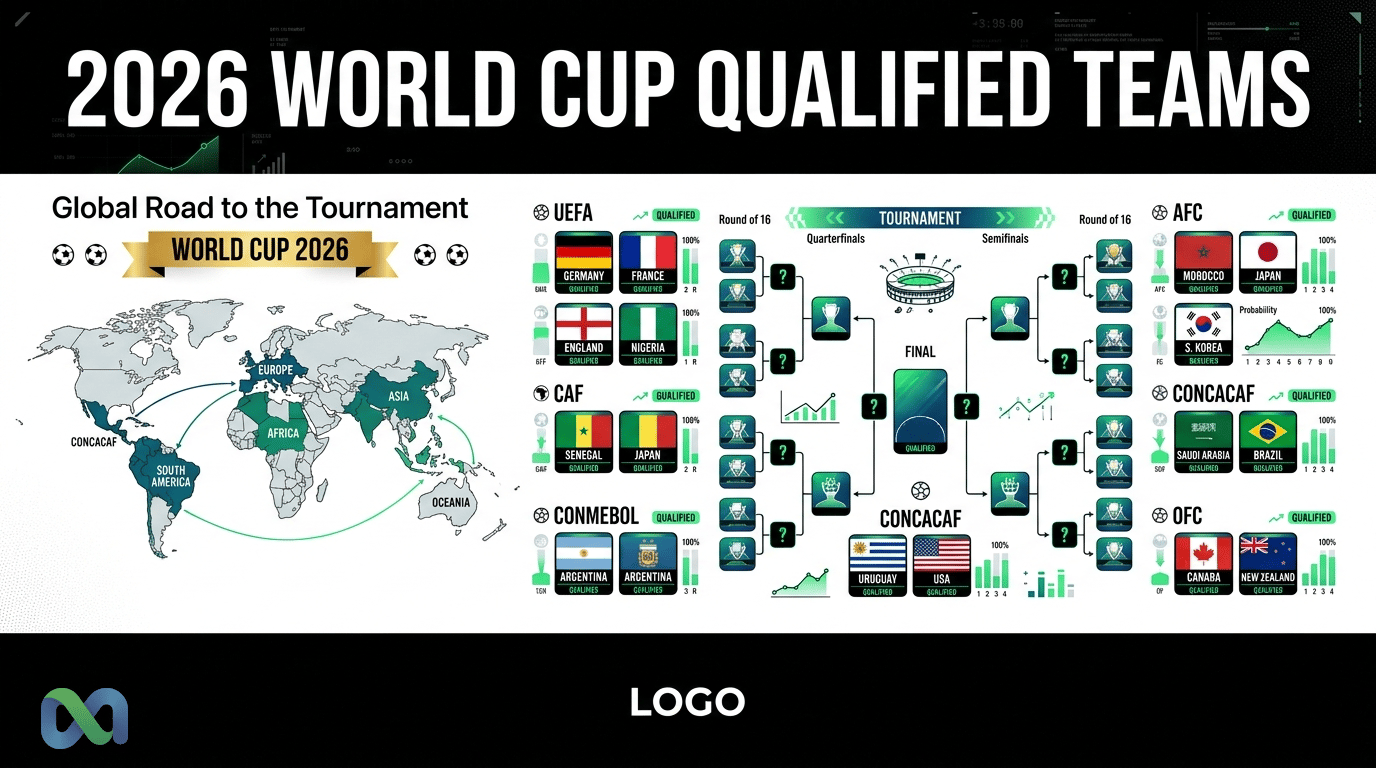
Updated on May 7, 2026. The 2026 World Cup will be the first edition with 48 teams. That makes the question of the 2026 World Cup qualified teams bigger, more dynamic, and more important for anyone who follows football through a probability lens.
The field includes the three host countries, major contenders, important returns, first-time participants, and places decided through continental qualification paths. The tournament will be played in Canada, the United States, and Mexico from June 11 to July 19, 2026, according to FIFA.
In this guide, you get the complete list of countries, the regional breakdown, why the format changed, the most relevant absences, and how to turn the list into a clearer read on chances.
Which Countries Qualified for the 2026 World Cup?
The direct answer is simple: 48 teams will play in the 2026 World Cup. The list of 2026 World Cup qualified teams includes these groups:
- Hosts: Canada, United States, and Mexico.
- Concacaf: Curaçao, Haiti, and Panama.
- Asia: Japan, Iran, Uzbekistan, South Korea, Jordan, Australia, Qatar, and Saudi Arabia.
- Oceania: New Zealand.
- South America: Argentina, Brazil, Ecuador, Uruguay, Colombia, and Paraguay.
- Africa: Morocco, Tunisia, Egypt, Algeria, Ghana, Cape Verde, South Africa, Ivory Coast, and Senegal.
- Europe: England, France, Croatia, Portugal, Norway, Netherlands, Germany, Switzerland, Austria, Belgium, Spain, Scotland, Turkey, Czech Republic, Sweden, and Bosnia and Herzegovina.
- Playoffs: DR Congo and Iraq.
This list combines direct places, host places, and teams that reached the tournament through playoff routes. The main change is easy to understand. The World Cup moved from 32 teams to 48, so more regions gained places, and countries with strong cycles outside the traditional core entered the tournament.
Complete List of the 48 Qualified Countries
| Region | Countries | Quick read |
|---|---|---|
| Hosts | Canada, United States, Mexico. | Entered directly because they host the tournament. |
| Concacaf | Curaçao, Haiti, Panama. | Complete the regional block beyond the three hosts. |
| Asia | Japan, Iran, Uzbekistan, South Korea, Jordan, Australia, Qatar, Saudi Arabia. | The largest Asian presence in recent World Cup history. |
| Oceania | New Zealand. | Benefits from the region’s direct place. |
| South America | Argentina, Brazil, Ecuador, Uruguay, Colombia, Paraguay. | A strong block with favorites and dangerous teams. |
| Africa | Morocco, Tunisia, Egypt, Algeria, Ghana, Cape Verde, South Africa, Ivory Coast, Senegal. | Nine direct representatives in the new format. |
| Europe | England, France, Croatia, Portugal, Norway, Netherlands, Germany, Switzerland, Austria, Belgium, Spain, Scotland, Turkey, Czech Republic, Sweden, Bosnia and Herzegovina. | The largest continental delegation at the World Cup. |
| Playoffs | DR Congo, Iraq. | Enter through the final qualification route. |
This structure answers the main search quickly. However, it also shows something more important: the 2026 World Cup will have stronger diversity. The field includes former champions, recent semifinalists, emerging teams, and countries with a smaller tournament history.
For the casual fan, this means more interesting matches. For anyone analyzing chances, it creates more scenarios. Groups with one clear favorite may become more uneven. Groups with three middle-tier teams may create more variance.
Host Countries With Automatic Places
Canada, the United States, and Mexico qualify directly because they host the World Cup. This is standard practice at World Cups. The host country receives an automatic place because it must be part of the tournament it organizes.
In 2026, the rule extends to three host countries. The decision fits the scale of the event. There will be 48 teams, more matches, more travel, and more demand for stadiums. Splitting the tournament across three countries reduces operational pressure and expands the commercial reach of the World Cup.
2026 World Cup Qualified Teams by Region
The 2026 World Cup place allocation reflects the new size of the tournament. FIFA increased the presence of almost every region. Europe still has the largest block, but Africa, Asia, Concacaf, and Oceania all gained more room.
The broad distribution is:
- Europe: 16 places.
- Africa: 9 direct places, with an additional chance through playoffs.
- Asia: 8 direct places, with an additional chance through playoffs.
- South America: 6 direct places, with an additional chance through playoffs.
- Concacaf: 6 direct places, including the three host countries.
- Oceania: 1 direct place.
- Global playoffs: 2 final places.
This design creates a more global World Cup. It also lowers the barrier for teams from regions that previously needed near-perfect qualification campaigns. The result is a larger field with more return stories and more new angles.
Europe: 16 Places
Europe remains the region with the most countries. England, France, Croatia, Portugal, the Netherlands, Germany, Belgium, Spain, and other teams arrive with strong squads. Many of them should appear near the top of pre-draw projections.
The expansion to 16 places also opens the door for campaigns that, under the old format, might have fallen into a tougher playoff path. Norway, Scotland, Turkey, Czech Republic, Sweden, Bosnia and Herzegovina, Switzerland, and Austria add depth to the European block.
For analysis, this creates two levels. The first level includes real title contenders. The second includes teams capable of advancing from balanced groups. Separating those levels helps avoid treating every European team as if it had the same ceiling.
Africa: 9 Places Plus Playoff Route
Africa will have a much larger presence in 2026. Morocco, Senegal, Ghana, Tunisia, Egypt, Algeria, Cape Verde, South Africa, and Ivory Coast form a strong and diverse group.
Morocco arrives with the weight of its historic 2022 campaign. Senegal and Ivory Coast have physical and powerful squads. Egypt, Algeria, Ghana, and Tunisia bring continental tradition. Cape Verde and South Africa add different tournament narratives.
This increase in places matters for market reading. More African teams mean more styles and more upset potential. Pre-tournament rankings do not always capture that kind of risk well.
Asia, South America, Concacaf, and Oceania
Asia will have a strong World Cup by volume. Japan, South Korea, Iran, Australia, Qatar, Saudi Arabia, Uzbekistan, and Jordan show the region’s growth. Japan and South Korea often arrive with tactical discipline. Saudi Arabia and Qatar have already shown strength in specific tournament settings.
South America keeps a high concentration of talent. Argentina, Brazil, Uruguay, Colombia, Ecuador, and Paraguay should draw constant attention. The region has fewer places than Europe, but it often produces teams with very high ceilings.
Concacaf mixes host countries with regional qualifiers. Canada, the United States, Mexico, Curaçao, Haiti, and Panama will have partial advantages from environment, travel, and adaptation. That does not guarantee a long run, but it can influence close matches.
Oceania will have New Zealand as its direct representative. The change matters because, in the past, the region often had to go through playoffs. In 2026, the direct place reduces uncertainty for the zone.
Why Will the 2026 World Cup Have 48 Teams?
The 2026 World Cup will have 48 teams because FIFA expanded the tournament to include more countries and more matches. The change increases global participation, creates new revenue, and makes the World Cup more accessible for regions with fewer historical places.
Under the previous model, 32 teams played in eight groups of four. In 2026, there will be 12 groups of four teams. The top two teams from each group advance, along with the eight best third-place teams. That means the knockout stage begins with 32 teams.
What Changes From the 32-Team Format
The main change is volume. With 48 teams, the World Cup will have more matches, more host cities, and more possible combinations. That increases the chance of debuts and returns. It also reduces qualification pressure in some regions.
However, the format requires care in analysis. More countries do not automatically mean more balance. Some groups may be stronger than others. The path to the quarterfinals or semifinals may also vary heavily after the draw.
In practical terms, fans need to look beyond the country list. The draw, match order, travel schedule, and squad fitness can all change the strength reading.
How the Group Stage and Third-Place Spots Work
The group stage will have 12 groups with four teams each. Every team plays three matches. The top two teams in each group advance directly. Then, the eight best third-place teams also move on.
This detail is crucial. In a 32-team World Cup, finishing third meant elimination. In 2026, a third-place finish with a good points total can keep a team alive. Therefore, goal difference, tactical discipline, and risk management in the third match become more important.
For prediction markets, this changes the pricing of middle-tier teams. A team that does not look like a group favorite may still have a strong chance to advance. The question is no longer only “who wins the group?” It also becomes “who survives the third-place cutoff?”
Which Teams Missed the 2026 World Cup?
The teams that missed the 2026 World Cup are those that did not finish inside the direct qualification places and did not advance through the playoff routes. The exact list of absences depends on each qualifying path, but it always includes strong countries that lost decisive points during the cycle.
This topic draws attention because the expansion to 48 teams lowers the chance of middle-tier teams missing out. Still, the new format does not remove failure. It only changes how high the bar is for missing the tournament.
Relevant Absences by Region
In Europe, the race remains difficult even with 16 places. Countries with World Cup history can miss out if they land in strong groups, lose direct matches, or fail in the playoff route. That keeps European qualification among the most demanding paths.
In South America, the cut also remains hard. The region has fewer countries, but a high average level. Even with six direct places, irregular campaigns still carry a heavy cost.
In Africa and Asia, expansion opened doors. However, regional depth also improved. Strong teams face more organized opponents, long travel, and difficult calendars.
How Qualification Paths Decided the Final Places
Qualification paths work as continental filters. Each region sets its own route, with groups, final rounds, or playoffs. After that, some teams still compete for intercontinental places.
That is why the final list of 2026 World Cup countries should not be read as a pure strength ranking. It reflects performance, regional context, qualifying draws, calendars, injuries, and adaptation.
This distinction matters. A qualified team is not automatically strong. A missing team is not automatically weak. International football depends on short cycles, and a few matches can change everything.
What the Country List Says About 2026 World Cup Chances
The list of 2026 World Cup qualified teams is the starting point for evaluating chances. It shows who is in the tournament, but it does not yet show path, opponents, fatigue, or possible knockout matchups. Those factors appear later, especially after the draw and group stage schedule.
Even so, the list already lets you separate teams into blocks. There are title favorites, candidates for long campaigns, dangerous one-match teams, and outsiders. That framework helps interpret price moves in prediction markets.
Favorites, Outsiders, and Group Asymmetry
Favorites usually combine a deep squad, stable coaching, strong tradition, and a good player generation. France, Argentina, Brazil, Spain, England, Germany, and Portugal tend to enter that debate. However, their order changes with injuries, recent form, and the draw.
Outsiders are teams with a lower initial chance but a possible path. Morocco in 2022 showed how organization, confidence, and a favorable bracket can change a World Cup. In 2026, the expanded format may create new windows for this kind of run.
Group asymmetry will be decisive. A favorite in an easier group may preserve energy. A favorite in a hard group may pay a physical and emotional cost early. Therefore, the country list is only the first layer of analysis.
How to Track Chances in Prediction Markets
Prediction markets help turn opinion into observable chance. Instead of relying only on headlines, an analyst can watch how prices change when news, injuries, squad lists, and draws appear.
On Macro Markets, the read should be professional: track chances, volume, liquidity, and scenario changes. The question is not “who do I want to win?” The better question is: “is the market underestimating or overestimating this team after new information?”
That approach avoids hype. It also helps separate narrative from signal. If a team gets heavy media attention but its chance barely moves, the market may already have priced the event. If the chance moves before public opinion reacts, there may be meaningful information in the flow.
Quick Summary of the 2026 World Cup Teams List
Want the short version? Start with three points. The 2026 World Cup will have 48 teams. It will be held in three countries. Canada, the United States, and Mexico are already in.
Then, look by region. Europe has the most teams. Africa grows sharply. Asia also gains weight. South America remains strong, with Brazil and Argentina at the center of the picture.
To know which countries qualified for the 2026 World Cup, use the regional list. It is easier to read than one long list. It also helps show who could land in a difficult group.
Use the list as a map. First, see who is in the World Cup. Then, check the group. Finally, look at the route to the knockout stage. This step-by-step approach reduces noise and keeps the focus on probability, not reputation alone. It also helps you notice when a draw changes the real path for a favorite or outsider.
The key point is simple. Having a place does not make a team a favorite. Landing in a good group helps. Drawing a strong group changes everything. That is why the list is only the start of the analysis.
How to Use This List Without Getting Lost
Use the list in three steps. First, check the 2026 World Cup qualified teams. Then, separate them by region. Finally, wait for the group draw.
This method is easy. It cuts noise. It also prevents rushed conclusions. A strong country can land in a hard group. A middle-tier country can get a lighter path.
Also watch home advantage and travel. Canada, the United States, and Mexico face less shock from time zones and climate. That can matter in short tournaments. Even so, the pitch still decides a lot.
For Brazil, the point is clear. The list shows strong rivals. France, Argentina, Spain, Germany, England, and Portugal all enter the radar. But the group draw changes the whole map.
For anyone searching for which countries qualified for the 2026 World Cup, the best answer is the regional list. It is cleaner. It shows the weight of each zone. It helps compare favorites and underdogs.
FAQ: 2026 World Cup Qualified Teams
Which countries are in the 2026 World Cup?
There are 48 countries in the 2026 World Cup. They include the host countries Canada, the United States, and Mexico. Brazil, Argentina, France, Spain, Germany, England, Portugal, Morocco, Japan, South Korea, Senegal, Uruguay, Colombia, and other teams are also listed above by region.
How many teams qualify from each region?
The 2026 World Cup will have 48 teams. There are 16 from Europe, 9 from Africa, 8 from Asia, 6 from South America, 6 from Concacaf, 1 from Oceania, and 2 from the global playoff route.
Why is the 2026 World Cup in three countries?
The 2026 World Cup will be held in Canada, the United States, and Mexico because the expanded tournament requires more stadiums, infrastructure, and operational capacity. Joint hosting makes it possible to distribute matches, fans, travel, and costs across three large North American markets.
Which teams will not participate in the 2026 World Cup?
The teams outside the 2026 World Cup are those eliminated in their regions or in the playoffs. Since the format has 48 places, fewer middle-tier teams miss out. Even so, poor campaigns, difficult groups, and losses in direct matches still eliminate strong teams.
When does the 2026 World Cup start?
The 2026 World Cup starts on June 11 and ends on July 19. The edition will have matches in cities across Canada, the United States, and Mexico. The official calendar can be followed on the FIFA website.
Conclusion
Now you know the 2026 World Cup qualified teams and why this will be the largest edition in history. The 48-team list changes the scale of the tournament, expands continental diversity, and creates new paths for favorites and outsiders.
To follow the World Cup well, memorizing the countries is not enough. The next step is to watch groups, schedule, injuries, squad lists, and chances. That is where the list becomes analysis.
On Macro Markets, this type of reading takes shape in prediction markets. Track moves before and after the draw, compare chances, and use the country list to build scenarios with more clarity.
Editorial note: this article will be updated if FIFA publishes any official change to the 2026 World Cup country list. Until then, the answer to which countries qualified for the 2026 World Cup is the complete list above.
