


World Cup trophy: History, Value and 2026
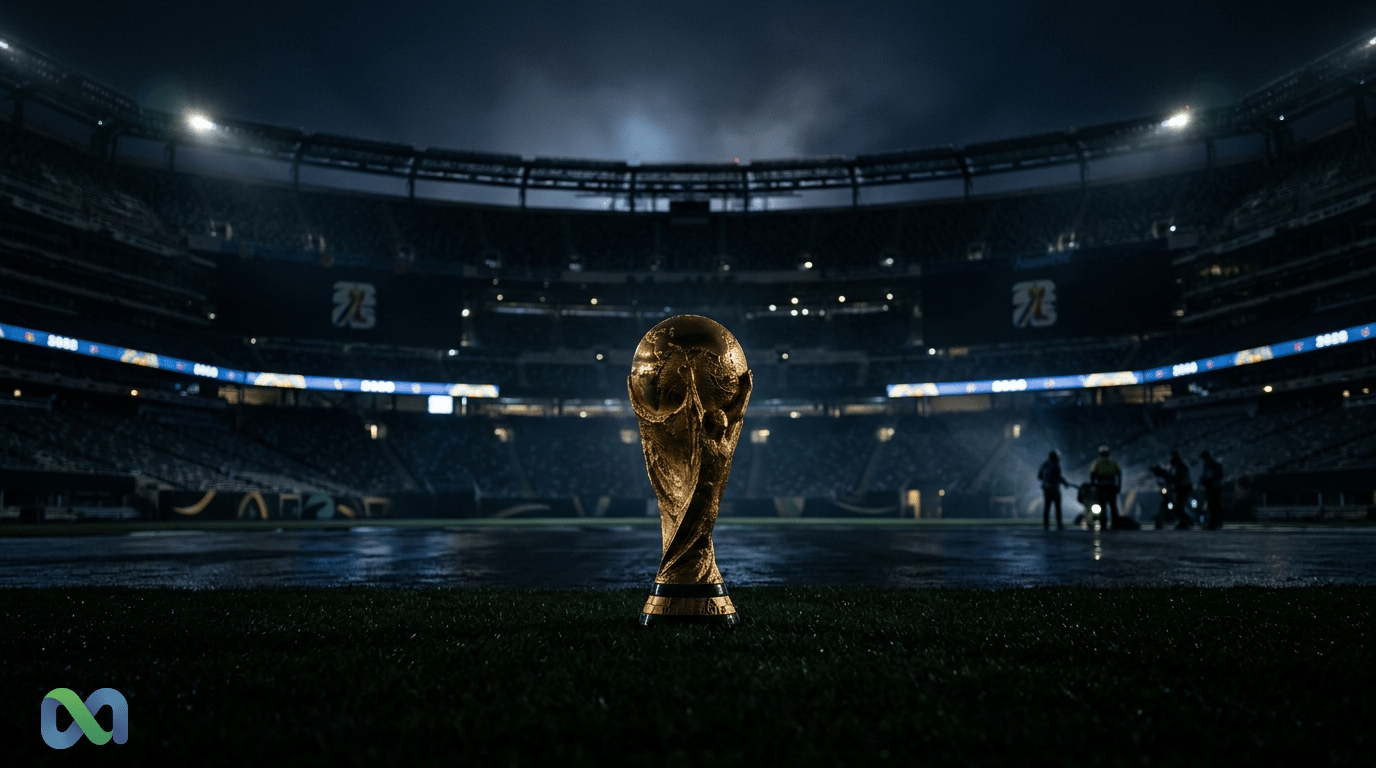
The World Cup trophy is the most desired object in football. It appears at every final, passes through the hands of the greatest champions, and becomes the official image of sporting glory every four years. Even so, many questions remain open. Which trophy is the real one? Where is it kept? How much is it worth? And which trophy will be used at the 2026 World Cup?
This guide answers those questions without confusing FIFA's official trophy with commercial replicas sold online. It also explains the difference between the old Jules Rimet Trophy and the current trophy, used since 1974. That distinction matters because the piece has material, historical, political, and symbolic value far beyond any replica.
Last reviewed: 05/06/2026. We learned that the cleanest way to read this topic is to separate FIFA's original trophy from replicas first, then compare that fixed object with the changing tournament around it. The 2026 cycle covers 48 teams, 16 host cities, 3 countries, and 104 matches. The current trophy has been in use for more than 50 years, while the Jules Rimet era ended after 40 years of World Cup history. [source: FIFA]
What Is the World Cup Trophy?
The World Cup trophy is the official prize symbolically awarded to the champion of the FIFA men's tournament. It represents the world title, but it does not remain permanently with the winner. The champion team lifts the original trophy at the ceremony, takes part in official celebrations, and later receives a gold-plated replica.
That rule exists because the current trophy belongs to FIFA. The organization controls its custody, transport, security, and public display. So when captains lift the trophy on the pitch, they are holding the original piece in a highly controlled moment.
The Official FIFA Trophy
The current trophy was created by Italian sculptor Silvio Gazzaniga. According to FIFA, it is about 36.8 centimeters tall, weighs a little more than 6 kilograms, and is made of 18-carat gold with a malachite base. The design shows two human figures holding up the planet.
The visual idea is simple and powerful. Football appears as a global language, while world victory becomes a collective achievement. That is why the World Cup trophy works both as a sporting prize and as a cultural symbol.
The names of the champions are engraved on the base. That creates a historical line connecting Brazil, Germany, Argentina, France, Italy, Spain, England, and Uruguay. Each edition adds another layer of memory.
Why It Became a Global Symbol
Few objects in sport are recognized so quickly. The trophy appears on posters, broadcasts, official tours, sticker albums, games, shirts, and sponsor campaigns. Even people who do not follow football recognize its shape.
The World Cup is also the biggest national-team event on the planet. The trophy concentrates that scale in one object. It communicates victory, country, identity, and international competition without needing a long explanation.
That visual power also explains the demand for replicas. Many people search for World Cup trophy replicas because they want party decorations, collectibles, or a better understanding of the real piece. But the official object is in a completely different category of rarity.
What Is the Difference Between the Jules Rimet Trophy and the Current Trophy?
The history of the World Cup trophy has two phases. The first was the Jules Rimet Trophy era, which lasted until 1970. The second began in 1974 with the current FIFA trophy. This difference is essential if you want to understand which trophy is real today.
A lot of confusion comes from Brazil winning permanent possession of the Jules Rimet Trophy after its third World Cup title in 1970. After that, FIFA needed to create a new trophy for future tournaments.
The Jules Rimet Era
The Jules Rimet Trophy was named after the FIFA president who helped launch the World Cup. It was used in the early editions of the tournament. The piece showed a female figure representing Nike, the Greek goddess of victory.
The old regulations stated that a team winning the tournament three times would keep the trophy permanently. Brazil reached that mark in 1970 after winning in 1958, 1962, and 1970. The Jules Rimet Trophy then became the property of the Brazilian Football Confederation.
The story ended badly. The trophy was stolen in Brazil in 1983 and was never recovered. The most accepted version is that it was melted down, although the case still carries doubts and myths. Today, the original Jules Rimet Trophy is not available for public display.
That episode reinforced the need for stricter rules. FIFA began treating the current trophy as a permanent asset of the organization, not as a prize that changes owners.
The Creation of the Trophy Used Since 1974
After Brazil took permanent possession of the Jules Rimet Trophy, FIFA opened a competition to choose a new cup. The winning design was Silvio Gazzaniga's, selected before the 1974 World Cup. Since then, this has been the official trophy lifted by world champions.
West Germany was the first team to lift the new trophy in 1974. Later came Argentina, Italy, Brazil, France, Spain, Germany, and other modern champions. For several generations, this piece became the dominant image of the World Cup.
The change also altered the logic of possession. The champion does not keep the original trophy. It receives an official replica, while the authentic piece returns to FIFA control after the celebration events.
That rule protects the historical value of the trophy. It also ensures that every World Cup uses the same original object at the central ceremonies.
Which Is the Real World Cup Trophy?
The real World Cup trophy is FIFA's original trophy, created by Silvio Gazzaniga and used since 1974. It belongs to FIFA, appears at the final, is lifted by the champion team, and then returns to the organization's custody. Champions receive an official replica for their collections.
That short answer resolves the main doubt, but it helps to separate three categories: original, official replica, and licensed product. Each one has a different function, value, and level of authenticity.
Who Gets the Original
At the award ceremony, the captain of the champion team lifts the original trophy. The image is real. The piece on the stage is not an ordinary copy. But that contact happens in a controlled context.
After the ceremony, FIFA resumes custody of the trophy. The piece can appear at official events, promotional tours, public presentations, and future finals. It does not spend years inside the federation headquarters of the winning country.
This policy avoids loss, theft, damage, and ownership disputes. The Jules Rimet experience showed the risk of leaving a symbol of this size in permanent third-party possession.
How the Replicas Given to Champions Work
The champion team receives an official replica, often known as the winners' trophy. It is gold-plated and serves as a physical memory of the title. The national federation can display it in museums and use it at institutional events.
Official replicas are not the same as decorative items sold on marketplaces. Licensed products can have very different sizes, materials, finishes, and prices. They serve fans and collectors, but they do not carry the same historical value.
Here is the difference in simple terms:
- The original trophy belongs to FIFA. It has sporting, historical, and global-memory value.
- The official replica stays with the champion federation. It records the country's title.
- A licensed commercial replica is made for fans. It has collectible value.
- A generic replica is useful for parties or decoration. It has no official value.
So a store replica can be cheap. The original World Cup trophy does not have an ordinary market price. They are objects of different kinds.
How Much Is the World Cup Trophy Worth?
The World Cup trophy is worth much more than the gold used to make it. Its material value can be estimated from its weight, 18-carat gold, and malachite base. But its historical value is almost impossible to calculate because the trophy is not for sale and represents decades of global sporting memory.
This distinction prevents a misleading reading. One thing is to calculate the metal value. Another is to evaluate a unique, protected object connected to Pelé, Maradona, Zidane, Messi, Ronaldo, Iniesta, Mbappé, and generations of champions.
Gold and Material Value
The current trophy weighs more than 6 kilograms, but that does not mean all that weight is pure gold. FIFA says the piece is made of 18-carat gold and has a malachite base. Eighteen-carat gold combines gold with other metals to add strength.
In practice, any material calculation depends on the gold price on the day and on the exact composition considered. Even then, the material estimate usually sits far below the cultural value of the object. The market does not treat the trophy like a gold bar.
It is also important to note that commercial replicas use different materials. Many are made of resin, plastic, metal alloy, gold-colored paint, or simple plating. The price of those products says nothing about the value of the original trophy.
Why Historical Value Exceeds Material Value
The real value of the trophy comes from scarcity. There is one original piece. It appears at the center of the most watched sporting event in the world. Each champion adds a new story to it.
Think of a football shirt. The fabric of a shirt worn in a final may be worth little. But the shirt linked to a decisive goal can become far more valuable because of the context. The same logic applies to the trophy, at a much larger scale.
The trophy also has diplomatic and institutional value. It represents countries, generations, sponsors, broadcasters, federations, and national memories. That is why speaking only about the gold price reduces the meaning of the piece too much.
Where Is the World Cup Trophy Today and What Changes in 2026?
The World Cup trophy remains under FIFA control and is usually protected when it is not at official events. It appears publicly on tours, at draws, ceremonies, promotional activations, and at the tournament final. For 2026, the trophy model remains the same one used since 1974.
The next World Cup will be played in the United States, Mexico, and Canada. That increases the trophy's symbolic weight because the tournament will be expanded and hosted by three countries.
Where FIFA Keeps the Trophy
FIFA keeps the trophy in a secure environment and controls its movement. It can be displayed at the FIFA Museum in Zurich and can also appear at official events organized by the body. Public access depends on FIFA's calendar, not on possession by a national team.
That policy creates a clear difference between the original trophy and replicas. The original travels under protocol. It does not circulate freely, it is not sold, and it does not move from collection to collection.
At major events, FIFA usually presents the trophy with strict security. That includes special transport, handling control, and the presence of official representatives. The goal is to preserve the trophy's physical and symbolic integrity.
Expectations for the 2026 World Cup
The 2026 World Cup trophy will be the current FIFA trophy, not a new Jules Rimet and not a design created specifically for that edition. What changes is the tournament context. For the first time, the men's World Cup will have 48 teams and will be organized across three countries.
That may increase the trophy's exposure in campaigns, tours, and official content. It should also expand interest in replicas, collectibles, and historical details. Searches for which trophy will be used at the 2026 World Cup are likely to grow as the tournament approaches.
For fans, the main answer is direct. The trophy will be the same official piece introduced in 1974. The 2026 champion will lift it at the ceremony and later receive its official replica.
Frequently Asked Questions About the World Cup Trophy
What Is the Value of a World Cup Trophy?
A commercial replica can cost little or a lot depending on size and material. FIFA's official trophy does not have a normal sale price. Its value combines 18-carat gold, rarity, history, and direct association with world champions.
Which Trophy Will Be Used at the 2026 World Cup?
The 2026 World Cup will use FIFA's current official trophy, created by Silvio Gazzaniga and used since 1974. There is no switch to a new Jules Rimet. The champion will lift the original at the ceremony and receive a replica.
Which Is the Real World Cup Trophy?
The real trophy is the original controlled by FIFA. It is used in official ceremonies and does not stay permanently with the champion team. Winning federations receive official replicas for display and memory preservation.
Where Is the World Cup Trophy Today?
The trophy is kept by FIFA and appears at official events, tours, draws, exhibitions, and finals. When it is not on a public schedule, it remains protected in a controlled environment. Replicas can be found in museums of champion federations.
Quick Glossary of the Trophy
Some terms look similar, but they are not the same. This section helps readers understand news, photos, stores, and posts without confusion.
The original trophy is FIFA's real piece. It appears at the final. It stays with FIFA. It travels carefully. It is not sold.
An official replica is the copy given to the champion. It marks the title. It can stay in a museum. It has value for the country. But it is not the piece used at the final.
A licensed product is a store item. It may carry FIFA branding. It may be well made. It may be expensive. Even so, it is a product for fans.
A common replica has no official weight. It works for a party, photo, living room, or simple collection. Its price changes by size, brand, and material.
Jules Rimet is the old trophy. It marked the early World Cups. Brazil took permanent possession after 1970. Then the trophy disappeared.
The current trophy is the modern cup. It began in 1974. It is the image most people know today.
The world champion is the national team that wins the final. The captain lifts the trophy. The country celebrates. FIFA keeps the piece afterward.
The 2026 World Cup is the next major edition. It will have more teams. It will have three host countries. But the trophy will be the same current prize.
In short, look at the context. If the scene is the final, it is the original trophy. If it is in a federation museum, it may be an official replica. If it is in a store, it is a fan product.
Simple Timeline
1930 marked the first World Cup. The old trophy entered the scene. It was not yet called the Jules Rimet Trophy. The tournament was new. The prize was new too.
1958 marked Brazil's first title. Pelé was young. The trophy became part of Brazilian football memory. The country began linking that object to football's peak.
1962 brought Brazil's second title. Brazil won again. The trophy gained even more weight for fans. It was already seen as the ultimate target.
1970 brought the third title. Brazil kept the Jules Rimet Trophy. The rule at the time allowed it. It was a rare milestone. It was also the end of that phase.
1974 opened the current phase. The new trophy appeared. It had another design. It was taller. It showed two figures and the world at the top.
1983 marked the theft of the Jules Rimet Trophy in Brazil. The piece disappeared. The case became a legend. Many people still ask where it is.
2022 had Argentina as champion. Messi lifted the current trophy. The scene traveled around the world. It showed, once again, the force of the symbol.
2026 will bring a larger World Cup. More teams will play. More countries will dream. But the trophy will be the same. The final target does not change.
This timeline shows a simple idea. The trophy changes little. The tournament changes a lot. That is why each generation creates its own scene with the same prize.
What the Trophy Teaches About Probabilities and Expectations
The World Cup trophy also helps explain why football attracts so much attention before the final even begins. Every cycle starts with favorites, underdogs, promising squads, injuries, draws, and changes in form. The trophy is unique, but the path to it is uncertain.
That uncertainty is exactly what makes the World Cup a natural subject for probability analysis. Fans track rankings, groups, brackets, history, and recent performance. More analytical traders look at the same competition as a set of scenarios that changes over time.
At Macro Markets, we found this logic as it appears in markets tied to sporting and global events. The focus is not to guess a champion. The point is to follow how new information changes expectations. An injury, a squad announcement, or a difficult draw can alter the market's reading.
The lesson for readers is straightforward: avoid treating the trophy as a static trivia object. Compared with a normal collectible, the real piece is closer to a permanent institutional asset. So the trophy works as the final destination. Probabilities show how the path toward it changes before the final whistle.
Conclusion: More Than a Golden Trophy
The World Cup trophy is real when we are talking about FIFA's original trophy, used since 1974 and kept under the organization's control. It does not stay forever with the champion team. The winner lifts the original piece at the final and later receives an official replica.
The old Jules Rimet Trophy belongs to another phase of history. Brazil won it permanently in 1970 and it was stolen in 1983. The current trophy was created precisely to preserve world football's main symbol more effectively.
Therefore, the value of the World Cup trophy cannot be reduced to the price of gold. It lives in collective memory, in the images of champions, and in the expectations that move each tournament cycle. In 2026, the same trophy will again stand at center stage, waiting for the team that turns probability into a title.
Quick Summary to Avoid Confusion
The current trophy is not the Jules Rimet. The Jules Rimet was used in the past. Brazil kept it after its third title in 1970. Then it was stolen and never returned.
The current trophy is FIFA's piece. It began being used in 1974. It remains the central prize of the World Cup. It will also be used in 2026.
The champion lifts the real trophy at the final. Afterward, FIFA resumes custody. The champion team receives an official copy. That copy stays with the federation.
A trophy sold in a store is another thing. It may be beautiful. It may be official as a licensed product. But it is not the trophy from the final.
The value of the real trophy does not come only from gold. It comes from history. It comes from finals. It comes from champion countries. It comes from the scenes everyone remembers.
That is why the simplest answer is this: the World Cup trophy is a rare symbol. It belongs to FIFA. It appears to crown the champion. And it becomes everyone's target again whenever a new cycle begins.
