


2026 FIFA World Cup Teams: SEO Strategy by Country and Player
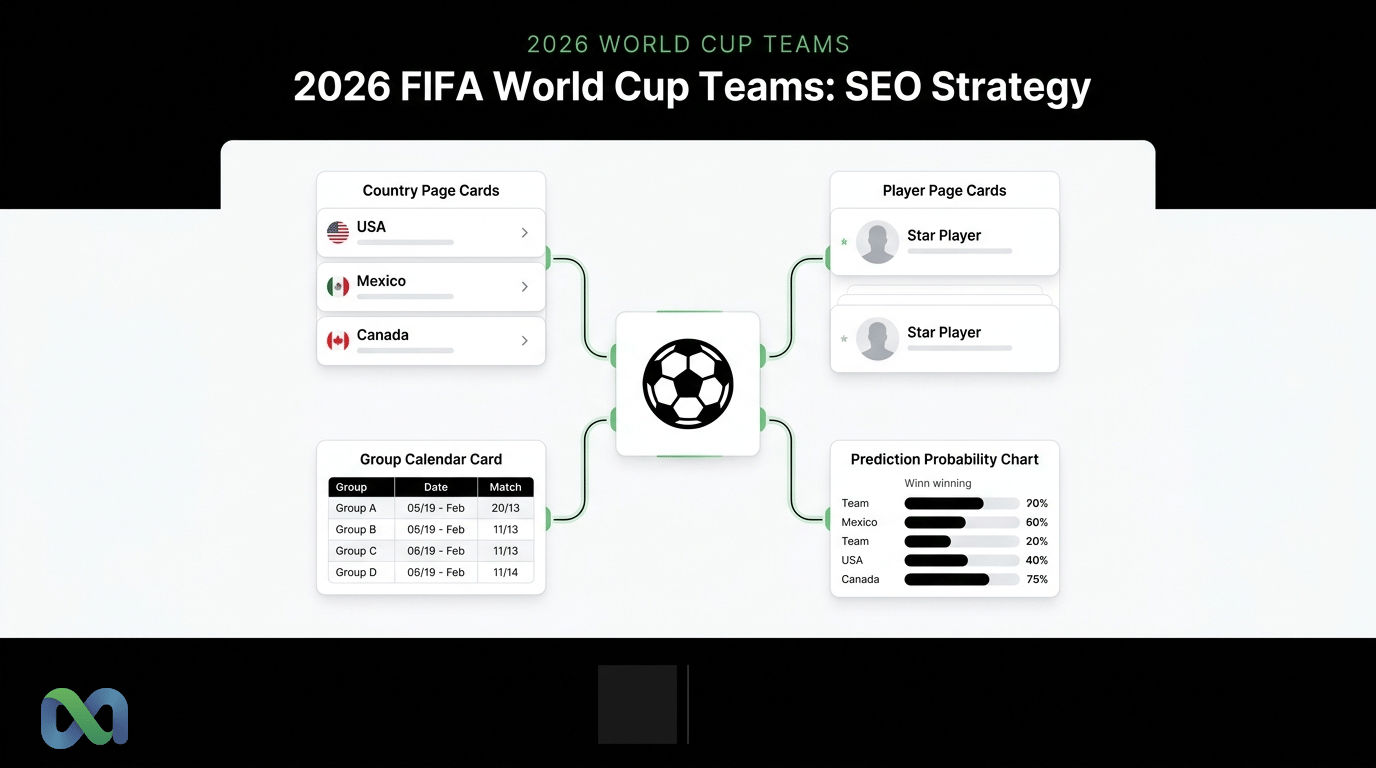
The 2026 FIFA World Cup teams will sit at the center of a search battle that is much bigger than the tournament schedule. Readers do not only want to know which countries have qualified. They want to compare favorites, understand key players, read probabilities, track groups, and return when new information changes the picture.
That is why the best SEO strategy for the 2026 World Cup is not a set of isolated posts. The stronger path is a living cluster. It needs pillar pages for each national team, satellite pages for relevant players, and clear links between format, groups, schedule, prediction markets, and title chances.
This guide organizes that system. The idea is simple: every URL needs one dominant intent. This helps Macro Markets avoid cannibalization, improve navigation, and build a base that can be updated until kickoff.
Why 2026 FIFA World Cup Teams Need Their Own Cluster
The 2026 World Cup will use an expanded format with 48 teams and host cities across three countries. According to FIFA, the tournament will be played in Canada, Mexico, and the United States. That new structure increases demand for context.
Readers will look for answers in layers. First, they want to know which 2026 FIFA World Cup teams are in the tournament. Then they want to understand the group, knockout path, likely squad, key players, and real chances for each country.
This journey creates a clear SEO opportunity. A general page about favorites cannot answer everything. At the same time, a short page for each country can feel thin if it is not connected to the right hub.
A cluster solves that problem. It creates an editorial map where each page has a specific job. The team page explains the country. The player page explains individual impact. The group page organizes the calendar. The prediction market page teaches readers how to read price and probability.
The topic also changes fast. Injuries, the draw, squad announcements, club form, and recent results all shift search demand. Therefore, the cluster should be built for continuous updates, not one-time publication.
Recommended Architecture for the Teams Hub
The central page should target the keyword 2026 FIFA World Cup teams. It works as the hub. Its job is not to exhaust every country, but to guide the reader toward the right next click.
A strong H1 can be direct: “2026 FIFA World Cup Teams: Guide by Country, Players, and Chances.” It includes the keyword, promises complete coverage, and leaves room for internal links.
The recommended hub structure is:
- A map of qualified or likely teams.
- Blocks for favorites, strong contenders, and possible surprises.
- A simple explanation of how to read probabilities by country.
- A list of key players with links to satellite pages.
- Schedule, groups, and upcoming update milestones.
- FAQ answers for recurring search questions.
The hub should be short enough to stay useful. A practical target is 1,800 to 2,600 words. Anything much longer will likely duplicate content from country pages.
Its main role is to distribute authority. When the reader searches for Brazil, Argentina, France, Spain, England, Germany, or Portugal, they should find a specific page. When they search for the overall map, the hub should deliver the overview and point to the right paths.
Template for 2026 World Cup Country Pages
Each national team page needs a consistent template. This helps scale production, review quality, and build internal links. It also improves the reader experience because each page follows a familiar structure.
The recommended template for a country is:
Team Status for the 2026 World Cup
Open with the current status. Has the team already qualified? Is it still in qualifying? Does it need a playoff? This answer should appear near the top.
Use an update block such as “Updated in: month 2026.” This detail matters because squad status, group details, and fixtures can change.
Qualification Path
Explain how the team reached the tournament or how it can still qualify. For high-demand teams such as Brazil, Argentina, France, England, Spain, Germany, and Portugal, this section should stay concise.
The goal is not to retell every qualifier. The goal is to explain what the path says about strength, stability, and risk.
Likely Squad and Key Players
List the central names, but do not turn the country page into a set of athlete biographies. The country page should explain the collective role.
When a player has search intent of their own, create a satellite page. This applies to names such as Mbappé, Vini Jr, Neymar, Bellingham, Lamine Yamal, Kane, Saka, Musiala, Wirtz, Pedri, Rodrygo, and Endrick.
Style of Play
The style section should be clear. Explain whether the team depends on transition, possession, high pressing, set pieces, or individual talent.
This block separates the page from a simple squad summary. It also connects football analysis with market reading.
Chances by Tournament Stage
Break the analysis into stages: group stage, early knockout rounds, semifinal, final, and title. Do not promise an outcome. Show scenarios.
If there is an active Macro Markets market, guide readers toward probability reading. If not, explain that prices should be reviewed after the draw, squad announcement, and friendlies.
Probabilities and Market Reading
Use professional language. Prefer “probabilities,” “market price,” and “implied probability.” The word “odds” may appear when it is a keyword, but it should not dominate the article.
The goal is to educate readers. Probability is not an isolated opinion. It changes when new information enters the market.
Editorial Priority: Which Teams Should Come First
Not every 2026 FIFA World Cup team deserves the same effort at the start. The queue should combine demand, sporting strength, public narrative, and market potential.
The first block should include teams with high intent and strong recurring search potential:
These pages come first because they concentrate search volume, famous players, and title discussions. They also connect well with pages about favorites and World Cup probabilities.
The second block should cover teams with regional demand or a strong public narrative:
- Mexico.
- United States.
- Canada.
- Uruguay.
- Netherlands.
- Italy, if applicable.
- Japan.
- South Korea.
- Morocco.
- Iran.
This group needs a different editorial treatment. In some cases, the intent will focus on schedule and group. In others, it will focus on surprise potential, a historic campaign, or players based in European leagues.
The third block should be programmatic but controlled. It can include qualified teams with lower demand. The risk is creating too many weak pages. Therefore, each page needs a clear intent, even when the article is short.
A practical rule helps: publish first where volume, narrative, and internal linking overlap. Then expand based on official qualification and the draw.
When to Create Player Pages
Not every player named in a squad deserves a separate URL. A player page should exist when there is search demand, narrative value, or a real impact on the team’s probabilities.
Use four criteria:
- Does the player have independent search volume?
- Does the player change the team’s ceiling?
- Is there a related market, such as top scorer, title, or country performance?
- Does the page strengthen the country page?
If at least two answers are yes, the satellite page makes sense.
The ideal player template is shorter. It should usually sit between 900 and 1,400 words, except for special cases. The recommended structure is:
- Is the player likely to be at the 2026 World Cup?
- What role does he play for the national team?
- What recent form supports the analysis?
- How does he change the team’s probabilities?
- Which related markets deserve attention?
This approach avoids generic biographies. The reader does not need a full career recap. They want to understand the player’s impact on the 2026 World Cup.
For example, a page about Mbappé should explain how his presence changes France. A page about Vini Jr should connect his role for Brazil, recent form, and title scenarios. A page about Endrick should explain uncertainty, competition for minutes, and likely role.
Interlinking Between Team, Player, Group, and Market
Internal linking is what turns the cluster into an SEO asset. Without internal links, pages become islands. With too many links and no logic, the content feels artificial.
The main rule is simple: link when the next click solves a real question.
A country page should link to:
- The 2026 FIFA World Cup teams hub.
- The group page, once the draw is defined.
- The calendar or fixture page.
- The title favorites page.
- Key player pages.
- A relevant team market, when one exists.
A player page should link to:
- The country page.
- A top scorer page or related market.
- The World Cup favorites page.
- Content about how to read prediction markets.
This network must be validated through the internal catalog. Do not invent URLs. The ideal workflow uses only links that already exist in the system and lets the link builder insert approved destinations.
It is also important to avoid repeated anchors. Use natural variations such as “Brazil at the 2026 World Cup,” “Brazil’s title chances,” and “Brazil probabilities.” This distributes relevance without sounding mechanical.
How to Avoid Cannibalization Across World Cup Pages
Cannibalization happens when two URLs compete for the same intent. In a World Cup cluster, this risk is high.
The page “who will win the 2026 World Cup” should not try to rank for every country. It should compare favorites and explain market price.
The page “Brazil 2026 World Cup” should answer questions about Brazil. It can mention France and Argentina, but only as comparisons.
The “2026 FIFA World Cup teams” page should be the cluster map. It should not become a deep analysis of every country.
A player page should focus on individual impact. It should not compete with the country page for general team intent.
To keep this separation clear, define one dominant intent before writing each URL. Then review the H1, meta title, slug, introduction, and H2s. If two pages make the same promise, one of them needs to change.
This discipline also helps the reader. They find exactly what they searched for instead of landing on a generic page.
How to Use Probabilities Without Losing Editorial Precision
Probabilities are a natural editorial advantage for Macro Markets. They connect football, public information, and markets. But they need to be used carefully.
Never treat a market price as a guaranteed forecast. The correct approach is to present it as a collective estimate that can change. Injury news, the draw, starting lineups, and recent form can alter everything.
It is also important to separate editorial analysis from price. Analysis explains why a team looks strong or fragile. The market shows how participants price that information at a specific moment.
On country pages, use blocks such as:
- What the market is pricing now.
- What could change the reading.
- Which risks remain unresolved.
- Where the price may be sensitive to news.
This format is more useful than listing numbers without context. It teaches the reader to think like an analyst.
The Wikipedia page on the 2026 FIFA World Cup can support general format and host data. Official tournament facts should prioritize FIFA and other primary sources.
Practical Production Plan for the First English Batch
The first English batch should build the backbone of the cluster. It needs to cover the most searched teams and connect the players with the greatest impact.
The recommended order is:
- The “2026 FIFA World Cup teams” hub.
- Brazil, Argentina, France, England, Spain, Germany, and Portugal.
- Pages for Mbappé, Vini Jr, Neymar, Bellingham, Lamine Yamal, Kane, Musiala, and Endrick.
- Pages about format, groups, fixtures, and prediction markets.
- Updates after the draw and squad announcements.
Each publication should include an update block. This protects the content against fast changes. It also signals to readers that the page will be maintained.
The editorial control sheet should record three fields per URL:
- Dominant intent.
- Related pillar page.
- Next planned update.
With this system, the team avoids overlap and knows which pages need review after important events.
Publishing Checklist for Each Cluster Page
Before publishing a country or player page, use this checklist:
- The main keyword appears in the H1, introduction, and slug.
- The URL has one clear dominant intent.
- The text uses official data for format, venues, and schedule.
- The analysis separates probability from editorial opinion.
- There are approved internal links to the hub, team, player, group, or market.
- The page states when it should be updated.
- The content avoids promises about results.
- The reading level is simple, with short sentences and light paragraphs.
- The meta title has a clear promise.
- The meta description explains the benefit of the click.
This checklist may look basic, but it reduces errors at scale. In a cluster with dozens of pages, consistency beats improvisation.
FAQ About 2026 FIFA World Cup Teams and SEO
Which teams should get their own page first?
Brazil, Argentina, France, England, Spain, Germany, and Portugal should come first. They combine demand, contender status, known players, and high search potential.
Which teams have qualified for the 2026 World Cup?
The final list changes as qualifiers finish. Use FIFA as the primary source for qualified teams, then update the hub whenever a new country secures a place.
How many countries are in the World Cup 2026?
The 2026 tournament uses an expanded 48-team format. That expansion creates more search demand for country pages, group explainers, and qualification updates.
Does every qualified team need a page?
Not at the start. Every qualified team can enter the cluster, but depth should vary. Lower-demand teams can have shorter pages that get expanded after the draw.
When should a player page be created?
Create one when the player has search demand, changes the team’s ceiling, or connects to relevant markets. If the player is only a squad name, keep the detail inside the country page.
How should probabilities be used in World Cup articles?
Use probabilities as market reading, not certainty. Explain what is priced, what news could move the price, and why editorial analysis may differ from the market.
How do you avoid duplicate content between team and player pages?
Define roles. The team page covers the country. The player page covers individual impact. When a topic becomes too large, link to the more specific page.
Conclusion
The winning strategy for 2026 FIFA World Cup teams is to build a cluster, not just a sequence of articles. The hub organizes the journey. Country pages capture specific intent. Player pages deepen narratives with independent demand.
Macro Markets has a natural advantage in this topic. It can connect football, probability, and market reading in clear language. For that to work, each URL needs a clear intent, validated interlinking, and a planned update cycle.
Start with the strongest teams, move to decisive players, and adjust the cluster after the draw, squad announcements, and new markets. This turns 2026 World Cup coverage into a continuous SEO asset that can grow until the tournament.
Quick Summary for 2026 FIFA World Cup Teams
The plan is clear. Each page has a job. The hub shows the map. The country page explains the team. The player page explains the weight of one name.
This keeps the reader oriented. They arrive, read, click, and move to the next question. That helps SEO. It also helps the fan who wants a clean answer.
For 2026 FIFA World Cup teams, start with the basics. List who is in the tournament. Show who is strong. Show who can improve. Then connect each team to its most searched players.
For example, Brazil should lead to pages about Vini Jr, Neymar, Rodrygo, and Endrick. France should lead to Mbappé. England should lead to Bellingham, Kane, and Saka. Spain should lead to Lamine Yamal and Pedri.
Each page should also say when it will be reviewed. The World Cup changes quickly. A draw changes the path. An injury changes the plan. A squad announcement changes the text. Therefore, revision is part of the product.
The best cluster is easy to read. It does not try to say everything on one URL. It creates routes. One route leads to the group. Another leads to the market. Another leads to the player. Another leads to the team.
So treat 2026 FIFA World Cup teams as a network. Do not treat them as a loose list. A good network earns search for much longer.
Simple Guide to Using the Cluster
Use this plan every day. Open the hub. Check the list. Choose a country. Read the country page. Then read about the player who most changes that team.
Fans want this flow. They want to know whether a team is strong. They want to know whether the group is hard. They want to know whether a star will play. They want to know whether a market price is worth watching.
The content team should keep the text clean. One idea per block. One question per section. One link for the next step. This keeps the reading light.
Do not use one page for everything. The hub does not need to tell Brazil’s full story. The Brazil page does not need to tell Vini Jr’s whole life. The Vini Jr page does not need to explain the entire World Cup format.
Each article needs a target. That target guides the title, slug, H2s, and links. If the target changes, the page should change too.
Before the draw, focus on strength, form, squad, and scenario. After the draw, add group, date, venue, and path. Close to the tournament, add squad list, injuries, form, and official news.
If a story changes everything, update the top. Say what changed. Say what is still unknown. Say when the page will be reviewed again.
This care builds trust. Readers come back because they know the page is not stale. Google also understands that the topic is alive.
For each team, ask one central question. Does Brazil arrive as a real favorite? Does France still have the strongest squad? Can Argentina maintain its level? Is Spain already an elite force? Does England have a squad for the final? Is Germany a threat again? Which generation will define Portugal?
These questions create strong titles. They also create useful FAQ snippets. However, the answer should be short at the start and richer in the body.
Use official data for facts. Use analysis for scenarios. Use market price to show the collective view. Do not mix the three.
The reader should leave with a clear idea. They should know which page to open next. They should understand why a team rises or falls in the conversation.
That is the point of the cluster. It organizes the World Cup. It reduces noise. It turns search into a route.
