


What Is Slippage in Kalshi? Meaning and How to Reduce It

What is slippage in Kalshi? In a Kalshi-style YES/NO order book, slippage is the gap between the price you expect and the average price where your order actually executes. In prediction markets, that gap matters because the contract price also acts like an implied probability. If execution slips, you paid a different price for the same contract. This changes your entry cost, not the actual probability of the event.
The cost can look small. Half a point here. One point there. However, in event trading, small price differences can change expected value. A good thesis can become a poor position if the average entry price is too high.
This guide explains slippage meaning in trading, how slippage appears in Kalshi order books, how it differs from spread and market depth, and practical ways to limit execution cost before placing a trade. It uses public documentation and simple examples. It does not claim private Kalshi metrics, hidden liquidity, or guaranteed execution outcomes.
Educational content only. This is not investment, trading, buying, selling, or platform-use advice.
What Is Slippage?
Slippage is the difference between the expected price of an order and the average executed price. It appears when available liquidity, bid-ask spread, market speed, or order size force the trade to fill at price levels different from the first quote.
In plain terms, the market moved or the order consumed more liquidity than the first visible level could provide. The word is common across trading, crypto, and prediction markets because it describes execution rather than opinion.
Slippage meaning in trading
In trading, the price shown in an interface is only a snapshot. It may be the best available offer, the last traded price, or an estimated execution price. The order still needs real liquidity on the other side.
If you try to buy at 0.52, but part of the order fills at 0.53 and 0.55, you experienced slippage. Your average price was higher than expected, so your margin shrank.
A simple formula is:
Slippage = average executed price - expected price
With this formula, positive slippage on a buy means paying more than expected; negative slippage on a sell means receiving less than expected. Favorable execution has the opposite sign: a lower buy price or a higher sell price.
Why the screen price is not always the execution price
Markets are live systems. Traders submit orders. They cancel orders. New information arrives. Liquidity can disappear. A large order can also walk through several levels of the book.
Imagine a market with the best YES offer at 0.52. If only 300 contracts are available at that price, a buy order for 1,000 contracts cannot all fill at USD 0.52 per contract. The remaining size must match sellers at higher levels.
The visible price is not a guarantee. It is the first point of available liquidity. The final execution depends on the path your order takes through the market.
A Practical Example
The easiest way to understand slippage is to calculate the average execution price. Do not focus only on the first quote. Focus on the weighted average price of the full order.
Suppose a binary market is trading around a central bank decision. In this hypothetical example without fees, the YES contract is offered at USD 0.52 per contract, and you want to buy 1,000 contracts. The book looks like this:
| YES price per contract (USD) | Available contracts |
|---|---|
| 0.52 | 300 |
| 0.53 | 300 |
| 0.55 | 400 |
The interface shows 0.52 as the best offer. But the order needs three levels to fill. The average execution is:
- 300 contracts at USD 0.52 = USD 156
- 300 contracts at USD 0.53 = USD 159
- 400 contracts at USD 0.55 = USD 220
The total cost is USD 535 for 1,000 contracts: (300 × 0.52 + 300 × 0.53 + 400 × 0.55) ÷ 1,000 = USD 0.535 per contract. Compared with the reference price of USD 0.52, slippage is USD 0.015 per contract, or USD 15 in total, before fees.
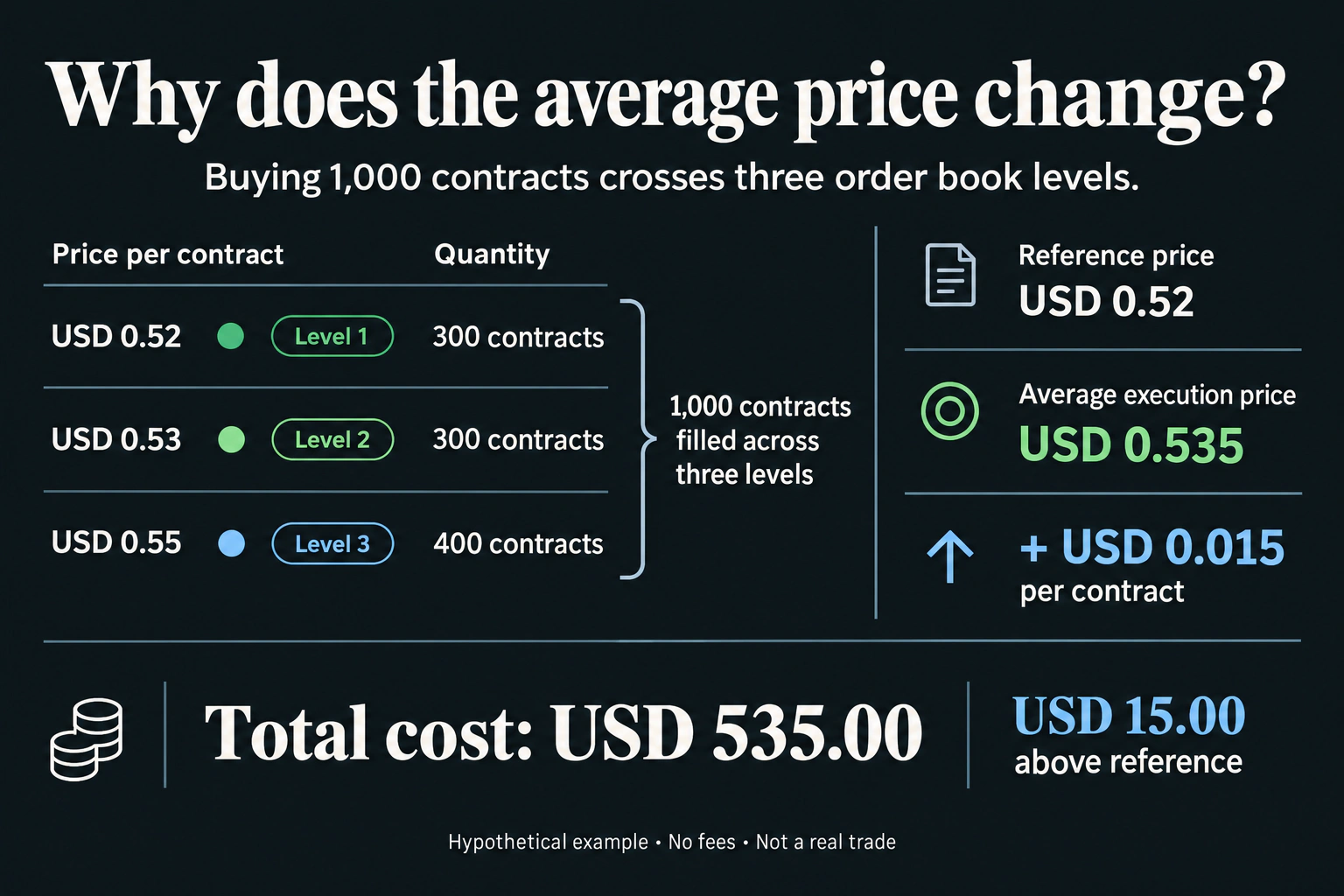
Hypothetical example in USD, without fees: the purchase consumes three order book levels. Not a real trade.
That difference may look modest. In a contract that pays 1.00 if the event resolves YES, each point changes expected return. Buying at 0.535 requires a stronger probability view than buying at 0.52.
Favorable and unfavorable slippage
Slippage is not always bad. It simply measures the difference between expected and executed price. The difference can help or hurt.
For a buy order, executing below the expected price is favorable. For a sell order, receiving more than expected is favorable.
In practice, traders monitor unfavorable slippage because it reduces edge. It often appears when the order crosses the spread, consumes depth, or reaches the market after a fast price move.
Slippage in Prediction Markets
Prediction markets add an extra layer. Price is not just a financial quote. It also communicates implied probability.
If a YES contract trades at 0.52, the market is signaling something close to 52% before fees, spread, and microstructure frictions. If your order fills at 0.535, your entry price is higher. That execution does not change the actual probability of the event.
Price as implied probability
Binary contracts usually pay 1.00 if the event happens and 0 if it does not. That makes price a useful shorthand for market-implied probability.
YES at 0.40 roughly points to 40%. YES at 0.70 roughly points to 70%. This reading is useful, but it is not perfect.
Spread, fees, liquidity, and slippage affect the real execution. The price you pay may differ from the displayed quote, without changing the actual probability of the event.
Impact on expected value
Assume you believe an event has a 58% chance of happening. The market shows YES at 0.52. On paper, there is a gap between your estimate and the market price.
Now include execution. If your average buy price becomes 0.56, the edge is much smaller. If fees and exit spread also matter, the trade may no longer make sense.
The goal is not to avoid every trade with slippage. That is unrealistic. The goal is to measure the cost before accepting the order.
Why thin markets slip more
Liquidity is the ability to trade without moving price too much. A liquid market has many contracts available near the current price. A thin market has little size at each level.
Thin prediction markets slip more because even a modest order can consume several price levels. News can also remove liquidity quickly. Traders cancel resting orders when information changes.
This is common around elections, economic data, sports events, and court decisions. The book may look acceptable before the update. Seconds later, the market can be different.
Slippage vs Spread vs Liquidity
Slippage, spread, and liquidity are related, but they are not the same thing. Confusing them leads to poor execution decisions.
Spread is visible before the trade. Slippage is measured during or after execution. Liquidity determines how much size the market can absorb.
| Concept | What It Measures | When It Appears | How to Reduce It |
|---|---|---|---|
| Spread | Gap between best bid and best offer | Before execution | Wait, quote better, or use a limit order |
| Slippage | Gap between expected and executed price | During or after execution | Set a limit, reduce size, check depth |
| Liquidity | Size available at each price | Before and during execution | Prefer deeper markets or split orders |
| Depth | Distribution of size in the book | Before execution | Estimate average price for full size |
Spread is a quote; slippage is execution
The spread shows the distance between buyers and sellers. For example, best bid at 0.51 and best offer at 0.53 means a 2-point spread.
Slippage compares the expected price with the actual fill. You may see an offer at 0.53 and still buy at an average of 0.55 if there is not enough size at 0.53.
A tight spread can still hide weak depth. That is why serious execution checks the full book, not only the top quote.
CLOB vs AMM: Where Slippage Comes From
Market design changes how slippage appears. Two important models are the central limit order book (CLOB) and the automated market maker (AMM).
In a CLOB: walking the book
In a CLOB, traders post limit buy and sell orders. An aggressive order consumes liquidity from the other side.
A small order may fill at the best level. A larger order can walk through several levels. Slippage comes from that walk through the order book.
The model is transparent when depth is visible. You can estimate the average fill before sending the order, although the book can still change.
In an AMM: moving the price curve
In an AMM, execution happens against a pricing curve. The price changes as the order changes the pool state. The larger the order relative to liquidity, the larger the price impact tends to be.
For prediction markets, that means a large YES buy can push the YES price higher. A large sale can reduce the price received.
AMMs can provide continuous liquidity. But continuous liquidity does not mean a fixed price. The price impact must still be measured.
What Is Slippage in Kalshi and Polymarket?
Public documentation gives useful examples without assuming private platform behavior. For a broader platform overview, see how Kalshi works. Polymarket documentation discusses market-order mechanics with price protection such as FOK and FAK constraints. Kalshi documentation shows YES and NO order books with price levels and quantities.
Polymarket: market orders with price protection
Polymarket order documentation describes market-order execution with parameters that limit the worst acceptable price. The general lesson is important: even a market-style order needs price protection.
Protection does not eliminate slippage. It limits how much you are willing to accept. If there is not enough liquidity inside the limit, the order may fill partially or fail depending on order type.
Source: Polymarket Docs, Create Order.
Kalshi: YES/NO order books and depth
Kalshi documentation shows order books with price levels and quantities for YES and NO contracts. That is exactly why market depth matters in binary markets.
If there is enough size near the current price, a larger order may have less impact. If there is little size, the average price can move fast.
Source: Kalshi Docs, Get Market Orderbook.
How to Avoid Slippage in Trading
You cannot eliminate slippage in every market. The practical goal is to measure it, limit it, and accept it only when the cost fits the thesis.
Use limit orders when price matters
A limit order defines the worst acceptable price. For a buy order, it prevents paying above the limit. For a sell order, it prevents selling below the limit.
This may reduce the chance of a complete fill. But it protects against a bad price. In thin markets, that protection often matters more than speed.
Split large orders in thin books
A large order can move price against you. Splitting the order can reduce impact, especially when depth is weak.
There is a trade-off. If the market is moving fast, splitting too much can make you miss the price. Still, in thin books, smaller orders help reveal the market response.
Avoid the first seconds after major news
After news, traders cancel and replace orders. Spreads can widen. Depth can disappear. If you do not need immediate execution, waiting can improve the read.
Waiting also has a cost. The price can move away. The right choice depends on urgency and edge.
Define your worst acceptable price before clicking
Before sending an order, write one rule: what is the highest price I can pay, or the lowest price I can sell, while the thesis still works?
If your estimate is 60%, you might accept buying YES at 0.55. You may not accept 0.58. That line depends on your model, fees, time horizon, and risk.
Quick Checklist
Use this checklist before placing a prediction-market order:
- Is the spread wide?
- Is there enough size at the best price?
- Is your order large relative to the market?
- Did major news just hit?
- Did you set a worst acceptable price?
- Does the expected edge cover slippage and fees?
- Does the trade need to happen now?
Warning signs include a wide spread, weak depth, a large order relative to available liquidity, recent news, no price limit, or an expected edge that does not cover costs. Consider reducing size, setting a limit, waiting, or skipping the trade.
FAQ
What does slippage mean?
Slippage means the difference between the price you expected and the price where your order executed.
Is 1% slippage good?
It depends. In a liquid market, 1% can be high. In a thin or volatile market, it may happen often. The key question is whether your edge still covers the cost.
Is 0.5% slippage good?
It can be acceptable if expected value is still positive after fees and spread. In tight binary markets, even 0.5% can matter.
Is slippage the same as spread?
No. Spread is the distance between the best bid and offer before execution. Slippage is the difference between expected and executed price.
Conclusion
Slippage is an execution cost, not a minor technical detail. In prediction markets, it changes your average execution price and the expected value of the position, without changing the actual probability of the event.
Do not look only at the screen price. Check spread, depth, order size, and your worst acceptable price. Then ask whether the thesis still works after the execution cost.
Good analysis and good execution are separate skills. You can be right about the event and still lose value by paying too much. Treat slippage as a core part of the decision before trading thin or fast-moving prediction markets.
