


2026 Midterms Corporate Election Spending: The Regulation Trade
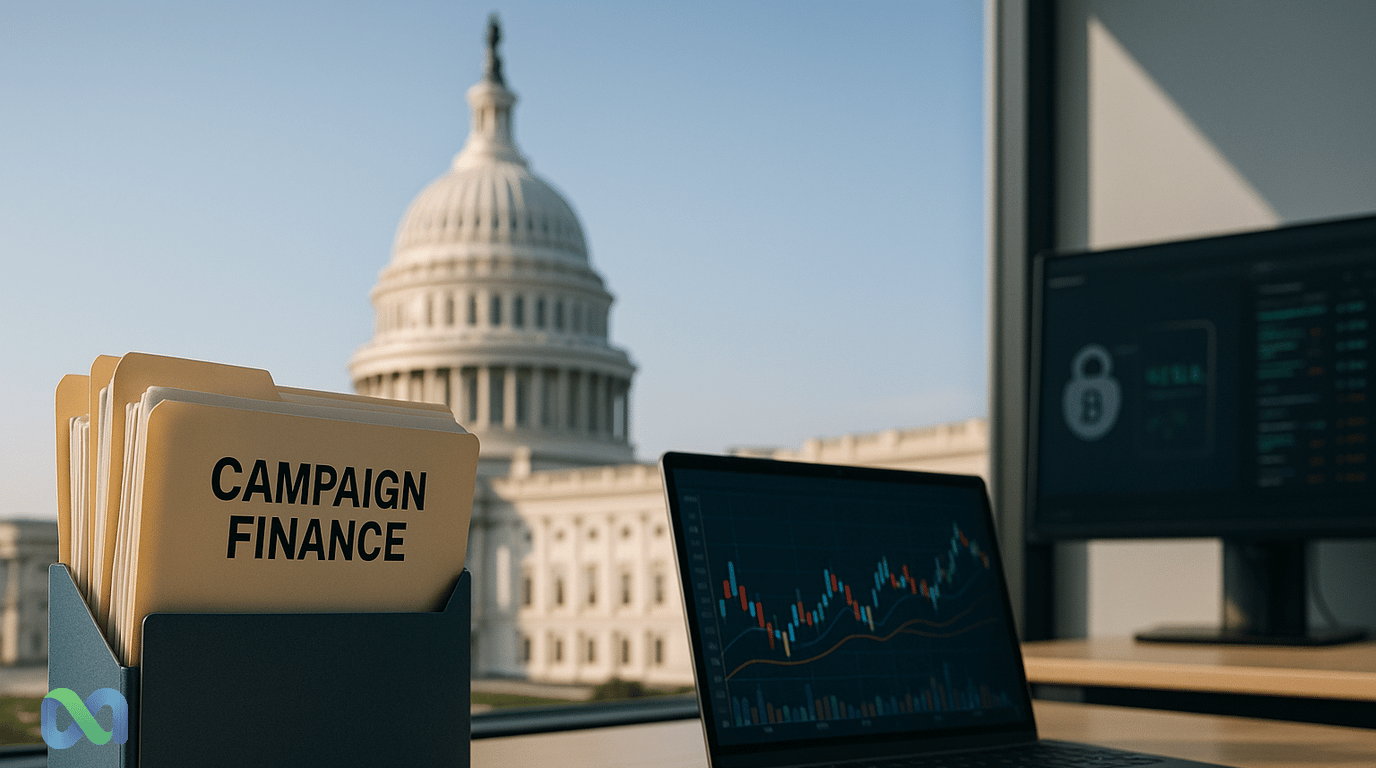
The 2026 midterms corporate election spending cycle is not just another money-in-politics story. It is becoming a live regulation trade for crypto, artificial intelligence and online betting. These sectors are spending because the next Congress may decide who can operate, who gets constrained and which agencies write the rules.
Reporting from Reuters and analysis from Public Citizen point to a record corporate spending push for a non-presidential cycle. Public Citizen says crypto, AI and online betting interests account for $294 million of a $517 million corporate-linked total. That is 57% of the reported sum.
For prediction-market traders, the key question is not whether money guarantees policy wins. It does not. The useful signal is narrower and more practical: which industries think regulation is about to move, where they are spending and which races may change the odds of future rules.
How to Read 2026 Midterms Corporate Election Spending
The 2026 midterms corporate election spending story can be read in plain terms. Big firms are paying close attention because rules are about to be written. Those rules can change costs, growth and legal risk.
Crypto firms want clear rules for tokens and exchanges. AI firms want more time to build before strict rules arrive. Betting firms want to keep the state-based model that helped them grow.
That does not mean donors can buy a law. It means they can try to lift one view and slow another. They can help a candidate win a primary. They can also make a narrow race more costly for the other side.
Therefore, traders should not treat the spending as noise. It shows where firms feel risk. It also shows which seats may matter before most news stories notice them.
However, the signal has limits. A large check does not decide a vote. A super PAC can lose. A friendly lawmaker can fail to pass a bill. The best use is to add the data to a wider view of polls, filings, court cases and agency action.
Why the 2026 Midterms Became a Regulatory Auction
Midterm elections often look smaller than presidential races. They can still matter more for regulated industries. A shift of a few seats can decide committee chairs, agency oversight, bill calendars and the tone of hearings.
That matters for sectors whose revenue depends on legal definitions. Crypto firms need clarity on market structure. AI companies want room to build before strict federal rules arrive. Online betting firms want to defend state licenses while event contracts test federal boundaries.
This is why the spending baseline deserves attention. Public Citizen's reported $517 million corporate-linked total is not a normal campaign footnote. It is a map of where large firms see policy risk.
The money is moving through super PACs and related political vehicles. These groups can support or oppose candidates without donating directly to campaigns. They can also move fast in primary races, where small changes in spending can shape the field before national attention arrives.
For market analysis, the exact route matters less than the revealed preference. Firms spend heavily when the expected value of policy influence is high. When several regulation-sensitive sectors spend at once, traders should ask what rule changes are being priced by the donors.
There is also a timing issue. Regulation rarely arrives in one clean vote. It moves through hearings, draft bills, agency letters, court cases and budget pressure. Campaign spending can show up before those signals become obvious in headlines.
Crypto Wants Market Structure, Not Just Friendly Rhetoric
Crypto is the clearest example. The industry is not only seeking sympathetic language from candidates. It wants market-structure rules that define when tokens are securities, how exchanges can operate and which agencies have authority.
Fairshake and its allied groups became the model for this approach. They support candidates across party lines when those candidates align with pro-crypto policy goals. That bipartisan strategy is important because crypto regulation is not a simple left-right issue.
The policy channel runs through Congress, the Securities and Exchange Commission and the Commodity Futures Trading Commission. If Congress creates a clearer framework, crypto firms may face lower legal uncertainty. If authority stays fragmented, enforcement risk remains higher.
For traders, this creates several watch points. One is whether pro-crypto candidates win seats on committees that handle financial services, agriculture or banking. Another is whether Senate races change the path for market-structure bills.
The spending does not mean every supported candidate will win. It also does not mean crypto gets the exact bill it wants. However, the size and focus of the spending can still change expectations about the probability of a softer or clearer regulatory regime.
This is where 2026 midterms corporate election spending becomes a market signal. A new filing, a targeted ad campaign or a primary intervention can reveal which races the industry thinks are pivotal. The signal is strongest when money moves toward candidates who could shape committee control or bill text.
Crypto traders should also watch how the industry frames its case. If the message is innovation and U. S. competitiveness, the sector is trying to make regulation a growth issue. If the message is consumer protection, it is trying to reduce the political cost of lighter-touch rules.
AI Money Is Buying Time on Regulation
AI spending has a different motive. Crypto wants legal clarity for trading and issuance. AI firms often want time, scale and a federal rulebook that does not split the market into many state-level regimes.
Politico has covered the rise of new AI and crypto power players in the campaign-finance field. CNBC has also reported on what AI companies want from midterm spending. The basic logic is direct: the next Congress may decide whether AI policy becomes strict, fragmented or mostly voluntary.
AI backers often use a competitiveness frame. They argue that the United States needs fast deployment to compete with China. That message can appeal to both parties because it links AI development to national security, productivity and economic growth.
For markets, the important detail is not the slogan. It is the policy target. AI firms care about model liability, data rules, export controls, federal preemption and agency enforcement.
If pro-AI candidates gain influence, traders may price a lower probability of aggressive federal restrictions. If candidates skeptical of large platforms gain influence, markets may price more hearings, subpoenas and rulemaking risk.
This does not turn AI spending into a forecast by itself. Political money is one input among many. But it can tell traders where the industry expects the battle to happen.
The strongest signals will likely come from committee races and bill sponsorships. A candidate can matter more because of committee placement than national visibility. Traders should also watch whether AI donors focus on primaries, because primaries can define the future bargaining range before a general election.
Betting Firms Face a Prediction-Market Challenge
The betting sector has another problem. Sportsbooks built their U. S. expansion around state licensing. Prediction markets and event contracts create a different regulatory path, especially when contracts fall under federal derivatives oversight.
This is why online betting firms should not be treated as just another donor group. DraftKings, FanDuel, Fanatics and bet365 have business models tied to state-by-state rules. They also face a broader debate over where betting ends and event-market trading begins.
That distinction matters for Macro Markets readers. Prediction markets are designed around market probabilities and event contracts. Sportsbooks offer house-set prices inside a gaming framework. The two models can overlap in public debate, but they are not the same analytical tool.
When betting firms spend on elections, they may be defending more than market share. They may be defending the regulatory perimeter that made their business possible. If federal event markets expand, sportsbooks could face competitors that do not rely on the same state licensing path.
For traders, this creates a second layer of signals. A congressional race may matter because it affects sports-betting taxation. It may also matter because it affects federal acceptance of event contracts.
State regulators are part of the story, but Congress still matters. Federal agencies and lawmakers can shape the legal environment around prediction markets. They can also influence whether event contracts are framed as financial markets, gaming products or something new.
The campaign-finance signal becomes useful when it is connected to that boundary fight. Spending by betting firms is not just an election headline. It can indicate where the industry sees a threat from prediction markets, exchange-like venues or federal rules.
How Campaign Finance Becomes a Prediction-Market Signal
Campaign finance becomes useful for prediction markets when it changes expectations before policy changes. Traders do not need a perfect forecast. They need a disciplined way to turn new information into probability updates.
The first signal is PAC cash. A surge in spending can show which races an industry believes are valuable. It can also reveal whether the industry is playing defense or offense.
The second signal is candidate targeting. A sector may spend against a candidate who threatens its business model. It may also support a less famous candidate because that candidate could sit on a relevant committee.
The third signal is issue language. Ads, endorsements and donor statements can show whether an industry is focused on consumer protection, innovation, national security, state rights or market access. Each frame points to a different regulatory path.
The fourth signal is timing. Spending before a primary can be more informative than spending late in a general election. Early spending can shape who gets to negotiate policy after the election.
The fifth signal is agency pressure. Congress does not write every rule. It can still pressure the SEC, CFTC and other agencies through hearings, budgets and oversight. Those channels can change enforcement risk even without a new statute.
Traders should verify these signals against primary sources. The Federal Election Commission remains the official route for campaign-finance filings. Watchdog analysis and news reports are useful, but filings are where spending claims can be checked.
The practical framework is simple:
- Track new FEC filings from major super PACs and sector-linked donors.
- Note which races receive early money, not only the largest total.
- Map candidates to committees, bill sponsorships and agency oversight roles.
- Compare donor messaging with current policy debates.
- Treat spending as a probability input, not a guarantee.
This approach helps avoid two mistakes. The first is ignoring campaign money because it is not a direct policy vote. The second is overreacting to every donation as if policy outcomes are already settled.
A Simple Checklist for Traders
Use a simple checklist when new filings land. Start with the cash. Ask who paid, how much they paid and where the money went.
Then look at the race. A small House race can matter if the seat is tied to a key panel. A Senate race can matter if it changes who controls the floor.
Next, look at the bill path. A bill needs sponsors, hearings and time. If a donor backs a lawmaker who can move that path, the filing has more weight.
Also check the agency path. The SEC and CFTC can act even when Congress is slow. A new chair, a hard hearing or a budget threat can change the tone of enforcement.
After that, read the message. Ads tell you what frame the donor wants voters to see. A crypto ad may talk about jobs. An AI ad may talk about China. A betting ad may talk about state rights.
Each frame points to a rule fight. Jobs means growth. China means speed. State rights means local control. Consumer harm means stricter rules.
However, keep the signal small at first. One filing is not a full trend. One race is not a full map. One ad is not a law.
Add weight when the same signal shows up three ways. For example, a PAC spends early. The same sector pushes a bill. A key panel race gets new cash. That mix is stronger than one news clip.
Also look for silence. If a large sector stops spending in a race, it may think the race is lost. It may also think the policy risk moved to a new seat.
This is why old data can mislead. FEC totals change. PAC plans change. Polls change. Traders should check fresh filings before they treat a number as current.
The core rule is simple: cash shows intent, not fate. It tells you what an industry wants and where it feels pain. It does not tell you who will win.
That is still useful. Markets move before laws pass. They move when odds shift. Campaign cash can be one early clue in that shift.
What Latin American Traders Should Take From This
The 2026 midterms are U. S. elections, but the regulatory effects can travel. U. S. rules often become reference points for global capital, platform design and compliance strategy. That is why Latin American traders should care.
Crypto is the obvious channel. If the United States clarifies market structure, global exchanges, issuers and liquidity providers may adjust. If uncertainty continues, offshore and regional strategies may remain more attractive.
AI is similar. U. S. rules can influence how companies allocate capital, release models and manage data risk. A light-touch federal path could support faster deployment. A stricter path could push firms to spend more on compliance and legal review.
Prediction markets sit at the center of the betting debate. If U. S. regulators accept a broader role for event contracts, that can raise the legitimacy of prediction markets globally. If lawmakers push the category back toward gaming, it can slow institutional acceptance.
For Macro Markets, the lesson is about transparency. Prediction markets work best when traders can see probabilities, compare signals and update views as information changes. That is different from a sportsbook model, where prices are set by the house and the regulatory logic is gaming-first.
Latin American readers should also watch how U. S. policy debates are copied or rejected by local regulators. Brazil and other markets do not need to follow the U. S. path exactly. Still, U. S. outcomes can shape investor expectations, media framing and the language regulators use.
This is especially relevant for elections, crypto and event contracts. These areas combine political risk with market structure. They also generate fast-moving headlines that can shift expectations before formal rules change.
FAQ: Corporate Spending, Super PACs and Prediction Markets
Why are crypto, AI and betting firms spending on the 2026 midterms?
They are spending because the next Congress may shape rules that affect their revenue models. Crypto firms want market-structure clarity. AI firms want favorable governance rules. Betting firms want to defend state-licensed businesses and influence the boundary around event contracts.
Which sectors are driving record corporate election spending in 2026?
Public Citizen says crypto, AI and online betting interests account for $294 million of a reported $517 million corporate-linked total. Those three sectors represent the largest part of the cited spending baseline.
Are prediction markets the same as sports betting?
No. Prediction markets organize trading around event contracts and market probabilities. Sports betting operates under gaming rules and house-set prices. The public debate can blur the two, but the market structure and regulatory logic are different.
How can campaign spending affect market probabilities?
Campaign spending can reveal which races and policy channels matter to an industry. Traders can use filings, endorsements and committee races as inputs when estimating the probability of future regulation.
Does corporate spending guarantee a policy outcome?
No. Spending can influence visibility, candidate support and political incentives, but it does not guarantee election wins or legislation. It should be treated as one signal inside a wider market framework.
The Bottom Line
The 2026 midterms corporate election spending surge is best read as a fight over regulatory architecture. Crypto, AI and betting firms are trying to shape the lawmakers who will define their operating room for the next cycle.
For prediction-market traders, the takeaway is practical. Follow the money, but do not stop there. Connect spending to committees, agencies, bill text and enforcement risk.
Campaign finance is not a forecast on its own. It is an early signal about where powerful industries expect the next regulatory battle to move. At Macro Markets, we track these signals as part of a wider view that includes prices, filings, polls, and official action. Last reviewed: August 26, 2026. In markets where rules can change valuations, access, and legitimacy, that signal deserves a place on the dashboard.
