




Brazil 2026 Election Date: First Round on October 4
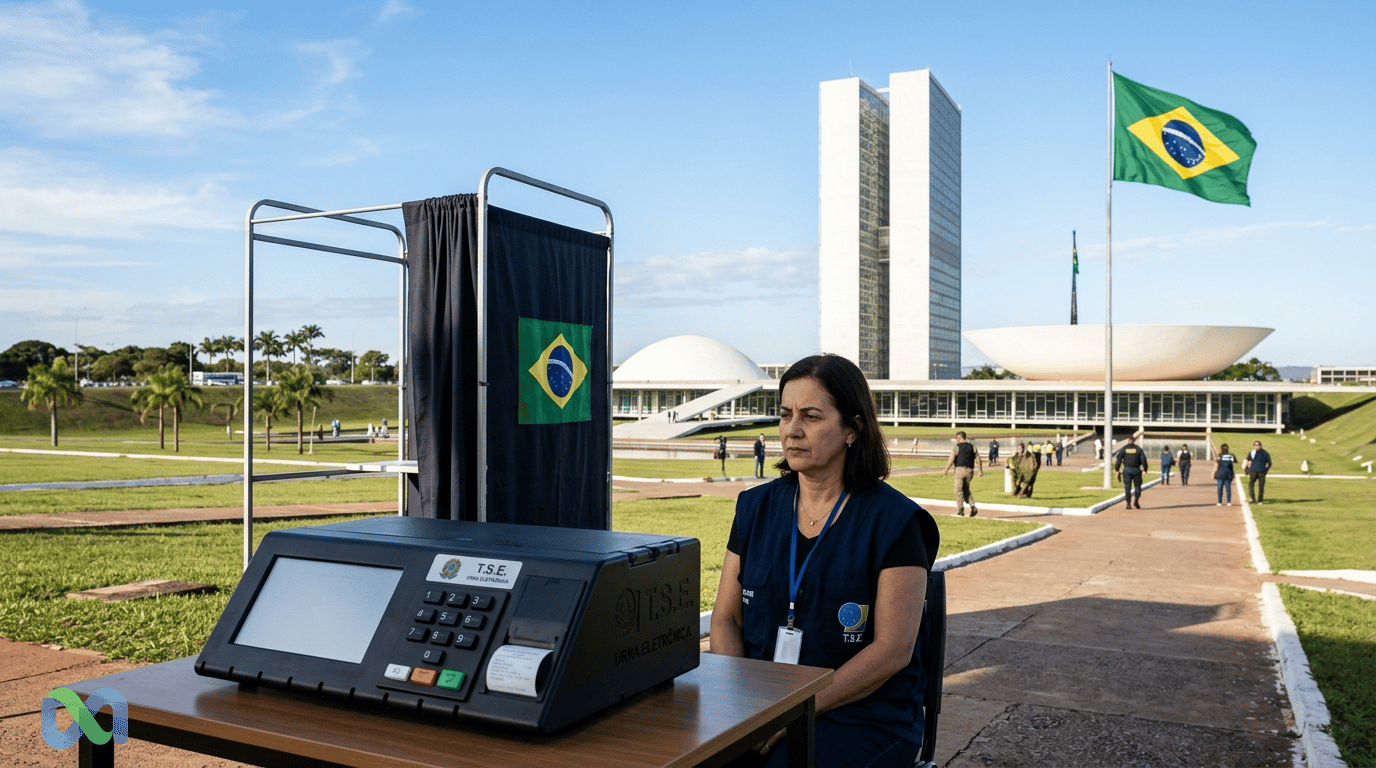
The first round of Brazil's 2026 general election will take place on October 4, 2026. Voting is expected to run from 8 a. m. to 5 p. m. Brasília time, according to the electoral calendar approved by Brazil's Superior Electoral Court, the TSE.
That is the direct answer for anyone searching for the Brazil 2026 election date. The date matters because it organizes the final stretch of the campaign, polling, debates, and probability analysis. It is also the day when voters choose the president, governors, senators, federal deputies, state deputies, and district deputies in Brasília.
The date also creates a simple anchor. Once you know it, every other deadline in the election cycle becomes easier to read.
This guide explains what is already set, what still depends on the campaign, and how the first-round date changes political analysis through October 2026. The goal is to separate the essential signal from the noise.
What Is the Brazil 2026 Election Date for the First Round?
The first round of Brazil's 2026 election is Sunday, October 4, 2026. The official calendar was released by the TSE, the court that organizes national election deadlines in Brazil.
Quick summary:
- First round: Sunday, October 4, 2026, from 8 a. m. to 5 p. m.
- Second round, if needed: Sunday, October 25, 2026, from 8 a. m. to 5 p. m.
- Time reference: Brasília time.
The rule is straightforward for voters. The first round is the main voting day. A second round only happens for president and governor races when no candidate wins a majority of valid votes in the first round.
According to the TSE, the 2026 calendar also includes many other deadlines. It covers party federations, conventions, candidate registration, campaign advertising, accounts, and certification. But for voters who simply want to know when to vote, the key date is October 4.
Quick Answer
Brazil's 2026 election first round will be held on October 4, 2026. Voting will take place on a Sunday, from 8 a. m. to 5 p. m. Brasília time.
If there is a second round, it will be held on October 25, 2026. That second vote can happen for the presidency and for state governor races.
Why do so many people search for this date?
Search interest around the Brazil 2026 election date rises because the presidential race shapes the whole political calendar. It affects parties, candidates, companies, journalists, analysts, and event traders.
It is also a practical search. Most people want the exact day without reading the full electoral calendar.
Many voters also mix up the voting date with other election deadlines. Party conventions, candidate registration, television advertising, and campaign accounts each have their own dates. They matter, but they are not the same as election day.
Why Will the First Round Be on October 4?
The first round falls on October 4 because Brazil's Constitution sets the election for the first Sunday of October. In 2026, the first Sunday of the month is exactly October 4.
This rule gives the electoral system predictability. Parties, campaigns, polling firms, media outlets, and voters can prepare well in advance. It also prevents the election date from depending on a last-minute political decision.
The possible second round follows a different rule. It takes place on the last Sunday of October when it is needed. In 2026, that date will be October 25.
Voting day is not the entire election calendar
The voting date answers when voters go to the polls. The full electoral calendar shows when parties and candidates must complete each legal step.
That distinction matters. A regular voter may only need the first-round date. Campaigns and media organizations follow many more stages. They track party affiliation, conventions, registration, advertising, campaign accounts, and certification.
The Brazilian Senate also published a summary of 2026 deadlines. The useful takeaway is simple: voting is one date, but the election is a sequence of events.
What can still change before October?
The constitutional first-round date should not change under normal conditions. Operational details, however, can still be updated by the TSE.
For example, the court may issue notices about biometric identification, accessibility, justification for absence, transportation, security, and local procedures. That is why the official source remains Brazil's electoral authority.
For political analysis, the more important point is different. Even with a fixed date, voter perception can change throughout the campaign. Polls, debates, alliances, court rulings, and economic news can move the race until the final days before voting.
Which Offices Are on the Ballot in Brazil's 2026 First Round?
In the 2026 first round, Brazilian voters are expected to vote for president, governor, senator, federal deputy, state deputy, and district deputy in the Federal District.
This is both a national and a state-level election. So the political impact goes beyond the presidential contest. It also reshapes Congress and state governments.
The composition of Congress matters because it affects governability. A president elected without a solid base may face higher costs to pass reforms, budgets, and economic measures.
President and governors
The presidential race and governor races can go to a second round. That happens when no candidate receives more than 50% of valid votes.
This rule changes how the campaign should be read. Sometimes the key question is not only who leads in the first round. It is also who can remain competitive in the runoff.
In prediction markets, that difference creates separate readings. A candidate may lead the first round but have high rejection in head-to-head scenarios. Another candidate may be in second place but look stronger in a final-round matchup.
Senate and Chamber of Deputies
The 2026 election also renews seats in the Senate and the Chamber of Deputies. The Senate uses a majoritarian rule. The Chamber uses a proportional system.
In practice, voters and analysts need to separate the races. The presidential election gets the most attention. However, Congress and state governments can define the pace of politics in 2027.
For investors, analysts, and event traders, this institutional composition matters. It influences the fiscal agenda, reform prospects, relations between the executive and legislature, and the broader perception of risk.
How the Brazil 2026 Election Date Affects Polls and Prediction Markets
The Brazil 2026 election date affects polls and prediction markets because it creates a countdown. The closer the race gets to October 4, the more weight recent data usually carries.
Early in the cycle, electoral scenarios are more open. Candidates can drop out, form alliances, or move in polls. Some names may not even be formally registered yet.
In the final stretch, markets tend to react faster. Voting-intention polls, debates, campaign advertising, economic performance, and legal events can shift probabilities in a few days.
Polls are not the same as probabilities
Polls measure voting intention at a specific moment. They have methodology, margins of error, geographic samples, and fieldwork dates.
Market probabilities answer a different question. They estimate the chance that an event will happen, using public information, collective expectations, and participant positioning.
That is why a poll can show one candidate ahead while the market assigns that candidate a lower chance of winning. This can happen because of rejection levels, runoff risk, legal uncertainty, or doubts about future growth.
The first-round date helps interpret that gap. When many months remain, markets can price scenarios. When only a few days remain, they tend to react more to concrete evidence.
Debates, advertising, and liquidity
The formal campaign usually increases public attention. Debates, interviews, televised forums, and free electoral advertising make candidates more visible.
With more attention, prediction markets may also see more liquidity. More liquidity means more participants, more trades, and prices that may better reflect available information.
Still, liquidity does not remove uncertainty. It only improves price discovery. An unexpected event can change a candidate's probability even in election week.
Before and after October 4
Before October 4, the main question is who reaches voting day with momentum. After the first round, the question changes.
If a candidate wins in the first round, the presidential cycle ends there. If there is a second round, the market shifts to vote transfers, endorsements, rejection, turnout, and campaign strategy.
That transition is often fast. Election-night results can reprice the race within hours. So the first-round date is not just calendar information. It is a regime change for political analysis.
What to watch in the final week
In the final week, three signals usually gain weight. The first is the direction of the last polls. Do not look only at a single number. The movement across surveys can show growth, stability, or loss of momentum.
The second signal is rejection. In a race that may go to a runoff, high rejection can limit a candidate's ceiling. That helps explain why a first-round lead does not always become clear favoritism.
The third signal is turnout. Abstention, regional mobilization, local holidays, transportation, and the political climate can affect the actual vote. These factors are hard to measure, but they appear in analyst discussion and market prices.
The most useful reading combines the calendar, polls, electoral rules, and voter behavior. The first-round date gives the axis. Campaign data shows how the race reaches that axis.
How to Follow Brazil's 2026 Election Calendar Without Confusion
The best way to follow the calendar is to separate three layers: voting day, official deadlines, and campaign events.
Voting day is the simplest layer. The first round will be on October 4, 2026. The possible second round will be on October 25.
Official deadlines are listed in the TSE calendar. They include conventions, candidate registration, advertising, financing, campaign accounts, and certification.
Campaign events are more dynamic. They include polls, debates, interviews, alliances, court decisions, and economic facts. These events do not always have a fixed date, but they can change how the race is read.
Quick checklist for voters
To avoid confusion, track these points:
- Confirm your polling place before October.
- Check rules for biometric identification and accepted documents.
- Save October 4, 2026, as the first-round date.
- Follow the official TSE calendar.
- Separate election polls from market probabilities.
- Watch possible second-round scenarios.
This checklist covers the basics. For election analysis, it is also worth tracking registered candidacies, ticket composition, state-level alliances, and poll trends.
FAQ About the Brazil 2026 Election Date
What is the date of Brazil's 2026 election first round?
The first round of Brazil's 2026 election will be held on October 4, 2026. The date falls on a Sunday.
Will the first round happen across all of Brazil on the same day?
Yes. National voting takes place on the same day across the country. The official time reference is Brasília time.
What will the voting hours be?
Voting is expected to run from 8 a. m. to 5 p. m. Brasília time. Voters should check official notices close to election day.
When will the second round of Brazil's 2026 election be held?
The second round, if needed, will be held on October 25, 2026. It can happen for the presidency and for governor races.
Which offices are included in the 2026 first round?
Voters choose president, governor, senator, federal deputy, state deputy, and district deputy in the Federal District.
Where can voters check the full electoral calendar?
The main source is the TSE. The official calendar lists deadlines for parties, candidates, voters, advertising, accounts, and certification.
Can the first-round date be used to predict the result?
The date alone does not predict the result. But it structures campaign analysis. As the first round gets closer, recent polls, debates, alliances, and turnout signals become more important.
Simple Summary to Save
Save this line: the first round is on October 4, 2026. It is a Sunday. Voting starts at 8 a. m. and ends at 5 p. m. Brasília time.
Put the date on your phone. Check your polling place before election day. Bring a photo ID. Arrive with time to spare. If possible, vote early. That reduces queue risk and last-minute problems.
The vote counts across the whole country. Each person votes in their own city. Anyone away from their voting domicile should check the absence justification rules. The TSE explains those steps close to the election.
To follow the race, use a simple routine. Check the poll sponsor. Check the fieldwork date. Check the margin of error. Then compare the result with market reaction. That order helps avoid overreacting to headlines.
It is also useful to separate fact from scenario. The voting date is fact. The probability of victory is scenario. One comes from the calendar. The other changes with news, polls, debates, endorsements, and strategic voting.
If you are unsure, return to the basics. What is the date? October 4. What day is it? Sunday. What are the hours? 8 a. m. to 5 p. m. Who is the source? Brazil's electoral authority. Once that is clear, the rest is easier.
If there is a second round, the new vote will be on October 25. Not every race goes to a second round. That depends on the result of the first voting day.
For people who only want to plan, those two dates are enough. For people following the political race, they are milestones. Before them, polls and debates gain weight. After them, the scenario becomes clearer.
The Brazil 2026 election date also matters outside Brazil. Investors, political analysts, and global observers use the calendar to map uncertainty. Brazil is a large democracy and a major emerging market. Its election can affect fiscal expectations, policy forecasts, and regional political narratives.
That does not mean every poll should move a market. It means the calendar gives structure to the information flow. Early data shows possibilities. Late data tests those possibilities against voter behavior.
For prediction-market users, the first round is especially important because it can split one broad question into several narrower ones. Before October 4, users may price who reaches the runoff, whether a candidate can win outright, and which alliances matter. After October 4, the focus can narrow to one runoff matchup or to the next government's congressional base.
That is why the date should be treated as both a planning fact and an analytical boundary. It tells voters when to act. It tells analysts when uncertainty may compress.
Conclusion: What to Remember About the Brazil 2026 Election Date
The central point is simple: Brazil 2026 election date = October 4, 2026, for the first round. Voting is expected to run from 8 a. m. to 5 p. m. Brasília time.
The possible second round will be held on October 25, 2026. It only happens where the race requires another vote, such as the presidential contest or governor races without a valid-vote majority.
For voters, the next step is to follow the official calendar and confirm practical details before voting. For analysts and traders, the date marks the final stretch of polls, debates, liquidity, and probability repricing.
In short, October 4 is not just a date on the calendar. It is the point where campaign data, voter decisions, and market expectations meet.
