


Brazil 2026 Election: Offices on the Ballot
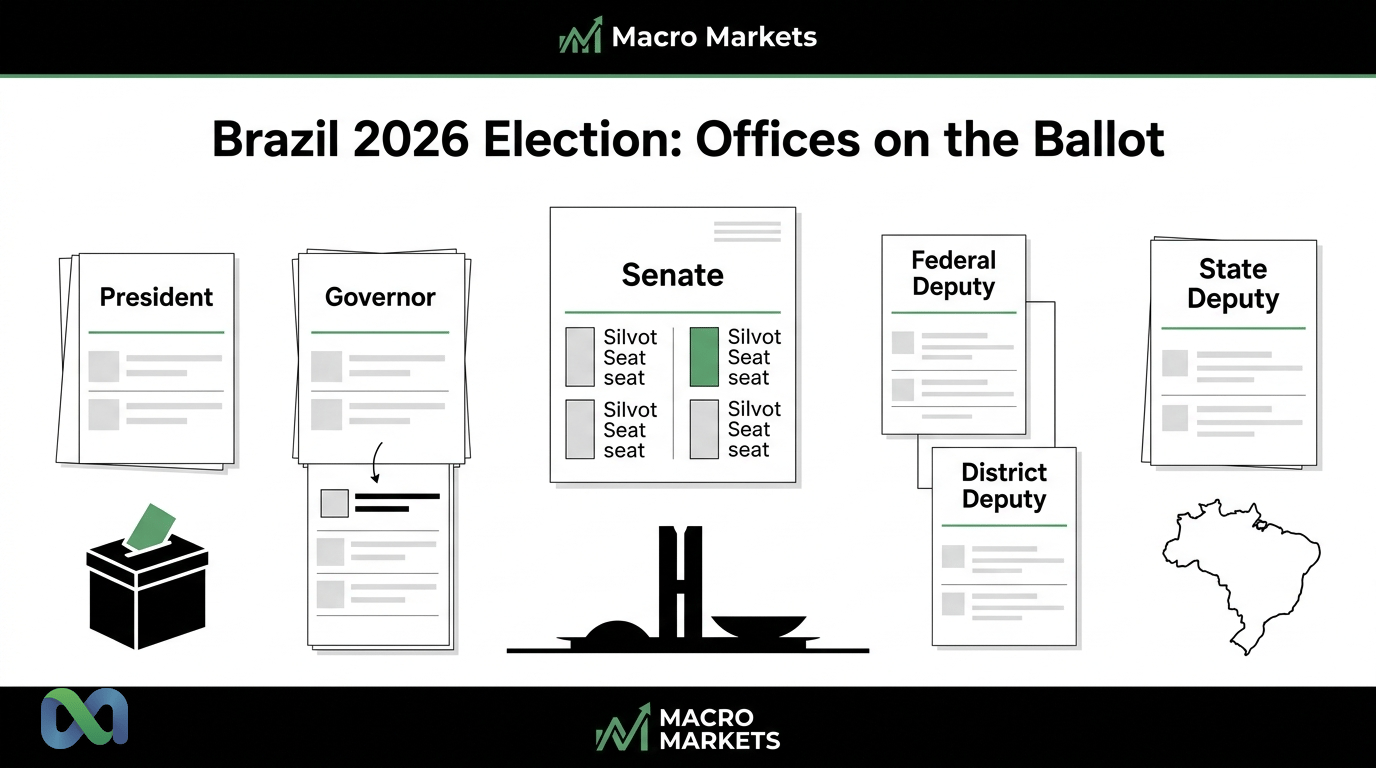
In the Brazil 2026 election, voters will choose the president, state governors, senators, federal deputies, state deputies, and district deputies in the Federal District. The Brazil 2026 election will not include mayors or city council members, because those offices belong to Brazil’s municipal election cycle.
That distinction matters. Brazil alternates between general elections and municipal elections. In 2026, the country will hold a general election. It will decide the federal executive, state governments, a large part of Congress, and state-level legislatures.
This guide explains which offices will appear on the ballot. It also explains the difference between president and mayor, why voters will choose two senators, how the São Paulo ballot works, and what changes in the Federal District. At the end, there is a quick FAQ for easy reference.
Official information on offices and dates should come from Brazil’s electoral authorities. For English-language background, the 2026 Brazilian general election page summarizes the offices and dates. FTI Consulting also explains what is at stake for business in the Brazil 2026 ballot box.
Quick summary: in 2026, Brazilians vote for the country and the states. They do not vote for city governments. So there is no mayoral race on this ballot. There is also no city council vote.
There will also be two votes for senator. That detail changes how voters read the Senate race. The voter will not pick only one Senate candidate. The voter will pick two.
Therefore, think of the ballot in three blocks. First comes national leadership. Then comes state leadership. Finally, voters choose seats in Congress and in the local legislative chamber.
Brazil 2026 Election Offices: Direct Answer
The Brazil 2026 election will include six types of offices: president of the Republic, governor, senator, federal deputy, state deputy, and district deputy in the Federal District. In regular states, voters choose a state deputy. In the Federal District, voters choose a district deputy.
The list can look long, but the logic is simple. Voters choose executive and legislative offices. The executive offices are president and governor. The legislative offices are the Senate, the Chamber of Deputies, and state legislative assemblies.
Quick list of offices on the ballot
Which offices are in the Brazil 2026 election? Here is the direct list:
- President of the Republic.
- Governor of the state or the Federal District.
- Senator.
- Federal deputy.
- State deputy.
- District deputy, only for voters in the Federal District.
This list does not include mayor. It also does not include city council member. Those offices were chosen in the previous municipal election and return in another municipal cycle.
Table: office, level, term, and practical note
| Office | Level | Term | Practical note |
|---|---|---|---|
| President | Federal | 4 years | May have a runoff. |
| Governor | State or Federal District | 4 years | May have a runoff. |
| Senator | Federal | 8 years | In 2026, each voter chooses two names. |
| Federal deputy | Federal | 4 years | Represents the state in the Chamber of Deputies. |
| State deputy | State | 4 years | Represents voters in the state legislative assembly. |
| District deputy | Federal District | 4 years | Replaces the state deputy role in the Federal District. |
This table helps separate each level of government. The president and senators are national offices. Governors and state deputies focus on the state. Federal deputies work in Brasília, but they represent the population of each state and the Federal District.
Does the Brazil 2026 Election Choose President or Mayors?
The Brazil 2026 election will choose the president. It will not choose mayors. That is one of the most important answers for anyone searching for Brazil 2026 election offices.
The president of the Republic is on the ballot because 2026 is a general election year. The same vote also includes governors, senators, and deputies. Mayors and city council members belong to the municipal election cycle.
President: yes
The president leads the federal executive branch. The term lasts four years. The election can go to a second round if no candidate wins a majority of valid votes in the first round.
The presidential race usually organizes the national debate. It pulls in themes such as the economy, public security, foreign policy, social programs, and the relationship with Congress. For that reason, many voters begin following the cycle through the presidential contest.
Even so, the presidential vote is only one part of the election. In 2026, voters also need to watch the Senate, the Chamber of Deputies, the state governorship, and the state legislative assembly.
Mayors and city council members: no
Mayors and city council members are not part of the 2026 vote. They are chosen in municipal elections, which happen in a different cycle.
This difference changes the ballot, the campaign, and the local issues in focus. A municipal election debates urban transport, municipal schools, local clinics, and city management. A general election debates federal government, state government, and parliamentary representation.
So if the question is “is the Brazil 2026 election for president or mayor?”, the short answer is: president, not mayor.
Which Legislative Offices Are Chosen in the Brazil 2026 Election?
The legislative offices in the Brazil 2026 election include the Senate, the Chamber of Deputies, and state legislative assemblies. In the Federal District, the local legislative office is the Legislative Chamber of the Federal District.
These offices define who writes laws, votes on budgets, and checks the executive branch. Therefore, they shape governability after the election. An elected president or governor must deal with that legislative map.
Senators: two-thirds renewal
Senators serve eight-year terms. The Senate does not renew every seat at every election. It alternates between one-third and two-thirds of the seats.
In 2026, the renewal will cover two-thirds of the Senate. In practice, each voter will choose two Senate candidates in their state or in the Federal District. That is a major difference from election years with only one Senate seat at stake.
A senator represents a state or the Federal District. The office participates in national votes, confirmation hearings, and major institutional decisions. As a result, the Senate’s composition can change the political balance of the country.
Federal deputies
Federal deputies represent the population in the Chamber of Deputies. Their term lasts four years. They vote on ordinary laws, constitutional amendments, the budget, and national policy issues.
The number of seats varies by state. More populous states elect more federal deputies. Still, every state elects representatives to the Chamber.
This point often creates confusion in searches about Brazil 2026 election offices. A vote for federal deputy is not the same as a vote for state deputy. They are different offices, with different legislative chambers.
State and district deputies
State deputies work in state legislative assemblies. They vote on state laws, review state budgets, and oversee state governments. Their term also lasts four years.
In the Federal District, the equivalent office is district deputy. District deputies serve in the Legislative Chamber of the Federal District. The name changes because the Federal District is not a regular state and has no municipalities.
Therefore, voters in São Paulo, Rio de Janeiro, Minas Gerais, and other states vote for state deputy. Voters in the Federal District vote for district deputy.
Brazil 2026 Election: Which Offices Are on the São Paulo Ballot?
In São Paulo, the Brazil 2026 election includes president, governor of São Paulo, two senators for São Paulo, federal deputies for São Paulo, and state deputies. There is no vote for mayor of São Paulo in 2026.
The São Paulo example is useful because local search demand is strong. Many voters want to know whether the national list changes by state. The basic structure stays the same, but the candidates and seats are tied to each voter’s state.
How the list changes by state
The types of offices barely change from one state to another. What changes are the candidates, parties, number of proportional seats, and the local race for governor.
A voter in Pernambuco chooses the governor of Pernambuco. A voter in Paraná chooses the governor of Paraná. The same logic applies to state deputies and federal deputies linked to that unit of the federation.
For the Senate, each state and the Federal District elect their own representatives. Because 2026 renews two-thirds of the Senate, each unit of the federation will choose two senators.
São Paulo example
A voter in São Paulo should expect the following types of votes in 2026:
- President of the Republic.
- Governor of São Paulo.
- Two senators for São Paulo.
- Federal deputy for São Paulo.
- State deputy for São Paulo.
This list does not include the mayor of the capital, mayors of inland cities, or city council members. Those offices belong to the municipal cycle.
It is also important to separate state and city government. The governor manages the state. The mayor manages the city. In 2026, the focus is state government, not city halls.
Federal District difference
In the Federal District, the main difference is the local legislative office. Voters choose a district deputy, not a state deputy.
That happens because the Federal District has its own structure. Its Legislative Chamber performs duties tied to the territory. Therefore, the local legislative office on the Federal District ballot is district deputy.
The rest of the logic remains the same. Voters in the Federal District also choose president, governor of the Federal District, senators, and federal deputy.
Brazil 2026 Election Dates and Possible Runoff
The Brazil 2026 election dates follow the official electoral calendar. The first round is expected on the first Sunday of October. A second round, when needed, occurs on the last Sunday of October.
For 2026, that means a first round on October 4 and a second round on October 25. These dates help voters plan voter registration transfers, check polling places, and follow campaigns. IFRI also notes this timeline in its briefing on Brazil one year before the October 2026 general elections.
First round
In the first round, all offices in dispute appear in the electoral process. Voters choose president, governor, senator, federal deputy, and state or district deputy.
Proportional offices, such as federal deputy and state deputy, are decided in the first round. There is no runoff for deputy. The runoff rule applies to majoritarian offices when the law allows it.
For that reason, voters should pay attention to every vote in the first round. Legislative decisions do not wait for a later round.
Runoff for majoritarian offices
A runoff can occur for president and governor. It happens when no candidate reaches a majority of valid votes in the first round, under the applicable rules.
Senators do not have a runoff. Deputies also do not have a runoff. This distinction prevents confusion when voters follow polls and results.
So if a second round happens in 2026, it will focus on unresolved majoritarian contests.
How to Follow the Brazil 2026 Election Scenario
Knowing the offices in the Brazil 2026 election is the first step. After that, voters can follow polls, coalitions, debates, the official calendar, and prediction-market probabilities.
The key is to separate official information from analysis. Offices, dates, and rules should come from electoral authorities. Political scenarios and probabilities require a reading of data, polls, and prediction markets.
Polls, calendar, and probabilities
Election polls measure voting intention at a specific moment. However, they change over time. Party conventions, alliances, campaign events, and new facts can move the race.
Prediction markets offer another kind of signal. They aggregate expectations from participants about future events. When liquidity and rules are clear, prices can indicate how the market assesses a probability.
That does not replace official sources. It also does not guarantee an outcome. However, it helps track how public perception changes during the cycle.
Where Macro Markets fits
Macro Markets follows prediction markets, political events, and probabilities with a focus on clear scenario reading. For the Brazil 2026 election cluster, this article answers a service question: which offices are on the ballot?
From that base, readers can move to content about the calendar, polls, market implied probabilities, presidential scenarios, and state races. That order avoids confusion. First comes the election structure. Then comes probability analysis.
This separation also reduces overlap inside the content cluster. This guide answers “which offices.” Other satellite articles can cover “who may run,” “when the election happens,” or “how to follow probabilities.”
FAQ About Brazil 2026 Election Offices
How many votes will a voter cast in 2026?
The exact number of votes depends on the ballot and the unit of the federation. In general, voters choose president, governor, two senators, federal deputy, and state deputy. In the Federal District, state deputy is replaced by district deputy.
Because 2026 renews two-thirds of the Senate, there will be two votes for senator. That is an important difference from cycles with only one Senate vacancy.
Do voters choose two senators?
Yes. In 2026, each voter chooses two Senate candidates. This happens because two-thirds of the Senate seats are up for renewal.
Each state and the Federal District elect their own senators. Voters should watch candidates from their own unit of the federation.
Is a district deputy the same as a state deputy?
Not exactly, but it plays an equivalent role in the Federal District. A state deputy serves in a state legislative assembly. A district deputy serves in the Legislative Chamber of the Federal District.
For voters, the practical rule is simple. People who live in a state vote for state deputy. People who vote in the Federal District choose district deputy.
Does the Brazil 2026 election include city council members?
No. City council member is a municipal office. It will not appear in Brazil’s 2026 general election.
The same applies to mayors. Those offices appear in municipal elections, not in general elections.
Which Brazil 2026 election offices can have a runoff?
A runoff can occur for president and governor. It does not occur for senator, federal deputy, state deputy, or district deputy.
Therefore, the first round is decisive for all legislative offices. President and governor may require a second vote if the contest is not settled in the first round.
Conclusion
The Brazil 2026 election includes president, governor, senator, federal deputy, state deputy, and district deputy in the Federal District. It does not include mayors or city council members.
The simplest rule is to remember that 2026 is a general election. It chooses federal and state offices. City governments and municipal councils stay outside this cycle.
To follow the cycle clearly, start with the ballot structure. Then move to the calendar, polls, and probabilities. That helps readers understand not only who will be on the ballot, but also how the electoral scenario may change before October 2026.
