


Brazil 2026 Election: President and Offices on the Ballot
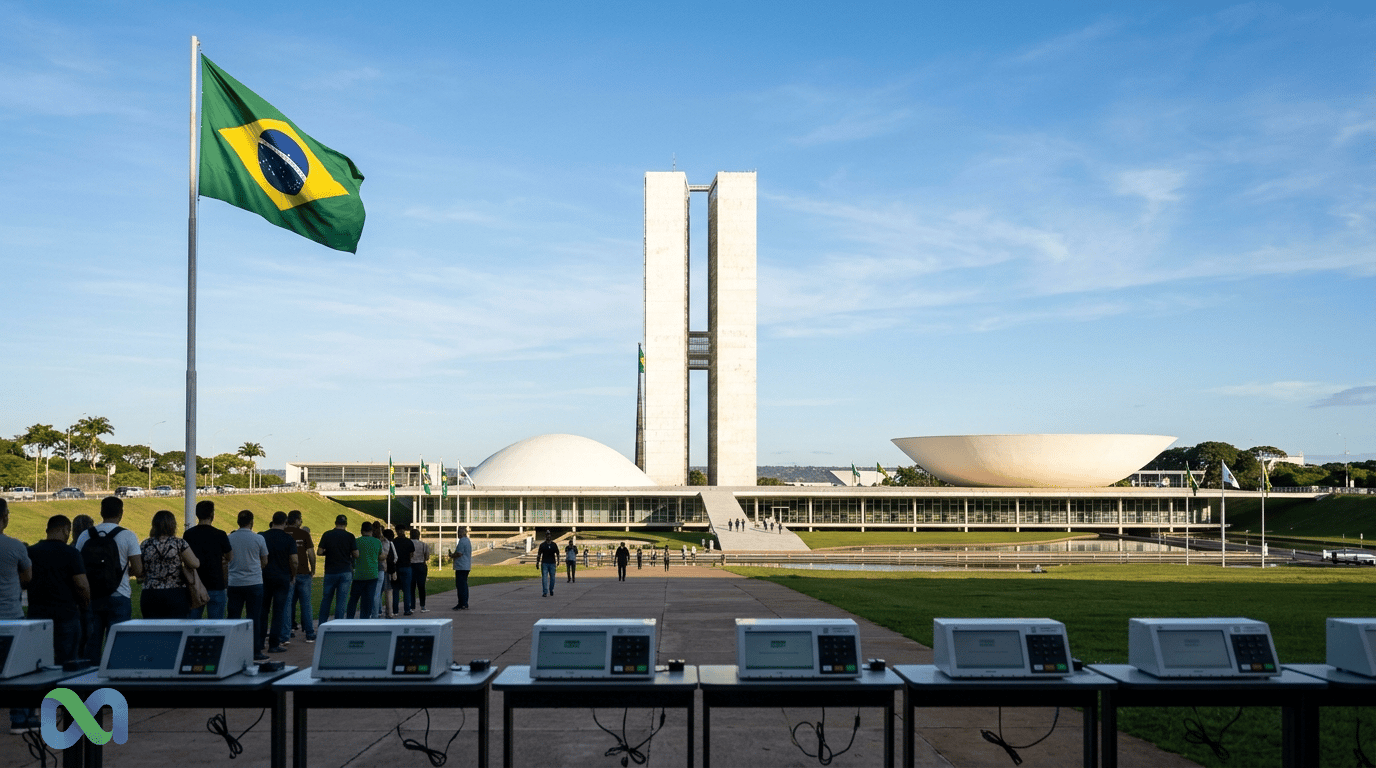
The Brazil 2026 election is not only a presidential contest. It is a full general election that will reset the federal executive, every state government, a large share of Congress, and state legislatures.
That distinction matters for political risk. A presidential race can dominate headlines, but governorships, Senate seats, and congressional blocs often decide how much room the next president has to govern.
Brazil will hold the first round on October 4, 2026. If needed, a second round will take place on October 25, 2026. The second round applies to president and governors, not to legislative races.
The official election authority is the Superior Electoral Court, known in Brazil as the TSE. Its 2026 calendar and resolutions define the dates, offices, filing rules, and voting order.
For traders and analysts, the first task is simple. Separate the presidential race from the broader ballot. Then track how each office changes coalition power, fiscal policy, state alliances, and congressional governability.
What is the Brazil 2026 election?
The Brazil 2026 election is the country's next general election cycle. Voters will choose the president and vice president, 27 governors and vice governors, 54 senators, 513 federal deputies, and state or district deputies.
It is a national vote, but it is also 27 state-level contests at the same time. Each state and the Federal District will elect its governor, two senators, federal deputies, and local legislators.
This creates a complex map. The presidential race is one layer. Senate control is another. State governments form a third layer because governors influence party machinery, regional coalitions, and voter mobilization.
The TSE says more than 155 million Brazilians are expected to go to electronic voting machines. Voters will make six choices in a fixed order. That order starts with legislative offices and ends with president.
The scale is why this election matters beyond Brazil. The outcome can affect fiscal strategy, social spending, central bank relations, environmental policy, energy policy, and Brazil's role in Latin America.
When is the Brazil 2026 election?
The first round is scheduled for Sunday, October 4, 2026. Voting runs from 8 a. m. to 5 p. m. according to Brasilia time, with the same official time used across all states and the Federal District.
If no presidential ticket wins a majority of valid votes in the first round, the top two tickets go to a second round. The same rule applies to governors in states where no candidate clears the majority threshold.
The second round is scheduled for Sunday, October 25, 2026. It can happen for the presidency, for some governor races, for both, or for neither, depending on first-round results.
The campaign calendar also has earlier checkpoints. Party conventions run from July 20 to August 5. Candidate registration requests must be filed by August 15. Official campaign advertising begins on August 16.
These dates matter because pre-campaign signals can be noisy. Before conventions, many names are bargaining chips. After filing, the official field becomes clearer and polling usually becomes more useful.
Which offices are on the ballot in 2026?
Brazil's 2026 ballot includes six choices for each voter. The official order is federal deputy, state or district deputy, senator for the first seat, senator for the second seat, governor, and president.
That order tells us something important. The election is not structured as a single national referendum. It is a layered political event that builds legislative and executive power at the same time.
The offices on the ballot are:
- President and vice president of the Republic.
- Governor and vice governor in the 26 states and the Federal District.
- Two senators from each state and the Federal District.
- Federal deputies for the Chamber of Deputies.
- State deputies, or district deputies in the Federal District.
There are no mayoral elections in 2026. Brazil elects mayors and city council members in municipal elections, which follow a separate cycle. The 2026 vote is a general election, not a local election.
That point answers one common search question. The Brazil 2026 election is for president, but it is not only for president. It is also a major congressional and state-level election.
The presidential race: why it gets the attention
The presidential contest will set the direction of the federal executive from 2027. The winning ticket will influence fiscal policy, cabinet choices, social programs, infrastructure priorities, foreign policy, and relations with Congress.
Brazil uses a two-round system for president. A ticket wins in the first round only if it receives more than 50% of valid votes. Blank and null votes do not count toward that valid-vote total.
If no ticket reaches that mark, the two leading tickets compete in the second round. This system makes runoff positioning central. A candidate can lead the first round and still face a difficult second round if rejection is high.
For market analysis, the presidency is the headline variable. It can move expectations about taxes, spending, privatization, state-owned companies, regulation, and Brazil's external stance.
However, presidential power is not automatic. The next president will need a coalition in Congress. That is why the rest of the ballot can matter as much as the name at the top.
Governors: the state-level power map
Brazil will elect 27 governors and vice governors in 2026. That includes the 26 states and the Federal District.
Governors control state administrations, public security structures, education systems, health networks, and regional budgets. They also shape presidential politics because they command local alliances and campaign machines.
Like the presidency, governor races use a majority system. A candidate can win in the first round with more than 50% of valid votes. If that does not happen, the top two go to a second round.
For analysts, governor races are important for three reasons. First, they show whether the president's party has territorial strength. Second, they reveal how the opposition is distributed across the country. Third, they shape Senate and Chamber alliances.
A president with weak governors behind the coalition may face a harder Congress. A president aligned with powerful governors can gain negotiation power before the new administration even begins.
Senate: why 54 seats are in play
The Senate is one of the most important parts of the Brazil 2026 election. Voters will elect 54 senators, which equals two-thirds of the 81-seat chamber.
Each state and the Federal District has three senators. Senate elections alternate between one seat and two seats per state. In 2026, two seats are up in each state and the Federal District.
The two most-voted Senate candidates in each state win. This is a majoritarian race, not a proportional one. Each elected senator serves an eight-year term and has two alternates.
The Senate can shape the next government's entire agenda. It approves major appointments, debates constitutional amendments, votes on fiscal rules, and can block or accelerate key legislation.
For prediction markets, Senate composition is a high-value signal. A presidential win paired with a hostile Senate can reduce policy execution. A weaker presidential candidate with strong Senate allies may still have room to govern.
Chamber of Deputies and state legislatures
Brazil will also elect all 513 federal deputies. These seats form the Chamber of Deputies, which is the lower house of Congress.
Federal deputies are elected through a proportional system. Voters choose a candidate or party, and seats are distributed based on party and federation performance. The most-voted candidates inside those groups then fill the seats.
This means party strength matters. A well-known candidate can draw votes that help elect other names from the same party or federation. The reverse is also true. A candidate with many personal votes still depends on the broader proportional calculation.
State deputy races follow the same broad logic at the state level. The TSE has reported 1,035 seats in state legislatures and 24 district deputy seats in the Federal District.
These races affect state budgets, local oversight, and governability. They also feed national politics because state legislators often support campaign networks for governors, senators, and presidential candidates.
Does Brazil elect mayors in 2026?
No. Brazil does not elect mayors in the 2026 general election.
Municipal elections happen on a different cycle. Mayors and city council members were elected in 2024 and will next be chosen in a municipal election, not in the 2026 general election.
This distinction is important for anyone reading early political coverage. Local leaders will matter in 2026 because mayors can influence turnout and regional alliances. But mayoral offices themselves are not on the ballot.
The 2026 ballot is focused on federal, state, and district offices. That is why the core offices are president, governor, senator, federal deputy, state deputy, and district deputy.
The voting order in the electronic machine
Brazil uses electronic voting machines. In 2026, voters will select offices in a fixed order.
The order is:
- Federal deputy.
- State deputy or district deputy.
- Senator, first seat.
- Senator, second seat.
- Governor and vice governor.
- President and vice president.
This order matters for campaign strategy. Legislative candidates often rely on voter memory, party numbers, and local organization. The presidential choice comes last, but it can still influence the broader ballot through party identity.
It also matters for voter education. In 2026, each voter will need to enter more than one legislative number before choosing governor and president. That can make party labels and local campaign work especially important.
What analysts should watch before October
The formal calendar is only one part of the story. The market-relevant question is how political expectations change before voters reach the ballot.
The first signal is party convention strength. A candidate who reaches August with a unified party, state alliances, and Senate candidates in key states is stronger than a name that only performs well in interviews.
The second signal is runoff viability. Brazil's presidential elections often become polarized. That makes rejection rates and second-round polling as important as first-round vote intention.
The third signal is congressional alignment. If the leading presidential candidates have very different coalition profiles, the market should price not just who wins, but what that person could actually pass.
The fourth signal is the economy. Inflation, employment, credit, income, fiscal credibility, and growth can change the political mood. These indicators can also alter how voters evaluate incumbency and opposition promises.
The fifth signal is state-level coordination. Governors and Senate candidates can help a presidential campaign expand into regions where the national candidate is weaker.
How prediction markets can read the Brazil 2026 election
Prediction markets do not replace polls, legal calendars, or election reporting. They add a different layer: a live estimate of what traders collectively believe is likely.
That can be useful when the election map is complicated. A poll may show vote intention today. A prediction market can update as traders process new information about alliances, court decisions, economic data, and candidate withdrawals.
The key is to treat markets as probabilities, not certainties. A 60% probability does not mean an event will happen. It means the market is pricing that outcome as more likely than the alternatives at that moment.
For Brazil 2026, market structure matters. Separate markets for president, Senate control, governor races, party performance, and policy outcomes can tell different stories. One market may price a presidential favorite. Another may show doubts about governability.
This is where Macro Markets' Brazil focus matters. A generic global platform may treat the election as one headline event. A Brazil-focused market can capture local details, such as party federations, regional machines, and the link between state contests and federal power.
Common questions about the Brazil 2026 election
Is Brazil's 2026 election for president?
Yes. Brazil will elect the president and vice president in 2026. But the same election also includes governors, senators, federal deputies, and state or district deputies.
When is Brazil's 2026 presidential election?
The first round is scheduled for October 4, 2026. If no presidential ticket wins a majority of valid votes, the second round is scheduled for October 25, 2026.
Which offices are on the ballot in Brazil's 2026 elections?
The ballot includes president and vice president, 27 governors and vice governors, 54 senators, 513 federal deputies, and state or district deputies.
Does Brazil elect mayors in 2026?
No. Mayors are not elected in the 2026 general election. Brazil's mayoral contests happen in municipal election years.
Bottom line
The Brazil 2026 election is best understood as a full power reset, not only as a presidential race. The presidency will dominate attention, but the Senate, Chamber, governors, and state legislatures will define the next government's operating space.
The official calendar gives the key dates. October 4 is the first round. October 25 is the possible second round. Party conventions, candidate filing, and campaign launch dates will narrow the field before voters make their choices.
For analysts, the main edge is discipline. Watch the presidential race, but do not stop there. Track governors, Senate math, Chamber blocs, party conventions, and economic conditions. That is where the Brazil 2026 election becomes a full market signal rather than just another campaign headline.
