




Brazil Elections 2026: What Offices Are on the Ballot?
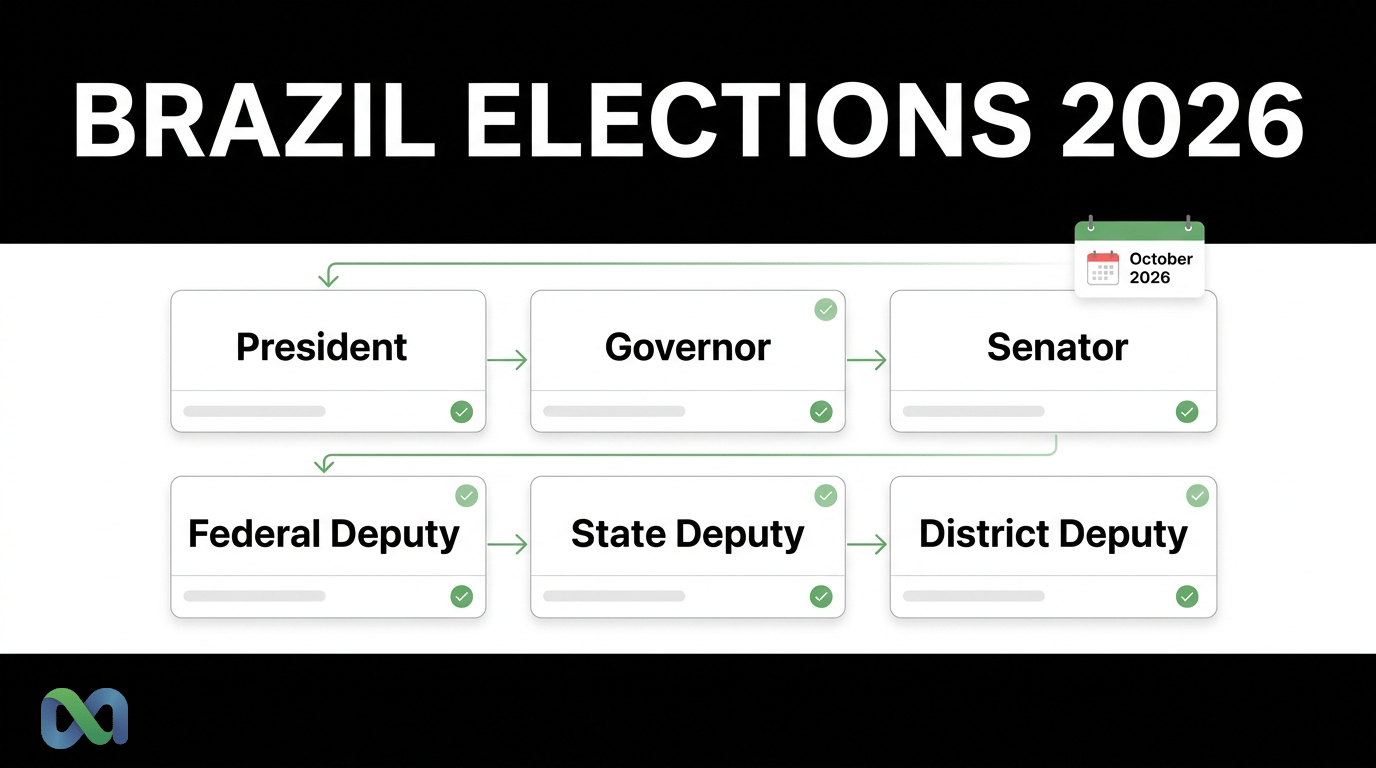
The search for Brazil elections 2026 usually asks for a direct answer. In 2026, Brazil votes for president, governor, senator, federal deputy, state deputy, and district deputy in the Federal District. It is a general election. It is not an election for mayor or city councilor, which belong to the municipal cycle.
Last reviewed: May 14, 2026. This guide uses the list of offices published by Brazil's electoral authorities and separates the general election cycle from the municipal election cycle.
That Brazil elections 2026 distinction matters because each office controls a different part of public power. The president runs the federal government. Governors run the states. Senators and federal deputies work in Congress. State deputies and district deputies work in state assemblies and in the Federal District's Legislative Chamber.
It also matters for following polls, alliances, and probabilities. The presidential race may dominate the headlines, but the Brazil elections 2026 also renew legislative blocs, state governments, and part of the Senate. So the question is not just “what is the election for?” It is the starting point for the whole 2026 political map.
Quick Answer: What Are the Brazil Elections 2026 For?
The Brazil elections 2026 are for choosing the president, governors, senators, federal deputies, state deputies, and district deputies where voters live in the Federal District. Voters do not choose mayors or city councilors in 2026. Those are municipal offices and return to the electoral calendar in 2028.
Brazil's Superior Electoral Court treats 2026 as a general election. That means one voting cycle combines national, state, and legislative contests. According to the TSE, the ballot includes executive and legislative offices. The list covers the federal level, the states, and the Federal District.
In practice, the electronic ballot organizes several choices in sequence. Voters confirm votes for proportional and majoritarian offices. The order can vary by office, but the logic is simple: 2026 decides who governs the country, who governs the states, and who represents voters in legislatures.
That short answer solves the main question. However, it is worth separating each office, because a lot of confusion comes from mixing general elections with municipal elections.
Which Offices Will Brazil Vote for in 2026?
In 2026, the offices on the ballot cover three levels of power. At the federal level, voters choose the president of the Republic, senators, and federal deputies. At the state level, they choose governors and state deputies. In the Federal District, voters choose a governor and district deputies.
The president is elected by a national majoritarian vote. If no candidate wins a majority of valid votes in the first round, a runoff is held between the two candidates with the most votes. Governors follow a similar rule in each state and in the Federal District.
The Senate is renewed in part. In 2026, each state and the Federal District take part in choosing senators according to the cycle's rule. That changes the balance of power in Congress, because the Senate votes on legislation, examines nominees, and participates in major institutional decisions.
The Chamber of Deputies and state assemblies use a proportional system. In those races, the performance of parties, federations, and candidates combines to define the seats. This is why legislative races are not just a list of strong individual names. They depend on slates, party votes, electoral quotients, and party strategy.
Quick List: On the 2026 Ballot vs. Not on the 2026 Ballot
On the ballot in 2026:
- President of the Republic.
- Governor.
- Senator.
- Federal deputy.
- State deputy.
- District deputy in the Federal District.
Not on the ballot in 2026:
- Mayor.
- City councilor.
- Guardianship councils.
- Internal party offices.
- Municipal elections for 2028.
This list is the simplest way to answer what the Brazil elections 2026 are for. The 2026 cycle is national and state-level. The municipal cycle is separate.
Why Mayors and City Councilors Are Not Elected in 2026
Mayors and city councilors are municipal offices. They were elected in 2024 and return in 2028, following Brazil's four-year municipal election cycle. So anyone asking whether the Brazil elections 2026 are for president or mayor should separate the calendars.
In 2026, the focus is the federal government, state governments, the Senate, the Chamber of Deputies, and state assemblies. This does not make municipal politics irrelevant. Mayors and city councilors influence local machines, campaign structures, and alliances. However, they do not appear as offices on the 2026 ballot.
That difference also prevents a bad reading of polls. A presidential poll measures a national race. A governor poll measures one state. A municipal race has a different calendar, different candidates, and a different political dynamic.
General Elections vs. Municipal Elections in Brazil
General elections choose national and state offices. Municipal elections choose mayors and city councilors. In Brazil, these two cycles alternate every two years. That means voters choose general offices in 2026 and return to municipal ballots in 2028.
The Brazil elections 2026 general cycle usually gets more national attention. That happens because the presidential race concentrates coverage, debates, endorsements, and alliances. Still, the legislative result can be as important as the executive result. Without a working majority in Congress, an elected president can struggle to approve projects.
State races also move the national board. Governors control political machines, influence congressional blocs, and help organize presidential tickets. In addition, strong state races can change the weight of parties in the Senate and the Chamber of Deputies.
Municipal elections are more local. They decide who manages everyday public services such as urban transport, municipal health care, municipal schools, and local works. City councilors oversee the mayor and vote on municipal laws. That agenda matters, but it does not belong to the 2026 ballot.
So when someone asks what the 2026 election is for, the correct answer is: general offices. That answer covers president, governor, senator, and deputies. It also excludes mayor and city councilor.
What to Track After You Know the Offices
Understanding the Brazil elections 2026 offices is the first step. After that, voters and analysts need to track dates, candidacies, polls, and market signals. Each layer answers a different question.
For Brazil elections 2026, dates answer when the decision happens. Candidacies show who may be on the ballot. Polls measure voting intention at specific moments. Market-implied probabilities show how traders price scenarios, risks, and shifts in the political narrative.
This combination is useful because an election is not a single event. It is a sequence of deadlines, alliances, court decisions, campaigns, and information shocks. Anyone who follows only one poll misses part of the picture.
First-Round and Runoff Dates
Brazil's Constitution places general elections on the first Sunday of October. If a runoff is needed for president or governor, it takes place on the last Sunday of October. The TRE-SP highlights this rule. It anchors the 2026 calendar.
Those Brazil elections 2026 dates are the cycle's main reference. Before them, there are deadlines for party affiliation, federations, conventions, candidate registration, advertising, and campaign finance reporting. Each deadline changes incentives. A party can look divided before its convention and align after it.
That is why the calendar is not only about knowing when to vote. It helps explain when a candidacy becomes more concrete and when an alliance stops being speculation.
Candidates and Alliances
The question “what are the Brazil elections 2026 for?” quickly leads to another question: who will run for those offices? In the presidential race, national figures dominate attention. In the states, races for governor and Senate create their own arrangements.
In Brazil elections 2026, alliances matter too. A competitive presidential candidate may need strong state-level tickets. A candidate for governor may depend on presidential support. Smaller parties may negotiate support in exchange for legislative space or participation in coalitions allowed under the current rules.
Voters should watch three signals. First, who already appears in polls. Second, who has party structure. Third, who can form alliances without losing political coherence. These factors affect campaign reach, media exposure, and mobilization capacity.
Election Polls and Market-Implied Probabilities
Brazil elections 2026 polls measure voting intention inside a sample, with methodology and a margin of error. They are snapshots, not final forecasts. A responsible reading compares polling firms, fieldwork dates, tested scenarios, and movement over time.
Market-implied probabilities serve a different function. They aggregate expectations from participants who buy and sell contracts linked to political events. Instead of asking “who would you vote for?”, the market tries to price “which result looks most likely right now?”
At Macro Markets, that angle matters because politics affects the exchange rate, interest rates, equities, fiscal risk, and expectations. A presidential election weighs on assets. A change in the Senate can alter the odds of reforms. A state race can redraw national alliances.
For context in English, readers can compare Brazil-focused political coverage with sources such as the 2026 Brazilian general election overview and the AS/COA poll tracker. These sources are not substitutes for official electoral rules, but they show how international observers frame the 2026 race.
Therefore, after understanding what the Brazil elections 2026 are for, follow the cycle as a map of probabilities. The office on the ballot shows the event. The poll shows the current voter mood. The market shows how political risk is being priced.
A Simple Guide for Voting Day
For Brazil elections 2026, think of the electronic ballot as a line of choices. One screen leads to the next. You see the office, type the number, check the name, and confirm. If the name does not match, go back and correct it. That simple step prevents mistakes.
Bring a paper voting note if you want. Brazil's electoral authorities allow it. It helps because there is more than one office. With a note, you do not depend on memory. You also reduce pressure and confusion inside the voting booth.
Before voting day, check your polling place. Review your electoral zone and section. Arrive with enough time. Bring an official photo ID. If you use the official app, check before election day that it opens without errors. Do not leave that for the line.
For president and governor, the winner must satisfy the majoritarian rule. A runoff may happen. For deputies, the rule is proportional. The party and federation count together with the candidate's name. So each vote helps form a legislative bloc.
Keep one idea in mind: 2026 decides power in the country and in the states. It does not decide your city hall. That sentence answers most of the confusion.
How to Use This Answer Without Getting Lost
Use this Brazil elections 2026 page as an entry point. First, confirm which offices are on the 2026 ballot. Then move to the specific question you want to answer. If the question is about dates, look at the electoral calendar. If it is about names, look at candidates and alliances. If it is about winning chances, compare polls and probabilities.
This Brazil elections 2026 method reduces noise. It also avoids mixing offices from different cycles. A story about a mayor can affect local support, but it does not change the list of offices voted in 2026. A presidential poll can move markets, but it does not explain the deputy race by itself.
Also separate fact, scenario, and price. A fact is the office that will be on the ballot. A scenario is the combination of candidates, parties, and polls. A price is the probability that the market assigns to an outcome. The three layers talk to each other, but they are not the same thing.
For Macro Markets readers, that separation is practical. It turns a simple civic question into a clearer reading of political risk. It also helps track changes without reacting to every headline as if it were a definitive shift.
FAQ: What Are the Brazil Elections 2026 For?
Does Brazil Elect Mayors in 2026?
No. Brazil does not elect mayors in 2026. Mayors are chosen in municipal elections, which took place in 2024 and return in 2028. In 2026, voters choose general offices such as president, governor, senator, and deputies.
Does Brazil Elect City Councilors in 2026?
No. City councilors are also part of the municipal cycle. They are not on the 2026 ballot. The confusion is common because Brazil has elections every two years, but the offices alternate between general and municipal cycles.
How Many Senators Will Be Elected in 2026?
In 2026, the Senate has a partial renewal. Each state and the Federal District participate in choosing senators according to the cycle's rule. The key point for voters is that senator is on the 2026 ballot, unlike mayor and city councilor.
Are Federal and State Deputies Elected in the Same Election?
Yes. Federal deputies and state deputies are chosen in the same general election. In the Federal District, voters choose district deputies instead of state deputies. These races help form the legislative base that influences governments and public policy.
Where Can I See the Official Calendar?
The official calendar should be followed through Brazil's electoral authorities, especially the TSE 2026 elections portal. Regional electoral courts also publish useful explanations about dates, voting order, and voter services.
Are the Brazil Elections 2026 for President or Governor?
They are for both. Voters choose the president of the Republic and the governor of their state or the Federal District. They also choose senator, federal deputy, state deputy, or district deputy.
Why Do People Ask This Question So Often?
People ask because Brazil's electoral calendar alternates cycles. In one election year, voters choose municipal offices. Two years later, they choose general offices. Also, quick searches such as “Brazil elections 2026 what for” mix informational intent with incomplete wording.
Conclusion
The Brazil elections 2026 are for choosing the president, governors, senators, and deputies. They are not for mayors or city councilors. That is the central split for understanding the calendar.
After separating the offices, the next step is to follow dates, candidates, polls, and probabilities. That is where the election stops being just a list of offices and becomes a live process. Voters understand what will be on the ballot. Analysts track how each new piece of information changes the scenario.
For Macro Markets, this reading is essential. Elections move expectations, public policy, and assets. Knowing what the Brazil elections 2026 are for is the starting point for tracking political risk with more clarity.
