




Brazil Elections 2026: President or Mayor?
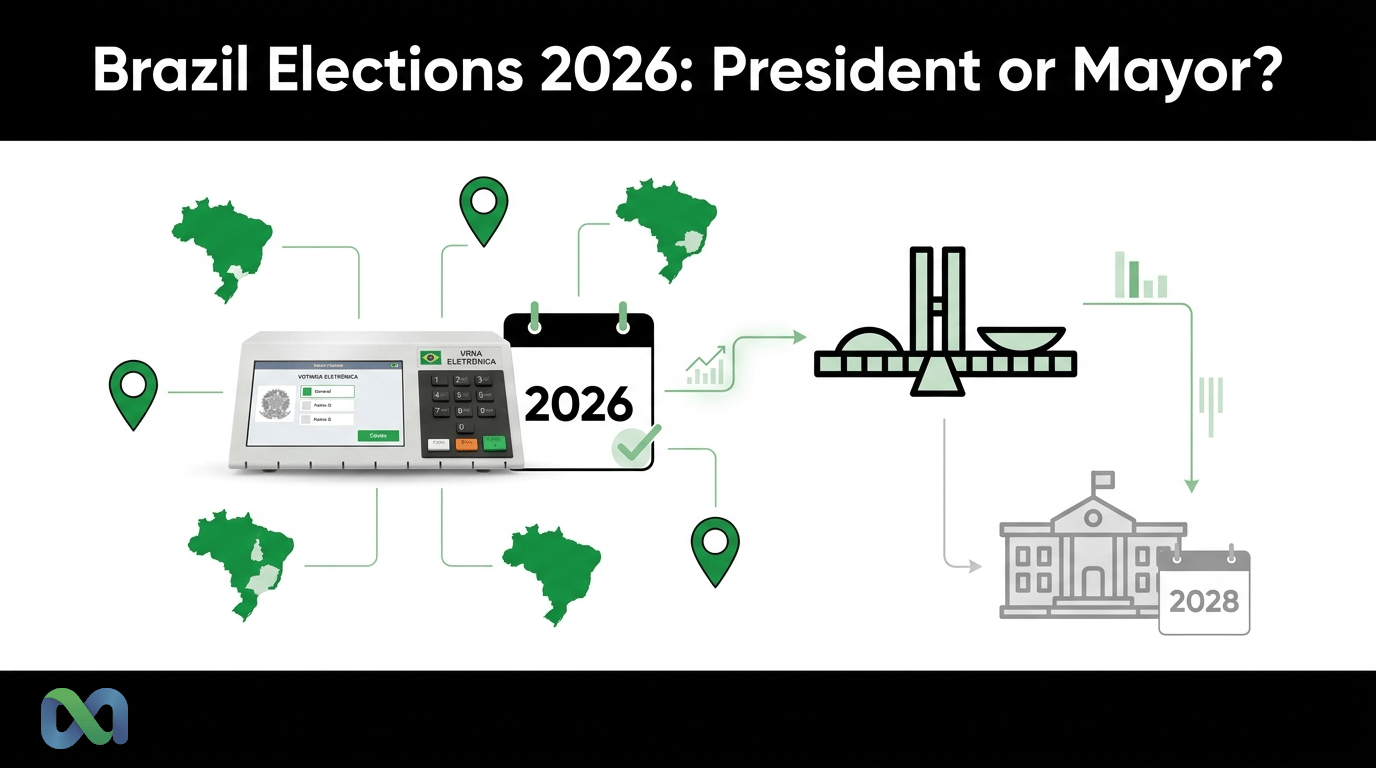
Are the Brazil elections 2026 for president or mayor? The direct answer is simple. In 2026, Brazil votes for president of the Republic. Voters also choose governors, senators, federal deputies, state deputies, and district deputies in the Federal District. It is not a year for mayoral elections.
Mayors and city council members belong to Brazil's municipal election cycle. That vote happened in 2024 and returns in the regular cycle in 2028. So, if the question is whether Brazil votes for mayor in 2026, the answer is no.
The confusion is normal. Brazil holds elections every two years, but the offices change. One cycle focuses on cities. The next cycle focuses on the country, the states, and Congress.
This guide explains what is on the 2026 ballot, what is not, and when Brazil votes for mayor again. It also explains why this difference matters for polling, campaign news, and prediction-market analysis.
Brazil Elections 2026 Are for President, Not Mayor
The Brazil elections 2026 are for president, not mayor. The Brazil elections 2026 are a general election. It includes president, governor, senator, federal deputy, state deputy, and district deputy. Mayor, vice mayor, and city council member stay on the municipal ballot in 2028.
That simple distinction prevents a lot of confusion. When Brazilian media talks about the 2026 election, it is talking about the national and state cycle. It is not talking about the normal turnover of city governments.
Therefore, voters should prepare for offices that affect the federal government, state governments, and the legislature. Cities continue with the mayors and council members elected in 2024.
This matters even for people outside Brazil. Headlines about the presidential race, state alliances, or congressional negotiations are part of the general-election cycle. They should not be read as mayoral-election news.
What Offices Are on the Ballot in Brazil Elections 2026?
In Brazil elections 2026, voters choose offices with major political weight. The ballot covers the presidency, state governments, and part of the National Congress.
According to Brazil's Superior Electoral Court, the offices in dispute include president of the Republic, governor, senator, federal deputy, state deputy, and district deputy. The official list is available in the TSE notice on the offices disputed in the 2026 elections.
Here is the clean split:
| Voted in 2026 | Not voted in 2026 |
|---|---|
| President of the Republic | Mayor |
| Governor | City council member |
| Senator | Vice mayor |
| Federal deputy | Municipal offices in general |
| State deputy | |
| District deputy in the Federal District |
The table shows the central point. 2026 is a year for general offices. It is not a year for municipal offices.
Each office also has its own election rule. President and governor can go to a runoff. Senator is a statewide majoritarian race. Deputies are chosen under proportional rules.
That difference matters because the path to victory changes by office. A poll for president does not mean the same thing as a poll for federal deputy. Each contest must be read in its own context.
Why Brazil Does Not Vote for Mayor in 2026
Brazil does not vote for mayor in 2026 because the country separates municipal elections from general elections. Mayors and city council members are city offices. President, governor, senator, and deputy are part of a different cycle.
The order is easy to remember. In 2024, voters chose mayors and city council members. In the Brazil elections 2026, they vote for president and general offices. In 2028, they return to mayor and city council races.
This system helps organize campaigns and terms of office. It also prevents every level of government from being chosen in the same year. As a result, local debates do not fully merge with national politics.
Still, mayors can matter in 2026. They are not on the ballot, but they can support candidates. They can help with rallies, local networks, party alliances, and territorial organization.
So a mayor can influence the Brazil elections 2026. But voters will not choose the office of mayor that year.
When Is the Next Mayoral Election in Brazil?
The next regular mayoral election in Brazil will be in 2028. In that year, voters choose mayor, vice mayor, and city council members in each municipality.
That applies to the normal cycle, not the Brazil elections 2026. Rare cases can produce supplementary elections in a specific city by decision of the Electoral Justice system. However, that does not change the national calendar. The regular municipal election returns in 2028.
A simple way to remember the calendar is this:
- 2024: mayor and city council.
- 2026: president, governor, senator, and deputies.
- 2028: mayor and city council again.
This two-year rhythm explains why people get confused. Many voters remember that there will be a vote in 2026, but they do not remember which offices are on the ballot.
If the search was “does Brazil vote for mayor in 2026?”, the short answer is no. Brazil votes for mayor again in 2028, not during Brazil elections 2026.
Key Dates for Brazil Elections 2026
The official dates for Brazil elections 2026 follow the calendar of the Electoral Justice system. The TSE election calendar gathers deadlines for candidate registration, campaign activity, voting, justification, and other steps in the process.
For voters, two moments usually matter most. The first is the first round. The second is the runoff, when a runoff is required.
The São Paulo regional electoral court explained that October contains both the first and second rounds in 2026. The basis is Brazil's constitutional rule. Still, voters should always check the official source before taking practical action.
First Round
The first round is the main vote. Every office in dispute appears at this stage.
President and governor can be decided there. To win in the first round, a candidate must reach the valid-vote majority required by electoral rules. If that does not happen, there is a runoff.
Deputies and senators are decided in the first round. However, they use different rules. For that reason, do not compare every office as if it were one single race.
Runoff
A runoff only happens in majoritarian contests that are not decided in the first round. In the Brazil elections 2026, that can apply to president and governor.
The runoff brings together the two most voted candidates. Voters choose between them. Offices such as senator and deputy do not follow that logic.
This difference helps explain polling. A first-round poll measures a broad field. A runoff simulation measures a head-to-head matchup.
General Election vs Municipal Election in Brazil
A general election chooses national and state offices. It includes president, governor, senator, and deputies. That is the Brazil elections 2026 cycle.
A municipal election chooses city offices. It includes mayor, vice mayor, and city council. That was the 2024 cycle and will be the 2028 cycle.
The difference changes the campaign agenda. In a municipal election, debate tends to focus on transport, local health care, schools, public works, street cleaning, neighborhoods, and city management.
In a general election, the agenda is broader. It includes the economy, public security, social programs, relations between the federal government and states, Congress, taxes, national rules, and foreign policy.
It also changes the type of poll. A municipal poll measures local strength. A presidential poll measures national strength. A governor poll measures a state race.
So the question “is Brazil's 2026 election municipal or presidential?” needs a careful answer. It is presidential and general. It is not municipal, so Brazil elections 2026 should not be read as a mayoral cycle.
Why This Difference Matters for Polls and Markets
Knowing which offices are on the ballot prevents bad polling analysis. A mayoral poll does not show who will win the presidential election. In the same way, a national poll does not decide a governor race.
Each office has a different voter base. President depends on the whole country. Governor depends on a state. Deputies depend on proportional rules. Senator depends on a statewide majoritarian contest.
Alliances also change from place to place. A party can support one name for president and a different arrangement for governor. Local state deals can carry a lot of weight.
Mayors can still appear in the 2026 environment. They help organize support and territorial presence. However, that does not mean voters will choose mayors in 2026.
For prediction markets, this distinction is useful. The market implied probability of an event depends on the office, the calendar, polls, alliances, and electoral rules. A local data point can affect the political mood, but it does not change the office being contested.
Before interpreting a political headline, ask one question: which office is this about? That simple question removes a lot of noise.
How to Follow Brazil Elections 2026 Without Mixing Offices
The best method is to separate three things: calendar, office, and scenario. The calendar shows when something happens. The office shows what will be decided. The scenario shows how polls, names, and alliances are changing.
First, use official sources for dates and rules. The TSE and regional electoral courts should be the base. This avoids old posts, cropped screenshots, and out-of-context claims.
Next, read every poll through the correct office. If the poll is for president, it speaks to the national race. If it is for governor, it speaks to one state. If it is municipal, it can show local strength, but it does not define the 2026 vote.
Finally, follow changes calmly. Party conventions, alliances, court decisions, economic data, and new candidates can move the scenario. The point is to separate official fact from political interpretation.
That routine helps voters and people who watch market probabilities. The Brazil elections 2026 can have local influence, but the ballot will not be for mayor.
Different offices also create different political risks. A presidential debate can move the national race. A state alliance can affect the governor and Senate contests. A mayor's statement can reveal local strength, but it does not create a municipal election in 2026. This separated reading makes the cycle cleaner.
What Voters Should Check Before Voting in 2026
Before voting, voters should confirm their polling place, their electoral status, and the offices in dispute. These details are available through official Electoral Justice channels.
They should also follow rules on documents, voting justification, and deadlines. Electoral deadlines change during the year. For that reason, official sources should be checked close to the date.
Another point is the voting order. The Electoral Justice system usually publishes guidance materials. They help voters arrive at the voting machine with fewer doubts.
Finally, compare proposals by office. The president does not do the same job as a governor. A senator does not do the same job as a federal deputy. A mayor will not even be on the Brazil elections 2026 ballot.
This clarity improves decision-making. It also reduces the chance of using news about one office to draw conclusions about another.
FAQ About Brazil Elections 2026
Does Brazil Have Municipal Elections in 2026?
No. Brazil does not have regular municipal elections in 2026. The vote will be for president and other general offices. The municipal election returns in 2028.
Is the Governor Elected in 2026?
Yes. Governors are elected in 2026. Each state votes to choose its state executive leader.
Is the Senate Elected in 2026?
Yes. The Senate is also part of the 2026 cycle. The race happens by state and follows majoritarian rules.
Are Federal and State Deputies on the Ballot?
Yes. Federal deputies and state deputies are on the ballot. In the Federal District, voters also choose district deputies.
Are Brazil Elections 2026 for President or Mayor?
Brazil elections 2026 are for president, not mayor. The more precise term is general election, because several offices beyond the presidency are also on the ballot.
When Is the Next Election for Mayor in Brazil?
The next regular election for mayor in Brazil will be in 2028. In that election, voters also choose city council members.
Why Do People Confuse 2026 With Mayoral Elections?
The confusion comes from Brazil's election rhythm. The country votes every two years, but it alternates offices. One cycle is municipal. The next cycle is general.
Conclusion
Are the Brazil elections 2026 for president or mayor? The final answer is simple. They are for president and other general offices. They are not for mayor.
In the Brazil elections 2026, voters choose president, governor, senator, federal deputy, state deputy, and district deputy where applicable. Mayor and city council stay for 2028.
To follow the cycle without error, separate offices, dates, and scenarios. Use the TSE for official facts about Brazil elections 2026. Use polls to measure each race at the right level. Use market probabilities as a reading of expectations, not as a substitute for electoral rules.
With that base, it becomes easier to understand news, polls, and alliances. Brazil elections 2026 will have a lot of local politics behind the scenes, but the ballot will be a general-election ballot.
