




Brazil Electronic Voting Machine in the 2026 Elections: How It Works and How It Is Audited
Update — October 24, 2026: Brazil's runoff takes place tomorrow, October 25, from 8:00 a.m. to 5:00 p.m. Brasília time. The ballot will include president and, depending on the location, may also include governor, a supplemental mayoral election, or a plebiscite. Check the official election calendar and the TSE voting scenarios.
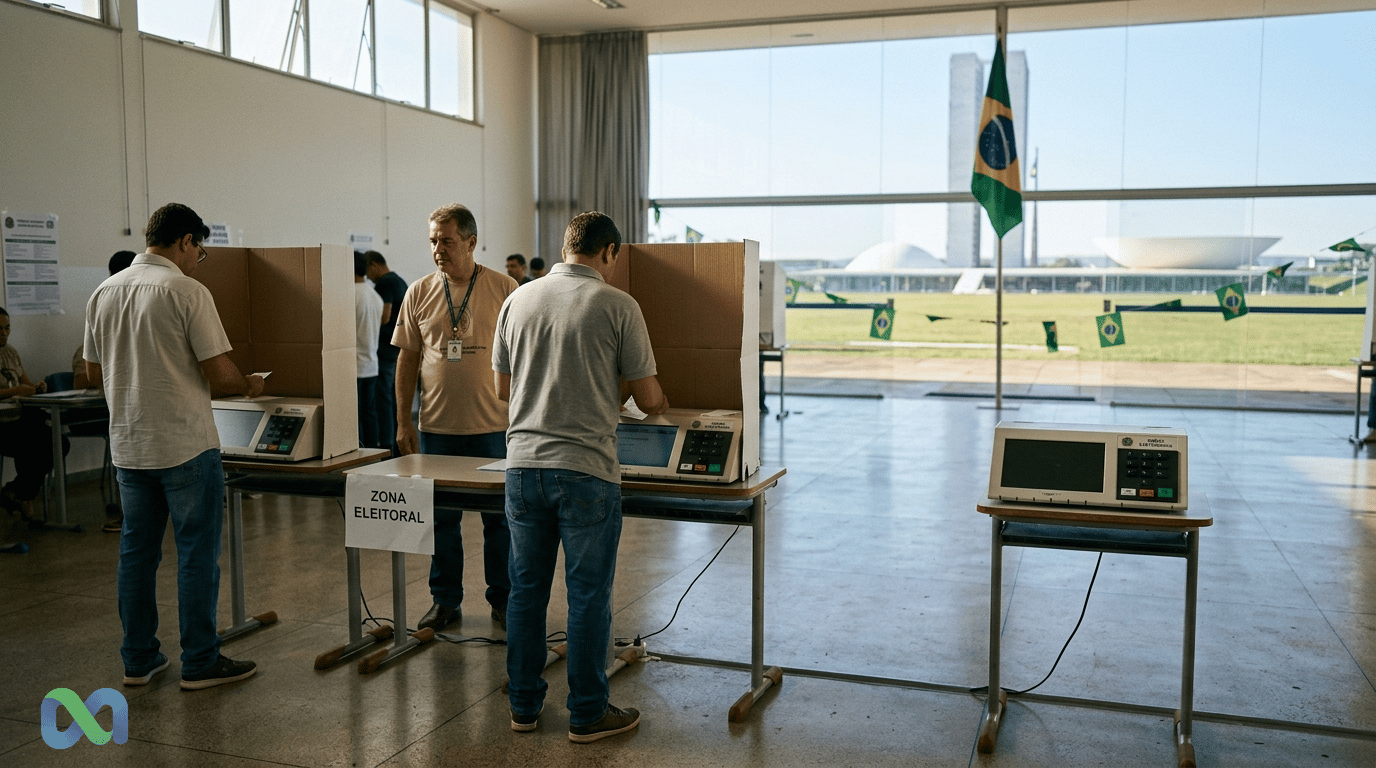
The Brazil electronic voting machine will be a central topic in the 2026 elections. It is the official machine used to cast votes in Brazil. A voter types a candidate number, checks the details on the screen, and confirms the vote.
The process does not end there. At the end of voting, each machine prints a Ballot Box Report. This report shows the totals for that polling section. Then the data moves into the official tally.
This guide explains the full flow. The goal is simple: show what happens before, during, and after election day. The article relies on the Electoral Justice system and the Superior Electoral Court, known as the TSE. It informs without giving oxygen to rumors.
Last reviewed: October 24, 2026. We checked this guide against official TSE material, open electoral data references, and public audit procedures available before the 2026 vote.
What Is the Brazil Electronic Voting Machine?
The Brazil electronic voting machine is the equipment used to collect votes. It records the voter’s choice in digital form. When voting ends, it issues a public summary for that polling section.
That summary is the Ballot Box Report, often called the BU in Portuguese. It shows vote totals. It does not show how each person voted.
The machine is part of a larger system. That system includes testing, software loading, sealing, voting, auditing, transmission, and final tallying. So it makes no sense to look only at the device. Analysts need to look at the whole chain.
Think of it as a line of steps. Each step leaves a trail. Each trail can be seen or checked by someone. That is the point. The vote begins in the polling section. The BU shows the local count. The final tally combines many sections. The data takes shape step by step.
For voters, the rule is straightforward. Vote calmly. Check the screen. Wait for the final sound. Then use official sources to follow the result.
This step-by-step flow does not require technical knowledge. It requires attention. The voter sees the screen. The polling section closes the BU. The country adds the data. Each phase has a time and a rule. Each phase should be read in its proper context.
The role of the Electoral Justice system
Brazil’s Electoral Justice system runs the process. The TSE coordinates rules, systems, tests, and national disclosure. Regional electoral courts, known as TREs, handle operations in each state.
There are also electoral zones, poll workers, technicians, party inspectors, and oversight bodies. Each group acts at a different stage. That creates several layers of checking.
Parties, federations, prosecutors, the Brazilian Bar Association, the Federal Police, universities, and other approved entities can monitor parts of the process. Oversight does not depend on one single person.
Why Brazil uses electronic voting
Brazil is large. It has many polling sections and many offices on the ballot. Paper voting made counting slow. It also created room for reading errors and local disputes.
The Brazil electronic voting machine reduced part of that problem. It shows the candidate’s name, number, party, and photo when the vote is typed. The voter can correct the choice before confirming.
Counting also became faster. The TSE says the machine reached 30 years of use in 2026 and helped Brazil release results on the same day in many elections. The TSE’s English site also explains the electronic ballot box and the election process in Brazil.
How the Brazil Electronic Voting Machine Works on Election Day
On election day, the voter sees a short process. The voter enters the polling section, shows identification, goes to the booth, types the vote, checks the screen, and confirms.
Behind that simple flow, there are formal rules. The machine has already been prepared. Systems were loaded. The polling section was linked to that equipment. The table authorizes voting after the voter is identified.
Voter identification at the polling station
Identification happens at the polling table. The voter presents an official document. Where biometric registration is available, a fingerprint may also be used.
This step confirms whether the person can vote in that section. After that, the table releases the machine. Only then does the voter go to the booth.
This point matters. Identification and voting are separate stages. The public result does not publish a list linking a person to a vote.
Typing, checking, and confirming the vote
Inside the booth, the voter types a number. The screen shows the details of the choice. If the details are correct, the voter confirms.
If there is a mistake, the voter can correct it. The voter can also cast a blank or null vote, depending on the choice made. The machine records only the confirmed vote.
This flow reduces human error. The voter does not need to write names by hand. The task is to check the screen and confirm the intended choice.
What happens after polls close
When voting ends, the polling table closes the machine. From that moment, no new votes enter. The equipment generates files and reports.
The main report is the Ballot Box Report. It is printed at the polling site. It can also be used for later checking.
Then the data is prepared for transmission. This phase connects the local polling section to the official tallying process.
Is the Brazil Electronic Voting Machine Secure?
Security is not a magic word. It depends on method. In the Brazil electronic voting machine system, there are physical, digital, and public layers.
The machine is not connected to the internet during voting. Systems go through tests. Software is sealed. There are audits before the election and on election day.
The machine is offline during voting
During voting, the machine works locally. It does not need to be online to record votes. That reduces the risk of remote attack at that stage.
Transmission happens after voting closes. Before that, each section records its own result. Then that local result enters the official count.
This separation is important. Voting, transmission, and tallying are different steps. A claim about one step should not be treated as proof about another.
Digital signatures and encryption
Brazil’s Electoral Justice system uses digital signatures and encryption. These tools help protect systems and files.
A digital signature works like a seal. If a file changes, verification can show the difference. Encryption protects data from improper reading or alteration.
These tools do not work alone. They combine with logs, seals, public ceremonies, and external inspection.
Security tests
The TSE conducts security tests with specialists. The point is to find weaknesses before the election. If a problem appears, it can be fixed and tested again.
The TSE describes auditability procedures in English, including source-code inspection and monitoring by authorized institutions. That kind of testing is healthy. Critical systems need pressure tests.
The short answer is this: security comes from the sum of technology, process, audit, and public control.
Is the Brazil Electronic Voting Machine Auditable?
Yes. The Brazil electronic voting machine is auditable at several stages. The audit starts before voting. It continues on election day. It can also continue after the election.
This includes public security testing, sealing, integrity tests, ballot reports, logs, and official data. Each stage answers a different question.
Public security testing
Public security testing allows specialists to examine electoral systems. They try to find weaknesses in a controlled environment.
The goal is not to create panic. The goal is to improve the system. If a flaw is found, the Electoral Justice system can correct it and test again.
This logic is common in technology. It is better to find a risk in a test than to discover it during a real election.
Software sealing ceremony
The sealing ceremony defines the official systems for the election. Programs receive digital signatures. After that, there is a reference point for comparison.
This stage is public for authorized entities. It helps show which version will be used. It also helps detect improper changes.
Without sealing, it would be harder to prove that a file is the same. With sealing, there is a base for verification.
Integrity testing
In the integrity test, machines are randomly selected. They go through a simulated and monitored vote. Then the expected result is compared with the result recorded by the machine.
This test happens on election day. That is why it uses real equipment prepared for that election. In some cases, there are formats that also involve biometric checks.
The test does not replace other audits. It is one more layer in the wider system.
Who can inspect the process
Oversight involves several institutions. Parties and coalitions have direct interest. Prosecutors and the Brazilian Bar Association act as institutional monitors.
The Federal Police and universities may also participate in stages defined by the rules. Citizens can also follow ballot reports and official published results.
This design reduces dependence on blind trust. A credible system must allow verification.
In plain English, to audit is to check. Check before. Check on election day. Check after. A strong election needs all three phases. It is not enough to say that something worked. It is better to show how it worked.
What Is the Ballot Box Report and How Can Voters Check It?
The Ballot Box Report is the report for a polling section. It is issued when voting closes. It shows how many votes each option received in that machine.
The BU matters because it makes the local result visible. It is printed and posted at the polling site. Party inspectors and voters can record the data.
What appears in the BU
The BU includes data for the electoral zone, section, city, and machine. It also shows the office, candidates, blank votes, null votes, and totals.
It does not show voter names. It also does not show the order of votes. It shows only the final total for that section.
That is why the BU protects vote secrecy. At the same time, it allows public checking.
Why the BU is posted
The BU is posted to support transparency. Anyone at the polling site can see the local result. Inspectors can photograph it or write it down.
Later, those numbers can be compared with official disclosure. If the section number and office are the same, the comparison is direct.
This practice creates a public trail. It helps contain rumors about invented results.
How to check and compare data
To compare, look at the electoral zone, section, city, office, and totals. Then check the official data from the Electoral Justice system.
The TSE maintains open electoral data. In an election year, it also uses official result pages and applications.
Avoid screenshots with no origin. Prefer official documents. Check whether the section and office are the same.
How the Official Vote Tally Works
Tallying is the official sum of votes from polling sections. It is not the same as the act of voting. First, the machine records the vote. Then each section generates its local result. Finally, the results are added together.
This difference helps. One thing is vote collection. Another is transmission. Another is the final sum.
From the polling section to the regional court
After polls close, the section files are prepared. They move into the Electoral Justice infrastructure.
Before the sum, checks happen. The system needs to verify origin and integrity. Files outside the expected pattern can trigger an alert or technical handling.
If there is a connection problem, contingency plans exist. That is necessary in a country with very different regions and infrastructure.
From regional courts to the TSE
In general elections, the TSE coordinates national disclosure. TREs participate in state operations. Data enters progressively.
That is why partial results change. At the start, only a small number of sections may be counted. Later, the sample grows.
This movement does not prove an error. In most cases, it simply shows new sections entering the count.
Why results can come out on the same day
Results can come out on the same day because there is no manual count section by section. The machine already generates the local summary. Transmission speeds up the sum.
Even so, timing varies. Remote locations may take longer. Large cities may have heavy volume. A runoff also has its own rhythm.
Speed is useful. But speed does not replace checking.
Brazil Electronic Voting Machine and the 2026 Elections: What Analysts Should Watch
For analysts, the Brazil electronic voting machine is part of the data infrastructure. It defines how a vote becomes official information.
That matters for the press, parties, researchers, and prediction markets. With each official update, expectations can change.
Timing and the pace of the count
The first point is the time when polls close. After that, ballot reports and transmission begin. Official disclosure tends to advance in waves.
At the start, the count may reflect one region more than another. So a partial swing may not be a real nationwide swing. Analysts need to look at the map of incoming data.
As more sections are counted, uncertainty falls. The read becomes more stable.
How to avoid rumor
Use official sources. That is the safest rule. Check the TSE, TREs, official apps, and public databases.
FAPESP’s English overview of Brazil’s electronic voting machine history adds context on the development of electronic voting in Brazil. Context helps readers understand the process without relying on viral clips.
Also check the date, office, section, and context. A true data point can mislead when removed from its setting.
How it affects market probabilities
In prediction markets, prices move with information. Before the election, polls and political events matter. On vote-counting day, official data starts to matter more.
The Brazil electronic voting machine enters at this point. It defines when a polling section becomes public data. Then the official tally changes the reading of probability.
Still, not every partial result has the same weight. Analysts should check which regions have entered. They should also check how much of the vote has been counted.
A Simple Checklist for Election Day
Use this short checklist to read the count more calmly. It does not replace official sources. It helps avoid common mistakes.
First, check the source. Did the data come from the TSE or a TRE? If not, treat it carefully.
Then check the date. During elections, old screenshots can return and create noise with no basis.
Next, check the office. President, governor, senator, deputy, and other races have different counts. Do not mix one race with another.
Also check the zone and section. A local BU does not show the whole country. It shows only that polling section.
Finally, check the share of votes counted. Early data can move sharply. With more sections, the picture becomes clearer.
A good habit is to wait for official sources. Another good habit is to compare before sharing. If the information feels too urgent, stop for one minute. That minute can prevent an error.
For market analysis, the same rule applies. One data point is not enough. Check origin, time, region, and weight. Only then should you update the probability.
FAQ About the Brazil Electronic Voting Machine
Is the machine connected to the internet?
Not during voting. The Brazil electronic voting machine records votes locally. Transmission happens after the polling section closes.
Is the vote identified?
Not in the public result. The voter is identified to vote. The confirmed vote is not published with the voter’s name.
Who develops the systems?
Brazil’s Electoral Justice system develops and manages the systems. The TSE coordinates the national layer. Authorized entities can inspect technical stages.
Can the election be audited afterward?
Yes. There are ballot reports, logs, files, official data, and checking procedures. Audit also occurs before and during the election.
Is the BU the official result?
The BU is the result for that polling section. The official result comes from the sum of all valid sections for each office.
Why do partial results change early in the count?
Because sections do not enter at the same time. Some regions transmit earlier. With more data, the result becomes more complete.
Conclusion
The Brazil electronic voting machine is not just a voting device. It is part of a public process. That process includes preparation, voting, the Ballot Box Report, audits, transmission, and tallying.
In the 2026 elections, understanding this flow will be essential. Readers should know where to find data. They should also know how to compare ballot reports with official results.
That reduces noise. It also improves the reading of polls, partial counts, and market probabilities. In an election, the best path is simple: official source, context, and calm analysis.
If in doubt, stop. Read again. Check the source. Check the time. Check the location. Only then draw a conclusion. That care matters for every voter.
