


Kelly Criterion for Prediction Markets: Full, Half and Quarter Kelly

The Kelly criterion for prediction markets turns a price and your own probability estimate into a model for position size. It does not tell you which outcome will win. For a fully paid binary contract, a win pays $1 and a loss pays $0. The full Kelly fraction is (p − c) / (1 − c). Here, p is your assumed chance of winning. The value c is the total linear cost per contract, in dollars. A zero or negative result means no cash goes into this long position.
Half Kelly and quarter Kelly multiply that fraction by 0.5 and 0.25. They do not mean putting half or a quarter of your whole account into a trade. Smaller fractions put less cash at risk. A smaller trade can still rely on a wrong forecast.
Use the free Kelly calculator to follow the example below. All amounts are USD. The inputs are hypothetical, with an assumed fee rather than any platform's actual fee schedule.
What Kelly Optimizes
Kelly models growth across repeated trades. It aims to maximize the expected logarithm of wealth. The logarithm weighs losses and gains differently. A 50% loss needs a 100% gain to get back to the start. J. L. Kelly's original paper introduced the approach in 1956.
The bankroll is the sum set aside for this one-position model. It is not automatically your account balance, net worth or money needed for expenses. The calculator does not subtract cash already committed to other positions.
Expected value asks what a trade earns on average under your assumed chance of winning. Kelly adds a different question: how much of the modeled bankroll to expose. Positive expected value alone does not tell you how much to put at risk.
The growth result depends on the assumed chances, payoffs and trades. It does not promise a profit on the next contract or a smooth path through repeated losses.
Calculate Kelly for a $1 Binary Contract
Define the inputs before using the formula:
- p: your probability that the purchased side pays $1, entered as a decimal in the formula.
- c: the contract buy price plus an assumed linear fee per contract, in dollars.
- B: the available USD bankroll used for this one-position model.
- f: the fraction of that bankroll allocated to the contract's full cost.
For 0 < c < 1, the long-only full Kelly fraction is:
f = max(0, (p − c) / (1 − c))
The model budget is B × f × the chosen Kelly multiplier. Divide that cash budget by c to find the number of contracts. Round down to a whole contract. Cash includes the entered fee; it is not just the contract premium.
This formula assumes that costs are paid regardless of the outcome, the winning payout is $1 and the losing payout is $0. Taxes, rebates, fixed order charges and outcome-dependent fees need a different cash-flow model. It also assumes that the modeled number of contracts can be bought at the entered price.
A Worked Example with Fees and Whole Contracts
Take a hypothetical $1,000 bankroll, a 60% winning probability, a 55-cent buy price and a 1-cent fee per contract. The full cost is 56 cents, or c = 0.56.
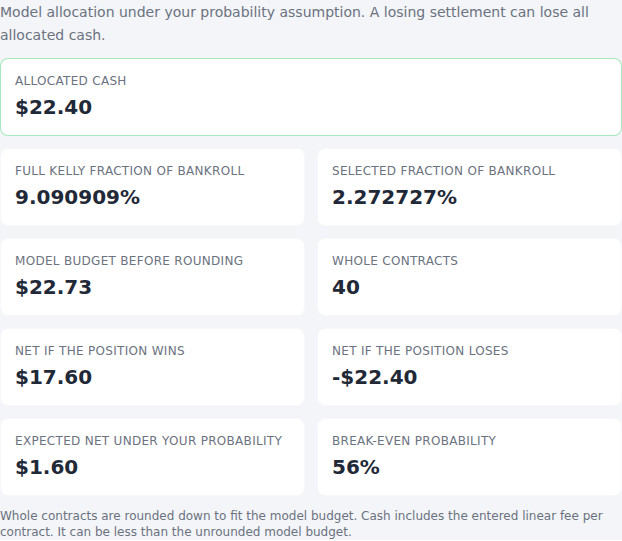
The full Kelly fraction is (0.60 − 0.56) / (1 − 0.56) = 0.04 / 0.44 ≈ 9.09%. Quarter Kelly uses about 2.27% of the bankroll, giving an unrounded model budget of about $22.7273.
At 56 cents each, that budget buys 40 whole contracts for $22.40. Buying 41 would cost $22.96, above the quarter-Kelly budget. The calculator therefore separates the displayed $22.73 budget from actual allocated cash.
If the position wins, 40 contracts pay $40. Subtracting the $22.40 cost leaves $17.60 net profit. If it loses, the payout is $0 and the net result is −$22.40.
At the assumed 60% probability, expected net is 0.60 × $17.60 + 0.40 × (−$22.40) = $1.60. That $1.60 is a weighted estimate, not a third settlement outcome.
Full Kelly, Half Kelly and Quarter Kelly Compared
Keep the same bankroll, price, probability and per-contract fee. Change only the multiplier:
| Kelly | Budget / cash cost |
|---|---|
| Full | $90.91 / $90.72 |
| Half | $45.45 / $45.36 |
| Quarter | $22.73 / $22.40 |
Full Kelly buys 162 whole contracts; half Kelly buys 81; quarter Kelly buys 40. Budgets in the table display two decimal places. Contract quantities use the unrounded budgets, then round down. Quarter Kelly is a quarter of the theoretical full fraction; it need not buy exactly a quarter of the rounded full-Kelly contract count.
The corresponding winning nets are $71.28, $35.64 and $17.60. Losing nets are −$90.72, −$45.36 and −$22.40. Each smaller allocation reduces the cash lost in this example's losing settlement.
Fractional Kelly is a trade-off. It does not promise a profit. Busseti, Ryu and Boyd's risk-constrained Kelly paper distinguishes growth from drawdown risk and discusses fractional sizing. A drawdown is a fall from a previous level of wealth. Choosing a smaller multiplier does not impose a fixed maximum drawdown across a sequence of positions.
The calculator starts at quarter Kelly as an example. That default does not establish which fraction fits an individual reader.
A Wrong Probability Can Reverse the Result
The price is a cost in the example. The 60% chance is a belief you supply. The calculator cannot verify that belief.
Hold the 40-contract position and $22.40 cost fixed. Change only the assumed winning probability used to evaluate it:
| Chance | EV on 40 contracts |
|---|---|
| 54% | −$0.80 |
| 56% | $0.00 |
| 58% | +$0.80 |
| 60% | +$1.60 |
This table tests how one input changes the result. It is not a forecast or a range of likely chances. In every row, the two normal cash outcomes remain +$17.60 and −$22.40. Only the weight given to each outcome changes.
If you enter 54% into the Kelly calculator itself, it recalculates the allocation as zero. The table instead shows what that lower probability means for a position already fixed at 40 contracts. Those are different questions.
For your own probability estimate, record the evidence, its date and what would change your view. Replacing uncertainty with a higher number makes the displayed position larger without making the estimate more reliable. Positive expected value can disappear when the probability assumption changes.
Our binary-contract expected value calculator lets you compare lower, base and higher assumptions while keeping a position's quantity and costs fixed.
Fees, Zero Allocation and Traditional Odds
A fee changes the effective purchase cost and therefore the break-even probability. Without a fee, the example's 55-cent contract has a 55% break-even threshold. Adding the assumed 1-cent fee raises it to 56%.
At p = 60%, ignoring that fee gives a full Kelly fraction of about 11.11%, compared with 9.09% after including it. The lower figure follows from both a smaller probability edge and a changed net payoff.
The calculator models a linear fee per contract, paid in either outcome. A $1 total fee on an order is different from $1 on each contract. Check the actual product's cost rules before translating them into inputs. A platform name alone does not make this fee model applicable.
If p is at or below c, the long-only allocation is zero. If cost reaches or exceeds the $1 winning payout, the model also allocates zero. A positive theoretical budget can still be too small to buy one whole contract.
Standard Betting Odds Use a Different Input Model
The same calculator also accepts American, decimal and fractional odds for a standard back bet. Here, a winning payout includes the returned stake, and the odds mode excludes fees.
For decimal odds D, the break-even probability is 1 / D. The full Kelly fraction is max(0, (p − 1/D) / (1 − 1/D)).
For example, +100 American odds equal 2.0 decimal odds and 1/1 fractional odds. At an assumed 55% winning probability, full Kelly is 10% of the modeled bankroll. On $1,000, half Kelly gives a $50 stake before costs. That is a separate example from the 56-cent binary contract.
Use the odds converter when you only need to change price formats. Changing format in the Kelly calculator clears the price, so re-enter it in the new units and check the fee field when returning to contract mode.
What a Single-Position Calculator Leaves Out
The tool checks one long position at a time. It does not find the best mix of open positions. Two contracts about the same election, economic release or underlying team can share an important source of risk.
Using the same full bankroll for each trade can count the same cash more than once. Smaller fractions do not automatically solve that overlap. Check total committed cash and related exposures separately.
Execution also matters. A displayed quote may not support the modeled quantity, and buying more contracts can change the average fill price. The formula does not check available size or provide an early exit. Its binary example assumes holding through the stated normal settlement.
A 100% probability input is a mathematical assumption, not verified certainty. If it drives a full-bankroll result, an incorrect estimate can expose all that allocated cash to loss. Neither the formula nor the calculator supplies evidence for such an input.
Using the Tool Alongside Macro Markets
Macro Markets publishes the calculator and operates our own crypto-native prediction-market alternative. The tool is separate from order execution and does not pull live venue prices or apply a platform fee preset.
Before applying a calculation to a particular market, check its actual payout, contract rules, executable price, quantity, costs and access requirements. This guide does not claim that every product on Macro Markets, Kalshi or Polymarket matches the same payoff or fee model.
Questions About Kelly Position Sizing
Does Kelly tell me the probability of winning?
No. You enter the probability. Kelly uses that assumption with the price and modeled payoff to calculate a bankroll fraction. An exact calculation can still be built on a poor estimate.
Is half Kelly half of my account balance?
No. It is half of the full Kelly fraction. If full Kelly is 10% of the modeled bankroll, half Kelly is 5%, not 50%.
Can a positive-EV position still lose its whole cost?
Yes. The 40-contract example has +$1.60 expected net under a 60% assumption, while a normal losing settlement loses all $22.40 allocated. Expected net and one realized outcome are different quantities.
Does a zero result mean the opposite side is a good trade?
No. Zero means no positive long allocation for the entered side under the model. The opposite contract has its own executable price, costs and rules. The calculator does not establish that buying it is favorable.
Should I use Kelly or an EV calculator first?
Use the relevant EV model to understand the position's cash outcomes and probability assumptions. Kelly then adds a bankroll-allocation calculation under those assumptions. Neither tool validates the estimate or accounts for your full financial circumstances.
