Prediction Market Expected Value Calculator: Fees and Scenarios
Prediction Market Expected Value Calculator
Estimate one binary position held to normal settlement. Enter executable price, whole contracts, total USD fees and your own probability that the side you buy pays the winning amount. All defaults are hypothetical; the tool does not forecast outcomes.
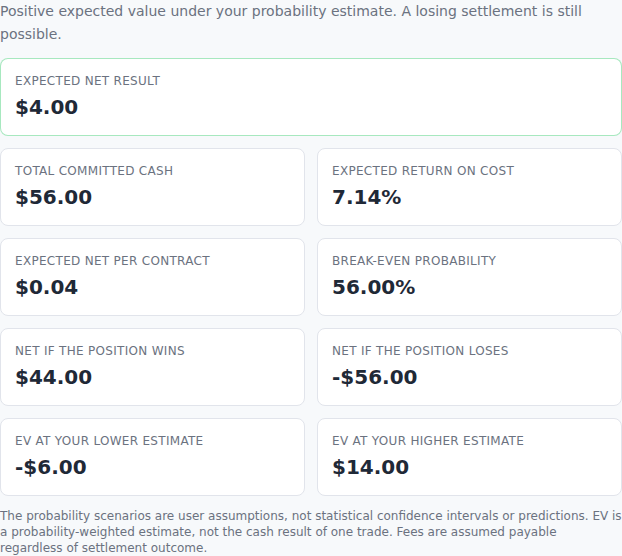
Positive expected value under your probability estimate. A losing settlement is still possible.
The probability scenarios are user assumptions, not statistical confidence intervals or predictions. EV is a probability-weighted estimate, not the cash result of one trade. Fees are assumed payable regardless of settlement outcome.
Educational estimate only. Assumes full fills and a fully paid binary contract held to normal settlement. No live prices, automatic probabilities, fee presets, rebates, tax, early sale, cancellation/refund modeling or order execution. Nothing is submitted or traded.
Use this prediction market expected value calculator to estimate the probability-weighted net result of one binary position after the fees and costs you enter. It combines your executable purchase price with your own probability estimate. It does not estimate that probability for you, find a mispriced market or place an order.
The initial example is hypothetical: 100 contracts bought at 55 cents, an assumed $1 total trading fee, no other cost and a user-entered 60% probability of the purchased side paying $1. The total cost is $56 and the expected net result is $4. A single normal settlement still produces either a $44 gain or a $56 loss, not a $4 cash payout.
Reviewed November 6, 2026. Macro Markets publishes this tool and operates a crypto-native prediction platform. The examples below use invented inputs to explain the calculation. They are not live quotes, platform fee schedules, probability forecasts or actual trade results.
How to Use the Prediction Market Expected Value Calculator
Start with the side you intend to buy. For a Yes position, enter your estimate that Yes pays the winning amount. For a No position, enter your estimate that No pays that amount. Do not use a Yes probability unchanged for a No position.
The tool uses eight inputs:
- Buy price: the executable or average fill price in cents per contract.
- Number of contracts: a whole-contract quantity from one to one million.
- Winning payout per contract: dollars paid by a winning contract. The default is $1; the losing payout is modeled as $0.
- Total trading fees: the total dollar fee for the entire position, not a percentage or fee per contract.
- Other included costs: additional dollar costs you choose to allocate to this position once.
- Your probability estimate: your assumed percentage chance that the purchased side receives its winning payout.
- Lower probability scenario: a smaller or equal probability you want to examine.
- Higher probability scenario: a larger or equal probability you want to examine.
Prices are in cents. Fees, other costs and payouts are in US dollars. Enter a $1 total order fee as 1, not as 1%. Check the fee in the actual order preview or execution record. The default fee is only an assumption for the worked example.
Each probability must be between 0% and 100%, inclusive, and the inputs must follow lower ≤ your estimate ≤ higher. These are three assumptions you supply, not an automatically calculated confidence interval.
Empty fields and invalid values remove the results and show a validation message. The calculator rejects a fractional contract quantity rather than silently rounding it. Reset restores the complete hypothetical example.
If order prices, fills and settlement are unfamiliar, start with our beginner guide to trading prediction markets. The arithmetic here assumes the entered quantity fills at the entered average price and is held to normal settlement.
The EV Formula and What the Outputs Mean
Expected value is a probability-weighted average of possible results. OpenStax's expected value chapter explains that distinction between a theoretical average and an actual realized outcome. A binary trade can have a positive modeled expectation while its next settlement loses the full cost.
Let q be your assumed winning probability as a decimal, N the number of contracts and P the winning dollar payout per contract. First calculate the position's cost:
Premium = buy price in cents ÷ 100 × N
Total cost = premium + total trading fees + other included costs
For the two normal-settlement outcomes:
Net if the position wins = N × P − total cost
Net if the position loses = −total cost
The expected net result is:
EV = q × net if win + (1 − q) × net if lose
Equivalently, EV = q × N × P − total cost. This follows because the entered costs are assumed payable regardless of which normal outcome occurs.
Expected Return Uses Total Committed Cash
The expected return percentage is EV ÷ total cost × 100. It uses all the committed cash, including entered fees, rather than the winning payout. It is not an annualized return, a win rate or the percentage profit a single trade will necessarily produce.
The calculator also shows EV per contract and the break-even probability, calculated as total cost ÷ winning settlement payout × 100. At that probability, modeled EV is zero. It is a cost threshold, not a forecast of the event.
When total cost is exactly zero, a return percentage has no usable denominator and the tool shows N/A. A break-even threshold above 100% is displayed rather than capped: it tells you that a valid probability cannot recover all the entered costs under this model.
Very small nonzero values retain extra decimal places. Values below the displayed precision receive a threshold label that preserves whether the result is positive or negative. This avoids displaying a small loss as an ordinary zero.
Worked Example: Positive EV Is Different from Winning Profit
Assume you buy 100 binary contracts on one selected side at 55 cents each, each winning contract pays $1, the total fee is an assumed $1 and you enter no other cost. This is one directional position, not two sides of an arbitrage trade.
The premium is $0.55 × 100 = $55. Adding the assumed fee gives $56 total committed cash. Your central probability estimate is 60%, so the expected payout is $100 × 0.60 = $60 and the expected net result is $60 − $56 = $4.
The expected return on cost is $4 ÷ $56 × 100, approximately 7.14%. Expected net per contract is $4 ÷ 100 = $0.04. The break-even probability is $56 ÷ $100 × 100 = 56%.
Under the modeled normal settlement, the actual position pays $100 or $0. Its realized net result is therefore +$44 or −$56. The $4 EV is a weighted estimate between those outcomes. It is not an additional payment, a guaranteed gain or a prediction that either result will happen.
Change the Probability, Keep the Trade Costs Fixed
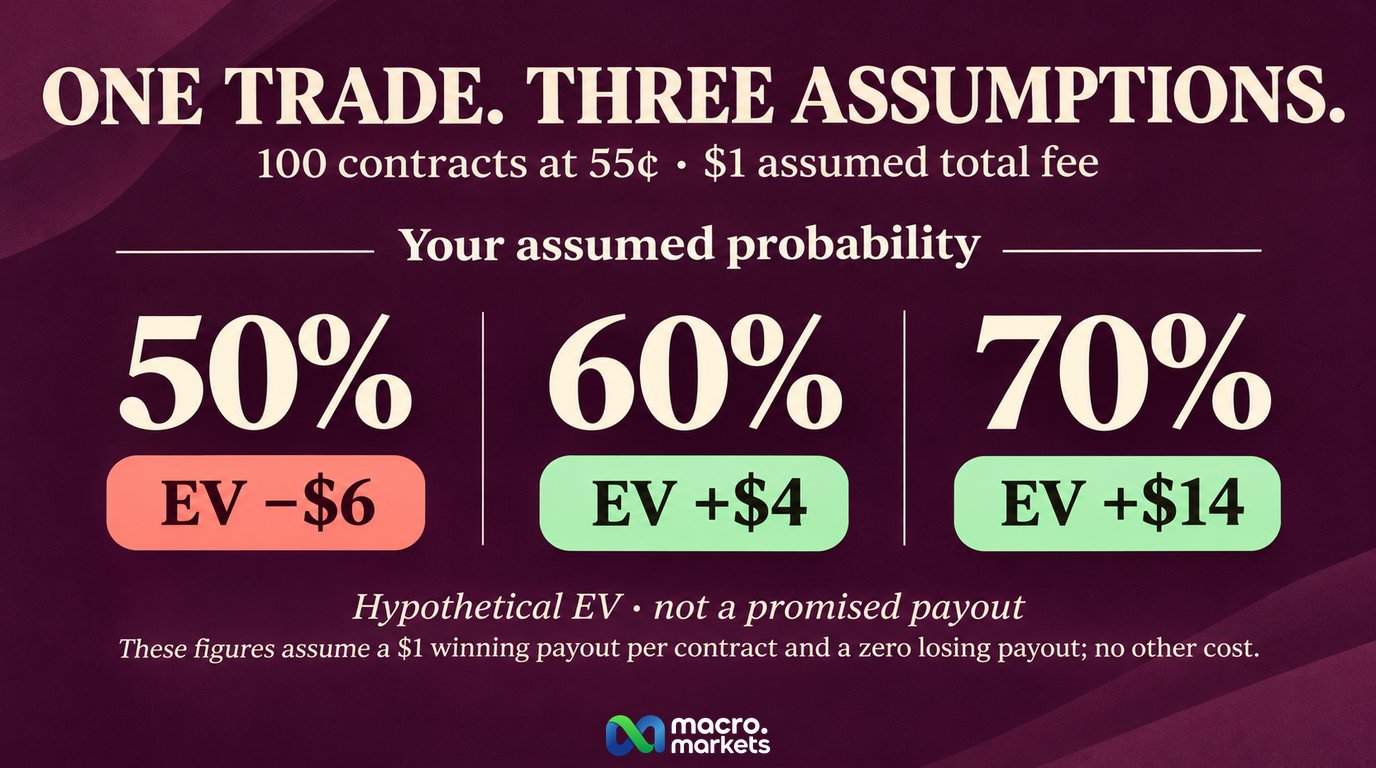
The default lower and higher scenarios use 50% and 70%. With the same $56 cost and $100 winning payout:
| Your probability | Expected payout | Expected net |
|---|---|---|
| 50% | $50 | −$6 |
| 56% | $56 | $0 |
| 60% | $60 | +$4 |
| 70% | $70 | +$14 |
The trade does not become safer because you type a larger probability. The table shows how strongly the conclusion depends on the assumption. If your 60% estimate is too optimistic and 50% is more accurate, modeled EV changes from +$4 to −$6.
The lower and higher scenario results are alternative expected values, not the smallest and largest possible cash settlements. In every row, the normal realized net outcomes remain +$44 and −$56. Scenario analysis changes the weighting, not those two cash outcomes.
For a position's cost and winning outcome without a subjective probability assumption, use the prediction market fee calculator.
Choosing a Probability without Confusing Price and Forecast
The probability field is an input to your analysis. A market price is information about what participants are trading; it does not independently establish the true probability of the side paying out.
Entering a 60% estimate because the contract costs 60 cents does not create an edge. Before fees, the cost and probability-weighted payout then match for a standard $1 contract. Added costs make the modeled expectation negative unless another assumption changes.
Use evidence relevant to the exact proposition and document how it supports your estimate. Consider what would change your view and how uncertain the estimate is. The tool does not evaluate your sources, calibrate a forecasting model or assign a probability from news, social posts or an AI answer.
Treat the Scenario Range as Your Assumptions
The lower and higher inputs can help you examine an uncertain judgment. They do not constitute a measured confidence interval, a statistical error bar or proof that the actual probability lies between them.
If you cannot justify an estimate, a precise-looking EV does not fix that missing evidence. Keep the outcome analysis separate from the decision about how much money, if any, to commit. This calculator does not recommend a position size or apply the Kelly criterion.
A positive modeled expectation is also different from arbitrage. Our prediction market arbitrage guide explains complementary payouts, matching rules and execution risk. The arbitrage calculator models two complementary positions and unequal quantities; this EV tool models one side using your assumed probability.
Fees, Contract Rules and Model Limits
Use actual executable prices and total fees for the intended quantity. Kalshi's fee guidance says fees can vary by market and some resting orders incur maker fees when executed. A limit order is therefore not automatically a fee-free input.
Polymarket US publishes its own fee schedule. Use the documentation and order preview for the particular product. Its US schedule should not be applied automatically to international Polymarket or another venue. This calculator has no platform fee preset.
The model treats the entered fees and other costs as payable regardless of settlement outcome. It accepts nonnegative amounts and does not apply rebates, promotional credits or outcome-dependent charges. If a charge only applies after a win, or a rebate changes the cash flows, work through that separate scenario instead of treating it as a supported automatic adjustment.
Reflect spread and slippage in the executable or average fill price. Adding the same effect again as another cost would count it twice. Taxes, an early sale, currency conversion rates and withdrawal timing are not calculated automatically.
Polymarket US's resolution documentation describes its process, but the particular contract still determines what pays. This tool assumes one winning amount and a losing payout of zero. Cancellations, refunds, disputed definitions or another payout structure need a different model. It does not verify the rules or the execution record.
Where Macro Markets Fits
Macro Markets is our own crypto-native prediction-market alternative. Eligible users considering it should inspect the exact contract, liquidity, funding route, fees and settlement rules before using any numbers here. The calculator does not connect to Macro Markets, Kalshi, Polymarket or an order book.
Macro Markets should not be treated as a CFTC-designated US exchange. This tool makes no claim of shared liquidity, transferable cross-venue positions, universal availability or guaranteed profits. Review the prediction-market legality guide and confirm current eligibility directly with the venue.
Frequently Asked Questions
What is expected value in a prediction market?
It is the probability-weighted net result under your assumptions. For a fully paid binary position, multiply your assumed winning probability by the winning settlement payout and subtract total entered costs.
Can positive EV still lose money?
Yes. In the default example, EV is +$4 while the position can lose $56 at a normal losing settlement. Expected value does not guarantee the result of one trade or a particular sequence of trades.
Does the calculator predict the event probability?
No. You supply the central probability and both scenario probabilities. The tool checks the arithmetic and input ranges; it does not estimate likelihood, validate a forecasting method or prove an informational advantage.
Can I use this as a Kalshi EV calculator or Polymarket EV calculator?
You can enter a position from a venue when it fits the stated binary model. Check that product's actual price, fees, quantity and payout rules. All default numbers are hypothetical and none is a current platform fee formula.
What probability should I enter for a No contract?
Enter the probability that the No position you are buying pays the winning amount. In a strictly complementary binary event, that relates to the opposite of Yes, but you must first check that the contract actually has that structure.
Why does the break-even probability exceed 100%?
The entered cost exceeds the modeled winning payout. Under those inputs, even a winning settlement cannot recover all costs. A lower cost or a different valid contract model would be needed to change that conclusion.
Are the lower and higher scenarios worst-case and best-case profits?
No. They are EV calculations at two other probabilities you supplied. Actual normal-settlement cash outcomes are shown separately as net if the position wins and net if it loses.