


How to Trade on Prediction Markets: A Beginner’s Guide

Learning how to trade on prediction markets starts with one rule: read the contract before you look at the price. A prediction-market contract pays according to a written event definition, deadline, and settlement source. Your forecast can be directionally right and still lose if it does not match those exact terms.
The basic process is straightforward. Choose a regulated venue available in your location, verify your account, find an event you understand, read its rules, estimate the probability, compare that estimate with the market price, review the order book and fees, and place a position sized for a complete loss.
This guide explains each step using a hypothetical Yes/No contract. It also shows how spread, depth, slippage, and fees change the real cost of a trade.
Last reviewed and fact-checked: October 24, 2026.
Risk warning: Event contracts can settle at $0. You can lose the full amount paid plus fees. Trade only with money you can afford to lose. This guide is educational and is not financial or legal advice.
How to Trade on Prediction Markets: Contract Basics
A prediction market lets participants buy and sell contracts tied to the outcome of a future event. The Commodity Futures Trading Commission’s prediction-market guide explains that many event contracts use Yes/No outcomes, have a fixed payout, and expire when a defined event is resolved.
Consider the hypothetical question: “Will Event A happen by December 31?”
- A Yes contract pays if the rules determine that Event A happened.
- A No contract pays if the rules determine that it did not happen.
- A winning binary contract commonly settles at $1.
- A losing contract settles at $0.
If Yes trades at 42¢, the market is often read as assigning roughly a 42% probability to Yes. That is the market’s collective estimate—not a verified fact or a guarantee. Prices change as participants submit and match orders.
Your potential gross profit on a winning contract is the settlement value minus your purchase price. If you buy Yes at 42¢ and it settles at $1, the gross profit is 58¢ per contract before fees. If it settles at $0, the 42¢ purchase price is lost.
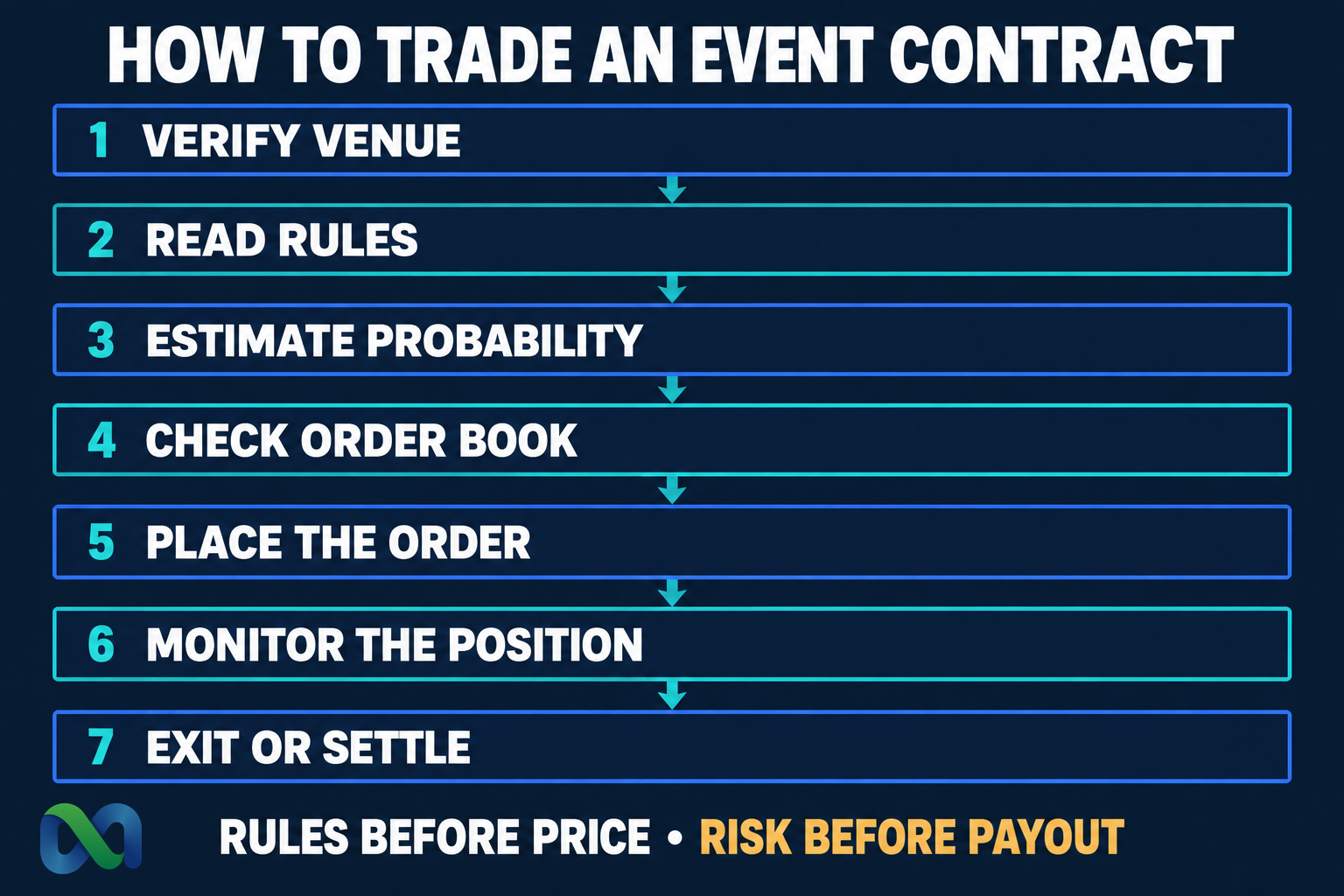
You do not always have to wait for settlement. If another participant is willing to trade, you may be able to sell the position earlier at the current market price. The exit price can be higher or lower than your entry price, and there may be little or no liquidity when you want to exit.
How to Trade on Prediction Markets Step by Step
1. Choose a venue you can legally access
Start with a venue that is registered for the product and available in your physical location. The CFTC advises customers to verify that websites and apps belong to registered entities. An app-store listing alone is not proof.
For US event-contract exchanges, check the CFTC’s official registries and the platform’s current location notices. Product availability can change, especially for sports contracts. Do not use a virtual private network or false location information to bypass a restriction.
Our guide to the best prediction market apps in the US compares regulation, access, funding, fees, and market fit. Our Kalshi vs Polymarket US comparison also explains why US users should not treat polymarket.com and Polymarket US as the same product.
2. Complete identity and funding checks
Regulated venues generally require identity verification. You may need to provide your legal name, date of birth, address, tax information, and an identity document. The platform may also confirm your location and screen the account against restricted-person lists.
Before depositing, review:
- available funding and withdrawal methods;
- minimum and maximum amounts;
- transfer or card charges;
- deposit and withdrawal holds;
- the expected processing time; and
- whether the method is available in your state.
Do not deposit money needed for bills, emergencies, debt payments, or near-term savings goals. A deposit may be subject to a security hold even when the trading balance appears immediately.
3. Select an event you understand
Begin with a subject where you can identify the relevant data and official sources. Economic releases, elections, weather measurements, court decisions, and sports results all have different timelines and resolution risks.
A beginner learning how to trade on prediction markets should not choose a contract only because its headline is familiar. Ask whether you understand:
- what must happen for Yes to win;
- the measurement period;
- the named source;
- the time zone;
- what happens after a delay, cancellation, tie, revision, or disputed result; and
- when trading closes and settlement is expected.
A simple-looking question can hide a precise legal definition. The headline summarizes the contract; it does not replace the full terms.
4. Read the rules and settlement source
This is the most important step. Kalshi’s market-rules documentation says each market has its own criteria and outcome-verification source. Its rules summary is useful, but the platform also warns that the full rules control.
Check four elements:
- Event definition: The exact condition that produces a Yes outcome.
- Deadline: The date, time, and time zone used by the contract.
- Resolution source: The agency, league, court, publisher, index, or other authority that supplies the result.
- Exceptional cases: Rules for postponement, cancellation, missing data, revisions, ties, or ambiguous outcomes.
The event may appear finished before the official source publishes. Kalshi’s current settlement FAQ notes that close time and determination time can differ. Never assume a contract has resolved because social media or a news report announced an outcome.
5. Estimate the probability independently
Knowing how to trade on prediction markets requires an estimate that is independent of the displayed price. Write down your probability before anchoring on the market. Use evidence that is available to all participants or that you obtained lawfully. Do not trade on confidential information when doing so would violate a duty, and never trade on an outcome you can control or materially influence.
Suppose you estimate a 55% chance of Yes, while the executable purchase price is 42¢. Your rough forecast edge is 13 percentage points before costs:
estimated edge = your probability − all-in purchase price
That difference is not guaranteed profit. Your model may be wrong, the contract may be misunderstood, and fees or poor execution may erase the apparent edge. A market price can be informative without being correct.
6. Inspect bid, ask, and depth
The last traded price is not necessarily the price available now. Look at the order book:
- Bid: The highest price a buyer currently offers.
- Ask: The lowest price a seller currently accepts.
- Spread: The difference between the best ask and best bid.
- Depth: The number of contracts available at each price level.
If the best Yes bid is 40¢ and the best Yes ask is 44¢, the spread is 4¢. Buying immediately at 44¢ and then selling immediately at 40¢ would create a 4¢ loss per contract before fees, assuming enough depth at both prices.
Read our guide to the bid-ask spread in prediction markets for formulas and order-book examples.
7. Choose the order type and size
Order names and behavior vary by platform, so confirm the live order ticket. Two common approaches are:
- Immediate or market-style order: Seeks execution against prices already available. It offers speed, but the average fill can move through several levels.
- Limit order: Sets the worst price you will accept. It controls price but may fill only partly or not at all.
Kalshi’s quick-order guide explains that a large immediate order can fill at multiple prices. Its limit-order documentation says the unmatched portion can remain on the order book. Fee treatment may differ by market and whether an order adds or removes liquidity.
Choose the position size by maximum loss, not by the payout you hope to receive. For a simple long Yes purchase, the cash paid plus applicable fees is a useful starting point for maximum-loss planning. More complex products can behave differently.
8. Review, submit, and monitor
Before confirming the order, check:
- contract side: Yes or No;
- number of contracts;
- limit or estimated average price;
- displayed fee;
- total amount at risk;
- maximum potential payout;
- open-order behavior; and
- settlement date and source.
After submitting, confirm whether the order is open, partially filled, fully filled, canceled, or rejected. Do not assume clicking the button created a position. Monitor the order and the contract rules, especially after breaking news or a schedule change.
How to Trade on Prediction Markets Without Ignoring Costs
The displayed contract price is only the starting point. Your all-in result depends on four components:
all-in entry cost = contract cost + transaction fee + spread impact + slippage
The spread is visible before execution. Slippage is the difference between the expected price and the actual average fill, often because an order consumes more than one price level. Learn how to estimate it in our guide to slippage in prediction markets.
Fees may depend on price, order type, market, or current fee schedule. For example, Kalshi’s fee page says fees can differ across markets and that some markets have maker fees. Always use the fee shown in the live order preview rather than an old article or screenshot.
Exit cost matters too. If you plan to sell before settlement, you may cross the spread again and incur another fee. A small theoretical edge can disappear after both entry and exit.
Worked Prediction-Market Trade Example
The following example is hypothetical and excludes platform fees so the execution math is easy to audit.
Assume a Yes order book offers:
| Price | Contracts available |
|---|---|
| 42¢ | 6 |
| 44¢ | 4 |
You submit an immediate order for 10 Yes contracts. The first six fill at 42¢ and the next four fill at 44¢.
Total contract cost:
(6 × $0.42) + (4 × $0.44) = $4.28
Average fill price:
$4.28 ÷ 10 = $0.428, or 42.8¢
If you expected every contract to fill at 42¢, the depth-driven slippage cost is:
$4.28 − $4.20 = $0.08
If Yes settles at $1, the gross payout is $10. The gross profit before fees is:
$10.00 − $4.28 = $5.72
If Yes settles at $0, the $4.28 contract cost is lost. Fees would increase the economic loss.
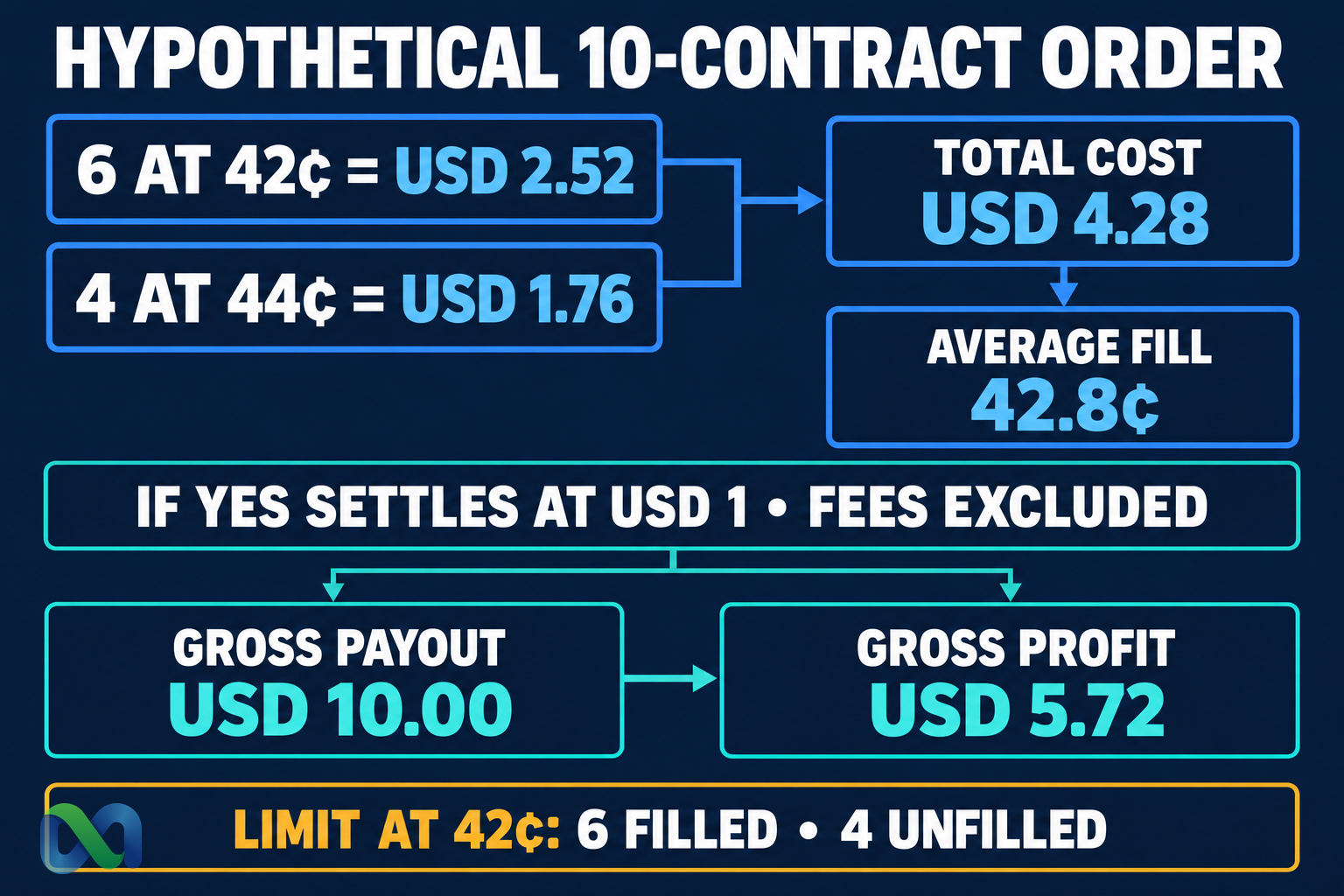
A limit order for 10 contracts at 42¢ would prevent a fill above 42¢ in this simplified book. However, only six contracts could fill immediately. The remaining four might stay open or never fill. Price certainty and execution certainty are different goals.
Beginner Risk Checklist
Use this checklist whenever you apply what you learned about how to trade on prediction markets:
- Venue: Is the platform and product registered and available where you are?
- Rules: Can you state the exact condition for Yes and name the settlement source?
- Timing: Do you know the close time, determination time, and time zone?
- Forecast: Did you estimate probability before relying on the market price?
- Execution: Did you inspect bid, ask, spread, and depth?
- Costs: Did you include fees, likely slippage, and a possible exit cost?
- Size: Can you afford a total loss without affecting essential finances?
- Conduct: Are you free of confidential information or influence over the outcome?
- Order status: Did you verify the actual fill rather than assume execution?
- Records: Did you save the rules, confirmation, and transaction history?
The CFTC recommends using risk capital, understanding contract-specific rules, monitoring positions, and considering the impact of fees. It also warns customers to avoid promises of guaranteed returns and to verify that the trading entity is registered.
Regulation is important, but it does not insure a forecast or eliminate operational risk. Our Is Kalshi legit? review explains what federal oversight does and does not protect.
Common Beginner Mistakes
Trading the headline instead of the contract
A headline may omit the deadline, source, threshold, or exception that controls settlement. Read the full rules and save them if the position is material.
Treating price as certainty
A 70¢ contract is not guaranteed to win. It expresses the current market price and is often interpreted as roughly 70% market-implied probability. Low-probability outcomes happen, and high-probability outcomes fail.
Ignoring the difference between last price and ask
The last trade may be stale. Your executable purchase price is usually determined by the current offers and available depth, not by the most recent historical print.
Using an immediate order in a thin book
Speed can create a poor average fill when little size is available at the best price. Preview the order and use a limit when price control matters more than immediate execution.
Forgetting the cost of an early exit
Selling before settlement can require crossing the spread again. Include entry and exit costs when evaluating a short-term strategy.
Risking money based on payout size
A large possible payout does not make a trade attractive. Compare your evidence-based probability with the all-in cost, then size for the maximum loss.
Assuming every platform lists the same contract
Similar questions can use different deadlines and settlement sources. Compare the exact rules rather than treating titles as interchangeable.
For positions spanning two contracts or venues, our prediction market arbitrage guide explains how fees, partial fills and mismatched settlement rules can overturn a quoted price gap.
Frequently Asked Questions and Final Takeaways
Can I learn how to trade on prediction markets with a small account?
Platform minimums and contract prices vary. The better question is how much you can lose without affecting essential expenses or financial goals. A small position can teach order mechanics while limiting the cost of an error.
Does a 60¢ contract mean a 60% chance?
It is commonly interpreted as roughly 60% market-implied probability, but it is not an objective probability or guarantee. The price reflects available orders, information, liquidity, and participant beliefs.
Should a beginner use a market order or limit order?
A limit order provides more price control but may not fill. An immediate order provides more execution certainty but can experience slippage. Inspect the order book and choose based on urgency, depth, and your worst acceptable price.
Can I sell before the event ends?
Often yes, if the venue permits it and another participant is willing to trade. The exit price and available quantity depend on the live order book. Some contracts may become illiquid or stop trading before determination.
What happens when the market settles?
The platform applies the contract rules to the named resolution source. Winning binary contracts commonly pay $1, while losing contracts pay $0. Special outcomes or nonstandard products may follow different rules, so the specific contract controls.
Is prediction-market trading legal everywhere in the US?
Federally regulated exchanges operate under the Commodity Exchange Act, but product and location disputes can still affect availability, especially for sports contracts. Check the venue’s current notice and the law applicable to your location.
Final takeaways
Knowing how to trade on prediction markets responsibly means following the same checks every time:
- verify the venue and your access;
- read the complete contract rules;
- estimate probability independently;
- compare your estimate with the executable price;
- inspect spread, depth, slippage, and fees;
- use the order type that matches your price and execution priorities; and
- size every position for a complete loss.
The most important beginner habit is not predicting more events. It is becoming more selective. A contract should pass the rules, evidence, execution-cost, and risk checks before you submit an order.
