Prediction Market Arbitrage: How It Works, Fees and Risks
Prediction market arbitrage starts with a price discrepancy between contracts whose payouts should cover the same set of outcomes. The useful question is whether the completed positions still produce a positive result after fees, execution costs and the actual settlement rules. A cheap-looking pair of prices is only the beginning of that calculation.
The short answer: Buying complementary Yes and No positions for less than their combined settlement payout can create an arbitrage opportunity. That conclusion depends on matching the rules, filling both sides at the required size and keeping total costs below the payout. Two similar market titles or a scanner's green percentage do not establish those conditions.
Reviewed November 5, 2026. This guide uses official documentation, research and original hypothetical examples. It does not report live matched orders, funded-account results or an available trade. Macro Markets publishes the guide and operates a crypto-native prediction platform, discussed below.
What Is Prediction Market Arbitrage?
Arbitrage involves a discrepancy between economically linked prices. The Interactive Brokers glossary describes the concept in prediction markets. For a practical evaluation, the link between the payouts matters as much as the displayed price difference.
Consider two complementary binary positions. One pays $1 if a precisely defined event happens; the other pays $1 if that same event does not happen. If exactly one position pays, a matched pair has a $1 settlement payout. Paying less than $1 for the completed pair, including relevant costs, creates a positive conditional difference.
That condition is stricter than finding one platform at 45 cents and another at 50 cents. Buying the same Yes exposure twice is a directional position, not a hedge. Buying a cheaper Yes without a valid opposite position also leaves you exposed to the event's outcome.
Within One Market or Across Venues
Opportunities can be studied within a set of related outcomes or across venues listing equivalent contracts. Research on arbitrage in Polymarket distinguishes market-rebalancing and combinatorial forms. Its historical findings do not establish that a particular opportunity remains available or executable today.
A multi-outcome example needs an exhaustive, mutually exclusive set: every possible valid outcome must be covered, and the assumed payout must follow from the actual contracts. Similar topics or correlated outcomes are insufficient.
Across venues, you also need separate account access, balances and executable orders. Do not assume a contract bought on one exchange can be transferred, merged or redeemed against a position bought on another.
Our beginner's guide to trading prediction markets explains the basic order and payout mechanics before adding this second layer of analysis.
Calculate the Complete Pair, Including Costs
For equal quantities of complementary $1 contracts, begin with:
Premium = quantity × (Yes purchase price + No purchase price)
Total committed cash = premium + both legs' fees + other included costs
Conditional net result = settlement payout − total committed cash
Prices are dollar amounts, and the settlement payout is the matched quantity multiplied by $1 only when exactly one side pays under the applicable rules. Keep the quantity the same on both sides before using that simplified payout.
When a 97-Cent Pair Loses Money
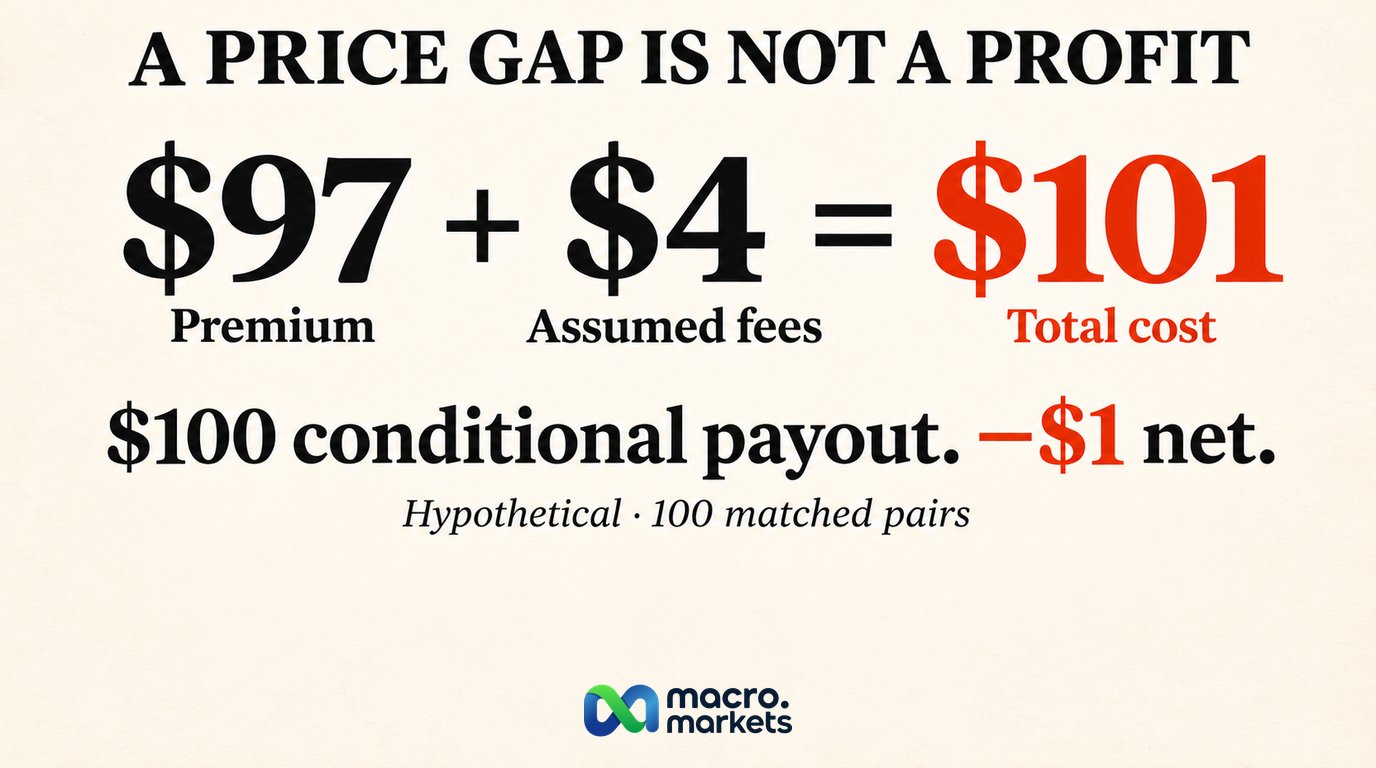
Assume two generic venues offer economically equivalent contracts. You buy 100 Yes contracts at $0.48 and 100 No contracts at $0.49. The premiums total $97. For this example only, assume a $2 fee on each order, creating $4 of total fees.
The completed positions therefore cost $101 against a conditional $100 payout. The result is a $1 loss, despite the two quoted prices adding up to less than $1 per pair.
Now change only the Yes price to $0.45. The premium becomes $94. With the same assumed $4 of fees, total cost is $98 and the conditional net result is $2.
| Per 100 matched pairs | 48¢ Yes + 49¢ No | 45¢ Yes + 49¢ No |
|---|---|---|
| Premium | $97 | $94 |
| Assumed total fees | $4 | $4 |
| Total cost | $101 | $98 |
| Conditional payout | $100 | $100 |
| Net result | −$1 | +$2 |
These are hypothetical prices and assumed fees, not Kalshi, Polymarket or Macro Markets quotes or fee schedules. Both examples assume all 100 contracts fill on each side and exactly one side settles at $1. Funding costs, taxes and the opportunity cost of tied-up capital are excluded.
In the positive example, $2 divided by $98 is approximately 2.04% on the cash committed. That is different from dividing by the $100 payout. It is also not an annual return: settlement could take days or months, and withdrawal availability can differ from settlement timing.
Replace Assumptions With the Actual Fee Inputs
Kalshi's official fee guidance says fees can differ by market and that some resting orders incur maker fees when executed. Do not assume every limit order is free or that one headline rate covers every product.
The Polymarket US fee schedule separately defines its standard taker formula, rounding, eligible rebates and exceptions for products such as table tennis and combos. International Polymarket has a different product and fee framework. A calculator preset must identify which one it represents.
Our prediction-market fee calculator provides a starting point for examining fees. It does not establish that two contracts are equivalent or that both orders can execute. Check the complete confirmation for each intended leg.
Enter both positions in our prediction market arbitrage calculator to compare prices, quantities and manual fees, inspect both conditional outcomes and see the effect of unmatched fills.
Match Settlement Rules Before Comparing Prices
The most expensive mistake can be a rule mismatch rather than a trading fee. Polymarket US's resolution documentation explains that outcomes follow the criteria and named sources in each market's rules. Read the corresponding specification on the other venue as well.
A useful comparison records the event, selected outcome, observation period, time zone, official source and treatment of exceptional events. For economic releases, check whether the contract uses an initial number or a later revision. For sports, check overtime, postponement and cancellation treatment.
A Hypothetical Hedge That Can Lose on Both Sides
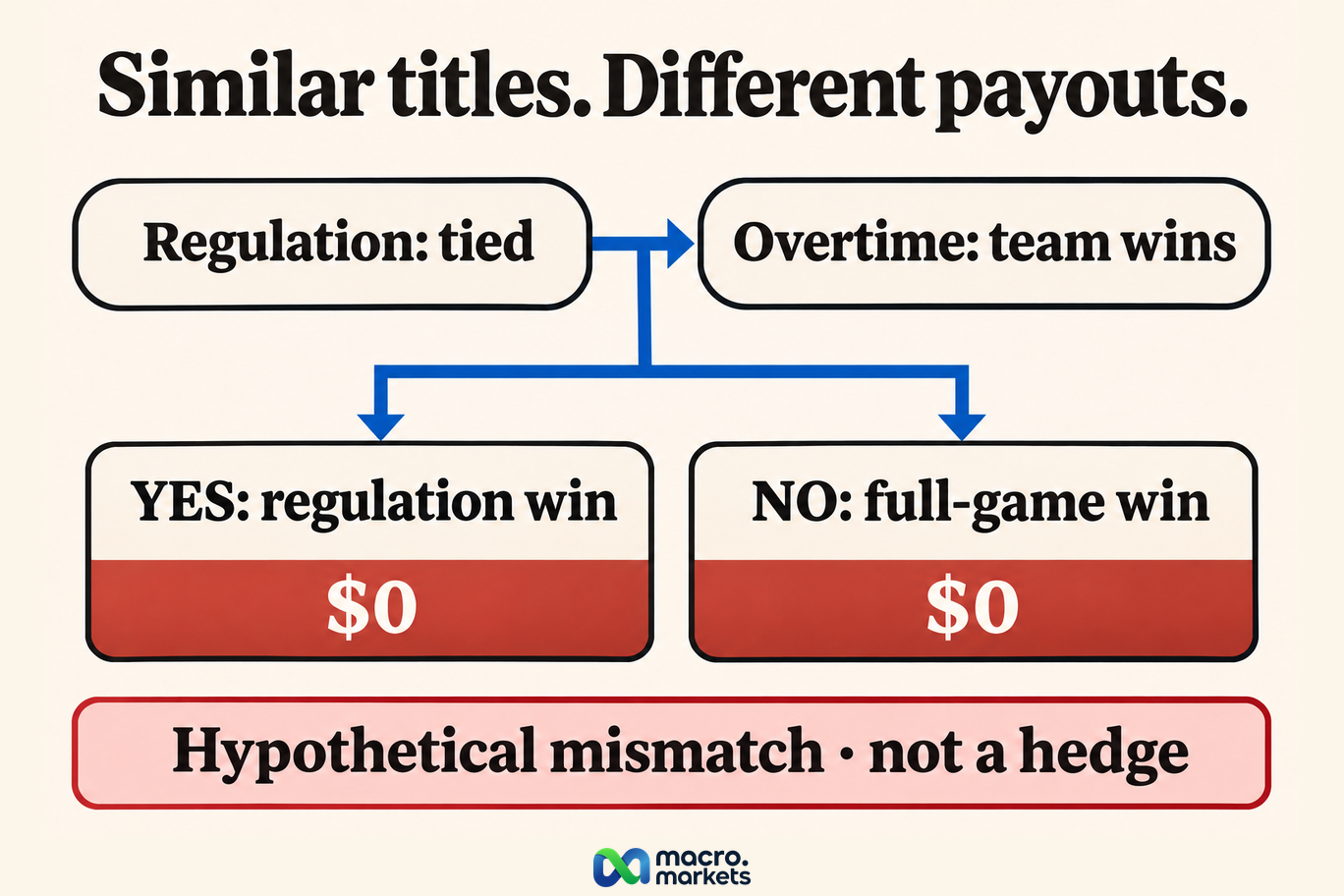
Suppose Contract A asks whether a team wins in regulation, while Contract B asks whether the team wins the full game, including overtime. You buy Yes on A and No on B, treating them as opposites.
If regulation ends tied and the team then wins in overtime, Yes on A can lose because the team did not win in regulation. No on B can also lose because the team won the full game. The questions were related, but they were not complementary.
This is an invented rule-mismatch example, not a description of a particular listed market. Its purpose is to show why a team name and date are insufficient evidence of a hedge.
| Rule check | What must line up |
|---|---|
| Outcome | The same underlying proposition |
| Time | Observation window and cutoff |
| Result source | The designated authority |
| Exceptions | Cancellation and refund treatment |
| Payout | Amount and settlement conditions |
A cancellation or refund provision can also change the assumed payout. Model that scenario before treating the normal $1 outcome as a floor. When the rules cannot be reconciled, classify the discrepancy as unverified rather than calling it a locked return.
Execution Risk: The Quote Is Not the Completed Trade
Use the price at which you can buy the required quantity, not a last-traded price, midpoint or probability shown on a market card. If the cheapest offer covers ten contracts, it does not establish the cost of buying 100.
For a No purchase, inspect the executable No offer. Do not mechanically subtract a displayed Yes purchase price from $1 and assume the result is an available No purchase price. Bid and ask represent different sides of an order book.
Polymarket US's order-type documentation describes partial fills, limit-price protection and the treatment of unfilled quantity. Those controls can restrict an execution price; they do not guarantee that the complete position will fill.
Two Orders Do Not Become Atomic Because a Scanner Groups Them
Suppose the intended position requires 100 contracts on each venue. One order fills completely and the other fills only 20. The remaining 80 contracts on the first side are not covered by the intended opposite position.
Finishing the second side at a worse price or unwinding the first side creates a new cost calculation. The original scanner percentage no longer describes the actual position. Canceling an unfilled order does not reverse contracts that have already executed.
Before relying on an opportunity, record the intended size, available depth, permitted order instructions and the maximum tolerable unmatched exposure. Two independent orders on separate venues should not be treated as one guaranteed simultaneous fill.
Holding, Selling Early and Funding Are Different Steps
The settlement arithmetic assumes holding the matched positions through their valid resolution. Selling early introduces executable bids, possible exit fees and the availability of buyers. A positive settlement calculation does not guarantee a profitable early sale.
Capital also has to be available in the required accounts. Polymarket US's funding documentation distinguishes instant buying power from funds cleared for withdrawal. Moving money after spotting a gap may take longer than the gap remains available.
Assess the cash requirement across both venues, applicable deposit or conversion costs and the consequences of settlement or withdrawal delays. Do not add a funding charge again if it is already included in the total cash-cost input.
Kalshi, Polymarket US and International Polymarket
These names should not be collapsed into one interchangeable product. Polymarket's US overview distinguishes its US-dollar exchange from its international blockchain-based platform. An international wallet, market or balance does not automatically carry over to the US product.
For a proposed Kalshi–Polymarket pair, identify the exact venue behind each position. Then compare contracts, supported access, collateral currency, fees, executable size and resolution. Similar branding or topic coverage does not establish shared liquidity.
Our Kalshi vs Polymarket comparison and Polymarket US review provide product context. They are not evidence of a currently available arbitrage opportunity.
Eligibility is part of the operational check. Verify each platform's current account and location rules. A price visible on a public page is not proof that you can legally open and manage both positions. The US prediction-market legality guide explains the broader distinctions.
Where Macro Markets Fits
Macro Markets is our own crypto-native prediction-market alternative. It belongs in the broader platform evaluation for readers comparing crypto funding, supported markets and account models. We disclose that commercial interest rather than presenting the platform as an independent recommendation.
Its inclusion does not establish that a Macro Markets contract is equivalent to one on Kalshi, Polymarket US or international Polymarket. Verify the precise question, payout currency, source, fees, liquidity, custody arrangement and jurisdictional eligibility for any proposed comparison.
Do not assume positions are transferable across those platforms or that Macro Markets provides an atomic cross-venue execution route. We are not representing it as a CFTC-designated US exchange, a universal-access service or a source of guaranteed arbitrage returns.
For a broader shortlist, our prediction-market apps guide compares product models. Apply the same contract, access and cost checks to Macro Markets as to every other platform.
Verification Checklist and Frequently Asked Questions
Before treating a price discrepancy as an executable opportunity, establish all of the following:
- Equivalent payouts: The contracts cover the same proposition and relevant exceptional outcomes.
- Available size: Both required quantities can execute within the assumed prices and instructions.
- Complete costs: Fees, spread, funding and other included expenses use the actual intended size.
- Access and balances: Both accounts are eligible and have usable funds before the orders are needed.
- Unmatched-order plan: Partial fills, rejected orders and cancellation behavior are understood.
- Settlement and cash timing: The holding period, resolution rules and withdrawal conditions are acceptable.
Save the contract identifiers, rule versions, observation time and calculation inputs. A saved result is a record of assumptions, not proof that the same prices remain available. Our comparison methodology uses the same distinction between documented features and observed execution.
Is Prediction Market Arbitrage Risk-Free?
The theoretical payoff depends on a complete, correctly specified position. In practice, rule mismatch, partial fills, changing prices, account restrictions and settlement problems can prevent that position from being established or paid as assumed. A scanner label does not remove those risks.
Does Yes Plus No Below $1 Always Mean a Profit?
No. The positions must be complementary, both orders must execute at the intended size, and total cost must remain below the applicable settlement payout. Our 97-cent example loses money after the assumed fees.
Can a Limit Order Guarantee the Opportunity?
No. A limit can constrain the execution price, but it can remain unfilled or fill only partly. A completed order on one venue does not guarantee the opposite order elsewhere.
Do I Need an Arbitrage Bot?
A bot or scanner can help monitor prices and organize calculations. It cannot establish rule equivalence merely by matching titles, guarantee both fills or remove platform eligibility requirements. Evaluate data freshness and execution assumptions before relying on its output.
Which Calculation Should a Tool Show?
At minimum: quantity, both executable purchase prices, both legs' fees, total committed cash, the assumed settlement payout and the conditional net result. Return should use a clearly stated denominator. Show a loss when costs exceed the payout, and keep rule and execution assumptions visible.
The useful standard for prediction market arbitrage is a completed, correctly matched position with a positive result after its relevant costs. Start with that standard before valuing a headline price gap or choosing a scanner.